
A local walk
Ten places to visit in Folkestone, and the rooftops you pass on the way
Castles, a canal bank, Martello towers and old churches lie within a few miles of Folkestone. Each is worth a walk, and each shows what the rules and the weather ask of a roof.
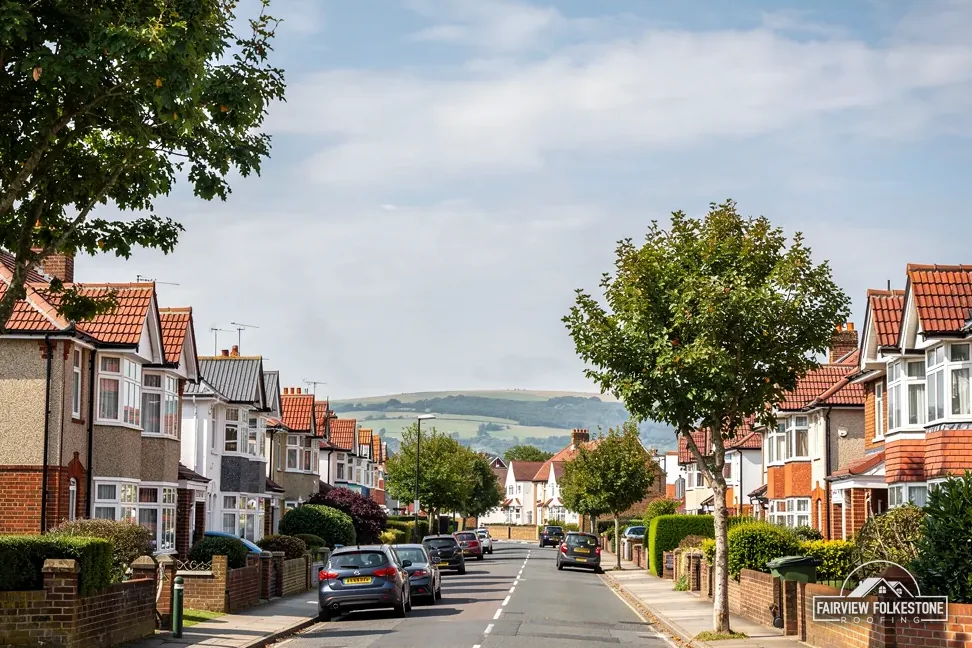
A walk around Folkestone and the villages beside it is a walk under roofs that have been repaired, rebuilt and argued over for a very long time. Some belong to castles and churches. Some cap the Martello towers built for defence. Others stand in streets the council has set aside for special protection. Every one of them shows how a roof decision gets made when a building is protected.
This post lists ten places within a few miles of the town centre, taken from Historic England's heritage list and the council boundary data, and says what each one shows a roofer. It gives no opening times, prices or tickets, because those change and are not ours to quote: check a site's own visiting details before you set out.
Underneath the list is a plain point. The rules that protect a castle also reach the ordinary houses in the same streets, so a day out is a handy way to learn what to ask about your own roof.
01Sandgate
Sandgate: a castle and a protected village street
Sandgate Castle is listed Grade I and is also a scheduled monument. That pairing shows how protection can be layered. Under section 7 of the Planning (Listed Buildings and Conservation Areas) Act 1990, anything that would alter what makes a listed building special needs listed building consent. For a scheduled monument, section 2 of the 1979 monuments legislation bars any works that are not authorised, and breaking that bar is an offence. Roof work on either is never a matter of booking a roofer and starting on Monday.
- Place 1: Sandgate Castle, Grade I and a scheduled monument.
- Place 2: the High Street and the Esplanade, each a conservation area, with the Church of St Paul (Grade II) and Wells House (Grade II*) among the listed buildings close by.
Sandgate also lies within a tenth of a mile of the coast, which puts every roof on its seaward streets in an exposed position. Cupa, the slate manufacturer, says sites on coasts, hills and slopes, and tall buildings, will be graded with higher exposure, and BS 5534 supplies a method for working out the fixings for a given address. A re-roof on this stretch is therefore specified for where it stands, not lifted from a job in a sheltered road.
For a house on those streets, replacing the covering is normally permitted development even in a conservation area, while dormers are excluded, and an Article 4 direction may strip away more of the rights. Which streets carry such a direction is a question for Folkestone & Hythe District Council, not a guess made from the pavement.
02Hythe
Hythe: a church, a town hall and the canal bank
Hythe has the most protected buildings of any town on this walk, and the table sets out three of them with the route roof work would take. Each status is as published on the national heritage list.
The church row needs care. In the Church of England, a church that is still in use answers to the faculty system, not to listed building consent, while Unitarian and Quaker chapels, and redundant churches, do need listed building consent. The church itself is the right place to ask before anyone prices a repair to its roof.
Hythe is roughly 0.25 mile from the sea and has a conservation area of its own beside the town centre. Dormers are not permitted development inside it, and Class C rights for the roof covering are untouched unless the council has made a direction.
| Place | Status | Roof work goes through |
|---|---|---|
| Parish Church of St Leonard | Grade I | Depends on the church and whether it is in use |
| The Town Hall | Grade II* | Listed building consent |
| Royal Military Canal, Town Bridge to Twiss Road Bridge | Scheduled monument | Scheduled monument consent |
Places 3, 4 and 5 are the church, the town hall and the canal. If you own a house in the old streets nearby, a roofer who knows these rules asks about the designation before pricing anything, and says so on the written quote. A terraced house that shares a wall or chimney breast has one more step: the person having the work done must give the neighbour a party wall notice, and for work to the party structure that notice has to reach them at least two months before the start, so talk to the neighbours early.
Listed roofs and local rules
Do I need consent to repair the roof of a listed house?
A listed house needs listed building consent for anything that would change its special character, in addition to the permitted development rights such homes keep. A like-for-like repair may leave the character alone, but the council decides, so ask its conservation team before work starts and keep the reply in writing.
03Dymchurch
Martello towers at Seabrook and Dymchurch
Two Martello towers stand on this stretch of coast, and each carries a different status. Martello Tower No 9 at Seabrook is listed Grade II. Martello Tower No 24 at Dymchurch is a scheduled monument. Neither is a house, and nobody will re-roof one on a quote from a local roofer, but together they make the difference between the two consent routes easy to remember.
- Place 6: Martello Tower No 9, Seabrook, listed Grade II. Alterations that change its character need listed building consent.
- Place 7: Martello Tower No 24, Dymchurch, a scheduled monument. Works need authorisation under the 1979 legislation before they start.
Both villages lie within about 0.2 mile of the shoreline, so the coastal point from Sandgate applies again. Cupa's guidance says coastal sites are graded with higher exposure, and the fixings on a re-roof there are worked out from BS 5534 for the address. Marley points out that working to BS 5534 "isn't required by law"; even so, since the 2015 amendments, mortar on its own has stopped counting as a sufficient way to hold the covering on, which makes an old mortar-bedded ridge near the water worth a second look.
The Royal Military Canal also runs through Seabrook, and the stretch between Seabrook Lodge Bridge and Seabrook Sluice is scheduled too. A house beside it should check its status with the council before any work is planned. Mill House in Seabrook is listed Grade II as well, a reminder that a listed address can look like any other house from the road.
04Lympne
Lympne: a castle and a church on the Downs
Inland and uphill, Lympne has two Grade I listed buildings: Lympne Castle and the Church of St Stephen. Shepway Cross, listed Grade II, stands in the same parish. The village lies within the Kent Downs National Landscape, known until recently as an Area of Outstanding Natural Beauty, and the Lympne conservation area lies close to its centre. Folkestone & Hythe District Council handles planning for the village, and its building control team takes calls on 01303 853538.
That mix matters to anyone with a house there. The Kent Downs team can advise, but planning decisions stay with the district council. A dormer on a house inside the boundary needs planning permission, while re-covering the existing roof follows the ordinary route.
Does a conservation area stop me re-roofing my house?
No. Replacing the covering is normally permitted development even there, but dormers are not, and an Article 4 direction can take away further rights. Folkestone & Hythe District Council publishes a map for checking an address, and its planning team can tell you if a direction applies to your road before you book anything.
- Place 8: Lympne Castle, Grade I.
- Place 9: the Church of St Stephen, Grade I.
Lympne is a little under two miles from the shoreline, so the exposure question here is about height and slope. Cupa lists buildings on hills among those graded as more exposed, so a roof on high ground still needs its fixings calculated for the site, just as one at the water's edge does.
If your house is listed, here is the extra step. Your permitted development rights for roof work remain, but listed building consent is also required whenever the work would change what gives the building its special character. The council's conservation team is the right person to ask, and the answer should be in writing before a ladder goes up.
05Morehall
Morehall and the rest of Folkestone
Back in Folkestone, the town has no castle but it has its own protected ground. The Folkestone conservation area lies close to Foord, though not to the centre of Morehall, and Folkestone & Hythe District Council says designation "means that new developments must be appropriately designed, including using traditional natural materials". The council also runs an interactive map for anyone who wants to check an address. Folkestone parish had 47,356 usual residents at the 2021 Census, according to the ONS, so a great many roofs sit under one council's rules.
Place 10 is the Church of St Saviour in Morehall, listed Grade II. Broadmead Manor and the barn north of it, both Grade II, stand nearby. Cheriton, a little further west, is a short drive from the Sandgate and Newington conservation areas, so an address there is worth checking too.
None of this makes a home near these buildings hard to re-roof. It means the first question is which rules apply, and the council's map and building control team (01303 853538) can answer that quickly. A sensible order for any owner is simple.
- Look your address up on the council's conservation area map.
- Ask the planning team whether an Article 4 direction covers your road.
- Check whether the house itself is on the national list.
- Only then ask a roofer for a written quote, and show them what you found.
A roofer who hears all that before the survey can price the right job once, instead of finding a restriction halfway through.
06Rooflines · On foot
Reading a roofline as you walk
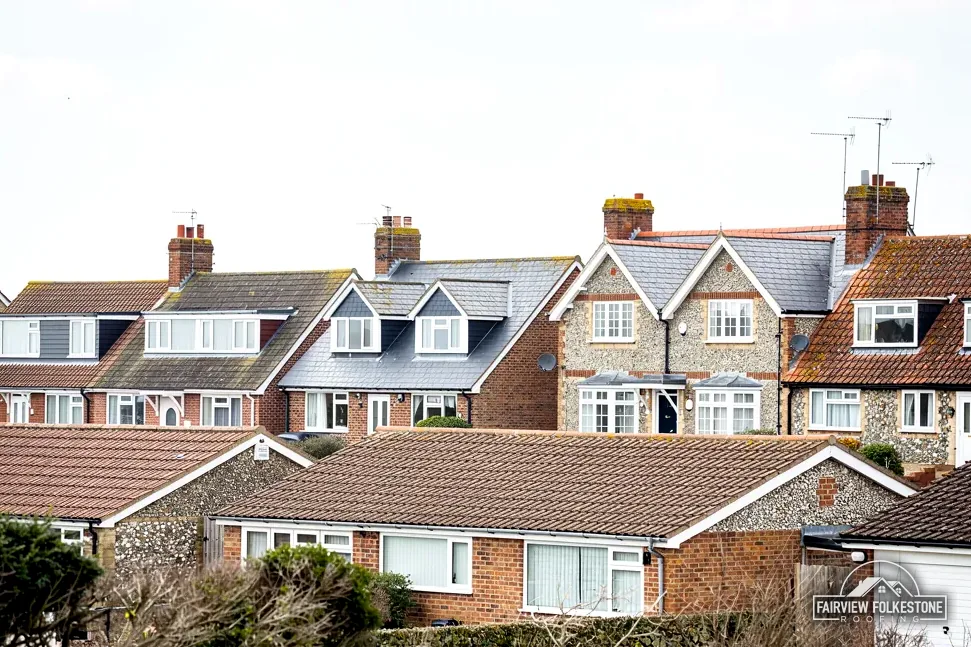
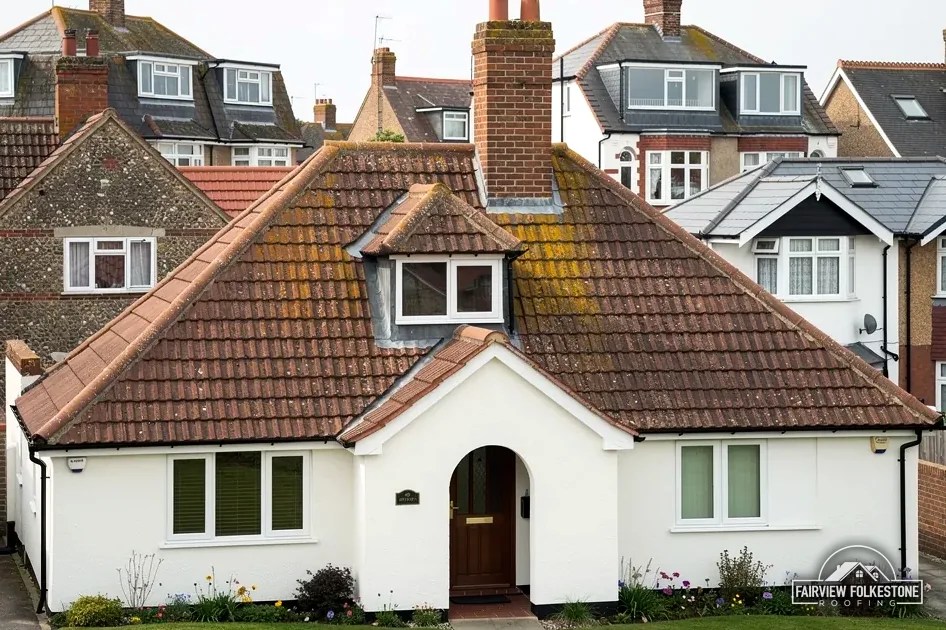
You do not need to climb anything to learn from a roof. From the pavement, look along the ridge for gaps or a sag, at the hips and verges for loose or missing tiles, at the lead where the roof meets a chimney stack, and at the gutters for stains running down the wall. A roof patched many times often shows a quilt of different colours that a survey would explore.
Who do I contact about roof work in Sandgate or Hythe?
Both are in Folkestone & Hythe District, so the district council is the planning authority and its building control team is on 01303 853538. Building control can also be done by a registered building control approver, and its building control page names new roof coverings as a job that can need approval, so ask before a re-roof.
- A dip along the ridge can point to a problem with the timbers beneath.
- Tiles or slates sitting out of line may have slipped.
- Lead standing proud of a chimney, or green staining under a gutter, deserves a closer look.
If you spot something on your own house, scaffold may be the safe way to reach it. Kent County Council charges £52 per week for 2026 to 2027 for scaffold on the highway, and expects the scaffolding company to file the application. At Rye or Camber, the East Sussex Highways fee table lists £127 for 28 days, and it is worth confirming the figure in force. We arrange the licence with our scaffolder.
These streets also sit in protected settings, so the guide to planning permission for roof work sets out what to ask the council, and the guide to house types and their roofs in Folkestone shows what a survey checks. Our roofing in Folkestone home page lists every service we offer.
More from the blog
All guides and posts
Tell us what's wrong with the roof.
You'll get one written total price.