
Roof care schedule
How often should a roof be inspected, and what does it add to its life?
No single number of years suits every roof. How often to look depends on the covering, its age and the weather, and a visit adds life by catching small faults before they spread.
Ask how often a roof should be inspected and a confident number turns up almost at once. The trouble is that a roof is several things at once: a covering, the timber beneath it, the flashings where it meets a wall and the gutters that carry the water away. Each ages at its own pace, and any of them can be hurried along by one rough night.
Rather than hand you a figure that would not fit half the roofs it was quoted for, this post sets out the three triggers that decide when to look: the age of the covering set against its published lifespan, the weather the roof has been through, and a regular look from the ground and the loft. It then shows what a visit can add to a roof's life, which has less to do with the visit than with what it prompts you to fix.
You will also find published lifespans, published repair costs set beside the cost of a new roof, and the kinds of roof that deserve a closer look. Every price here is quoted from a named third party. Our own quote for any work is a single written total, given once we have surveyed the roof.
01In order
Three triggers that decide when to look
A calendar alone is a blunt tool. Three triggers do more of the work, and any one of them is a good reason to book a visit.
The third trigger is the one households miss. A roof gives no signal until water reaches a ceiling, and by then the damp may have been at work for some time. A tile that has slipped, or a flashing that has split, does its harm above the ceiling, in a space nobody is looking at.
None of these triggers asks for a set number of years, and that is deliberate. A flat roof membrane that dries out, a ridge bedded in mortar and a roof of natural slate all age on different clocks, which is why the next section sets the published lifespans side by side. Use them as a prompt for a closer look, never as an expiry date.
- The covering is nearing the lifespan published for it, or you do not know how old it is. A roof of unknown age is best treated as an older roof until someone has looked. Age matters twice over: an old covering is nearer the end of its published range, and an old roof has had more seasons in which a small fault could grow.
- The roof has been through weather that could have shifted something: a gale, a long spell of heavy rain, snow or hail.
- Nobody has checked the roof, the loft or the gutters for a good while, and you cannot say when it was last done.
02Lifespans
What the published lifespans say about each covering
Lifespans come from manufacturers and cost guides, and the figures differ from one publisher to the next, so each is named here. They describe typical roofs. They are not a promise about yours.
Inspection timing: your questions
Does a new roof still need checking each year?
The same triggers apply to a new roof as to an old one: bad weather, and a look at the same time each year. A first check after the winter that follows the work is sensible, because workmanship faults show early. Keep the photographs taken when the job finished so later visits have something to compare.
- Welsh slate: HomeBuilding gives "100+ years" as an approximate lifespan, with Spanish natural slate at 75 to 100 years and reclaimed Welsh slate at 50 to 80 years.
- Clay tiles: Marley reports that the BRE set a minimum life expectancy of 60 years for clay roof tiles, while HomeBuilding gives 60 to 80 years, approximately.
- Concrete tiles: Marley's figure for roof tiles is around 60 years, with a note that it is not a guarantee or warranty. HomeBuilding's figure for plain concrete tiles is lower, at 40 to 50 years.
- Torch-on felt: HomeBuilding gives 10 to 15 years; Less allows 10 to 20, depending on how well it is made and laid.
- EPDM rubber: HomeBuilding gives 25 to 30 years, while Less says a rubber EPDM membrane typically lasts 30 to 50 years.
- Lead: MyJobQuote says correctly installed lead flashing can last for over 80 years.
Read these as a map rather than a timetable. A flat roof membrane near the lower end of its published range deserves a closer look every year; a slate roof in its early decades may only need an autumn glance from the ground. Whatever the covering, its flashings, ridge and gutters can fail well before the main field of the roof does.
03Key points
After bad weather: when to look straight away
Weather is the trigger that cannot wait for a date. After a gale or a hard night of rain, a quick look from the ground and the loft takes minutes and can save a repair from becoming a larger one.
- Tiles or ridge pieces lying in the garden, on the drive or in the gutter.
- A stain, a drip or a new damp patch on a ceiling or an upstairs wall.
- Daylight in the loft that was not there before.
- A gutter hanging at one end, or water pouring over its edge.
- Lead that has come away from the brickwork at a chimney or a wall.
Stay off the roof and off the ladder while it is wet or windy. Binoculars from the garden and a torch in the loft do the job at no risk to you.
If you may claim on your home insurance, speak to your insurer first and photograph everything before it is moved. In a disputed storm claim the Financial Ombudsman Service will usually want to see expert reports and photographs, and it treats a storm as more than wind, since rain, hail or snow can qualify without a gale. Whether a claim succeeds is a matter for you and your insurer. A written report with dated photographs from a roofer is one piece of evidence you can hand over; our page on roof inspection after a storm covers what that visit looks at.
04In brief
The yearly look from the ground and the loft
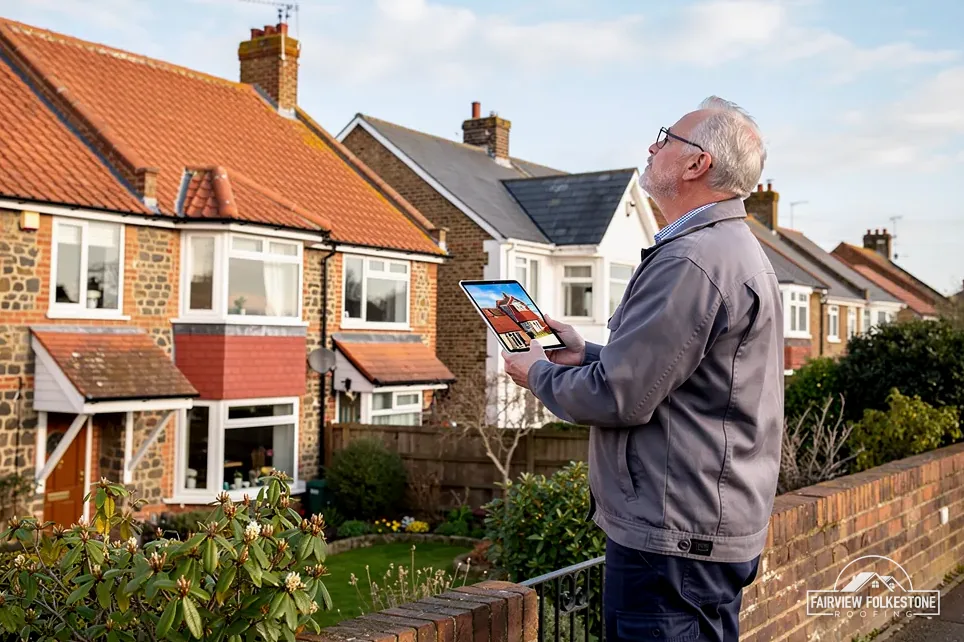
A regular look needs no tools beyond binoculars and a torch. Pick a time each year, such as early autumn before the weather turns, and go through the same short list so that you notice what has changed.
Keep a dated photograph of each slope and of any doubtful corner. Next year's photograph then shows at a glance whether a gap has widened or a stain has spread.
Write the date and a line on what you saw beside each photograph. A couple of minutes of notes a year gives a roofer, a buyer or an insurer a history to read, which is far easier to rely on than memory.
If anything on the list worries you, that is the moment to ask a roofer to look closer. Our roof inspection checklist goes through the same ground in more detail.
- From the garden or street, scan each slope for slipped, cracked or missing tiles, gaps along the ridge, and mortar crumbling at the verges.
- Check the gutters and downpipes from the ground: overflowing water down a wall means a blockage or a joint that has parted.
- Look at the chimney stack for a leaning pot, loose pointing or lead that has lifted.
- In the loft, look for daylight, dark staining on timber, torn underlay and damp insulation.
- On a flat roof, look for puddles still there the day after rain, and for splits or blisters.
Can I check my own roof safely?
You can do a good deal from the ground and the loft. Use binoculars on each slope, look at gutters and downpipes from below, and go through the loft with a torch, stepping only on the joists. Stay off the ladder and the roof itself. Anything beyond a look from those points is a job for a roofer with proper access.
05Side by side
What an inspection adds to a roof's life
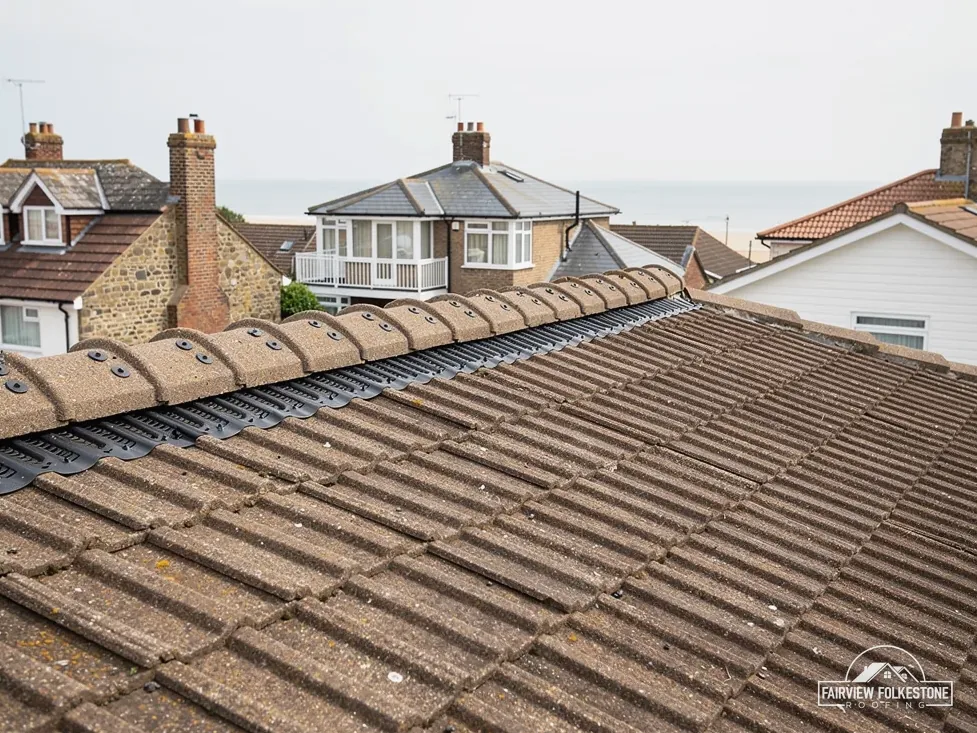
A visit does not add years by itself. The repair it prompts does, because a small fault mended early keeps water away from the timber, the underlay and the ceiling beneath. Marley says the 2015 amendments to BS 5534 ended reliance on mortar as the sole means of securing the covering, so a ridge held by old mortar alone is worth a look. Marley adds that installing to the standard isn't required by law, which is a good reason to ask what a given repair is fixed with.
Smaller jobs done in good time are also easier to reach. A repair to one slope may need only a ladder, while a leak that has got as far as the rafters can call for scaffold, new timber and a ceiling to make good.
The table sets published repair and survey figures beside the cost of replacing a whole roof. They are third-party numbers, with their sources, and not ours.
Which? expects prices in Kent and East Sussex, as part of the South East, to run towards the top of its scale. The gap between a few hundred pounds and many thousands is what a timely visit protects.
| Work | Published figure | Source |
|---|---|---|
| Mend a gap of one to six standard tiles, broken or gone | £75 to £400, excluding VAT | Which? Trusted Traders, November 2025 |
| Clear all gutters, front and back | £75 to £350, excluding VAT | Which? Trusted Traders, November 2025 |
| A roof survey, on average | Around £300 | MyJobQuote |
| A roof repair, on average | Around £650 in 2026 | MyJobQuote |
| Re-roofing an average three-bedroom house completely | £7,000 to £21,000, excluding VAT | Which? Trusted Traders, November 2025 |
06The short list
Roofs needing extra care and what a visit leaves you
Some roofs justify looking sooner or more often than the three triggers alone suggest.
Will an inspection report help if I need to make a claim?
A written report with dated photographs is the kind of evidence the Financial Ombudsman Service will usually want to see in a storm dispute. The insurer makes that decision. Before anything else, tell the insurer, keep every receipt, and photograph the damage before any clearing up.
- Roofs with spray foam on the underside: foam over the rafters hides the timber from view, as RICS's consumer guide points out, so an inspection has less to go on.
- Roofs on buildings built or refurbished before 2000: HSE tells owners to presume asbestos is there, and it calls asbestos cement roofs fragile, so never walk on or break up a roof you suspect.
- Exposed sites: Cupa, a slate maker, says buildings on hills, slopes or the coast will be graded with higher exposure, and that feeds into the fixing specification.
- Flat roofs: BS 6229:2025 sets a minimum finished fall of 1:80 for membrane roofs, and standing water after rain is a prompt to look at the fall and the membrane.
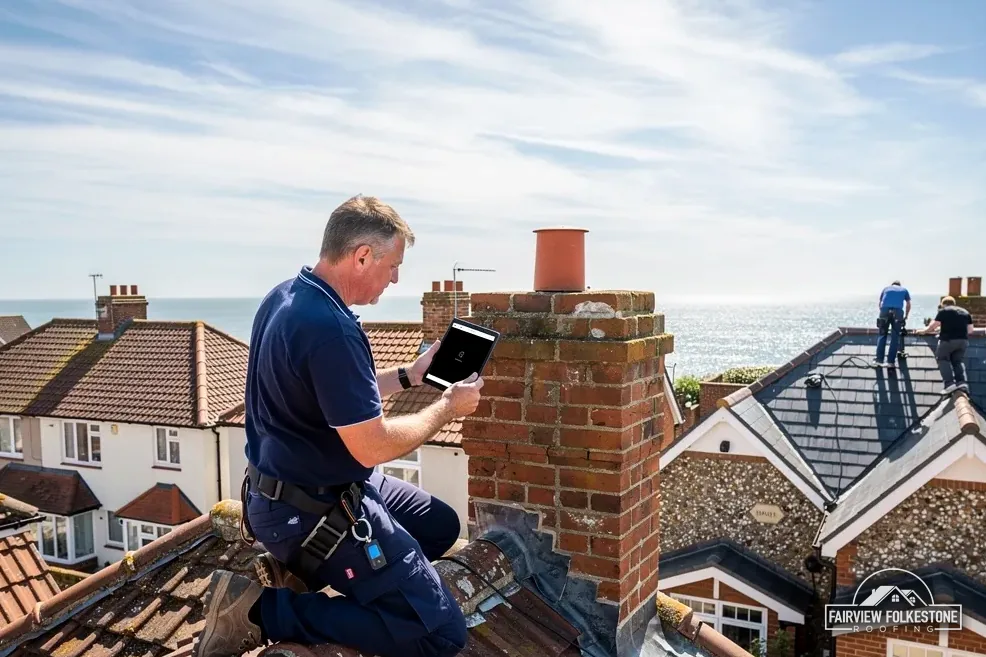
A good visit leaves you with something you can keep. That means notes in writing, close photographs of each fault, a note of what was not seen, and a verdict on each finding: fix, replace or leave be. We say which, and a sound repair comes first.
Ask for the findings to be kept apart from the offer of work. A report that lists faults and a quote that prices them are two documents, and having them separate lets you set a second opinion against the first fairly.
Our roof condition report guide shows what such a record contains, and the roof inspections page covers the visit itself.

Tell us what's wrong with the roof.
You'll get one written total price.