
Planned roof maintenance
Commercial roof maintenance: planned checks that prevent big bills
A roof that is looked at on a schedule costs less to keep than one only looked at when it leaks. This is a maintenance plan for a business building, from checks to safe access.
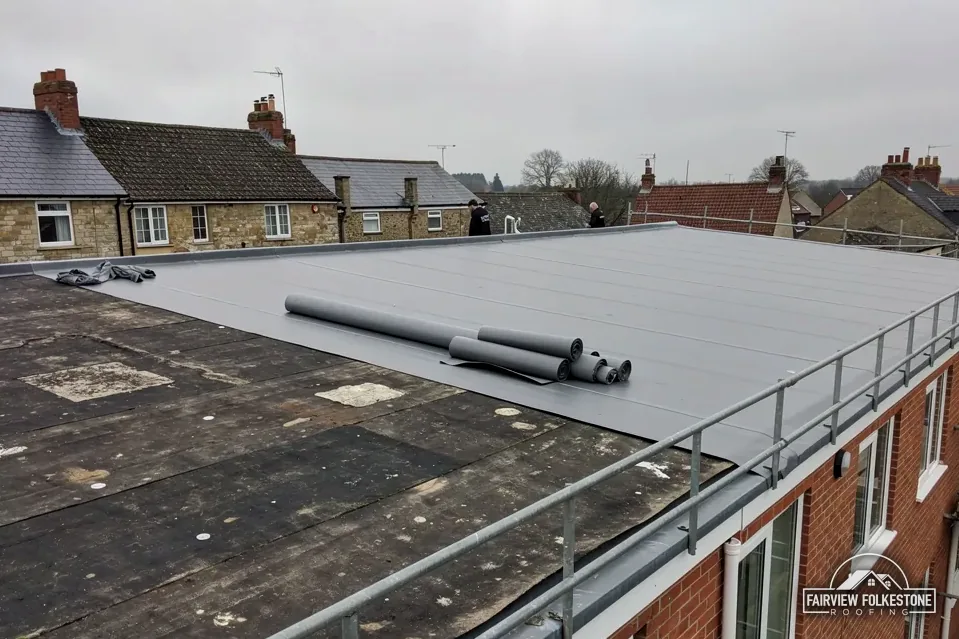
A business owner may meet the roof only twice: on the day a stain appears on a ceiling tile, and on the day a surveyor says it needs replacing. Planned maintenance fills the gap between them. A few short, regular checks catch a blocked outlet, a lifted flashing or a split in a membrane while the repair is still small and the weather is still on your side.
A maintenance programme is not a contract for its own sake. It is a diary: what gets looked at, by whom, how often, and what is written down afterwards. For a shop or an office it protects the stock, the equipment and the ceilings below. For a unit, it protects the contents and the trading days that a leak would cost you.
The sections below set out a sensible rhythm, deal with outlets and gutters, explain how people reach a roof safely, list what an inspection looks at surface by surface, cover cleaning and growth, and finish with the records that make the next decision easier. Repair costs on commercial roofs are set after a survey, so there are no price figures in this post.
01Leaks
A diary for the roof, not a reaction to leaks
A maintenance plan starts by deciding who looks, when, and what counts as a reason to call a roofer. Without that, a roof is looked at only when it fails, which is a costly moment to find out.
A workable rhythm has three layers, and none of them needs specialist kit.
- A quick look at the ceilings and walls under the roof each time the weather turns, for new stains or damp patches.
- A planned visual check of the roof itself at least once a year, with an extra look after a severe storm.
- A fuller survey when the covering reaches the later part of its published lifespan, or whenever a repair history starts to build up.
The yearly visit matters because it happens when nothing is wrong. A surveyor on a dry day can see lifted laps, cracked sealant, ponding marks and slumped outlets that nobody inside the building would notice for months.
Responsibility is the other half of the diary. In a single-occupier building, one named person holds the log. In a multi-let property or a block, the managing agent should hold it, and tenants should know who to tell when a stain appears. A lease can split roof duties between landlord and tenants, so check where yours puts them before assuming the roof is someone else's problem.
The point of all this is that a small, cheap visit does the work a large, urgent one would otherwise have to. A repair booked on a quiet week is also easier to fit around trading than an emergency in the middle of a delivery morning.
02Gutters
Outlets and gutters: keeping the water moving
A flat or low-pitched roof works only while water can leave it. Outlets, box gutters and downpipes are the exit, and anything that slows them turns a roof into a shallow tank.
NFRC's summary of BS 6229:2025 gives a minimum finished fall of 1:80, across the open roof and along internal gutters. A roof laid to that fall still stops draining if an outlet is choked with leaves, grit and litter, or if a gutter has dropped at a joint. The guttering manufacturer Brett Martin advises a fall of 1 mm for every 600 mm toward the outlet, which is barely visible to the eye and easy to lose when a bracket sags.
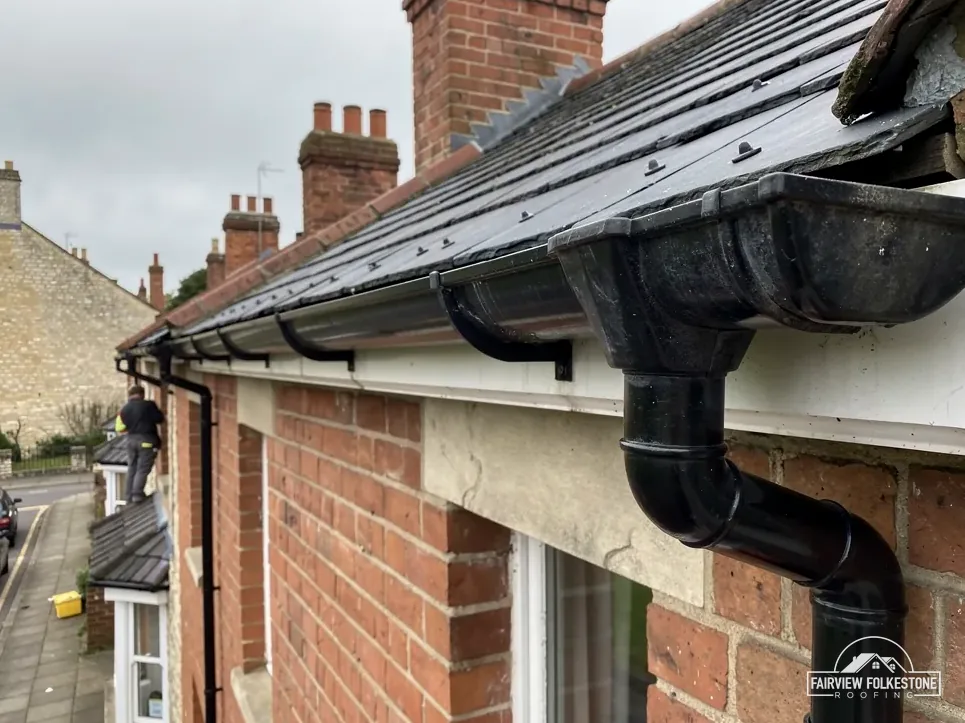
What to check at an outlet:
- Debris around and in the outlet, including leaves, moss and windblown packaging.
- The grate or leaf guard, which should be in place, whole and fixed.
- Standing water on the surface a day after rain, which points to a fall problem or a blocked outlet.
- Stains running down the wall beneath the gutter, which mark where it has overflowed or leaked at a joint.
- Overflow pipes, which are there to warn you and must not be blocked.
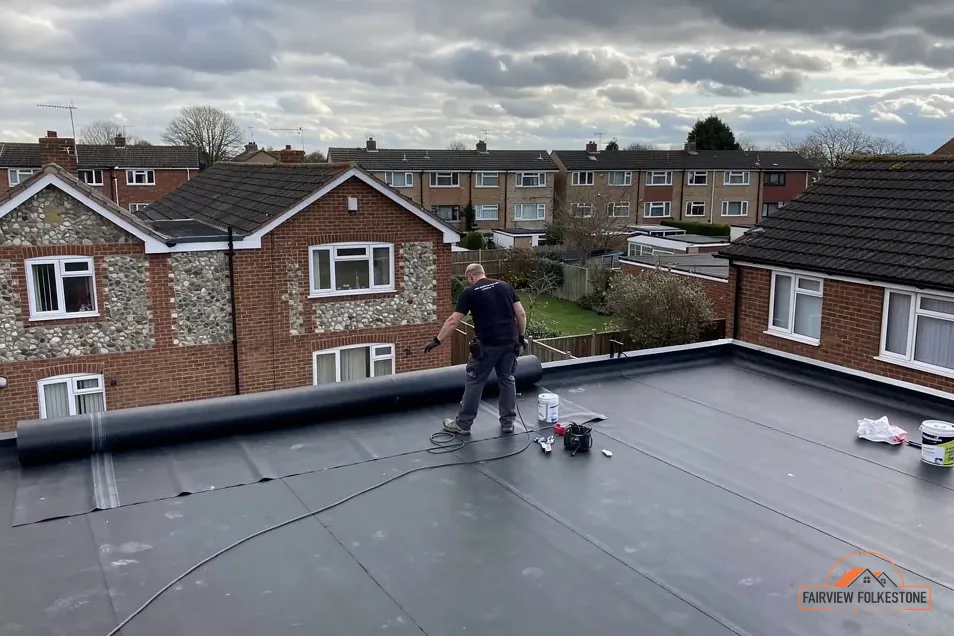
Clearing an outlet is a simple job but it is working at height. On a roof with a parapet or an edge protection system, it can be done in a visit that takes minutes. On a roof with no edge protection, it should not be done from a ladder by whoever happens to be available.
If you find water standing, take a photo with something in frame for scale, note the date, and send it to the roofer who holds your records. Ponding that stays for days points to more than a blocked outlet, and it belongs on the next survey.
Planned maintenance: your questions
How often should a commercial roof be inspected?
A planned look at the roof at least once a year, plus a check after any severe storm, is a sensible rhythm for most buildings. A survey is worth booking when the covering is approaching the later part of its published lifespan range or when repairs start to repeat in the same place.
03Key points
Safe access: who goes up and how
Every roof inspection is work at height, and for most commercial buildings that means a plan for access before anyone climbs. The question is not only how the roofer gets up, but how everyone else is kept off, and whether the surface will carry a person at all.
HSE's guidance is blunt on one point: AC roofs are always fragile. A corrugated asbestos cement sheet can look sound and still give way under a person. The same care applies to old rooflights, which can be hidden by moss or paint, and to any sheeting that has been exposed for decades. Nobody from the business should walk a roof they have not been told is safe.
Where work is more than a quick look, CDM 2015 applies. In HSE terms the domestic client is a householder, and a business building falls outside that. Extra duties arrive when more than one contractor is on site, and a plan for the construction phase is always needed. Our guide to fragile roofs and CDM goes through the rules in detail.
A sensible access plan includes:
- A fixed ladder or permanent access point where one exists, with a lockable hatch that keeps the roof off limits to casual visitors.
- Edge protection or a guarded route to any plant that needs routine attention.
- Crawl boards or walkways across fragile areas, so people step only where the roof is designed to be walked on.
- A rule that nobody goes up alone, and that everyone who does has been briefed on where the fragile parts are.
04Side by side
An inspection, surface by surface
An inspection is only as good as its checklist. The table pairs each part of a typical commercial roof with what to look at and what should be done about it. It is a guide to what a visit covers, not a substitute for a surveyor's own judgement on the day.
Lead is worth a line of its own. MyJobQuote says correctly installed lead flashing can last for over 80 years, so it can outlast some of the coverings around it. That depends on it being fixed well and dressed down properly, so loose or lifted lead is the item to report rather than ignore.
Photographs make the table useful. A set taken from the same positions each year gives a surveyor something to compare, and shows whether a stain is spreading or has been dry since last winter. Keep the photos in the same folder as the inspection notes, labelled with the date.
Where a particular junction keeps turning up on the list, that is information. It suggests the detail needs redoing rather than topping up again.
| Part of the roof | What to check | If it is wrong |
|---|---|---|
| Membrane surface | Splits, blisters, lifted seams, punctures | Local repair, then re-check the area |
| Upstands and flashings | Gaps at walls and rooftop equipment, loose edges | Re-seal or refix; lead dressed back |
| Metal sheets and fixings | Loose fixings, lifted laps, corrosion at cut edges | Refix, replace sheet, treat edges |
| Rooflights | Cracks, failed seals, surface condition | Replace unit; mark as fragile |
| Gutters and outlets | Blockage, joints, brackets, standing water | Clear, refix, correct the fall |
Can our own staff clear the gutters and outlets?
Only where there is safe access, such as a parapet, fixed edge protection or a permanent ladder, and where the surface is known to be strong enough to walk on. HSE's guidance treats AC roofs as always fragile, so on any older sheet roof the work should go to a contractor with the right access equipment.
05The detail
Cleaning, growth and what to avoid
Moss, algae and leaf litter do more than spoil the look of a roof. They hold moisture against the surface and block the routes water takes to leave it. Regular light cleaning belongs in the maintenance plan, but how it is done counts for as much as when.
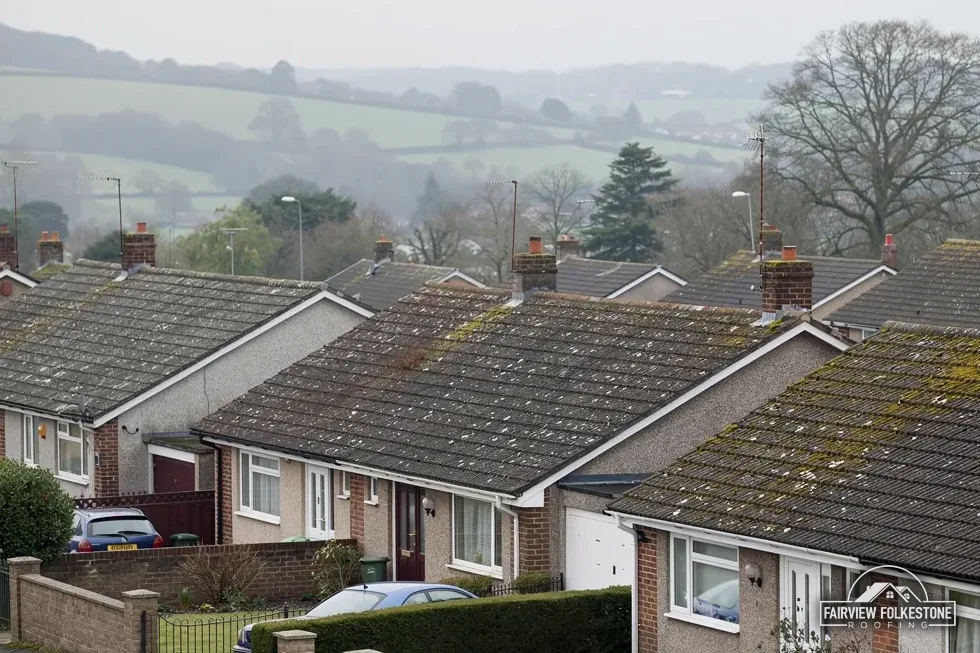
For slate and tile roofs, Marley warns against high powered jet washes, which can damage the surface and cut the covering's expected life considerably. Keep that in mind if a contractor offers a quick blast over a pitched roof: a gentler method protects the covering you are trying to keep.
On flat roofs, the same logic applies in a different form. A membrane is a skin, and a stiff brush or a hard jet can scuff it. Cleaning is best limited to clearing debris by hand, keeping outlets and gutters open, and removing growth gently, with care taken not to disturb seams and edges.
Nests and roosts
Nesting birds and bats can complicate any clearing job. The law shields a nest in use or being built from intentional harm, so if a gull or a pigeon has settled in a gutter or behind a parapet, the job waits. Bats get wider protection: a roost is protected regardless of intent, and GOV.UK's bat page includes roofing work in its list of activities. If you see either, stop and ask for advice before anything is moved.
Scaffold, where cleaning or repair needs it, is arranged with the work. Scaffold that sits on a public road or footway is licensed under the Highways Act 1980 s169, and we arrange the licence with our scaffolder.
06Repairs
Records, repairs and knowing when to stop patching
The best maintenance record is a plain one. It says what was checked, when, by whom, what turned up and what was dealt with. A roofer coming to a building for the first time can read it in minutes and see the pattern: the same corner repaired three times, or an outlet cleared every autumn because the fall is wrong.
Is a planned maintenance visit the same as a roof survey?
No. A maintenance visit checks surfaces, outlets and junctions against the last record and deals with small faults. A survey looks at the deck, the covering and the structure as a whole, and ends in a written recommendation: repair, refurbish or replace. The price that follows is one total.
A useful log holds:
- The date and name of each inspection, with photographs from fixed positions.
- A short note of anything repaired, and what was used.
- The date of the last survey and who carried it out.
- Any asbestos survey, with the location of anything it identified.
- The roof's published lifespan range for its covering, with the year it was laid.
Repair and replacement are not opposites. Sound covering and a dry deck mean repair does the job. Patching becomes false economy when repairs start to overlap, when the deck beneath is wet, or when the covering has reached the later part of the range published for it. At that point the useful question is no longer how to fix this leak but how much life the rest of the roof has left.
A survey answers that, and the written price that follows is one total, with no list of separate parts. Our answers on a commercial roof survey and on refurbishment or replacement explain what to expect, and the commercial roofing page shows how we work on business premises.
More on commercial roofing
All guides and posts
Tell us what's wrong with the roof.
You'll get one written total price.