
Repair or replace
Repair or replace your roof? Making the right call
Repair or replacement comes down to how far the fault has spread and whether the timbers underneath are sound. This post sets out the figures, the tests and the options between the two.
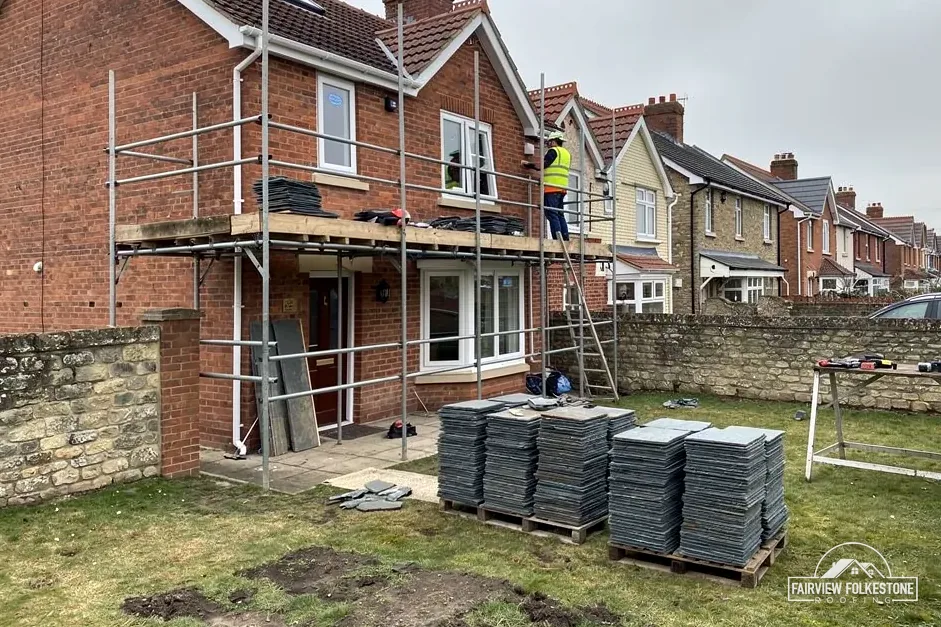
Does a repair cost less than a new roof? On the day, by a long way. Over the next ten years, it depends on what is wrong. A single fault in a sound roof is worth fixing. A roof that has started failing in several places is a different matter, because each repair buys a short reprieve and the next fault arrives while the scaffold or ladder is still fresh in the memory.
Choosing between roof repair or replacement is easier once you separate three questions: how big the damage is, how healthy the layers under the covering are, and what the roof has done over recent years. The sections below take each in turn, give the third-party cost figures we can stand behind, and cover the rules that apply when a repair grows into a re-roof.
Our rule: where a repair would be sound, we repair. A re-roof comes into it only when the survey shows it is needed, with the evidence put in front of you.
01Repairs · Costs
What repairs and new roofs cost on published figures
Yes, a repair costs less on the day, because a few tiles replaced is a small job beside stripping and re-covering a whole roof. The published figures show how wide the gap runs. They are third-party numbers, not quotes.
The Which? rows come from a survey of 11 Trusted Traders, exclude VAT, and carry the note that prices "are likely to be at the upper end of the scale if you live in London or the South East". Folkestone, Dover and Rye all fall inside that region. MyJobQuote's pages name no tax basis, so read its rows as a guide only.
The gap between the repair rows and the whole-roof rows is large, but it is the wrong sum on its own. A repair on a failing roof is no saving if it has to be repeated. The better comparison is what the roof will need over the next several years, and that comes from the survey. Ask for it to be written down, so that a repair today is judged against the likely cost of the next one, not against nothing.
| Work | Figure | Source |
|---|---|---|
| Replace 1 to 6 broken or missing tiles | £75 to £400 | Which?, November 2025 |
| Average roof repair | Around £650 in 2026 | MyJobQuote |
| Extensive storm damage repairs | £1,200 or more | MyJobQuote |
| Whole roof, average three-bedroom house | £7,000 to £21,000 | Which?, November 2025 |
| New roof, UK average | Around £5,250 | MyJobQuote |
02Repairs
When a repair is the right call
A repair is sound when the fault is local, the cause is understood and the layers under it are in good order. Five findings together make that case.
Repair or replace: your questions
How many slipped tiles are too many to repair?
There is no set number. A few slipped tiles over sound battens is a repair, while tiles slipping all across a slope point to fixings or timbers that are failing. The survey looks at why they moved and what lies underneath, then recommends the smaller job where it is sound.
- The damage sits in one area: a few slipped or cracked tiles, a lifted ridge section, one split in a flat roof membrane (the waterproof skin).
- The battens (the strips the tiles hang from) beneath the damage are firm when pressed with a screwdriver.
- The underlay (the sheet under the battens) is whole, not torn or slumped.
- The rest of the covering looks even, with no sign of flaking, crumbling or widespread slipped fixings.
- The cause is known: a gale, a fallen branch, a lifted flashing, a gutter that has dropped and wetted the eaves.
In that case, a repair restores the roof to the condition of the rest of it, and that is all it needs to do. A lifted lead flashing at a chimney is a good example. MyJobQuote says correctly installed lead flashing can last for over 80 years, so refixing or replacing the lifted section is worth doing before anyone talks about a new roof.
Ridge tiles on tired mortar are another repair that stands up. They can be re-bedded or refitted with fixings, and Marley notes that BS 5534 is a code and not a legal requirement, though a covering held on by mortar alone is out of step with the 2015 amendments. A ridge refixed with proper fixings can end up better secured than the one it replaces.
If your roof ticks these boxes, we repair it and tell you what we found.
03Key points
When repairs stop making sense
A repair stops making sense when it does not remove the cause. If the cause is a roof-wide problem, any repair treats a symptom.
- The same roof has needed attention in several places in a short period, and the faults are not obviously linked to one event.
- Battens are soft, split or crumbling, so new tiles would be fixed to timber that will not hold a nail.
- The underlay has perished across the roof, so water reaches the timbers wherever a tile lets it through.
- Tiles are flaking or breaking up across whole faces, or slates are slipping everywhere as their fixings give out.
- The ridge dips or a slope sags, which points to timbers or structure that need a surveyor's look before any covering is priced.
- A flat roof has split along several seams, or the deck below feels soft underfoot.
In each case the covering and the layers beneath are failing together, and the repair would sit on top of a fault it cannot reach. The roof then costs money to keep alive, every time with access to arrange again.
There is no fixed number of slipped tiles at which a repair turns into a replacement. What decides it is why they slipped and what lies beneath, so a survey looks under the covering as well as at it. If the survey finds a repair would be sound, we will say that even where a bigger job would pay us more. Where it is not, you will see why: the battens, the underlay and the photographs.
04Side by side
The options between a patch and a full roof
Repair and replacement are not the only two choices. A third group sits between them, and an older roof with one bad slope can land there.
Can I repair the roof now and replace it later?
That can be reasonable where the repair is sound and the remaining slopes are in order. It is less sensible on a roof that is failing everywhere, because a later replacement would strip the repair out. Ask the surveyor which of the two your roof is, and keep the written findings.
| Option | Fits when | Check |
|---|---|---|
| Re-cover one slope | One face has failed, the others are sound | The join with the old covering |
| Re-batten and re-felt, reusing sound tiles | Tiles are good, the layers beneath are not | How many tiles break on lifting |
| Strip and fit a new covering | Covering and layers are both worn out | Weight of the new covering |
| Renew a flat roof covering | Deck is firm, membrane has failed | Falls and insulation |
Reusing tiles saves material, but old tiles can break when they are lifted, and some will need replacing with matching ones. A survey can say how likely that is on your roof, and it is worth asking before you choose, because if many of the tiles would need renewing, re-covering may be the better value. Replacing a single slope still counts as re-roofing under the rules, so the Planning Portal tests apply to the share of the roof that is touched.
Where a slope is replaced and the roof otherwise stays as it is, the new part should be built to today's standards and tied into the old with care. The join between the two is where leaks start if it is rushed, and it is one of the things we point out when we explain the findings. Ask where the old and new meet, how the edges are finished and what the flashings will be, since those details decide whether a part-roof job stays dry.
05Repairs · Re-roofing
Rules that apply once a repair becomes a re-roof
A repair of a few tiles needs no approval. Once the work becomes a re-roof, the Planning Portal's England guide applies. It looks at how much is touched: under 25 per cent of the building envelope and under 50 per cent of the roof, and no application is normally needed. Separately, a new covering that weighs 15 per cent or more than the old one needs approval, and so does one that would perform very differently in a fire.
Approved Document A treats loading as a significant change when it "is increased by more than 15%". So a switch to a heavier covering needs a structural check, and Building Regulations approval. For Dover District Council addresses the council lists "replacement of roof coverings on pitched and flat roofs even if this is just like for like" as work needing approval. Where the property is in another district, we point to the Planning Portal test and the relevant council.
AD L 2021 sets a further test. If renovation takes in more than 50% of a roof surface, Table 4.3 asks for 0.16 W/m²K across the whole roof, against a threshold of 0.35, subject to feasibility and a 15 year payback. A flat roof counts too: replacing its waterproof membrane is renovation under paragraph 11.2.
Planning permission is separate. Class C of the permitted development rules covers re-roofing a house, while a listed house adds listed building consent whenever the work changes what makes it special. Our answer on building regulations for a re-roof sets out how we handle each of these.
06In order
Getting a clear comparison from a surveyor
You should be able to see why a roofer recommends a repair or a replacement. These are the things worth asking for before you decide.
Where a storm caused the damage, speak to the insurer ahead of any permanent repair. The Financial Ombudsman Service says "we'll usually look at expert reports and photos", and that "Rain, hail or snowfall by itself can constitute a storm". Making the roof safe for now is a separate step from the permanent decision, and photographs taken before anything is moved help either way.
After you sign at home following a survey, you have 14 days to cancel, and a start inside that period needs a written request from you. Under CDM 2015, the duties a homeowner holds as client pass to the contractor, and the project needs a construction phase plan. For the cost side in more detail, see our new roof cost guide, and the roof replacement page for the work itself.
- What was found under the covering, shown in photographs: the battens, the underlay and the timbers, not only the visible damage.
- Which findings point to a repair and which point to replacement, in plain words.
- A single written total price for the option recommended, stating whether VAT and scaffold are included.
- Where scaffold stands on the highway, who arranges the licence. We arrange it with our scaffolder; Kent County Council charges £52 per week for 2026 to 2027, and East Sussex Highways shows £127 for 28 days.
Does a repair make the roof good for another ten years?
A repair restores the part that was fixed, not the rest of the roof. How long the rest lasts depends on its covering and timbers. HomeBuilding gives approximate lifespans, for example 40 to 50 years for plain concrete tiles, which is a frame for the survey, not a promise.
More on roof replacement
All guides and posts

Tell us what's wrong with the roof.
You'll get one written total price.