
New roof benefits
Does a new roof save energy and add value to a house?
A new roof can bring better insulation and a cleaner survey, but the covering does not insulate and nobody can promise a figure for value. Here is what is true and what to check.
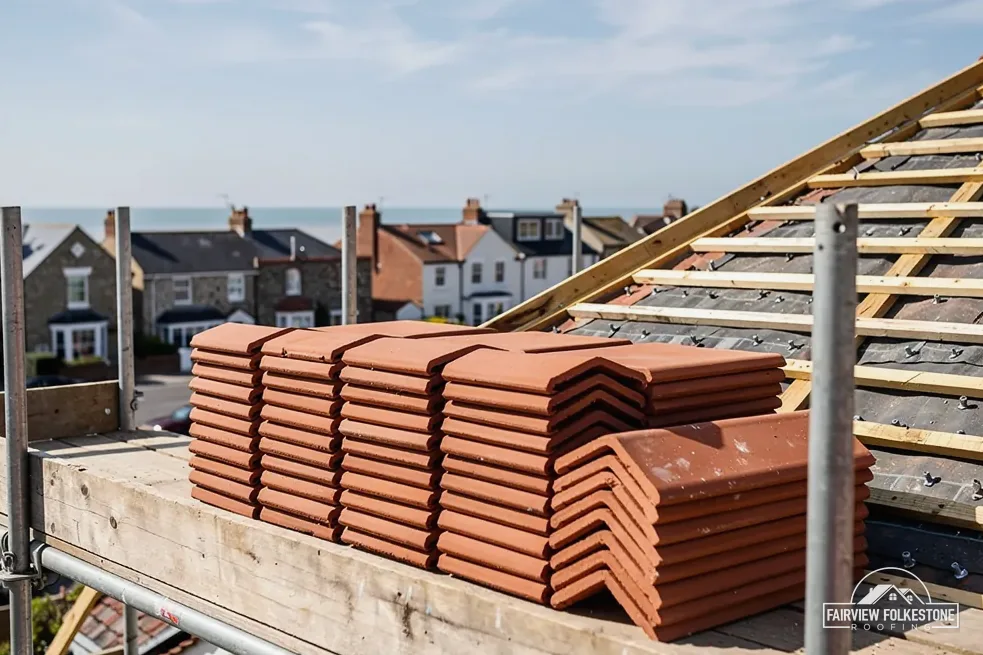
Does a new roof save energy and add value to a house? Partly, and for reasons that have little to do with the shiny new tiles. The covering keeps rain out. It is the insulation beneath it, and the ventilation around it, that decide how much heat a house loses through the roof, and a re-roof is the moment when the rules say that layer must be looked at.
On value, we will not quote a percentage, because none can be given honestly for a house we have not seen: what a buyer pays depends on far more than the roof. What a new roof does is remove a known defect, and that matters when a buyer's surveyor goes up into the loft.
The sections below cover what Part L of the Building Regulations asks when a roof is renovated, how insulation and ventilation fit together, what a new roof does and does not do for value, the tax and cost points, and the timing around the changes to Approved Document L.
01Key points
How a house loses heat through its roof
Tiles and slates are a weather skin. They keep rain and wind off the structure, but they are not insulation, and swapping an old covering for a new one does not by itself warm the house. Heat leaves through the ceiling and rafters, and what slows it is the insulation laid there.
That is why a re-roof matters for energy. With the old covering off, the rafters and the loft floor can be seen and reached, and the insulation can be topped up or fitted properly, rather than squeezed in around a roof that is staying put. It is also why the rules treat a big enough renovation as the trigger for an upgrade.
- Insulation: the thickness and the type decide how much heat the roof holds in.
- Gaps: insulation pushed hard against the eaves can block the ventilation that keeps the timbers dry.
- Air leaks: light fittings, loft hatches and pipe runs can let warm air into the roof space.
- Moisture: warm damp air meeting a cold roof surface condenses, and the timbers and underlay then stay wet.
A survey before the work looks at all four, in the loft and at the eaves from outside, and records what it finds so that the insulation and ventilation can be settled before the covering goes on. If the loft is already well insulated and dry, the job may need little more than the new covering. If it is thin or damp, the re-roof is the time to put that right. Nobody can predict the saving on your bills from the outside; the survey shows what the roof and loft need.
02Part L
What Part L asks for when a roof is renovated
Approved Document L (conservation of fuel and power) for dwellings in England sets limiting U-values. A U-value measures heat loss, so lower is better. The figures below come from the 2021 edition incorporating 2023 amendments, in W/m²K.
Paragraph 11.3 sets the trigger. The whole element is improved when the work covers more than 50% of its surface, or when the job is a major renovation: more than 25% of the external building envelope. On a flat roof, paragraph 11.2(d) counts a new waterproof membrane as renovation too, so a recovering job can trigger the upgrade. These figures are limits for England, and they concern the roof as built, not the covering seen from the street. A roofer prices the work to meet them, and building control checks the result.
Paragraph 4.13 gives a way out. Where the improved figure cannot be reached in a technically or functionally feasible way, or the payback would run past 15 years, the upgrade goes as far as feasibility and a 15 year payback allow. As a general point, an upgraded element should not exceed 0.7. Roof windows take the window figure, and 2.2 is for rooflights only.
| Element | Limit | Table |
|---|---|---|
| New roof element | 0.15 | 4.2 |
| Renovated roof, improved target | 0.16 | 4.3, column (b) |
| Retained roof, threshold | 0.35 | 4.3, column (a) |
| Roof window | 1.4 or WER Band B | 4.2 |
| Rooflight | 2.2 | 4.2 |
New roofs, energy and value: your questions
Will a new roof lower my heating bills?
Only to the extent that the insulation under it improves. The tiles or slates keep the weather out and do not hold heat in. Where the work reaches the Part L renovation trigger, the roof is expected to be brought up to 0.16 W/m²K where feasible, which is the part that can reduce heat loss.
03Insulation · Ventilation
Insulation and ventilation have to work together
A well-insulated roof that cannot breathe will rot. The two jobs are linked, so a re-roof that adds insulation should also settle the ventilation.
In a cold roof, where insulation sits at the loft floor and the roof space above it stays cold, Marley's guidance sets out how much eaves ventilation to leave. With a high-resistance underlay, Marley calls for a 25 mm eaves opening when the pitch is 15° or under, and 10 mm when it is steeper than 15°. A high-resistance underlay does not let moisture vapour through, hence the need for that eaves gap. Marley adds a second route: a breather-type underlay with a tightly sealed ceiling beneath it and an air-permeable covering above can rely on the 3 mm that ordinary eaves construction leaves open, though only if the UKAS certification conditions Marley mentions are met in full. Which of the two systems suits your roof is a design decision made at survey, not something to guess from the street. Our answer on breathable roof membranes goes into the detail.
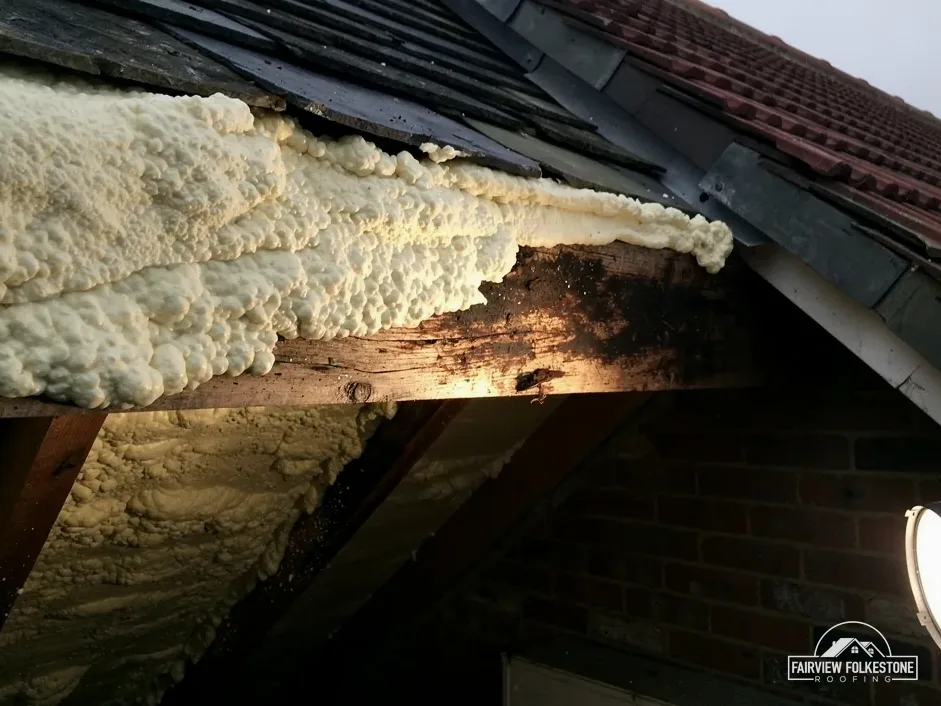
Spray foam applied under the roof is a different route, and one to approach with care. The Energy Saving Trust names the closed-cell type's chief drawback as being not vapour permeable, notes that foam sprayed straight onto the roof underside partially seals the timber, and adds that this risk "should be much lower with an open-cell foam". RICS says a timber roof structure covered with spray foam "cannot be fully seen or inspected", and in March 2023 it reported concern in some parts of the lending market, such as equity release mortgages. Check with your lender before any spray foam work.
For what Part L means for loft insulation when a roof is replaced, our answer on insulation when re-roofing sets it out.
04In brief
Does a new roof add value to a house?
It can help, but there is no sum we can hand you. The value of a house turns on its location, size, condition and the market on the day, and a roof is one part of that. We do not put a percentage on a new roof for that reason.
What a new roof does is take a defect off the list. A tired roof is the sort of finding a buyer's surveyor writes up, and it can shape the price or the negotiation. A replacement gives you a clean answer to that question and something to show for the money.
Is there a figure for how much value a new roof adds?
The value of a house depends on its location, condition and the market, and a roof is one part of that picture. What a new roof does is remove a defect a buyer would otherwise find, and leave you with a clear record of the work.
- Keep the written quote and the written findings that explain what was wrong.
- Keep the paperwork from building control if approval was needed for the work.
- Keep photographs of the old roof, the layers beneath and the finished job.
- Keep details of the insulation fitted, and what it is made of.
None of this raises the sale price by itself. It answers the questions a buyer, a surveyor or a solicitor will put to you, and answers given with paper behind them tend to be easier for everyone to accept.
Be wary of a different kind of "value": a repair that leaves the real fault in place, or a covering chosen only for looks, does not remove the defect. And a roof covering that is heavier than the old one needs a structural check, because Approved Document A treats a loading increase of more than 15% as a significant change. Spray foam is the reverse: it can make a buyer's survey harder, since the timbers beneath it cannot be seen.
05Costs
The cost, the tax and the grants question
Published costs for a whole roof vary with the house and the covering. In a November 2025 Which? survey of 11 Trusted Traders, renewing the roof of an average three-bedroom house came to £7,000 to £21,000, excluding VAT, Which? adds that prices "are likely to be at the upper end of the scale if you live in London or the South East". HomeBuilding prices a standard three-bedroom semi with a 65m2 roof and plain concrete tiles at between £10,000 and £15,000, including labour, scaffolding and insulation. MyJobQuote's UK average for a new roof is around £5,250.
On tax, VAT Notice 708/6 covers installations of energy-saving materials made between 1 May 2023 and 31 March 2027, and says insulation includes roofs or lofts. From 1 April 2027 the notice says such installations revert to the reduced rate of 5%. Ask how the rate applies to your job, and have the answer on the quote. The construction reverse charge is between VAT-registered businesses in the Construction Industry Scheme and never appears on a homeowner's bill.
On help with the cost, our answer on government grants for a new roof covers what is and is not available. Our quote is a single sum after the survey, and every figure above is a guide, not a price from us. Look in the quote for how VAT and scaffold are handled before you set one against another.
06In order
Timing the work around the new Part L
A new edition of Approved Document L is on the way. For building work other than higher-risk work, the 2026 edition takes effect on 24 March 2027, and higher-risk work follows on 24 September 2027. Its tables are renumbered 3.2 for new elements and 3.3 for existing ones. Until then, the 2021 edition described above applies.
That does not mean a roof should wait or rush. A roof that is failing should not be left for a date on a calendar, and a roof that is sound has no deadline. What we do is check with building control which edition and which rules apply to your particular job, and put the answer in writing.
Our roof replacement page covers the full job from survey to clear-up. Where a repair would do, a repair is what we recommend, and you will see the findings behind that. Some jobs straddle the dates, with a survey in one season and the work in the next, so ask building control which edition applies and keep the confirmation with your paperwork.
- Survey the roof and the loft, and decide what the work is: repair, part re-roof or full replacement.
- Check the Building Regulations position with building control, which means the council's team or a registered building control approver.
- Settle the insulation and ventilation to suit the structure and the covering.
- Agree one written total price and the start date, and get both in writing.
Does replacing a roof always need Building Regulations approval?
Not in every case. The Planning Portal's guide sets limits of under 25 per cent of the building envelope and under 50 per cent of the roof, past which an application is normally wanted, and a covering 15 per cent or more heavier needs approval. Dover addresses are stricter, as Dover District Council lists roof coverings replaced like for like.
More on roof replacement
All guides and posts

Tell us what's wrong with the roof.
You'll get one written total price.