
Gutter failures
What failing gutters do to walls, foundations and gardens
A gutter that stops carrying rain away drops it on the wall, the path and the soil beside the house. The harm builds slowly, so it is easy to miss until damp shows indoors.
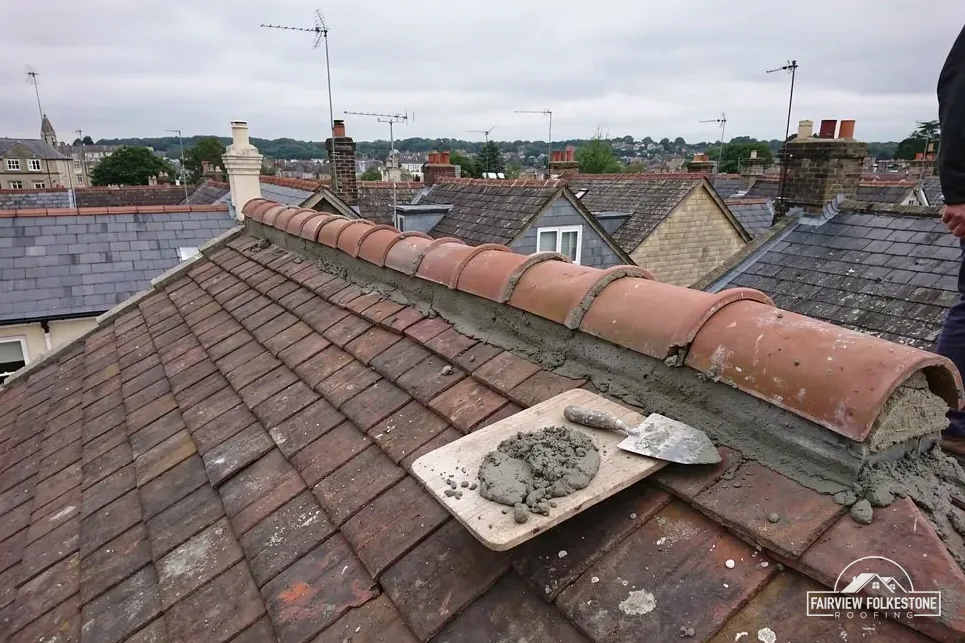
A roof sheds a surprising amount of rain in a short time, and the whole of it is meant to leave the property through the gutters and downpipes. If a joint leaks, an outlet blocks or a run sags, none of that stops raining. The water goes wherever gravity sends it: down the face of the wall, onto the paving below the eaves, or into the soil beside the foundations.
Nothing about this looks dramatic from the pavement. A green stain below a joint, a tide mark on the brick, a damp patch on the inside of an outer wall: each looks like a small thing. Left alone, each can turn into rot in a fascia, a repainted ceiling that keeps blistering or a flower bed that has turned to mud beside the wall.
This post follows the water from the roof edge to the garden. It covers what a failing gutter does to walls, what it can mean for the ground near the foundations, how drainage at the foot of a downpipe affects the garden, and how a roofer tells a repair from a replacement. We are roofers, so where a problem needs a structural or drainage specialist, the advice is to call one.
01Gutters
Where the water goes when a gutter fails
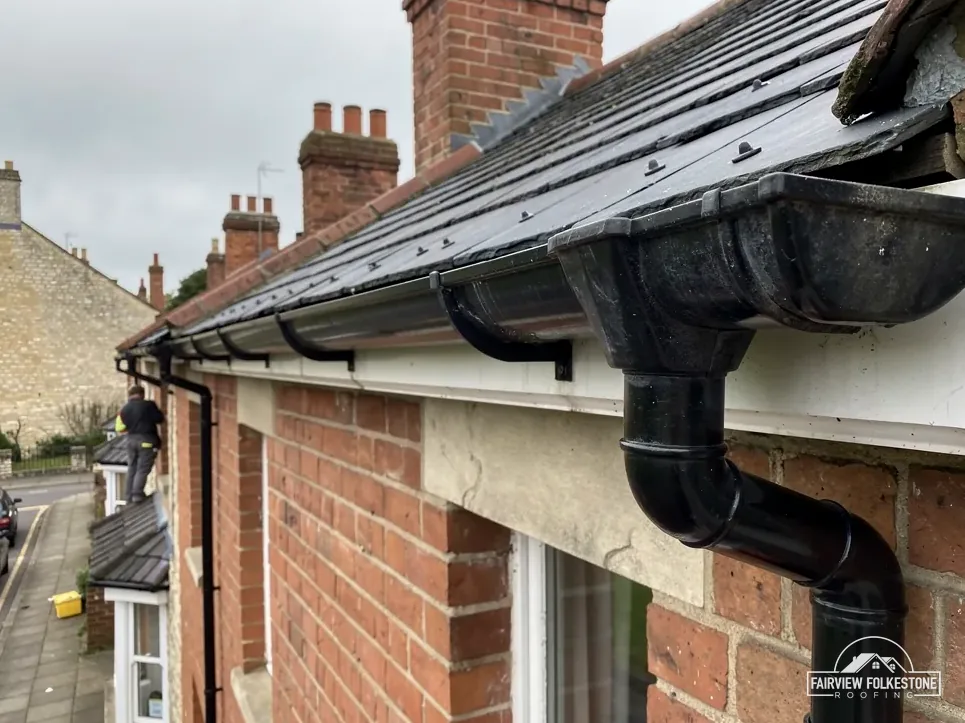
Each kind of gutter fault sends the water to a different place, which is why the marks on the house tell you so much. Reading them from the ground is the first step.
| Fault | Where the rain goes | What you see |
|---|---|---|
| Blocked outlet | Over the front lip of the channel | A curtain of water, stained wall below |
| Leaking joint | Down the wall at that point | A vertical green or dark streak |
| Sagging run | Over the lip along the low section | A wet band on the brick or render |
| Cracked downpipe | Out of the pipe onto the wall | Wet patches and stains at one height |
| Missing shoe or gully | Onto the ground beside the wall | Splashed brickwork and a muddy patch |
A tidy system leaves the wall dry in all but the heaviest rain. A system that fails sends the rain to the same few spots every time, so the staining repeats in the same places, getting darker as the seasons pass.
It also helps to watch the house in heavy rain, from a doorway or a window. From that spot, watch the roof edge and note where the water leaves the system. A stream pouring off the front of the gutter above a window tells you more than any inspection from a distance.
For the way the system works when it is in good order, our post on how gutters and downpipes protect a house sets out the parts and the fall. Everything that follows assumes the system is not doing its job.
02Rooflines
Damp walls, stains and rot at the roofline
Brick and render are made to shed rain that falls on them, but they are not meant to carry a steady flow down one strip. A joint that leaks over the same spot for a whole season leaves that spot wetter than the rest of the wall for longer than the surrounding masonry ever sees.
The signs show up in a few steps, and each one is worth acting on.
Gutter damage questions
Can a leaking gutter cause damp inside the house?
It can be one cause. A joint that sends water down the same stretch of wall keeps the masonry wet, and the damp can show on the inside face. Condensation or a roof fault can leave similar marks, so a hose test with someone watching the patch helps to tell which it is.
- A green or black streak below a joint or an outlet is algae or mould growing where the wall stays damp.
- Paint blistering or flaking on a fascia board or on render near the gutter means moisture is sitting behind it.
- A soft or dark fascia, felt with a screwdriver tip, is wood taking in water from the overflow.
- A damp patch or a brown stain on the inside face of an outer wall, level with a failing joint outside, links the two.
Be careful about blaming the gutter for every damp patch indoors. Condensation, a leaking pipe or a fault in the roof covering can leave the same kind of mark, and a patch directly below a gutter leak does not prove the gutter is the cause. A hose test, with a helper inside watching the patch, separates the cases: run water into the gutter alone and see whether the patch changes.
Rot at the roofline matters for another reason. The fascia carries the gutter, and a board that has gone soft stops holding the brackets, so the run sags and the problem feeds itself. Replacing the gutter on a rotten board only repeats the fault, which is why we check the board when we price the run.
Cleaning the staining off the wall is a cosmetic fix; the cause has to be put right first, or the mark returns.
03Key points
Splash-back and the foot of the wall
The place where a downpipe meets the ground deserves as much attention as the roof edge. It is where all the water the system has gathered finally leaves, and a poor finish there puts it exactly where it does the most harm.
A good finish has the water leave the shoe and run into a gully or a pipe to a drain. A poor one leaves it falling on to a path or into soil that slopes towards the wall.
- Check that every downpipe ends in a shoe, a gully or a pipe connection, and not in thin air.
- Look for the ground beside the wall: it should not slope towards the brickwork, nor sit higher than the damp-proof course, the layer of waterproof material set into the wall just above ground.
- Notice whether paths and patios fall away from the house, not towards it.
- Check that gullies are clear, since a blocked gully sends the water back up the pipe or across the ground.
Splash-back is the rain bouncing off hard ground onto the lower wall. It leaves a band of grime and, over time, damp in the bottom courses of the brickwork. Rain from the roof has already travelled a long way, and when it falls from a broken pipe or a shoe that ends too high, it hits the ground with force and throws mud and water up the wall.
A blocked downpipe can start the whole chain, because the water backs up the pipe and overflows at the top, wetting the wall the whole way down. Our answer on a blocked downpipe covers clearing one and the signs to look for.
Soil that stays wet beside a wall also stays cold and damp against it, so the problem does not end at the surface.
04In brief
Foundations: what to watch and who to ask
People worry most about foundations, so it is worth being plain about what a roofer can and cannot say. Water running down a wall and soaking the ground beside the footings is not something to ignore. Beyond that, how a given foundation responds depends on the ground, on the depth and design of the footings and on the age of the building, and none of that can be judged from the roofline.
We are not structural engineers, and we do not diagnose subsidence or movement. What we can do is deal with the water, which is the part a roofer controls.
- Fix the faults that send roof water to the base of the wall: joints, outlets, sagging runs and broken pipes.
- Make sure each downpipe discharges into a drain or gully rather than onto the ground beside the house.
- Report what we see at ground level, such as wet soil, standing water or a gully that does not drain, so you can pass it on.
If you can see cracks in the walls, doors or windows that suddenly stick, floors that have started to slope or gaps opening at a corner, do not wait on a gutter repair. Have a building surveyor or a structural engineer look at the house. A gutter fix is cheap compared with the cost of misreading movement.
When a roof drains into ground that needs managing, the drainage work itself belongs to a drainage contractor. Changing where a downpipe discharges can affect the drains, the neighbours and the Building Regulations, so ask your council's building control team before you reroute anything.
Do the sensible things first: clear what is blocked, repair what leaks and send the rain into the drain. Those steps address the roof's part in the problem and leave the specialist question to the specialist.
Do blocked gutters damage foundations?
Water that soaks the ground beside the footings is not something to leave, but how a foundation responds depends on the ground and the building, which a roofer cannot judge. We fix the faults that send roof water there. If you see cracks or sticking doors, ask a surveyor or structural engineer.
05The short list
Gardens, paths and soakaways
Water from a failed gutter does not stop at the wall. It lands in beds, on lawns and on paths, and the effects are easy to see once you look for them.
- A flower bed below a leaking joint turns to mud and washes soil onto the path.
- A lawn at the foot of a broken pipe stays boggy while the rest of the garden dries out.
- Paving beside the wall grows green slime where the splashing never stops, which makes it a slip risk.
- A shed or garage with an overflowing gutter of its own can leave the ground around it soaked as well.
A soakaway is a pit filled with rubble or a crate system that lets rainwater drain away into the ground. Where a house has one, the downpipe feeds it, and it only works if the pipe and the pit are clear. A downpipe that ends in a soakaway that has silted up behaves just like one with no drain at all, and the water backs up to the roof edge.
If you suspect a soakaway has failed, do not dig it up alone. The pit may be some distance from the house, and its position and condition are a matter for a drainage firm. Before changing the arrangement, ask the council's building control team what the rules are for your property.
Water butts are a simple way to take some of the load. A diverter fitted to a downpipe fills a butt and sends the overflow on down the pipe, which keeps water out of the border and gives you something for the garden. It does not replace a working drain, and the overflow must still reach one.
Where the garden is the place that suffers, fix the pipe or the joint above it. Re-turfing a bed that keeps getting soaked is a waste of money until the water has been stopped at the source.
06Repairs
Repair, replace or clear: what we look at first
With damp walls and a soaked garden, the sensible first step is a look at the gutters, because the cause can be a cheap one to remove. Our survey follows a fixed order.
That order matters because it puts the smallest fixes first. A blocked outlet needs clearing and nothing more. A single leaking joint needs a new seal. A whole run that has split or dropped is a replacement, and the survey names which case you have before a price is written.
- Check that the outlets and downpipes are clear, since an obstruction explains many overflows.
- Run water through the system to find leaking joints and sagging sections.
- Probe the fascia behind the run, because a soft board means the brackets have nothing to hold.
- Look at how each downpipe ends, and where the water goes from there.
Costs come from third-party guides, since we do not publish prices. MyJobQuote gives around £1,000 to £1,600 as the average cost of replacing gutters in the UK, with no VAT basis stated. Which? Trusted Traders list clearing out every gutter, front and back, at £75 to £350 excluding VAT in November 2025, a range it warns is likely to run higher in London and the South East.
What you receive from us is a single written total, issued after the survey. When the roof edge is too high to work from a ladder, scaffold goes on the pavement or the drive, and we arrange the licence with our scaffolder; and in any comparison, look for the line saying whether scaffold and VAT are covered.
For the signs that a run is overflowing, our short answer on why gutters overflow is the place to start, and our gutters, soffits and fascias page covers the whole job from the roof edge down.
Where should a downpipe empty to?
It should end in a drain, a gully or a pipe leading to one, not onto the ground beside the wall. Before you change where one discharges, ask your council's building control team, since the drains, the neighbours and the Building Regulations can all be affected by a new route.


Tell us what's wrong with the roof.
You'll get one written total price.