Shops · offices · flats · units
Commercial roofing in Folkestone
Commercial roofers for shops, offices, blocks of flats and industrial units across Folkestone and Kent. Flat or pitched, sheet or membrane, repaired wherever a repair is sound.
10-year workmanship guarantee, in writing
Guides for building owners
All guides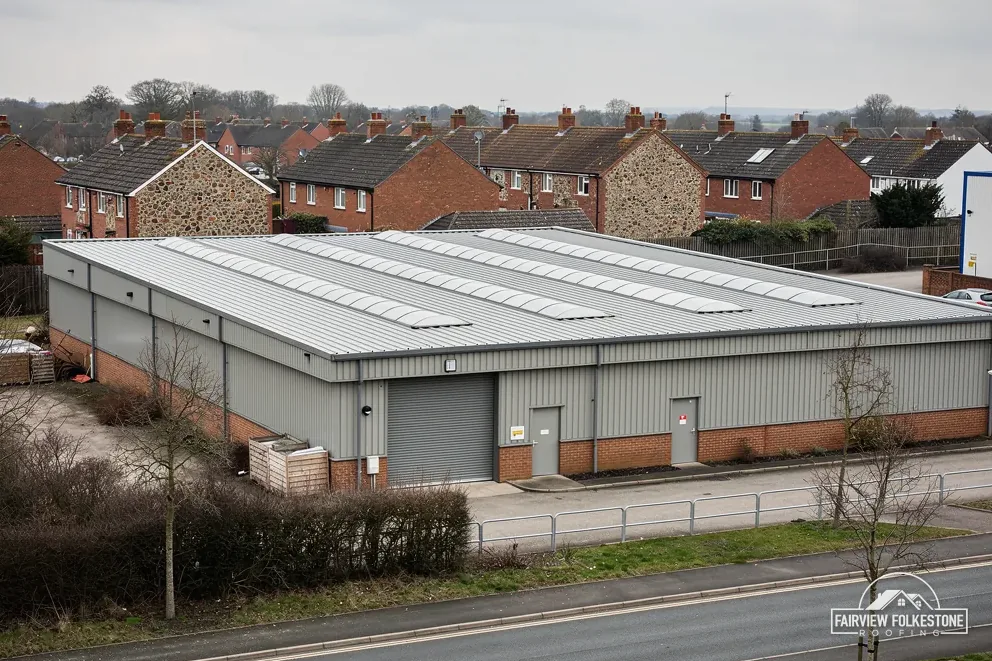 GuideCut edge corrosion on metal roof sheets: causes and repair9 min read
 GuideFragile roofs and CDM: what building owners must do before roof work9 min read
 GuideSection 20 consultation for roof works: a guide for freeholders and leaseholders9 min read
 AnswerHow much does a commercial roof replacement cost?4 min read
The fair ledger
Six commercial roof faults, and the verdict each one gets
From membrane seams to cement sheets, each entry shows what we check on a shop, office, flat block or unit roof, the verdict we reach, and the reasons behind it.
Entry 01Membrane
Single-ply, felt, EPDM or GRP: patch the membrane or renew it?
A flat commercial roof can be single-ply, built-up felt, EPDM rubber or GRP. Each one fails in its own way, so the fix depends on which layer has gone, and how far.
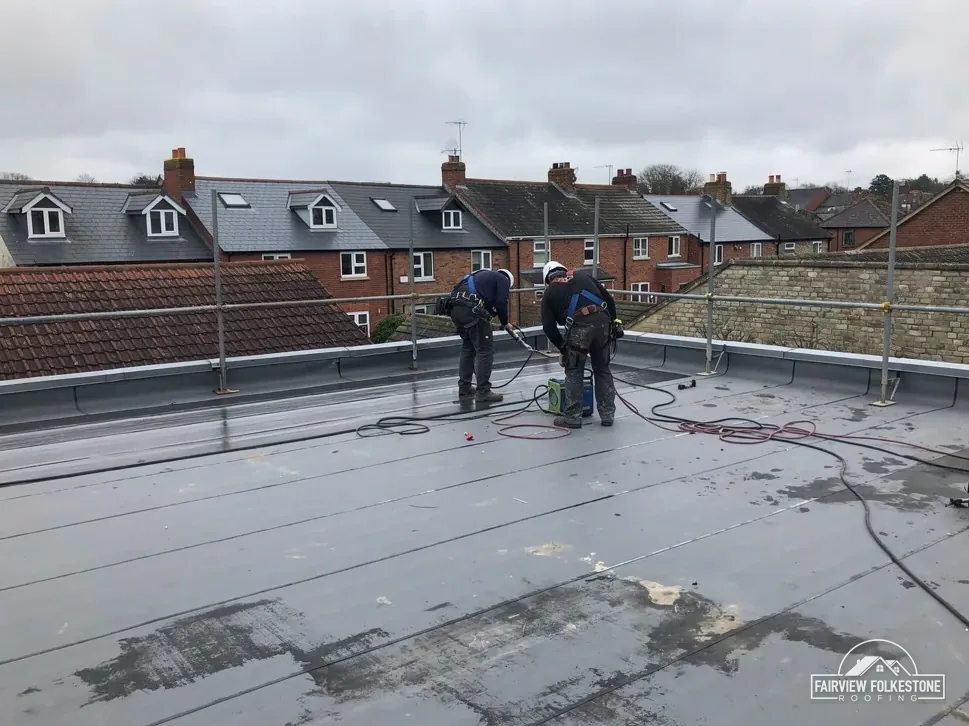
What we check when a membrane roof leaks
Single-ply means one layer of synthetic sheet, PVC, TPO or EPDM rubber, laid in wide rolls with welded or taped seams and held down by mechanical fixings, adhesive or ballast. Built-up felt is two or three layers of bitumen felt, torched or bonded on. GRP is fibreglass matting set in resin over a timber deck. Under any of them, on a shop, office or industrial unit, the deck may be timber, metal or concrete, with insulation between.
On the survey we walk the roof where it is safe to, and find the part that is letting the building down: a split seam, a lifted lap, a blister in the felt, a cracked upstand where the membrane turns up a wall, or a loose drip trim at the edge. We press for soft or wet insulation, look inside for ceiling stains, and trace each leak back to its source, because a drip indoors can land several metres from the hole above it. We also note what stands on the roof: plant, air-conditioning units and walkways add weight and foot traffic, and the membrane round their supports gets a close look. Our answer on single-ply membrane roofing explains the systems in more depth.
- Deck under the build-up
- Single-ply or felt membrane
- Upstand where it meets a wall
- Drip trim at the roof edge
Edges, seams and upstands are where our check of a flat roof begins.
Myth: Water standing on a flat roof after rain is normal.
Fact: BS 6229:2025 asks for a finished fall of at least 1:80, so ponding tells us the falls need checking.
1:40
the design fall the code of practice sets to finish at 1:80, as IKO reports
Membrane roofs under BS 6229:2025
What sets the price
- How much of the deck is wet
- Patch, overlay or strip to the deck
- Upstands, outlets and edge trims
- Access and working hours on site
One written total price
Patch, overlay or strip to the deck
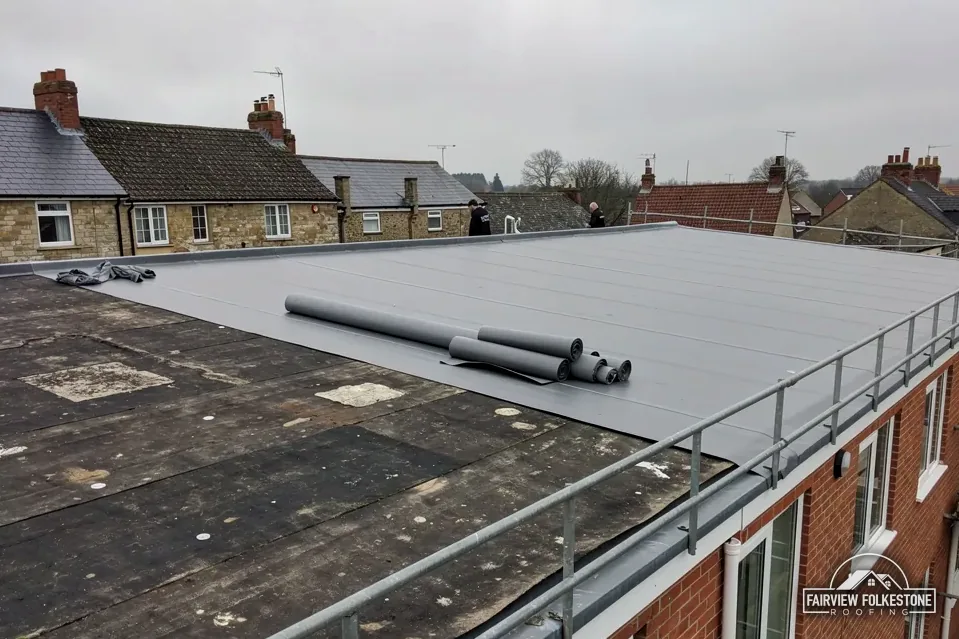
One split seam on a sound roof is a repair: clean it, prime it, and weld or tape a new strip over it. Where seams are lifting all over, or the insulation below is wet, patching just chases the next leak. Then the choice is an overlay, a new membrane laid over the old one where the deck and insulation are dry, or a strip back to the deck. If the deck itself has gone soft, an overlay is off the table and the roof comes up. We tell you which, why, and show you the wet areas we found.
On a commercial building the falls matter as much as the membrane. Standing water after rain points to falls that were never right, or a deck that has sagged, and any new membrane put down over those same falls will hold puddles exactly where the old one did. A strip-off is the chance to correct them with tapered insulation or firrings. Flat roofs on homes, over extensions and dormers, sit on our flat roofing page.
- Bracket or gutter support
- A joint that has dropped
- Outlet into the downpipe
Entry 02Gutters
Box gutters and outlets, where a big roof's rain ends up
A commercial roof sheds a lot of rain into a few gutters. When one outlet blocks, the gutter fills and spills over into the building.
How often should commercial gutters be cleared?
That depends on the trees nearby and the shape of the roof. After the first clean we set a clearing visit into a planned maintenance schedule, timed for when the leaves have come down, and adjust it once we see what collects.
Outlet blocked, lining sound
Clear and test
Lead lining split along a joint
Reline the gutter
Long run sagging at one bracket
Refix and reset the fall
Commercial sized guttering, cleared and tested
Large roofs drain into box gutters, set between two slopes or behind a parapet wall, or into wide eaves gutters running the length of a unit. A box gutter is a lined channel, in lead, a membrane or coated steel, that carries water to an outlet and a downpipe. Leaves, silt, moss and the odd lost ball gather at the outlet, the gutter backs up, and the water rises over the edge of the lining and runs inside. Behind a parapet there is nowhere for that overflow to go but inward, into the roof space or the room below. Some box gutters have an overflow pipe through the parapet as a warning; where yours has none, we tell you whether one would help.
So the first visit is a clean and a test. We clear the gutters and outlets, run water through them, and look at the joints, the lining and the seal around each outlet. Royston Lead lists Codes 5 to 8 for parapet, box and tapered valley gutters, and Code 4 is not on its list for them, so a box gutter lined in lighter sheet is outside the maker's list, and the survey says so.
Send us a photo of the gutter or outlet
Ask for a verdictFalls, joints and overflows
Eaves gutters on a unit need a steady fall to the outlet. Brett Martin, a manufacturer, advises 1 mm for every 600 mm towards the outlet, and a long run that has dropped at a bracket holds water in the dip and sags further. Wide gutters are joined in sections, and each joint carries a seal or gasket that hardens with age. An open joint lets water down the cladding or the wall below, where it shows as staining outside or a damp patch inside.
Downpipes that run inside a building, through offices or between flats, block as well, and the first sign can be a wet wall far from the roof. Running water through each outlet in turn shows us which pipe is holding it back.
A sound gutter with a blocked outlet needs clearing and a planned clean, not a new gutter. A lining that has split, or steel that has rusted through, is a relining job, and we price that once the gutter is clean and we can see all of it.
A box gutter cleared back to its lining
Entry 03Metal sheets
Profiled metal sheets: cut-edge corrosion, fixings and rooflights
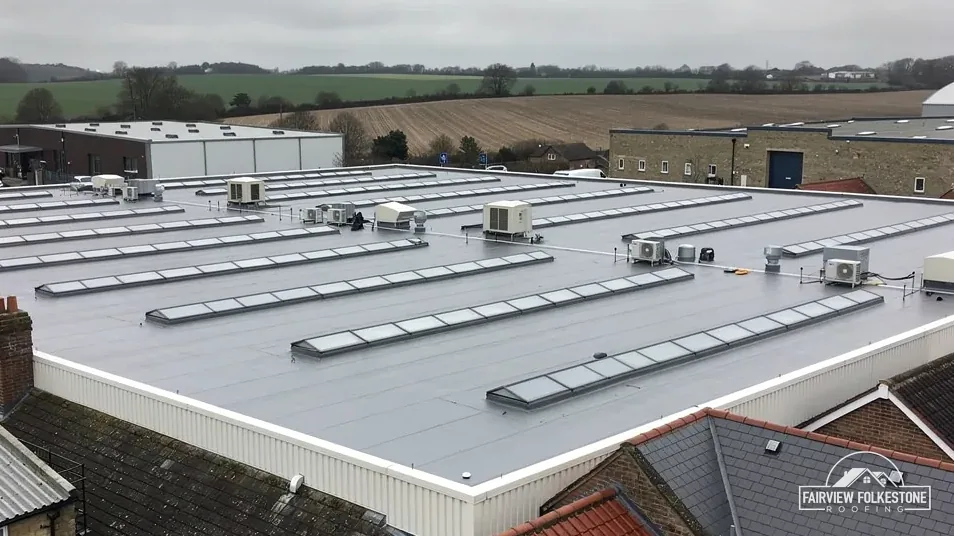
On industrial units and warehouses, profiled steel sheet covers the roof and sometimes the walls. Its weak points are the cut edges, the fixings and the laps.
What cut-edge corrosion looks like
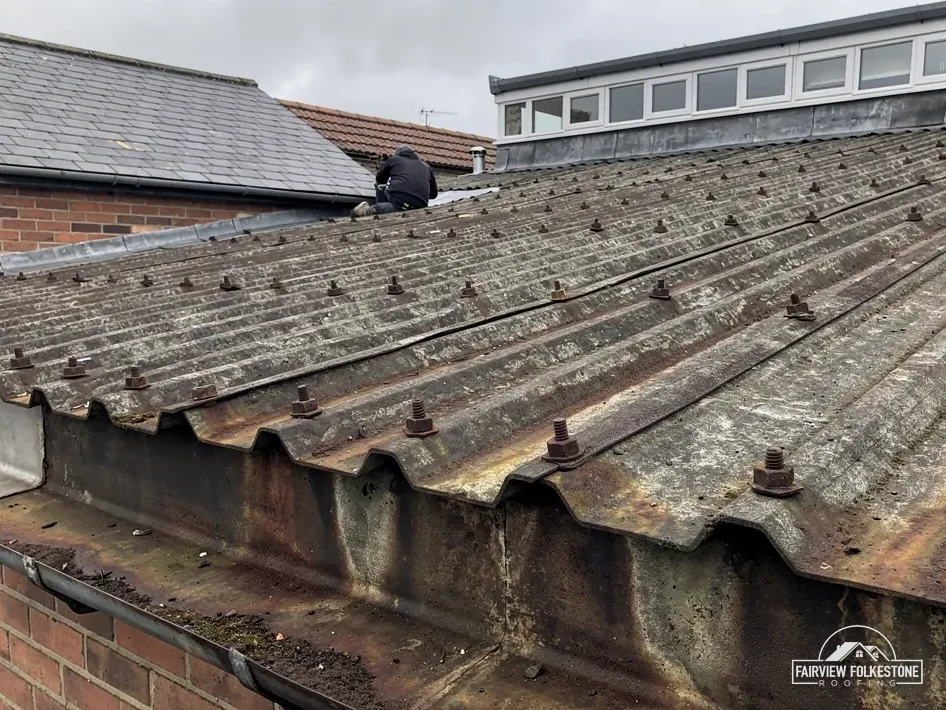
Profiled sheets are coated steel, cut to length before they reach site. The cut end has no factory coating over the steel, and cut-edge corrosion is the rust that starts at that edge and creeps back under the coating, lifting it as it goes. You see it as a brown line along the sheet ends at the eaves and at the end laps, where one sheet overlaps the next down the slope. Wall cladding in the same sheet can show the line at its bottom ends, so roofing and cladding are checked together.
Caught while the rust is still on the surface, the edge can be cleaned back to sound metal, primed and sealed with a cut-edge treatment, and the sheet stays in place. Where the steel has rusted through, or the coating has peeled well back from the edge, that run of sheets needs replacing. We tell you which you have, mark where it is on a roof plan, and photograph each area so you can see what we saw. Our guide to cut-edge corrosion on metal roof sheets covers the treatment step by step.
Myth: Rust along the sheet ends means the unit needs a new roof.
Fact: Surface rust at a cut edge can be cleaned, primed and sealed, and the sheet kept in service.
Can the unit stay open while the sheets are treated?
Yes, where the work is planned around you. Cut-edge treatment and new fixings are done from outside, and before we start we agree working areas, access routes and any days when the floor below a rooflight has to be kept clear.
Surface rust on the sheet ends
Clean, prime and seal
Steel rusted through at the laps
Replace that run of sheets
Rooflight brittle and discoloured
New rooflight, fitted safely
Fixings, laps and rooflights
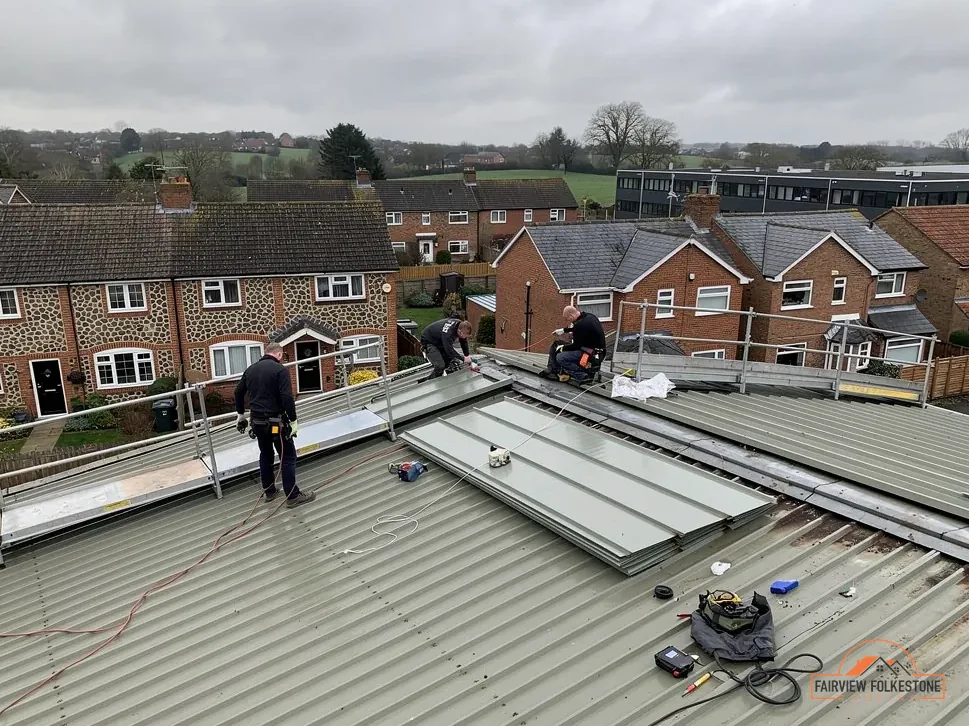
Sheets are held by screw fixings through the profile, each with a washer that seals the hole. Washers perish, screws work loose as the sheets move with heat and cold, and the leak follows the fixing. Laps between sheets carry sealant strips that dry out and shrink. Both are repairs: new fixings, new seals, and a hand check of the fixings around them. The fillers at the ridge and eaves, foam or plastic profiles that close the gaps under the sheets, crumble too and let in driven rain and birds, so we renew them on the same visit.
Standing seam metal roofs are built differently. The sheets lock together along raised seams over hidden clips, so there are no through-fixings to fail; on those we look at the seams, the ridge and the closures at the eaves.
Rooflights set into a metal roof are a different matter. We treat every rooflight as fragile until it has been checked, and we work beside one on boards or from a platform. Where a rooflight has gone brittle or discoloured, we replace it rather than patch it, with fall protection set up first.
What changes the price
- What the asbestos survey finds
- Repair, over-clad or full removal
- Staging and fall protection needed
- Waste handling and the skip
One written total price
Entry 04Cement sheets
Corrugated cement sheet roofs: survey first, then decide
Older corrugated cement sheets on units, workshops and farm buildings can contain asbestos. That changes how the roof is handled, not whether it can be put right.
Asbestos cement, handled the right way
HSE advises treating any building built or refurbished before 2000 as one that contains asbestos. For a corrugated cement sheet roof, that means an asbestos survey before work starts, carried out by an asbestos surveyor, so everyone on the job knows what the sheets contain. Not every corrugated sheet has asbestos in it, and the survey report settles which kind you have before anyone prices removal. HSE classes careful removal of asbestos cement sheeting, without breaking it up, as non-licensed work, and that includes sheets that are weathered but not otherwise substantially damaged. Sheets that are substantially damaged or broken up, after a fire for example, move the job into notifiable non-licensed work (NNLW), which HSE treats separately.
The sheets come down whole and go into a lockable skip, because HSE's guidance says it is not good enough to throw sheeting over a standard skip. The waste then leaves site with a registered waste carrier on a consignment note. Garage roofs in cement sheet have their own page: garage and asbestos roofs.
One cracked sheet, the rest sound
Replace that sheet safely
Sheets cracking across the roof
Remove and re-roof
No asbestos survey on record
Survey before any work
Myth: Old cement sheets can be broken up to get them off faster.
Fact: Breaking the sheets up turns non-licensed work into NNLW under HSE's rules, so they come off whole.
Fragile from the first step
HSE's guidance puts it plainly: AC roofs are always fragile. Nobody walks on the sheets, whatever their age or condition. Repairs and removal are planned from staging, crawling boards or a platform, with edge protection, and netting or other fall protection below where the roof needs it. Clear profiled rooflights set among the cement sheets get the same treatment: fragile until checked, and worked around from boards. If a storm has broken sheets, keep people away from the pieces and send us photos: broken sheets fall under NNLW, so they are cleared and bagged under that work's rules.
Then comes the decision. A cement sheet roof that is sound and dry can be repaired where one sheet has cracked, or over-clad with a new metal roof fixed through to the frame where the structure allows it. Where sheets are breaking, leaking at the laps or failing across the roof, they come off and a new roof goes on, in profiled metal or insulated panels chosen for the use of the building. Our answer on an asbestos cement roof on a commercial building sets out each route.
Entry 05Flat blocks
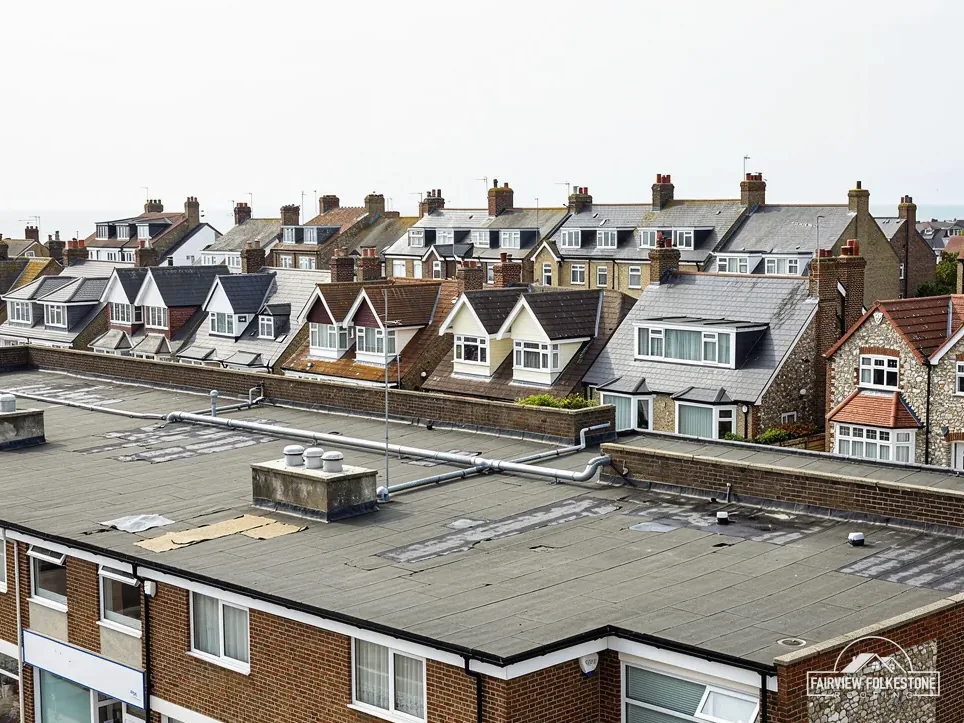
Blocks of flats and shops with flats above: access comes first
On a block of flats or a parade of shops, the roof is shared and the street below is busy. The plan for access matters as much as the roof work.
Do residents have to move out while the roof is done?
No. Roof work is done from outside, with the scaffold kept clear of entrances wherever the building allows. Residents may hear noise overhead during working hours, and we agree the working days and any quiet times with the managing agent first.
Scaffold, the pavement and the licence
Roof work on a block or a high street parade needs a safe way up, and in a town centre the scaffold stands on the pavement. Scaffolding on the highway needs a licence under section 169 of the Highways Act 1980. For every Kent address, Kent County Council issues that licence and its page says the scaffolding company should submit the application for you, and we arrange the licence with our scaffolder. For a walk-around scaffold, Kent County Council asks for a minimum distance of 1.2 metre between the scaffold and carriageway for pedestrian access. For Rye and Camber addresses East Sussex Highways issues the licence, and its terms ask for a clear pedestrian passage of at least 1.5 m and at least 450 mm between the scaffold and the carriageway edge.
Residents and shop tenants need notice of when the scaffold goes up, which entrances stay open, and when there will be noise overhead. Where the scaffold crosses a shop door, a covered walkway keeps customers coming in, and debris netting keeps tools and offcuts off the pavement. We agree that plan with the landlord or managing agent before the start date. For leasehold blocks, our guide to section 20 consultation for roof works covers the freeholder's side.
Section 169
of the Highways Act 1980: the licence any scaffold on the highway needs
Issued by the county highway authority
Leak into a top-floor flat
Trace it from the roof
Signs of bats in the roof void
Stop and survey first
Flashing lifted at a parapet
Redress or renew the lead
Planning, birds and bats on a shared roof
A building containing flats is not a dwellinghouse under the permitted development order, so the house rights for roof alterations do not apply to it. Canterbury City Council says, for its own district, that flats and maisonettes have no permitted development rights, so changing the outside appearance needs planning permission. Anywhere in the radius, a change to how the roof looks is a question for the council's planning team before we price it. Where works would affect a listed building's character as a building of special architectural or historic interest, listed building consent is required as well.
Roof voids and the gaps under ridges and verges can hold nesting birds and roosting bats. Under the Wildlife and Countryside Act 1981, taking, damaging or destroying a wild bird's nest is an offence where it is done intentionally and the nest is in use or being built; harming a bat roost is an offence even without intent. GOV.UK lists repairing or replacing a roof among the activities that can affect bats, so where there are signs, the work stops and a survey comes first.
What a planned maintenance visit covers
On a planned maintenance visit we clear gutters and outlets, check seams, laps, fixings and flashings, look at rooflights and upstands, and note anything that has moved since the last visit. You get a short written condition report with photos: the faults we found, which need doing now, and which can wait. For a site with several buildings, a condition survey sets a baseline for every roof on it. Our answer on what a commercial roof condition survey covers sets out the full list.
Visits are booked for the same months each year, with the gutters cleared after the leaves come down and an extra look after a spell of high winds. On a site with tenants, the report can go straight to the managing agent. Planned visits suit landlords with several units, and schools and offices where one leak can shut a room. Small repairs made on those visits stop a leak before it reaches stock, fittings and ceilings below, and they give you a record of the roof's condition year on year, which helps when you plan the budget for a new roof.
Entry 06Re-roof
Planned maintenance or a new commercial roof: how we decide
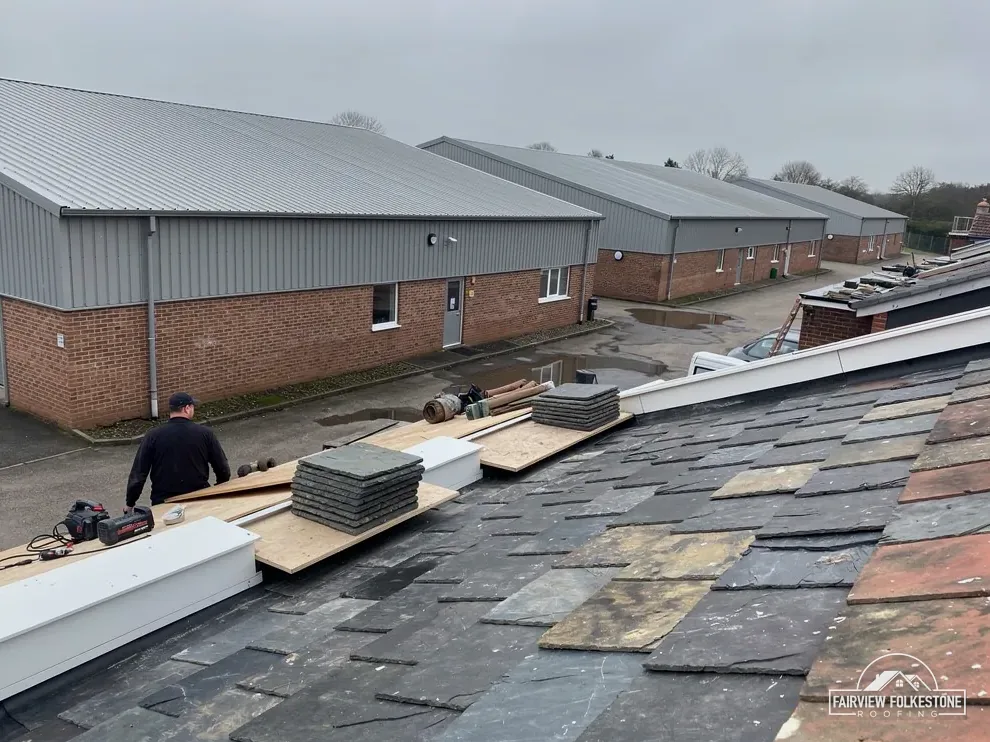
A planned maintenance visit keeps small faults small. When the faults run across the whole roof, a new roof is the sound answer, and we show you why.
One failed seam on a sound roof
Weld a patch over it
Wet insulation across the deck
Strip and re-roof
Sheets rusted through lap after lap
New roof sheets
What drives a re-roof price
- Roof area and the build-up chosen
- Strip, overlay or over-clad
- Access, scaffold and site hours
- Insulation, outlets and rooflights
One written total price
When replacement is the right call
We recommend a new roof when the faults are spread across it: seams failing everywhere, insulation wet across the deck, sheets rusted through at lap after lap, or cement sheets cracking from end to end. At that stage a repair is money spent on the next leak. A new roof is also the time to correct the falls, add insulation and improve the outlets.
Where the old covering stays under an overlay or an over-clad roof, the structure carries both, so we check the frame and deck before we suggest it. Approved Document A treats a roof load increased by more than 15% as a significant change, so a covering that much heavier needs Building Regulations approval and a structural check.
Under CDM 2015, extra duties start when there is more than one contractor on a job, and every project has a construction phase plan, drawn up by the contractor or, on a larger job, the principal contractor. Our guide to fragile roofs and CDM duties sets out what falls to the building owner.
When the faults cover the whole roof, you hear it from us, with the evidence.
Not sure which entry matches your building's roof? Ask us.
Send photos or book a survey. You get a verdict on every roof on the building, the reasons behind each, and one written total price.
Commercial roofing questions answered
Straight answers for owners, landlords and managing agents of commercial buildings in Kent.
Which towns do your commercial roofers cover from Folkestone?
We work across Folkestone, Hythe, Sandgate, Cheriton and Hawkinge, out along the coast to New Romney, Dymchurch and Romney Marsh, and inland to Ashford and Canterbury, up to 30 road miles from Folkestone. Dover and Deal sit inside that reach, and so do Rye and Camber over the border in East Sussex. Commercial roofing in Folkestone and across Kent follows the same survey and the same written quote; only the council, the highway authority and the scaffold licence change from one place to the next, and we deal with each.
Can you work on both flat and pitched commercial roofs?
Yes. Commercial buildings mix them: a flat membrane roof over a shop with a pitched slate or tile roof on the flats above, or a pitched metal roof on a unit with a flat roof over its office. We survey every roof on the building, flat and pitched, and the quote covers all of them, so you deal with one firm for the whole building. Pitched slate and tile roofs follow BS 5534, which covers slating and tiling, and membrane flat roofs follow BS 6229:2025.
How can I tell if a commercial roof needs repair or replacement?
Look at where the faults are. A single leak, split seam or cracked sheet on a roof that is otherwise sound counts as a roof repair. Faults spread across the whole roof, wet insulation over large areas, or sheets rusted through at lap after lap point to roof replacement. Signs worth reporting early include stained ceiling tiles, water dripping from light fittings, ponding after rain and rust lines along sheet ends. We walk the roof, give you the verdict, and show you the photos and readings behind it.
What should I do if storm damage opens up the roof?
Keep people away from the area below, move stock and equipment out of the wet, and photograph the damage before anything is moved. Then call us on 01303 476263 or send photos on WhatsApp. For an emergency leak we make the roof safe with a temporary repair first, then survey the damage once the weather allows, so the permanent repair or replacement is priced on what we actually found. Tell your insurer early, keep every photo and receipt, and write down the date and time you first saw the damage.
How long does a commercial flat roof last?
Sources disagree, so we name both. HomeBuilding gives 25 to 30 years for EPDM and for GRP, and 10 to 15 years for torch-on felt. Less says EPDM rubber typically lasts 30 to 50 years, GRP fibreglass 25 to 40 years with minimal maintenance, and torch-on felt 10 to 20 years depending on quality and installation. Both are typical ranges, never promises. On the survey we tell you what we can see of your roof's build-up, how it has been looked after, and how much life we think it has left.
How is a commercial roofing quote priced?
Commercial roofing is priced after a survey, because no two buildings share the same roof area, build-up, access or working hours. Once we have walked the roof and checked what lies underneath, you get one written total price for the work, with the scope set out in plain words. When you compare quotes, check that each one states if VAT and scaffold are in the total, and that each covers the same work: patching a membrane and replacing it are very different jobs, and the quotes should make clear which is being offered.
Do you repair chimney stacks and parapets on flat blocks and shops?
Yes. Chimney stacks, parapet walls and the lead where they meet the roof are part of the job on a block of flats or a shop with rooms above. We check the flashings, the pointing that holds them, and the flaunching, the mortar collar around the pots. A cracked parapet coping gets checked too. Correctly installed lead flashing can last for over 80 years, according to MyJobQuote. A stack in poor shape needs scaffold: on Kent roads, Kent County Council licenses it at £52 per week for 2026 to 2027.
Does re-roofing a business building need building regulations approval?
It can. Folkestone & Hythe District Council lists replacing roof coverings among the alterations that may need approval. For Dover district addresses, Dover District Council includes "replacement of roof coverings on pitched and flat roofs even if this is just like for like" in its list of work needing approval. Building control is handled either by the council's building control team or by a registered building control approver. We confirm the route before work starts; in Folkestone and Hythe, the council's building control team is on 01303 853538.
Tell us what's wrong with the roof.
You'll get one written total price.