
Roof repairs · Folkestone
Emergency and general roof repairs in Folkestone
Storm make-safe, leaks traced back to where they start, slipped tiles, loose ridges and lifted flashings. General roof repairs across Folkestone, Sandgate, Cheriton and Hythe.
10-year workmanship guarantee, in writing
The repair ledger
Six faults we repair, and how we reach each verdict
From the first night of a storm to a ridge that has started to rock, each entry sets out what we examine up on the roof, what it needs, and the reasons behind the call.
Entry 01Make-safe
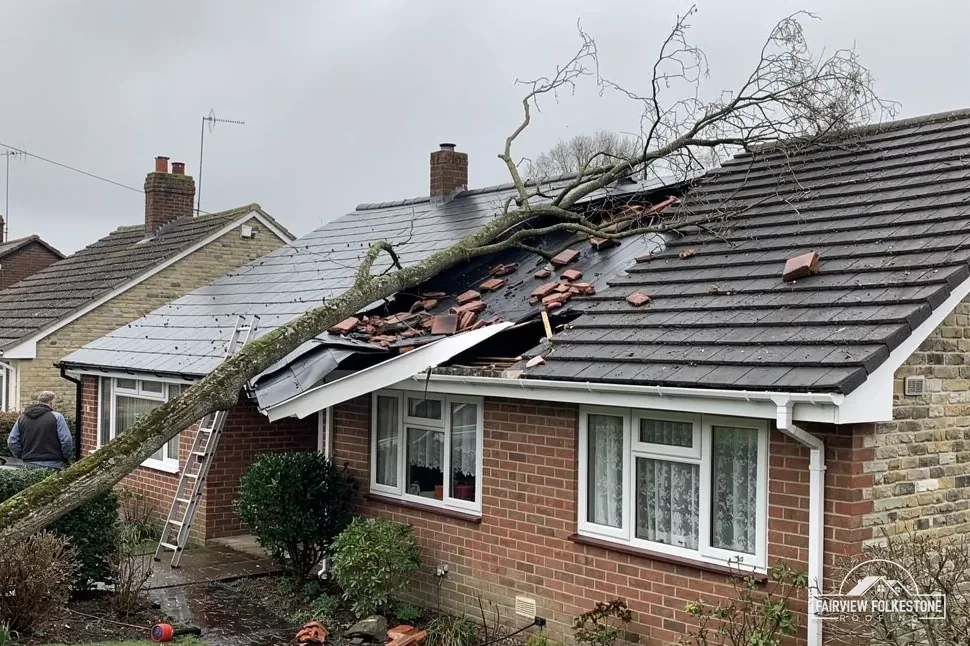
After the storm: making the roof safe before anything else
A roof opened up by wind needs covering first and diagnosing second. The make-safe buys time, and the real verdict comes once the damage can be seen in daylight.
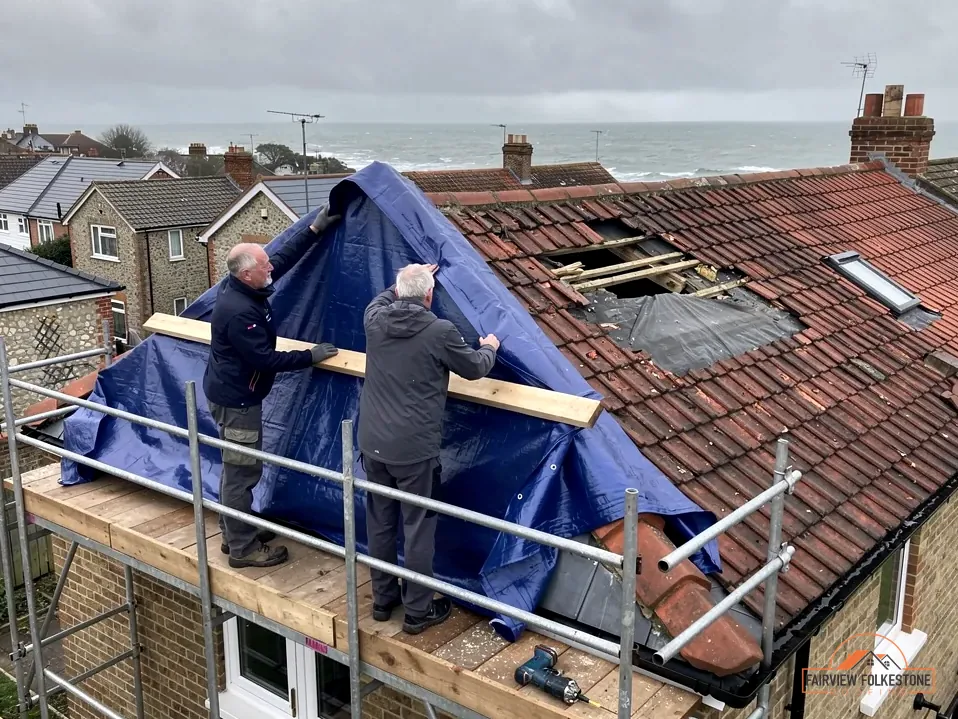
What an emergency roofer does first
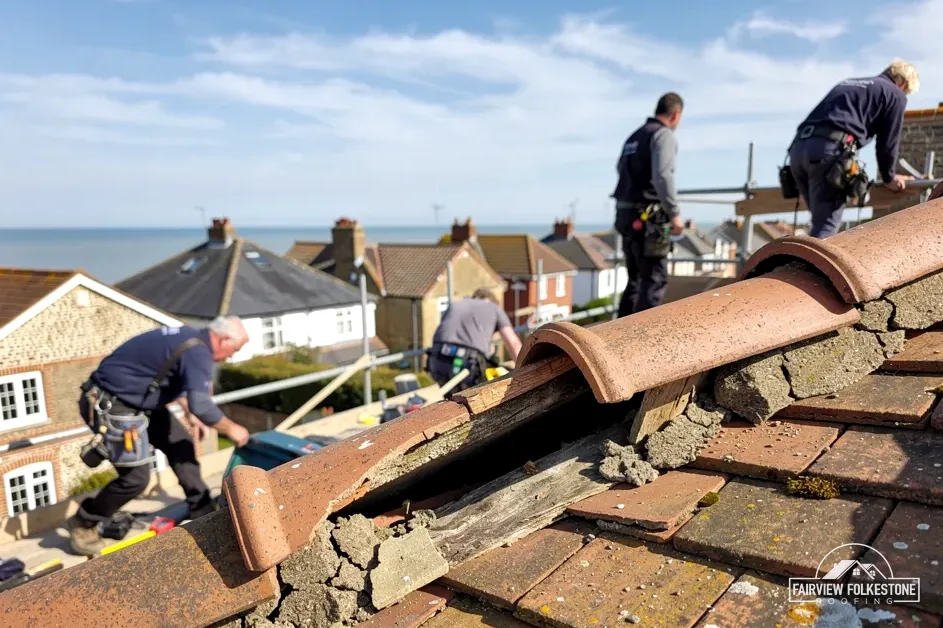
When tiles or slates have blown off, or a section of ridge has lifted, the first job is to stop more rain reaching the loft and the ceilings below. Depending on what has moved, that can mean refixing loose tiles that can be reached safely, slipping temporary slates into a gap, or sheeting the damaged area and battening the sheet down so the next gust cannot get underneath it.
We also look at what the storm has loosened but not yet moved: the tiles either side of a gap, the verge along the gable end, the flashings around the chimney and any lead that has been peeled back. A make-safe that ignores loose neighbours can mean a second visit after the next blow.
Before we leave, you get a plain account of what we covered, what we found under it and what the permanent repair will involve. If water is already through the ceiling, our page on water coming through the ceiling covers the first steps indoors while you wait.
Force 11
Winds the Met Office recorded in many of south-east England's coastal regions in 1987
The storm put a Channel ferry ashore near Folkestone
Myth: A tarpaulin over the hole means the roof is sorted.
Fact: A sheet keeps rain out until the next strong gust. The tiles, battens or ridge underneath still need a permanent repair.
Can I cancel an urgent repair visit I asked for?
No. Regulation 28(1)(e) of the Consumer Contracts Regulations 2013 removes the right to cancel where you specifically requested the visit to carry out urgent repairs. A larger job agreed at home after a survey is different, and that one carries 14 days to cancel.
What sets the price of a make-safe
- How much of the roof has opened up
- Whether it can be reached safely by ladder
- What has to be refixed before we leave
- The weather when we get there
One written total price
Storm damage and your home insurance
In the view of the Financial Ombudsman Service, a storm can be rain, hail or snowfall alone, so wind is not the only test. Whether a policy pays out is a matter between you and your insurer, so tell them about the damage before any permanent work starts and ask what they need from you.
Take photos of the roof and of any marks inside before anything is moved or cleared away, and keep the receipt for the make-safe. Expert reports and photos are what the Ombudsman will usually look at when a dispute reaches it, and an insurer will normally ask a surveyor to write a report. If a claim is turned down and you disagree, complain to the insurer first: for most complaints a business has up to 8 weeks to consider it, and you then have 6 months from its final response to go to the Financial Ombudsman Service on 0800 023 4567. Its guidance on storm damage complaints explains how it weighs them up.
- Cracked or slipped tile
- Batten it hangs from
- Underlay catching what gets past
- Rafter below the underlay
Rain past a cracked tile runs down the underlay, sometimes well below the fault.
Entry 02Leaks
A drip on the ceiling, and where it really starts
The stain on the ceiling shows where the water dropped, not always where it got in. So we follow it back up the roof before deciding anything.
How do I tell condensation from a roof leak?
Watch when it appears. Damp that follows rain and dries out in a dry spell points to the roof. Damp on cold, still mornings, with droplets forming under the felt and no rain at all, points to condensation in the loft.
Found, and what it needs
Stain under a cracked tile
Replace the tile
Damp only on frosty mornings
Look at loft ventilation
Water along a flat roof upstand
Reseal or renew the edge
Signs you may need roof repairs
Every roof leak repair in Folkestone starts the same way for us: working out where the water gets in. Some signs show up indoors and some from the garden, and each points to a different part of the roof:
- A damp patch on a bedroom ceiling after rain: a slipped or cracked tile above it, or water running down the underlay from higher up the slope.
- Damp on a chimney breast: the lead flashing where the stack meets the slope, or the pointing that holds it.
- Bits of tile or mortar on the path: a ridge or verge losing its bedding.
- Daylight in the loft: a gap in the tiles, or torn felt behind them.
- Water around a roof window: the flashing kit around the frame, which is why leaking skylights get the same check as any other junction.
- Sagging between the rafters, seen from the loft: battens or boards that have been wet for a long time, which need looking at before anyone walks on that slope.
- Gutters spilling over in rain: a blocked outlet, or a joint that has dropped and sends water down the wall.
None of these tells you the size of the job. They tell us where to look first.
Send a photo of the stain and the roof
Ask about a leakWhen the leak is a flat roof or a gutter
Not every leak is in the tiles. A flat roof over a kitchen, a bay or a dormer can let water in at a split in the felt, a lifted edge, or the point where the membrane is dressed up against a wall. Water can travel some distance across a flat deck before it shows on a ceiling, so we check the whole roof, the upstands and the drip edge rather than only the patch above the stain.
Gutters cause their own kind of damp. A blocked outlet or a sagging run can push water back under the bottom course of tiles or down the face of the wall, and from inside it looks just like a roof leak. Clearing and resetting a gutter is a smaller job than a roof repair, and we tell you when that is all it needs. If the damp only shows on cold mornings, read our page on condensation or a roof leak; to start the search yourself, our guide to finding where a roof is leaking walks through the checks from the loft.
Water staining on loft timbers below a cracked tile
Entry 03Ridge
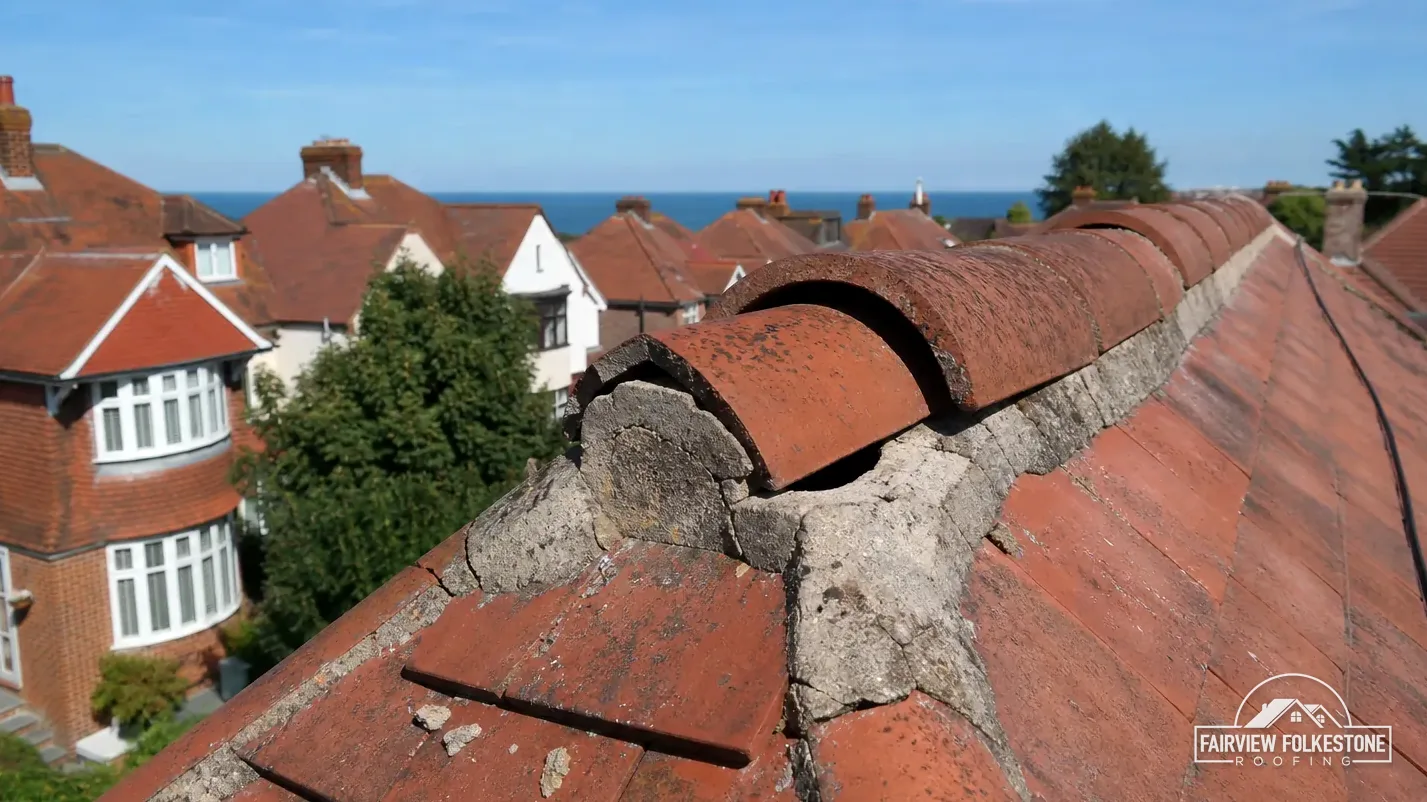
Ridge tile repairs: rebed in mortar, or fit a dry ridge
Ridge tiles run along the top of the roof, held down either by a bed of mortar or by a dry-fix system. Once the mortar cracks, the tiles start to rock.
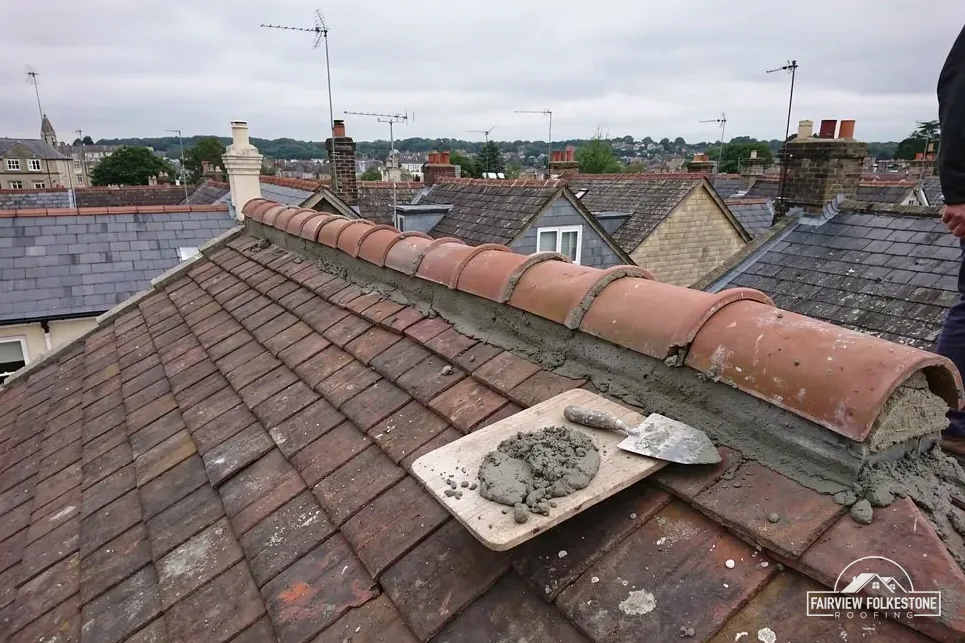
Rebedding and repointing in mortar
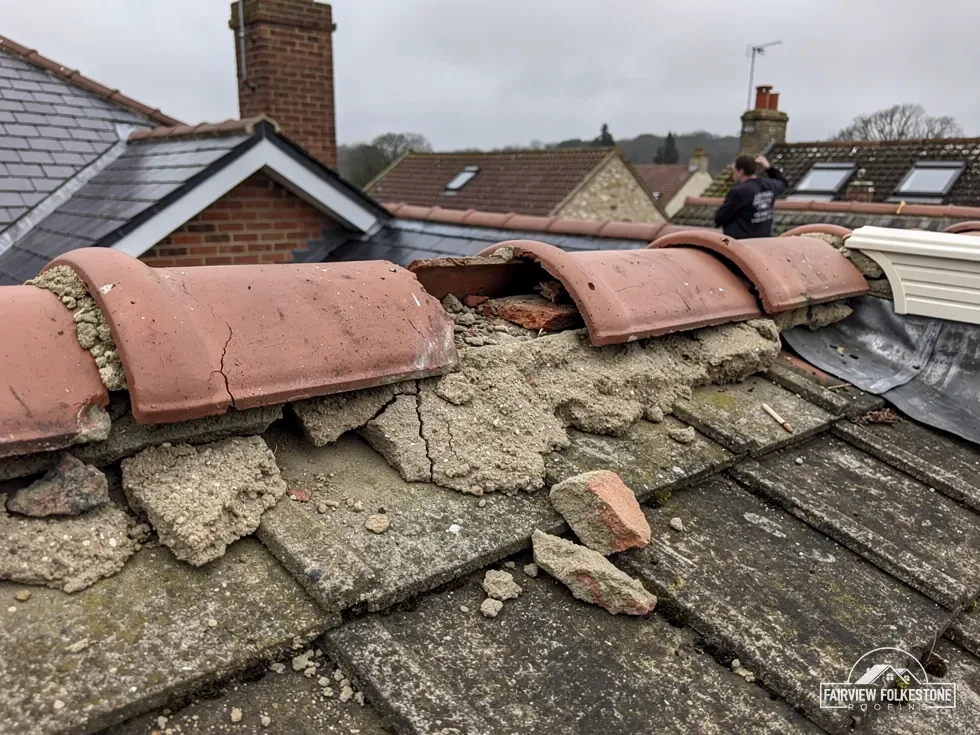
A traditional ridge sits on a bed of mortar, with the joints between the ridge tiles pointed. Frost and weather crack that mortar over the years, pieces drop into the gutter or onto the path, and the tiles begin to move. A ridge tile held only by mortar can lift in high wind, and one that falls from the top of a house can do real harm below.
Where the ridge tiles themselves are sound, ridge tile repairs mean lifting them, cleaning off the old bed and relaying them on fresh mortar with the joints repointed. Since BS 5534 was amended in 2015, a mortar bed is no longer treated as enough on its own to secure the covering, so a ridge we rebed also gets a mechanical fixing for each tile. A cracked or broken ridge tile is swapped for a match where one can be found.
Hips, the sloping ridges where two slopes meet at a corner of the roof, are bedded in the same way and fail in the same way, so we check them during the same visit. So does the verge, the edge of the roof at the gable end, where a mortar fillet under the end tiles can crack and drop out in pieces.
- Ridge tile capping the top
- Mortar bed, cracked and loose
- Dry-fix clip and screw
Left, the old mortar bed; right, the mechanical fixing that takes its place.
Myth: Fresh mortar on its own makes a proper ridge repair.
Fact: Under BS 5534 a mortar bed is not the only fixing any more, so a rebedded ridge is mechanically fixed as well.
BS 8612
The British Standard for dry-fixed ridge, hip and verge systems
The 2018 edition, listed as current by BSI
Dry ridge and dry verge systems
A dry ridge does away with the mortar. The ridge tiles are clipped and screwed down to a timber ridge batten, so nothing along the top depends on a mortar bed holding together. A dry verge does the same job at the gable end, with interlocking caps over the cut edge of the tiles in place of a mortar fillet. Dry-fixed ridge, hip and verge systems have their own British Standard, BS 8612:2018.
Which route suits your roof depends on the tiles, the pitch and the state of the rest of the ridge. Where the mortar has failed along the whole length, a dry ridge means the same run will not need rebedding again. If just a few tiles have moved while the mortar bed elsewhere stays firm, rebedding that handful is the smaller job. If a loose ridge tile is the worry right now, our answer on loose or fallen ridge tiles covers whether it is urgent.
What sets the price
- How many tiles or slates have moved
- Whether a match is in stock
- How we reach the slope safely
- The state of the battens underneath
One written total price
Entry 04Slipped tiles
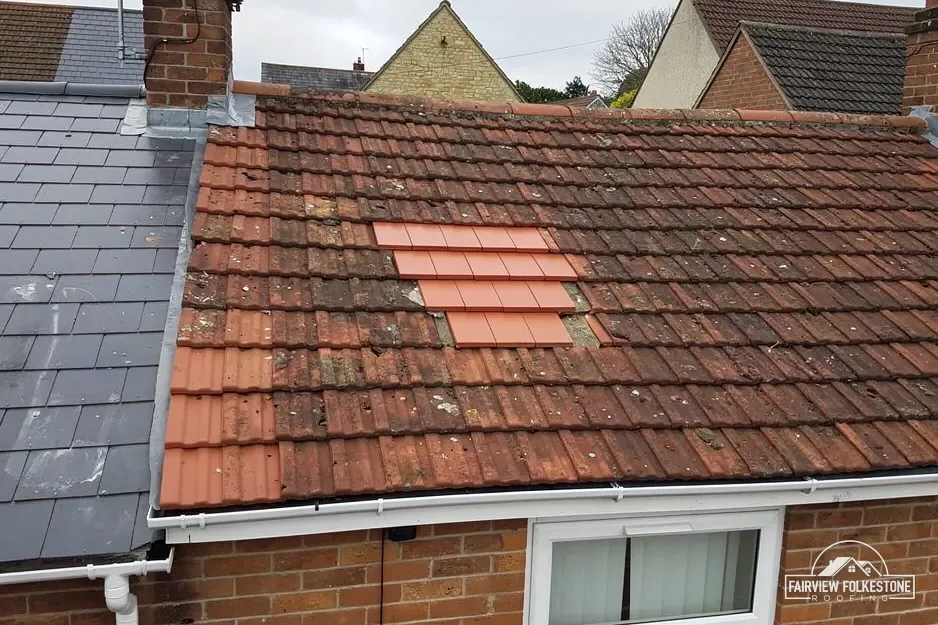
Slipped, cracked or missing tiles and slates
A tile in the garden after a windy night tells us one fixing let go. The question is why, and whether the tiles around it are about to follow.
Why tiles and slates slip
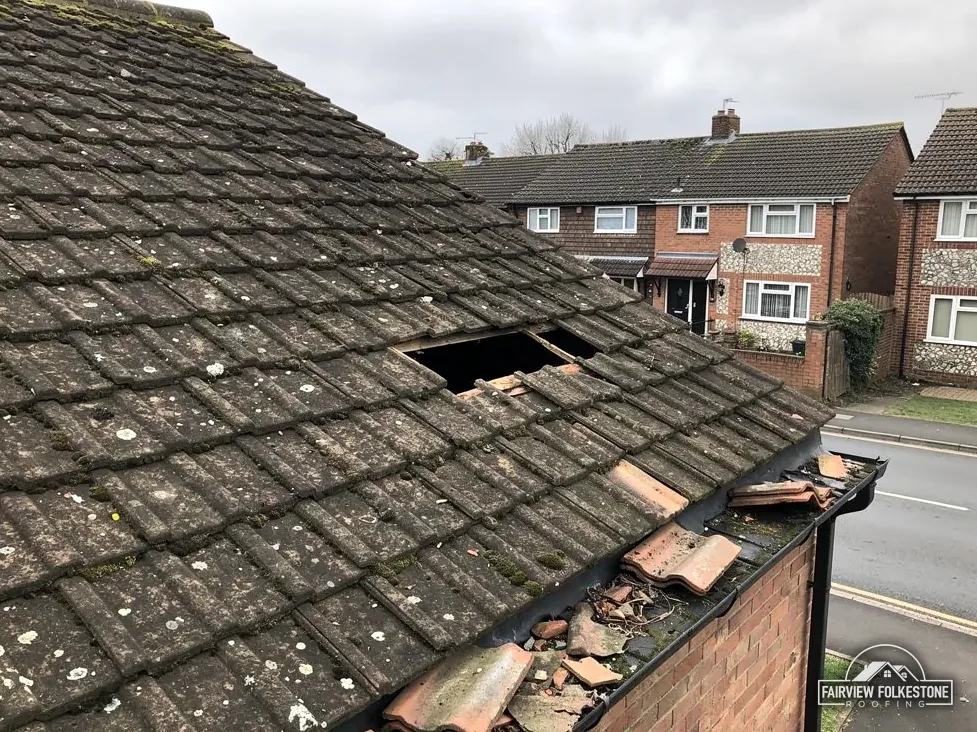
Tiles hang on battens by small nibs along their top edge, and they may be nailed or clipped as well; slates are held by nails, or by hooks and clips. When a nail rusts through, a batten softens or a tile cracks, it slides down the slope and leaves a gap, and in a strong wind a loose tile can lift right off. Exposure matters here. Cupa, the slate maker, says buildings in coastal areas, or on slopes and hills, are graded with higher exposure, so on a house near the sea at Sandgate the fixing specification for the slope is worked out for that site under BS 5534. Cupa also says hook fixings are not to be used on any pitch under 25 degrees, so a slate on a shallower slope is held another way.
One tile that has slipped, while the battens stay firm and its neighbours are sound, is a refix. The tile goes back in and is held by a clip or a tile hook, because a nail cannot be driven without lifting the course above. A broken tile is replaced, either with a new match or with a sound one taken from a less visible slope.
One tile slipped, battens firm
Refix with a clip
Cracked tile mid-slope
Replace with a match
Slips across the whole slope
Price a re-cover
- The slipped slate or tile
- Batten it hung from
- Clip holding the refix
A clip hooks over the batten, so the course above is never lifted.
Roofing materials and finding a match
Matching matters as much as fixing. Clay and concrete tiles come in a wide range of profiles and colours, and natural slate varies in size, thickness and shade. We check what is on your roof and tell you if a new match can be had, whether reclaimed stock will sit better, or whether a sound tile can be borrowed from a rear slope so the new one goes where nobody will see it. Moss on the slope gets a look while we are up there, and where it needs clearing we do it by hand, not with a jet wash, which Marley warns can harm a tile's surface and cut its expected life considerably.
When slips are spread across a whole slope, the fixings or the battens are failing together, and refixing tiles one at a time just moves the problem a few feet along. That is the point where we stop talking about a refix and explain what a re-cover would involve instead. Our guide to what roof repairs cost and what moves the price sets out the published figures.
Entry 05Flashings
Flashings: the joints where a roof meets a wall or stack
Flashing is the lead that seals the joint where a slope meets a chimney, a wall or a roof window. When it lifts, rain follows the brickwork inside.
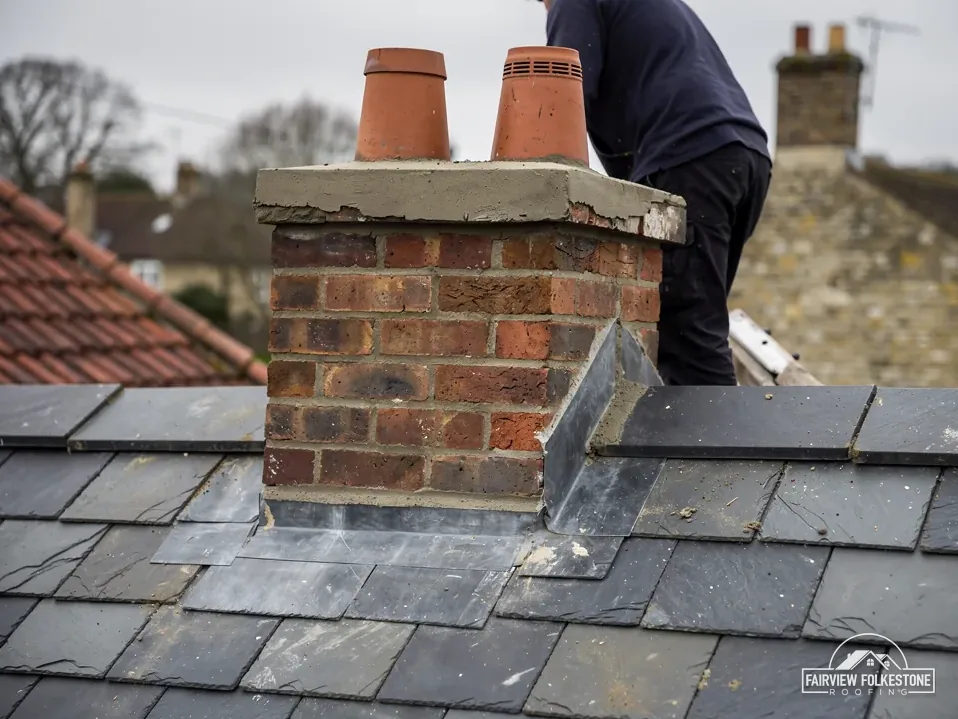
- Stepped flashing up the stack
- Mortar joint the step tucks into
- Soakers under each course
- Flaunching around the pots
Chimney stacks, abutments and soakers
Around a chimney, lead is dressed in steps up each side of the stack, each step tucked into a mortar joint in the brickwork. Beneath them, small pieces of lead called soakers sit under each course of tiles where it meets the brick, so water that gets past a step still runs out onto the roof. An apron crosses the front of the stack, and at the top the flaunching, a sloped collar of mortar, holds the pots and sheds water off. The same idea applies wherever a slope meets a wall, such as a lean-to against the house.
Flashings fail in a few ways. The pointing that holds the steps crumbles and the lead pulls out of its joint; old lead splits where it was worked too thin; and some roofs only ever had a mortar fillet, which cracks away from the wall. Lead pressed against render instead of tucked into a joint is another weak point. Where the lead is sound and only the joints have gone, we rewedge the steps and repoint. Where it has split, it is renewed in lead of the right code. Correctly installed lead flashing can last for over 80 years, according to MyJobQuote.
Can a flashing be repaired without scaffold?
It depends on height and reach. A low lean-to abutment can be worked from a ladder, while a chimney on a two-storey house needs a safe working platform. Scaffold that stands on a pavement or a road first needs the highway authority's licence, and we arrange the licence with our scaffolder.
Code 3
The lead Royston Lead recommends for soakers only
Flashings take Code 4, 5 or 6
Roof windows and leaking skylights
A roof window has its own flashing kit: shaped pieces that lap under the tiles above the frame and over them below it. A leak around the frame can come from the kit, from a channel at the top of the window blocked with leaves, or from tiles sitting badly against the sides. We check all three before anyone talks about a new window.
Some leaks around a window are not roof work at all. A failed seal shows as misting between the panes, and a cracked frame or a worn hinge gasket lets water onto the lining inside; both point to a window repair rather than new lead or tiles, and we say which it is. For bigger lead jobs, such as a valley lining or a lead flat roof, see our lead work page.
A damp chimney breast starts as a question about the lead, not the chimney.
How we decide between the two
We weigh up where the faults are, what lies under the tiles, and how much life the covering has left. Storm damage on one slope is a repair. The same faults on every slope point to fixings, battens or underlay failing as a set. From the loft we look for torn or brittle felt, damp battens and daylight, because a roof that is failing underneath will keep leaking however many tiles are refixed on top.
On the covering itself, HomeBuilding gives approximate lifespans of 100+ years for Welsh slate, 60 to 80 years for clay tiles and 40 to 50 years for plain concrete tiles. Tiles near the end of that span keep shedding pieces, and each repair buys less time than the last.
Repairs on a sound roof are money well spent. Repairs on a roof failing everywhere just move the next leak along the slope, and we would rather say that plainly than sell you a run of visits. When a re-roof is the answer, our roof replacement and new roofs page explains what is involved.
Entry 06Repair or replace
Is it cheaper to repair or replace the roof?
A repair is the right call while the faults are local and everything else up there is sound. Once they spread across every slope, the sums change.
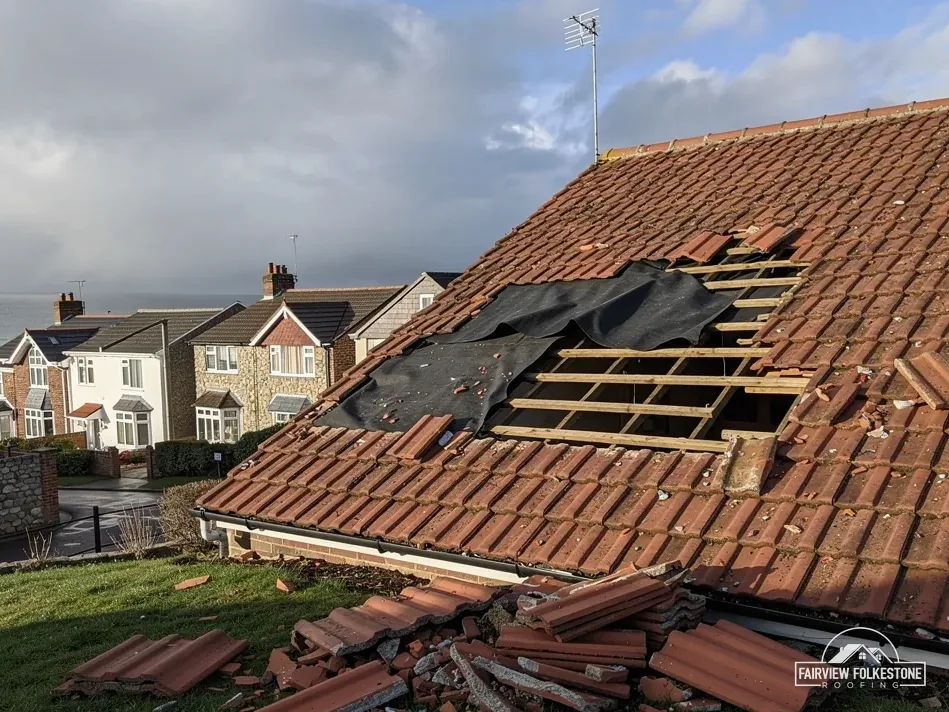
Storm damage on one slope
Repair that slope
Felt torn from ridge to gutter
Strip and re-cover
Slipped tiles on every slope
Survey for a re-roof
What sets the price of a repair
- How far the damage has spread
- Access by ladder, tower or scaffold
- Matching tiles, slates or lead
- Whether battens or felt need work
One written total price
Approval, scaffold and the paperwork
Folkestone & Hythe District Council says you don't need approval for most repairs, replacements, and maintenance work, though replacing roof coverings appears on its list of alterations that can need approval. Under the Planning Portal's guide, a re-roof is not normally something you apply for if less than 25 per cent of the building envelope and less than 50 per cent of the roof is affected; a replacement covering that is 15 per cent or more heavier needs approval either way.
Dover district is stricter. Dover District Council puts the replacement of roof coverings, even like for like, on its list of work needing approval, so for a house in Dover or in Deal we confirm the route with the council before a larger repair turns into a re-cover. Either the council's building control team or a registered building control approver can handle building control, and for Folkestone & Hythe addresses the council's building control team is on 01303 853538. Wherever scaffold has to stand on the highway, it needs a licence from the county highway authority before it goes up.
- Fascia board
- Gutter on its brackets
- Felt dipping into the gutter
- Soffit and its vent
Felt that has rotted where it dips into the gutter is a sign of age.
Got a leak or a loose tile? Start with a photo.
Book a visit, or send us a photo by WhatsApp. We make the roof safe where it needs it, then give you one written total price for the repair.
Roof repairs in Folkestone: costs and questions
Answers on cost, scaffold, insurance and what to do before a roofer arrives.
How much should I pay for roof repairs in Folkestone?
Which? Trusted Traders put replacing one to six broken or missing standard roof tiles at £75 to £400, excluding VAT, from a survey of traders in November 2025, and say prices in the South East, which takes in Kent, are likely to be at the top of the scale. MyJobQuote gives an average roof repair cost of around £650 in 2026. Your own figure turns on access, the extent of the damage and whether scaffold is needed, and we give it as one written total price after seeing the roof.
What does an emergency roof repair cost?
MyJobQuote says emergency roofer call-out costs typically range from £150 to £300, while extensive storm damage repairs can cost £1,200 or more. A call-out pays for someone attending; making the roof safe and the permanent repair are work on top, and the size of the damage sets their cost. Before anyone starts, ask whether the figure you are given covers the make-safe alone or the finished repair as well, and whether it includes VAT and any scaffold. A figure that changes once the ladder is up deserves a question too.
When should I call an emergency roofer in Folkestone?
Call when water is coming in and the drip is getting worse, when tiles, slates or a length of ridge have come off and the roof is open, or when something up there is loose enough to fall onto a path, a car or a neighbour's roof. A small damp patch that only shows in driving rain can wait for a booked visit, though it is worth photographing and watching. If water is near light fittings or sockets, switch the power off at the consumer unit before anything else.
How can I make a temporary roof repair safely?
From inside the house, never from a ladder in the wind. Put a bucket under the drip, move furniture and anything electrical out of the way, and if a ceiling is bulging with water, keep everyone out of the room below it. Up in the loft, a sheet of polythene laid under the leak can steer the water into a container. Leave tiles, sheeting and anything on the roof itself to a roofer once the weather allows, because a fall from a roof does far more harm than a wet ceiling.
Can I get help to pay for fixing my roof?
That depends on who owns the roof and what damaged it. If wind or a storm caused it, read your home insurance policy and tell your insurer before permanent work starts, keeping photos and the make-safe receipt. If you rent, report the problem to your landlord in writing and keep a copy; council tenants report it to the council's own repairs service. On a shared terrace roof, speak to your neighbour before any work, since a single repair can sit across both houses.
What are the signs of a dodgy roofer?
Be wary of anyone who knocks unasked to say they have spotted a problem on your roof, wants cash up front, or pushes you to agree on the doorstep. A sound quote is in writing, describes the work, and makes clear whether VAT and scaffold are in the price. Sign at home after a survey and the law gives you 14 days to cancel; a firm can begin inside that period only at your written request. For consumer advice, the Citizens Advice consumer helpline is on 0808 223 1133.
Should a roofer charge by the hour for a repair?
We price a repair as a whole job rather than by the hour, so the figure agreed is the figure for that work, whatever the clock says. What moves a repair price is access, materials and how much of the roof is involved, not just time on site. If you are weighing one firm's day rate against another's fixed figure, ask each of them exactly what their price covers and whether a second visit would cost extra. A day rate with no limit on the days is not a price for the job.
Do I need scaffolding for a roof repair?
Not always. A low roof or a single tile within safe reach can be done from a ladder and a roof ladder; a chimney, a ridge on a two-storey house or work above a conservatory needs a proper platform. If scaffold stands on a Kent pavement or road, Kent County Council licenses it at £52 per week for 2026 to 2027, and its own guidance has the scaffold firm submit the application for you. For Rye and Camber, East Sussex Highways issues the licence, at £127 for 28 days on its fee table.
Tell us what's wrong with the roof.
You'll get one written total price.