Lead work · Folkestone
Lead roofing and leadwork in Folkestone
Flashings, soakers, valleys and small lead roofs for homes in Folkestone, Hythe and east Kent, and a straight answer on whether the lead needs a repair or new sheet, and the reason.
10-year workmanship guarantee, in writing
The fair ledger
Lead work on Folkestone roofs, detail by detail
Six places where lead keeps the weather out, from a flashing against a wall to a lead bay roof. Each entry covers what we look at, how that detail fails and the verdict it points to.
Entry 01Abutments
Lead flashings where a roof slope meets a wall
Wherever a roof runs into brickwork, a chimney stack or the wall of the house next door, a strip of lead closes the gap. When that strip lifts or splits, rain gets behind it.
What a flashing does, and the work we do
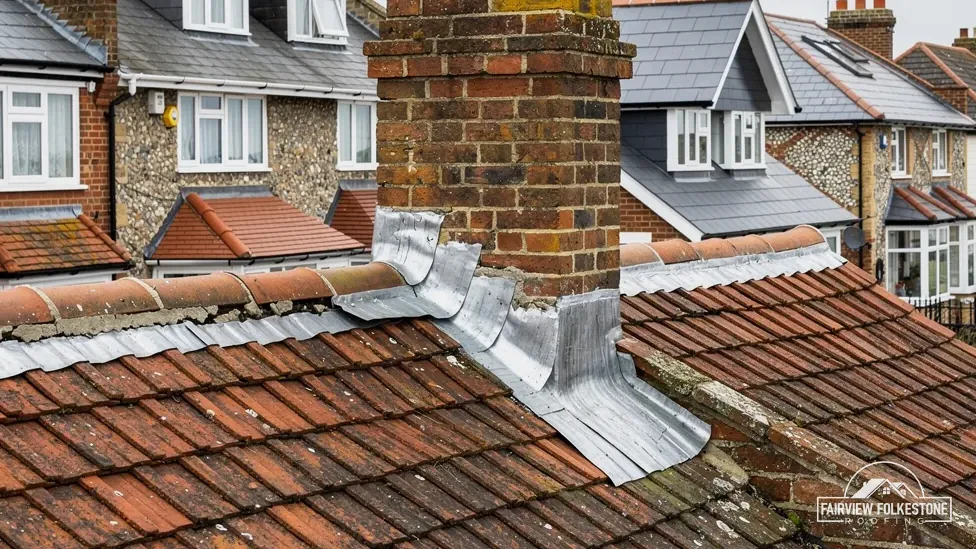
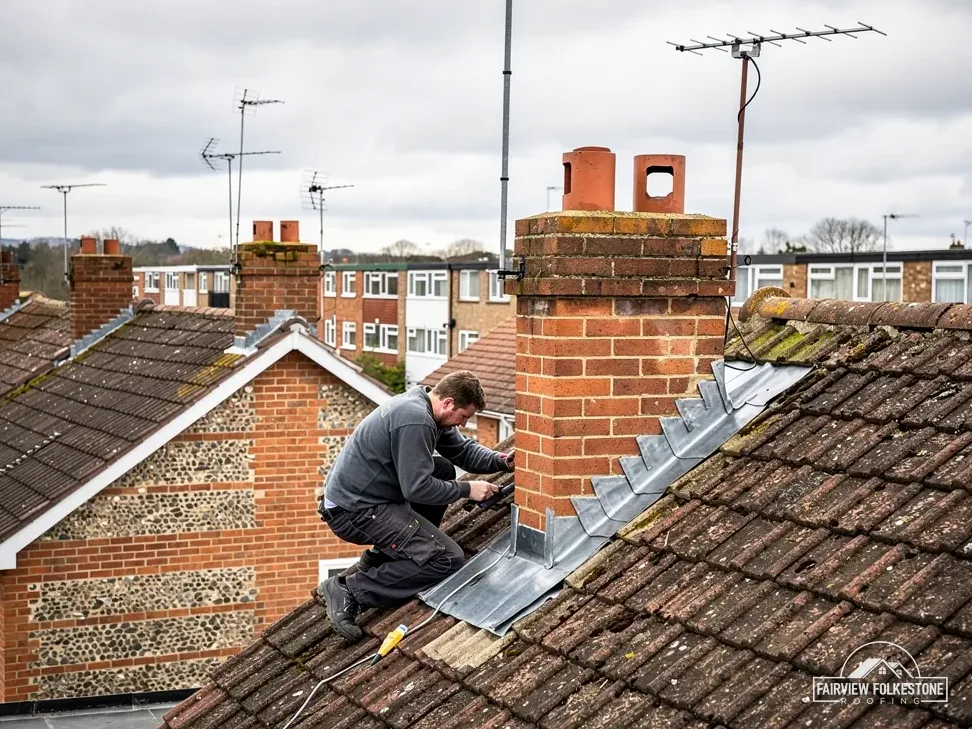
A flashing is the lead that covers the joint between a roof and anything standing above it. Where a pitched roof runs up beside a wall, the lead is cut into steps that follow the brick courses. The top edge of each step is turned into a mortar joint and held there with small lead wedges, and the rest of the sheet is dressed down over the slates or tiles. Across the front of a chimney stack or under a window sill, a single apron flashing does the same job in one piece.
Our lead roofing in Folkestone covers every part of that detail: new stepped and apron flashings, cover flashings over soakers, refixing lead that has pulled out of its joints and repointing the joints that hold it. Lead suits these places because it can be shaped by hand to an old wall that is no longer straight, and because it is one of the traditional materials period roofs were built with. Where the stack itself needs work, our chimney repairs page covers it. Where a lower extension meets the house, an extension roof abutting the house wall carries the same flashing along that wall, worked just as it is on the main slope.
- Stepped flashing up the wall
- Step turned into a mortar joint
- Soakers under each course
- Flaunching on top of the stack
Each step sits in a joint, with the soakers hidden under the slates below.
Myth: A damp patch beside a chimney means the stack needs rebuilding.
Fact: A lifted flashing or one loose step lets rain in just the same, and both are repairs to the lead.
s2(2)(j)
the Party Wall etc. Act 1996 right to cut into a neighbour's wall to insert a flashing
The building owner serves the notice
What sets the price of a flashing
- How long the run of lead is
- Whether the joints need repointing
- How we reach the wall safely
- Whether a neighbour's wall is involved
One written total price
Signs a flashing has failed
- Lead standing away from the wall, with a gap you can see from the garden
- Wedges missing, and the top of a step loose in its joint
- Pointing above the flashing cracked or fallen out
- A split in the lead, or a step patched with tape or mastic
- Damp on a ceiling or chimney breast close to the wall after rain
None of these on its own means the lead is finished. Lead that has come out of its joints but is otherwise whole can be refixed with new wedges and the joints repointed. Lead that has split, worn thin or been cut short by an earlier repair is where we would renew that run. Our answer on why lead flashing cracks explains how splits start.
Wind plays a part as well. A flashing with loose wedges can be lifted and folded back in a gale, and once the top edge is out of its joint the rest of the step follows. We dress the lead tight to the slates and check every wedge along the run before we come down.
Can soakers be fitted without stripping the whole roof?
Yes. Soakers run along the abutment only, so we lift the slates or tiles in a strip beside the wall, fit the lead course by course and relay them. The rest of the slope stays where it is, and only that strip needs safe access.
Entry 02Soakers
Soakers: the lead you cannot see from the ground
Under a stepped flashing sit the soakers, one small sheet of lead per course, folded up against the wall. When a slope leaks at a wall and the flashing looks sound, they are next.
What we found at the wall
Soakers in place, flashing pulled out
Refix and repoint the flashing
Soakers short or slipped down the slope
Lift the strip, refit them
No soakers and no flashing at all
A new abutment detail
Code 3
the lead Royston Lead recommends for soakers only
1.32 mm thick, colour-coded green
How soakers work, and how we check them
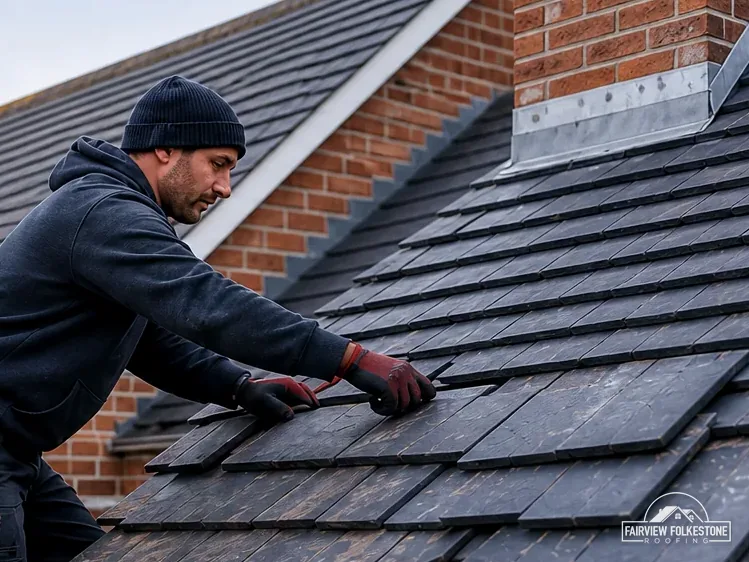
A soaker is a short strip of lead folded into an L. One leg lies flat under a slate or tile, the other stands up against the wall. One goes in with every course, so the run laps from the eaves to the top of the slope, and the stepped flashing is dressed down over their upstands. Rain running off the slates beside the wall lands on lead, not on the timber underneath.
Because each soaker sits under a slate, you cannot inspect one without lifting the covering beside it. When a wall leaks and the flashing is in good order, we lift a few slates at the abutment to look. Soakers cut too short, slipped down the slope or left out when the roof was last re-covered can only be confirmed this way, and a re-roof done without them can leave the fault behind. Where they are missing, the slates along the wall come off, a full run goes in and the slates go back. Our answer on what lead soakers are goes into the detail.
A leak beside a wall? Send us a photo
Get a verdictSoakers, slates and the code of sheet
Soakers belong with small coverings that overlap in narrow courses, such as natural slate and plain tiles, where each course needs its own piece of lead. Larger profiled tiles beside a wall can take a different detail, with one dressed flashing over the tiles. If a wall has neither soakers nor a sound flashing, that goes in writing before any price.
The thickness of the lead differs too. Royston Lead lists Code 3 for soakers only, and Code 4 upward for flashings and valleys, so a soaker run and the flashing above it can be different sheet. On coastal homes the slates beside the lead matter as much: coastal sites are graded for higher exposure, so the fixing specification for the slates is calculated for the site under BS 5534.
On a terrace where the roof runs up against a neighbour's higher wall, new lead is cut into a wall the neighbour owns, so the party wall rules apply and notice is served before the work. Any cracked slates lifted along the wall are swapped for matching ones before they go back.
Entry 03Valleys
Lead valleys and gutters between two roof slopes
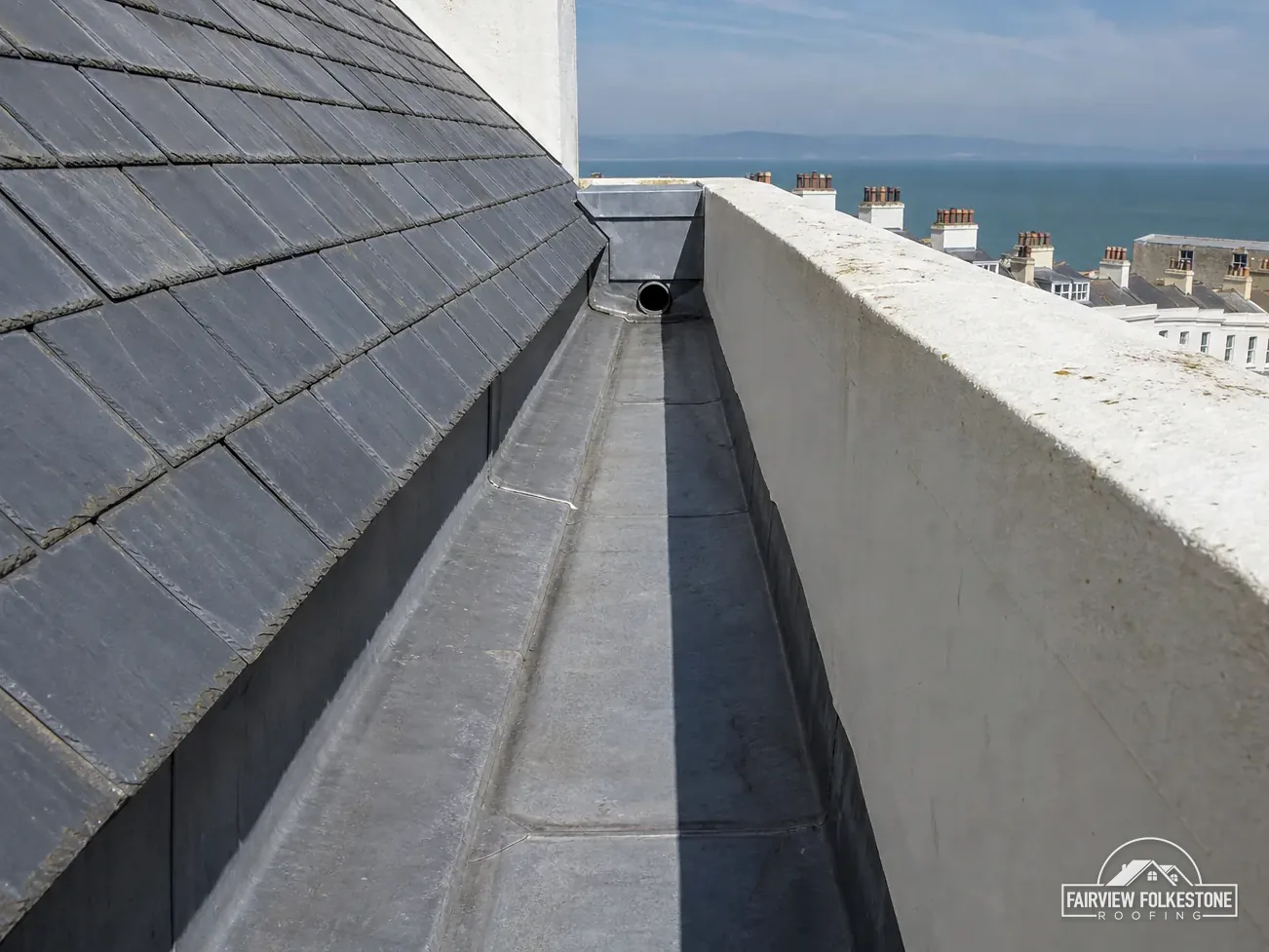
A valley takes the rain from two slopes at once and carries it down to the gutter. The lead lining there does a heavy job, and small faults in it show indoors quickly.
Open valleys, box gutters and parapets
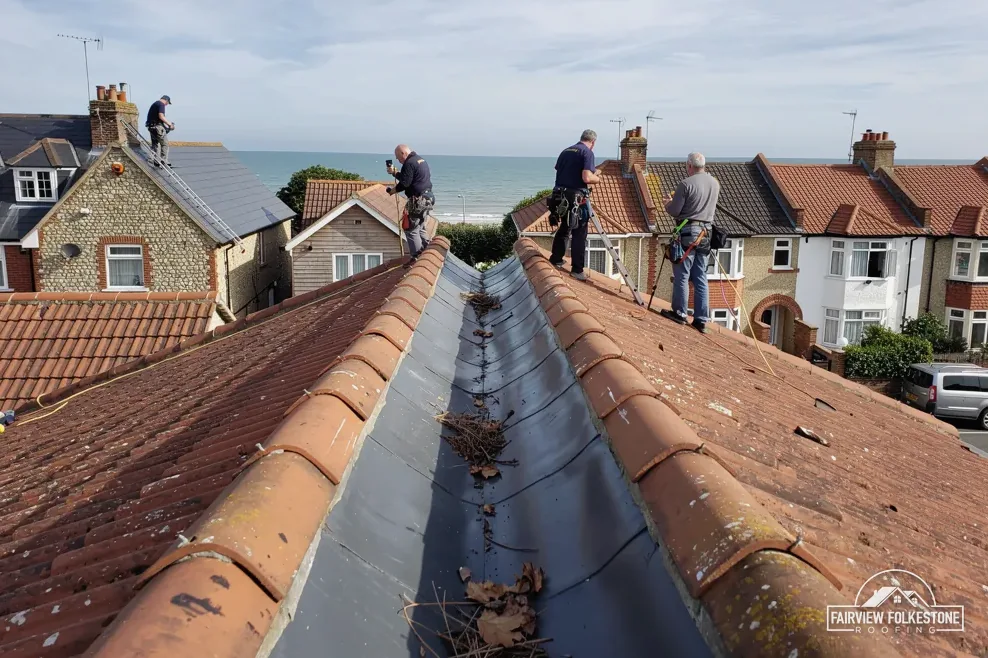
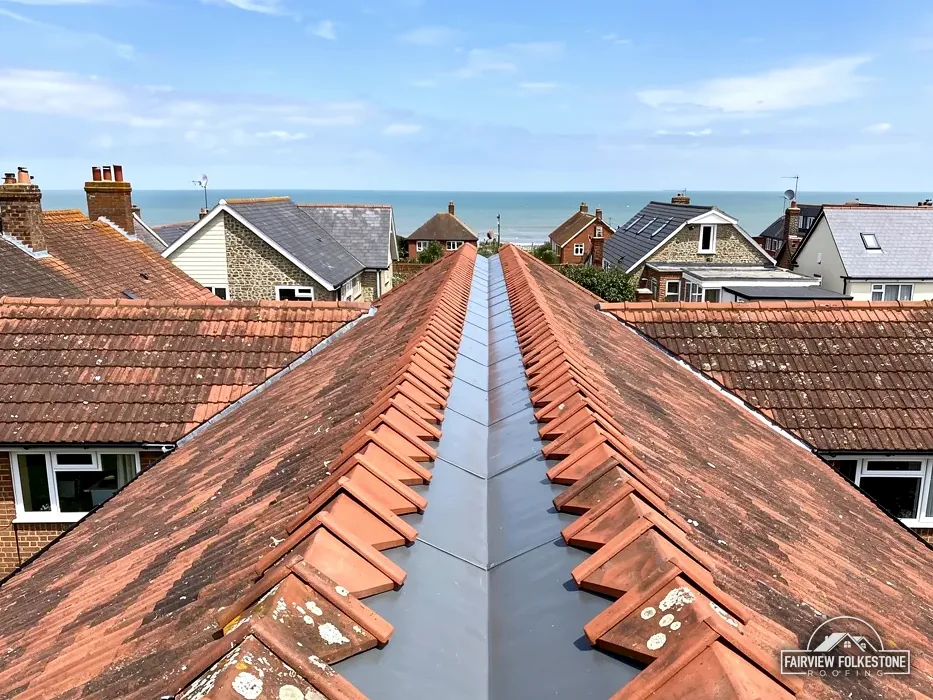
In an open valley, a lead lining is laid on boards fixed between the two slopes, and the slates or tiles are cut back on each side to leave a channel of lead showing. A box gutter is the flat-bottomed version, set behind a parapet wall or between two roofs that meet at a low point, with the lead turned up the sides. Either can turn up wherever an extension roof joins the main house.
A valley leaks for a short list of reasons. The lead splits along a fold or at a lap. Leaves, moss or a fallen slate dam the channel, so rain backs up over the edge of the lead. The cut slates or tiles slip down into the channel. Or the boards under the lead have rotted and sagged, leaving a dip where water sits. A box gutter adds one more: an outlet that blocks lets the gutter fill until it spills over the lead upstand and inside. Only the first and the last are faults in the lead lining itself, which is why we look at all four.
- Lead lining in the channel
- Valley board under the lead
- Slates cut back each side
The channel stays open, so rain runs on the lead and never under the slates.
Myth: A stain under a valley means the lead lining has failed.
Fact: A dammed channel or a slipped cut slate leaves the same stain, and both are cleared or refixed before the lead is touched.
Code 5
the lightest Royston Lead code for box, parapet and tapered valley gutters
Pitched valleys start at Code 4
Valley repair, or a new lining
We clear the channel and check the lining before anything else, because a valley that is only blocked needs clearing, not new lead. A slipped cut slate goes back on a clip. A split in otherwise sound lead can be repaired, and on a long valley a single bad length can be cut out and renewed with new laps at each end. Beyond keeping the channel clear, a sound lead valley needs little maintenance.
A new lining is the right call when the lead has split in several places, when earlier patches have failed, or when the boards underneath need replacing, since the lead has to come up for that anyway. The new lining goes in as separate lengths, each lapped over the one below, so it can move with heat and cold without tearing. Our answer on lead valley repair covers the choice in more depth.
Where a valley meets a chimney or a dormer, its lining is joined into the flashing there, and we check that junction as one detail rather than two.
What sets the price of a bay roof
- The size and shape of the bay
- Whether the deck boards are sound
- How many rolls and drips it needs
- Access over the ground below
One written total price
Entry 04Bay roofs
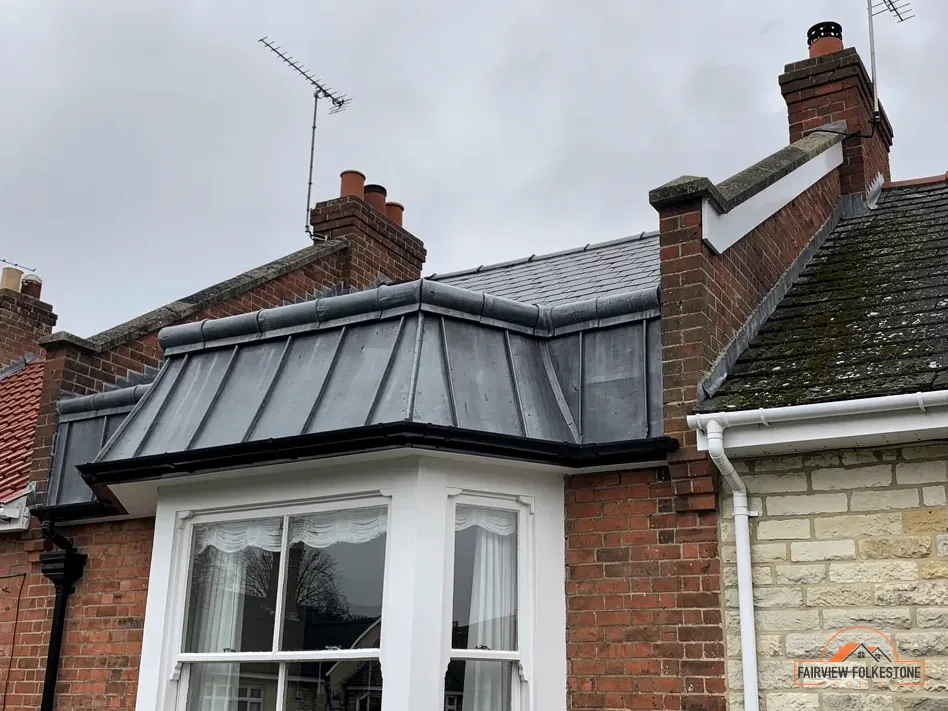
Lead on bay windows, porches and small flat roofs
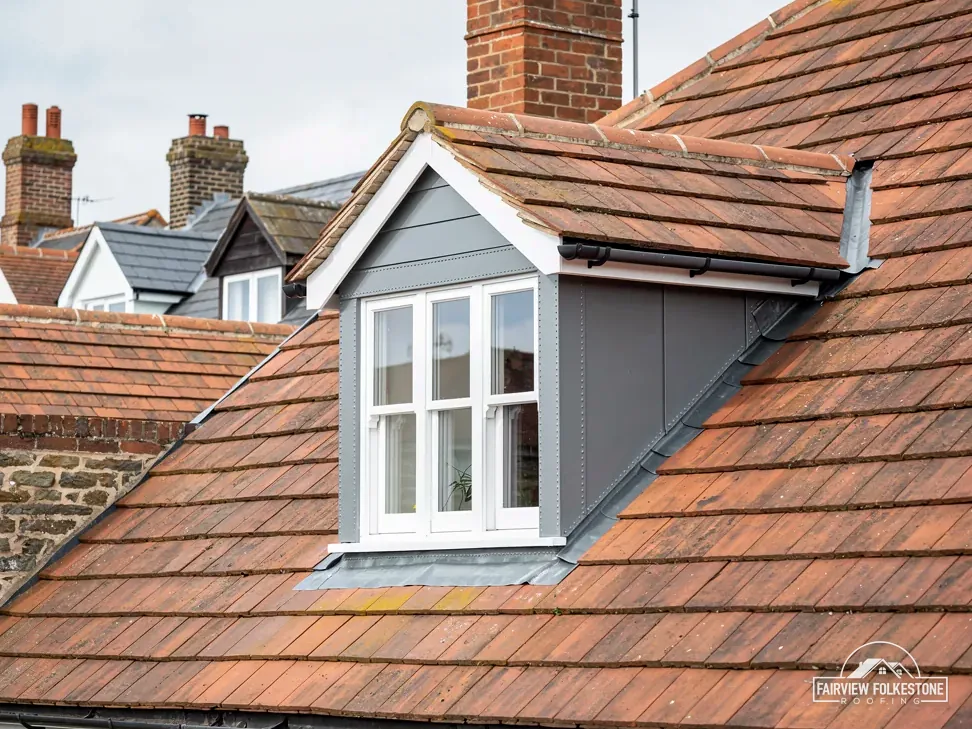
Lead laid flat or at a low pitch, over a bay window, a porch canopy or a dormer top, has to cope with heat. Sheet laid in pieces that are too large splits as it moves.
Thermal movement, rolls and drips
Lead expands as it warms and shrinks as it cools. On a small lead roof the sheet is laid in separate bays so that each piece can move on its own. Along the fall, one bay meets the next at a wood roll, a rounded length of timber that the lead is dressed over. Across the fall, the bays step down at drips, small steps in the deck where the upper sheet laps over the lower one. Each bay is fixed along one edge and left free to move elsewhere.
When a lead roof is laid as one oversized sheet, or nailed down all round, the lead cannot move. It ridges, cracks along the creases and in time splits right through. A split like that is not the place for a patch, because the same strain opens it again beside the repair. The fix is to relay the roof in properly sized bays on a sound deck, with new rolls and drips where the layout needs them.
On a porch canopy or a dormer top the bays are small, and there may be only one or two, but the same rule holds: lead fixed at one edge, free at the others, with laps that let it slide.
Bay and porch roofs
Lead sound, one lap lifted
Dress down and refix
Splits along the creases
Relay in smaller bays
Soft deck under the lead
New boards, new lead
- Boarded deck laid to a fall
- Lead sheet laid in bays
- Upstand turned up the wall
- Drip at the front edge
Each bay of lead is fixed along one edge and free to move elsewhere.
Why a lead bay roof sits outside BS 6229
Flat roofs covered in membranes follow BS 6229:2025, which sets a minimum finished fall of 1:80. That code covers continuously supported flexible membranes, not lead, so a lead bay roof is set out by the lead specification instead: the code of sheet, the bay sizes, and the rolls and drips that suit the size of the roof. For EPDM, GRP and felt over an extension, see our flat roofing page.
A listed house brings one more step: any works that would affect its character as a listed building need listed building consent, so we check with the council before original lead on a bay or porch is changed. Our answer on leadwork on listed buildings sets out what changes on those jobs.
Before we price a bay roof, we look at the decking from the edge and, where we can, from inside the bay, since soft boards turn a relay of the lead into a new deck as well. We also look at how the lead meets the window frame below, since a bay roof drains over it.
Entry 05Welding
Lead welding, bossing and ornamental leadwork
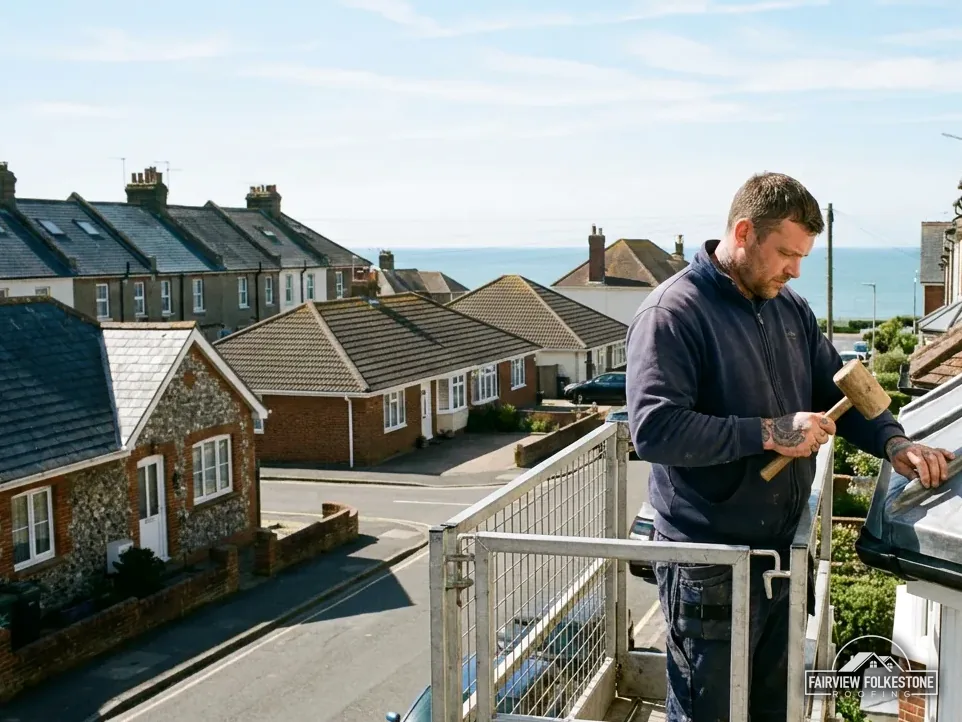
Some lead shapes cannot be cut from one flat sheet and folded. They are beaten into shape by hand, which is called bossing, or built from pieces joined by lead welding.
Why weld lead instead of folding a single sheet?
A single sheet folded into a complex shape has to be cut and lapped at every turn, and each lap is a place for rain to get in. A welded piece is one continuous sheet, so the only joints left are the laps we choose to put in for movement.
Bossing or welding, and how we choose
Bossing works the lead cold with hardwood tools, stretching and gathering it around a corner or over a curve until it forms one unbroken piece. A bossed corner has no joint to fail, so it is our first choice where the shape allows. Lead welding joins separate pieces with a flame and a strip of new lead, melting the edges together so they become one. It suits shapes that bossing cannot reach: a back gutter behind a chimney, the cheeks and top of a dormer, a box gutter with outlets, or a lead roll on a turret.
Welding is heat work on a roof, so we plan where it happens. Where we can, welded pieces are made up on the ground and fitted afterwards, which keeps the flame away from old timbers, felt and the gutter. When a joint has to be welded in place, the area around it is protected and checked once the work is done. Our answer on what lead welding is covers when it is used. Bossing and welding are both done by hand; the choice turns on the shape, the code of sheet and the room there is to work.
Lead that is free to move stays whole. Lead nailed down all round tears.
Myth: Old lead that has turned grey and chalky has worn out.
Fact: The grey surface is the patina lead forms in the open air; what matters is splits, thin spots and how the sheet is fixed.
Ornamental lead and period details
Ornamental leadwork covers the details that give an older house its finish: lead-covered finials and ridge ends, the curved roof of a bay or oriel window, decorative aprons and cappings on parapets, and the lead on a cupola or small dome. Each is made by hand to the shape that is there, using lead of the right code for that part.
We record a piece before taking it off, then match its shape and size in new sheet. On a listed building, or a house in a conservation area, we confirm with the council what consent the work needs before any original lead comes off. Like the bay roofs above, ornamental pieces are laid out so the lead can move with the seasons without tearing.
Some ornamental work needs no new lead at all. A finial that has leaned or a capping that has lifted at one end can be dressed back into place and refixed, and we say plainly when that is the whole job.
After a storm or a theft
Strong wind gets under a flashing whose wedges have worked loose and folds it back off the wall, and a run of lead lifted in a storm can tear where it bends. Stolen lead leaves the opposite problem: a bare joint, open to rain, with nothing over it at all. In both cases the first job is to keep the weather out with a temporary cover, then to look at what is left.
If you plan to claim on your home insurance, tell your insurer first, and take photos before anything is moved. On a disputed claim the Financial Ombudsman Service says "we'll usually look at expert reports and photos", so a record of the damage as it was found helps. Keep the receipt for any temporary cover as well. Our page on lead stolen from a roof goes through the first steps in order.
Storm damage to lead is repaired like any other fault: watertight first, then the permanent work priced once we can see the whole run.
Entry 06Renewal
Storm-torn or stolen lead: patch it, or renew the run
Lead lifted by wind, cut away by thieves or patched one time too many reaches a point where repairs stop holding. The survey is where that point is found, before any price.
Patch or renew
One clean tear in sound lead
Repair that tear
Lead cut away by thieves
New lead, same code
Patches over patches along a run
Renew the whole run
What sets the price of new lead
- How much lead has gone or failed
- The code of sheet each detail needs
- Scaffold, or a ladder and roof ladder
- Any repointing or decking under it
One written total price
When we renew instead of patching
- The lead has split in more than one place along the run
- Earlier patches of tape, mastic or bitumen paint have failed or hidden what is under them
- The lead is too short to lap properly over the slates or the soakers
- The sheet has been nailed in a way that stops it moving
- A whole flashing has gone, so there is nothing sound to join to
- The wedges and pointing along the whole run have failed together
A new run of lead, cut to length, wedged into fresh joints and lapped correctly, removes the weak points instead of adding another. We set out in the written quote which runs we would renew and which we would leave alone. Renewing a run of lead does not mean a new roof, and the slates either side stay put unless the soakers under them have failed too. If the scaffold has to sit out on the public pavement, our scaffolder arranges the licence.
Code 4
the lightest code Royston Lead lists for flashings
Codes 5 and 6 are listed for flashings too
Which piece of lead is letting the rain in on your roof?
Send us a photo from the ground or book a visit. We tell you what the lead needs, then give one written total price.
Lead roofing and leadwork questions
Straight answers on lead codes, lifespans, costs, neighbours' walls and listed homes.
What is leadwork on a roof, and where does it go?
Leadwork is any part of a roof made from lead sheet: the flashings where a slope meets a wall or chimney, the soakers under each course beside them, valley and box gutter linings, and small lead roofs over bays, porches and dormers. Lead is used at these points because it can be dressed by hand to fit the shape that is there, including old brickwork that has moved. Where another material suits a detail better, such as a roof window's flashing kit, we say which. We carry out leadwork across Folkestone, Hythe and the rest of east Kent.
How long can lead flashing last before it needs renewing?
Correctly installed lead flashing can last for over 80 years, according to MyJobQuote, which gives over 100 years for higher codes. For a lead flat roof the sources differ: HomeBuilding gives an approximate lifespan of 60 to 100 years, while Less puts lead at 50 to 100 years. Each figure assumes the right code, pieces sized so they can move, and proper fixing. Lead that was cut short or nailed down all round can split long before then. Lead needs little maintenance beyond clear valleys and gutters and a look at the wedges and pointing after a gale.
What is the difference between Code 4 and Code 5 lead?
The code is the thickness. Royston Lead puts Code 4 at 1.80 mm and 20.41 kg/m², and Code 5 at 2.24 mm and 25.40 kg/m². Royston lists Code 4 for soakers, flashings, pitched valley gutters and dormers. Code 5 is listed for flashings, pitched valleys and dormers, and also for box, parapet and tapered valley gutters, a use Royston does not give Code 4. The specification for each detail sets the code, and we name it in the quote. Thicker lead costs more and is harder to dress, so heavier is not always better.
Can lead flashing be the cause of a roof leak?
Yes. Lead that has pulled out of its mortar joint, split along a fold or been lifted by wind lets rain run behind it, and a damp patch shows on the ceiling or chimney breast below. A leak beside a wall is not always the lead, though. Cracked pointing above the flashing, missing soakers or a slipped slate can leave the same stain, so we check each of those before we say which one it is. A photo from the ground of the wall, and of the stain inside, helps narrow it down before a visit.
Is a lead repair enough, or does the whole run need replacing?
That depends on the state of the lead either side of the fault. A clean tear or a lifted step in otherwise sound lead is a roof repair: the lead is refixed, the joint repointed or a short length renewed. Lead that has split in several places, been patched before or was laid in pieces too large to move is better renewed as a run. Either way it is lead work on its own, never a reason for a re-roof. We put which it is in writing, with the reason.
What does lead flashing repair cost in the UK?
MyJobQuote says a chimney lead flashing patch repair typically costs around £200, while a full replacement averages around £570, and it puts a full leadwork replacement at £350 to £920, depending largely on whether scaffolding is required. Checkatrade gives lead flashing repairs at £50 to £70 per metre (June 2026), with VAT and access equipment on top. Neither figure is the price of a particular roof, because the length of lead and the access decide that. Our quote is one written total for your roof, and it says whether scaffold and VAT are included.
Do I need to tell my neighbour before flashing into their wall?
Yes, if the lead goes into a wall they own. Section 2(2)(j) of the Party Wall etc. Act 1996 lets a building owner cut into an adjoining owner's wall to insert a flashing, and serving notice is the building owner's job. That notice has to go two months or more ahead of the start date, unless the neighbour consents in writing to the work going ahead sooner. If they dissent, or let 14 days pass without replying, a dispute is deemed to have arisen and a surveyor is appointed.
Does leadwork on a listed house need consent first?
It can. Any works that would affect the character of a listed building need listed building consent, and original lead details such as a bay roof, a finial or a decorative apron can be part of that character. Listed homes keep their permitted development rights for roof work, but that consent still applies. We check with the council before original lead is altered or removed, and we record each piece so its shape can be matched.
Tell us what's wrong with the roof.
You'll get one written total price.