
Roofline installation and repair
Gutters, soffits and fascias in Folkestone
Guttering, fascias and soffits in Folkestone and across Kent: uPVC and cast-iron gutters, downpipes and boards, with a plain verdict on what your roofline needs.
10-year workmanship guarantee, in writing
The fair ledger
Gutters to soffits: six faults and the verdict on each
From a gutter that spills over in heavy rain to boards that have rotted behind a plastic cover, each entry sets out what we check, what we found and which way the verdict goes.
Entry 01Gutter runs
Gutters that spill over: blocked, sagging or set the wrong way
Rain pouring over the front edge of a gutter has a cause we can find, and the cause decides the repair, not the age of the gutter.
What we check first on a spilling gutter
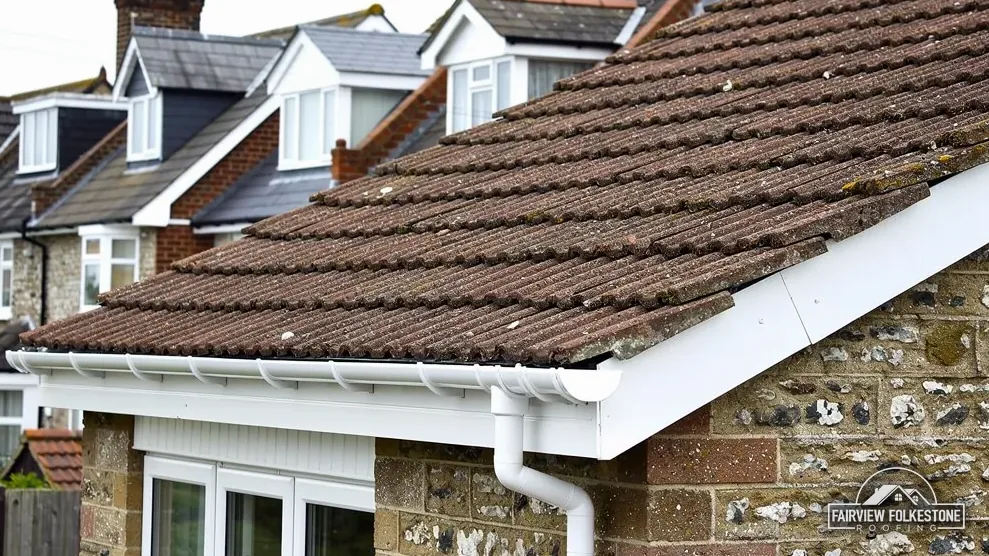
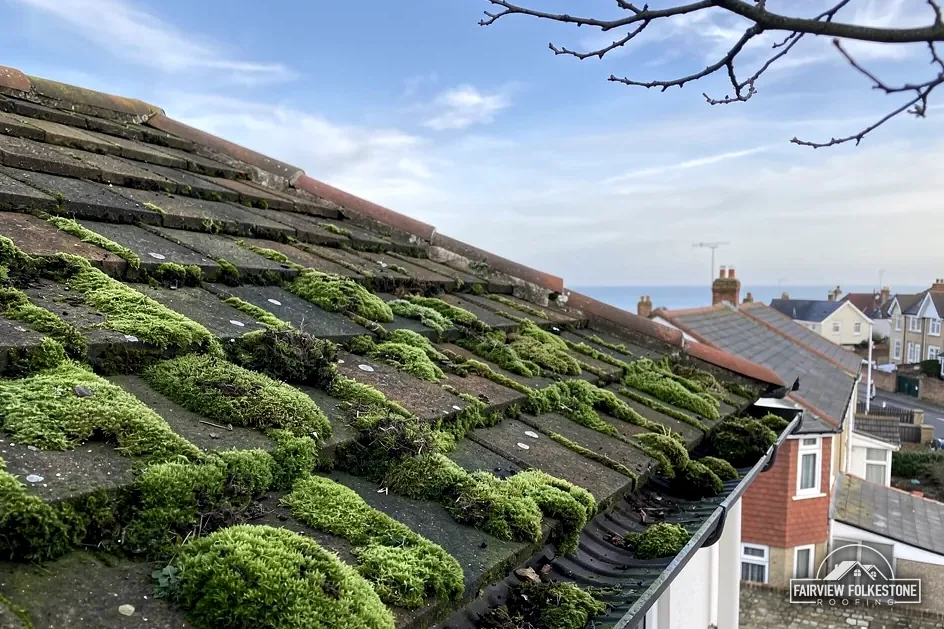
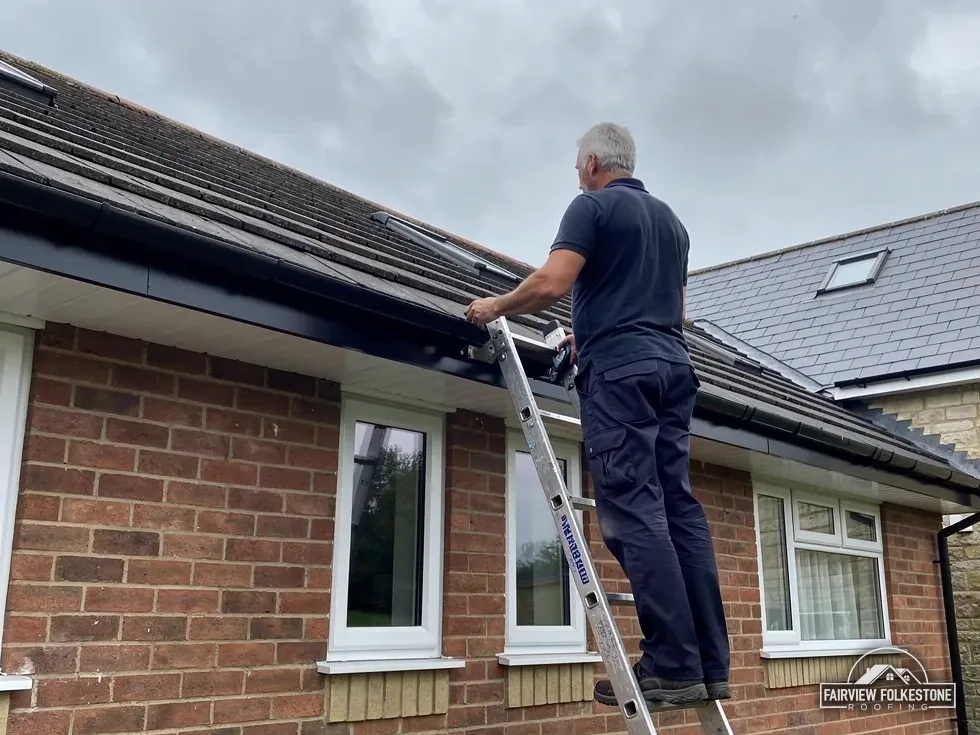
We start where the water should leave the gutter: the outlet that drops into the downpipe. Leaves, moss washed off the tiles and grit from the roof collect there, and once the outlet is choked the whole run fills and spills along its lowest edge. Clearing it, and checking that the downpipe below runs free, comes first on any overflow. We also look at the roof above, because moss on the tiles feeds the gutter after every storm.
Then we look along the line of the gutter. A level laid on the run shows up a dip between two brackets, and a dip holds a pool that never reaches the outlet. Brackets work loose when their screws lose grip in the fascia, and a gutter on a loose bracket drops a little further with each heavy shower. If the run was set to fall away from the outlet, water heads for the stop end and pours over there instead.
On a sound fascia this is repair work: clear the run, re-set or add brackets and correct the fall. Gutter clearing, the routine maintenance a roofline needs, also sits with our roof cleaning and moss removal work. There is more on why gutters overflow when it rains in a separate answer.
- Bracket screwed to the fascia
- The joint that has dropped
- Outlet into the downpipe
The low joint holds water that should be running to the outlet.
Myth: A gutter that overflows has reached the end of its life.
Fact: A choked outlet or one loose bracket makes a sound gutter spill just the same, and both are put right without new guttering.
1 in 600
the fall towards the outlet that Brett Martin advises for guttering
Brett Martin: 1 mm for every 600 mm
What sets the price
- How many runs need clearing or re-setting
- Brackets to re-fix or add
- How the eaves are reached safely
- The state of the fascia behind
One written total price
How much slope a gutter needs
Brett Martin, a gutter manufacturer, advises a fall of 1 mm for every 600 mm towards the rainwater outlet. That slope is too slight to judge from the ground, which is why we check it with a level rather than by eye.
A long front with a single outlet at the far end needs the most care, because a run started too low ends well below the fascia line. On a long elevation, a second outlet part way along can be the neater answer, and we show you where it would go before suggesting it.
Size matters as well as slope. Gutters come in different profiles, from half-round to square and ogee, and in deeper sections that carry more water. A large roof slope draining into one shallow gutter can spill in a downpour even when the run is clear and the fall is right. In that case the fix is a deeper profile or an extra downpipe, and we explain which before we price it.
Can a leaking joint be sealed from the outside?
For a short time, yes. The seal that failed sits inside the union clip, though, so a new union or a new seal is the repair that holds. On a level, sound run it is a small job, done from a ladder where the eaves are low enough. A run with several dripping joints is a different verdict.
Entry 02Joints, downpipes
A dripping joint or a blocked downpipe: two small repairs
A steady drip from one point under the gutter tells us where to look, and a joint or a downpipe is a small, contained piece of work.
What we found
One union dripping, run still level
New union and seal
Joints dripping all along the run
A new gutter run
Damp streak behind a downpipe
Look for a split pipe
Where the drip comes from
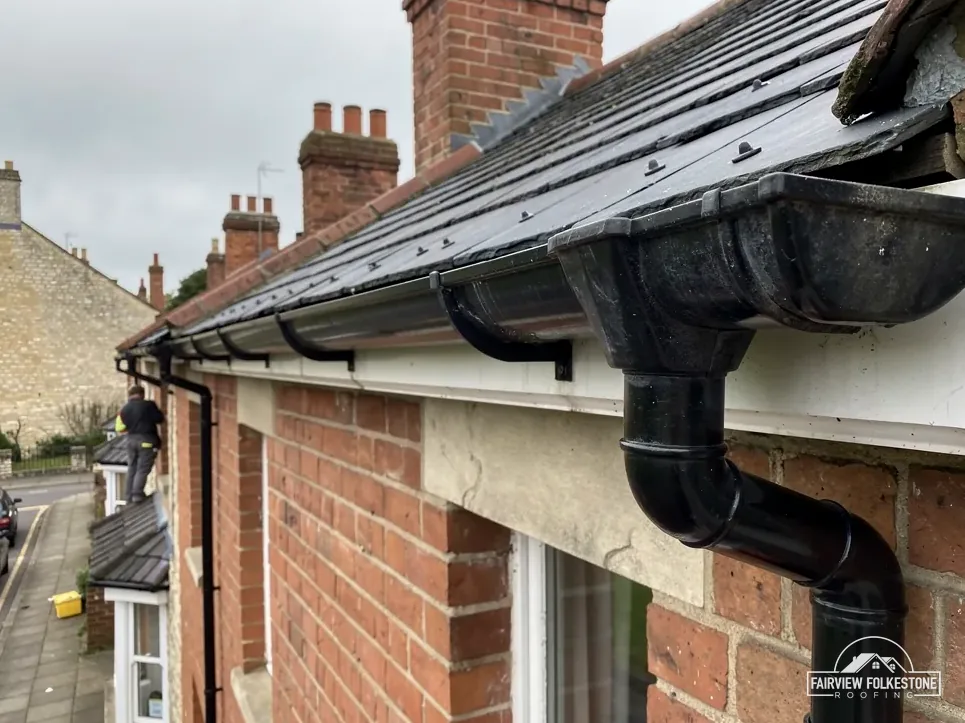
Plastic guttering is joined with union clips that carry a rubber seal. Over the years the seal hardens and stops gripping, or the gutter contracts in cold weather and pulls a short way out of the clip. Grit lodged under the seal does the same. Sealant smeared over the outside holds the drip back for a while, but the lasting repair is to open the joint, clean both ends and fit a new union. Where a joint has dropped as well as leaked, the bracket beside it is re-set at the same time. Our answer on how a leaking gutter joint is fixed takes it step by step.
Downpipes block at the bends. The swan neck, the offset that takes the pipe from the outlet back to the wall, catches leaves and clumps of moss. At the foot, the shoe or the gully grid silts up and water backs up the pipe and out of its joints. A damp streak on the wall behind a downpipe can mean a split in the back of the pipe, out of sight from the garden. We rod the pipe through, check each bracket holding it to the wall and replace a split length. The guide to clearing a blocked downpipe covers what you can safely do from the ground.
Send us a photo of the drip or the damp patch
Ask what it needsHoppers and shared downpipes
On older houses and on converted flats, two or three gutters can feed one hopper, the open box at the top of a downpipe that collects water from more than one run. A hopper fills with leaves faster than a plain outlet, and when it backs up the water spills down the wall rather than over the gutter, so the damp shows lower down. We clear it, check that its outlet into the pipe is open and look at the brickwork below for staining.
Where houses in a terrace share a downpipe on the party line, the drip may start on your side and the blockage sit on your neighbour's. We tell you where the fault is before any work starts, so the repair goes to the right run.
A downpipe that empties onto a path instead of into a gully splashes the base of the wall each time it rains. A shoe at the foot, or a short run to the drain, carries the water clear of the brickwork.
Entry 03Cast iron
Cast-iron gutters: keep the run you have, or replace it?
Cast iron can be repaired a section at a time. What we have to find out is how far rust has gone into the metal.
Paint, rust and bolted joints
A cast-iron gutter is made of heavy sections bolted together, with a sealing compound in each joint. When the paint fails, rust starts on the outside, where you can see it, and on the inside, where water lies after every shower and you cannot. So we look inside the run as well as along its face. Surface rust under flaking paint is wire-brushed, primed and painted, inside and out. A joint that drips is unbolted, cleaned back to bare metal, resealed and fixed with a new bolt, and that may be all an old run needs.
Rust that has eaten through the metal is a different matter. One holed section can be cut out and a matching length fitted, as long as the profile can still be found. Where holes and splits run the length of the gutter, a new run is the sounder spend. Weight matters too: a rusted bracket, or one loose in the masonry, lets a heavy section drop, so we check the fixing on every length and replace any bracket that has thinned. Cast iron painted over many times can hide a split under the layers, so we tap along it and look for weeping at the joints.
Myth: Rust on a cast-iron gutter means the whole run is finished.
Fact: Surface rust under failed paint is cleaned back and repainted; only metal rusted right through needs a new section.
Paint flaking, metal still solid
Clean back, prime and paint
One joint dripping between sections
Unbolt, reseal, new bolt
Holes and splits along the run
A new gutter run
Choosing a material to replace cast iron
Replacing cast iron does not have to mean plastic. New cast-iron gutters are still made, and there are aluminium and plastic systems shaped to match the old profiles. Each choice changes the weight on the brackets, the look from the street and how much painting the run needs in future, and we set those out side by side before you choose. Aluminium comes with a factory-coated finish, while plastic is quicker to fit, though it moves more with heat and cold.
On a listed house, anything touching the building's character needs listed building consent, so a change of gutter material is checked with the council before anything is ordered. In a conservation area an Article 4 direction can remove further rights, so we check with the council there too. Our answer on repairing or replacing cast-iron gutters goes into the choice in more detail.
What sets the price
- Capping over, or full replacement
- How many elevations and gables
- Rafter ends that need repair
- Scaffold to reach the eaves
One written total price
Entry 04Fascias
Rotten fascia boards, and why capping over them can hide rot
The fascia is the board along the rafter ends that carries the gutter. If the timber is soft, covering it in plastic only hides the problem.
What capping over does, and what it hides
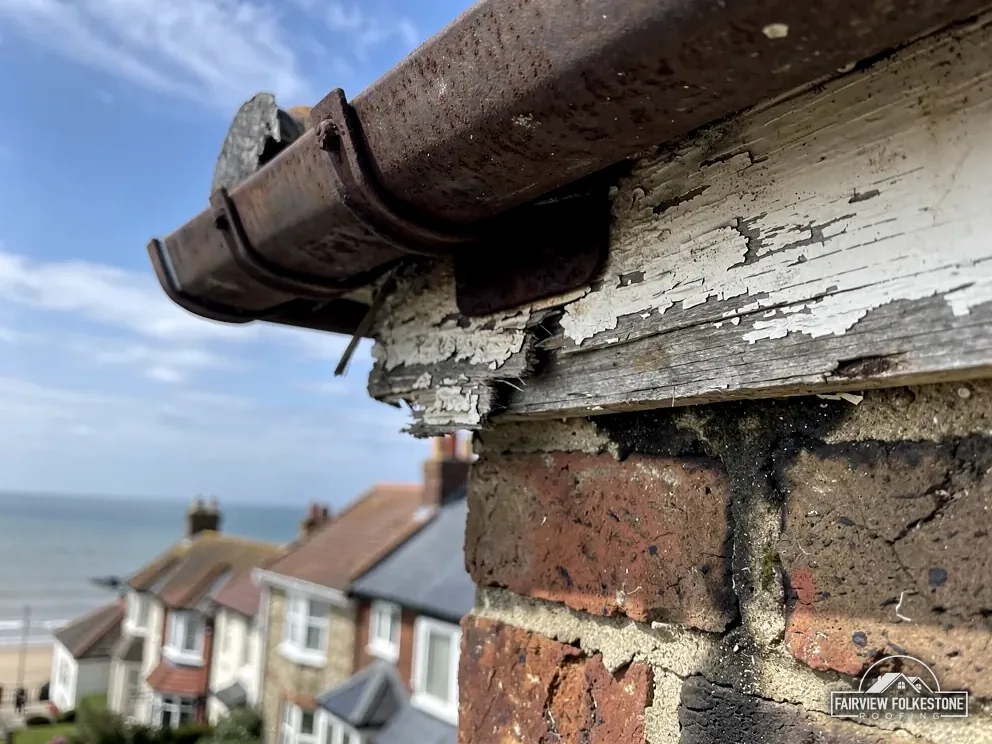
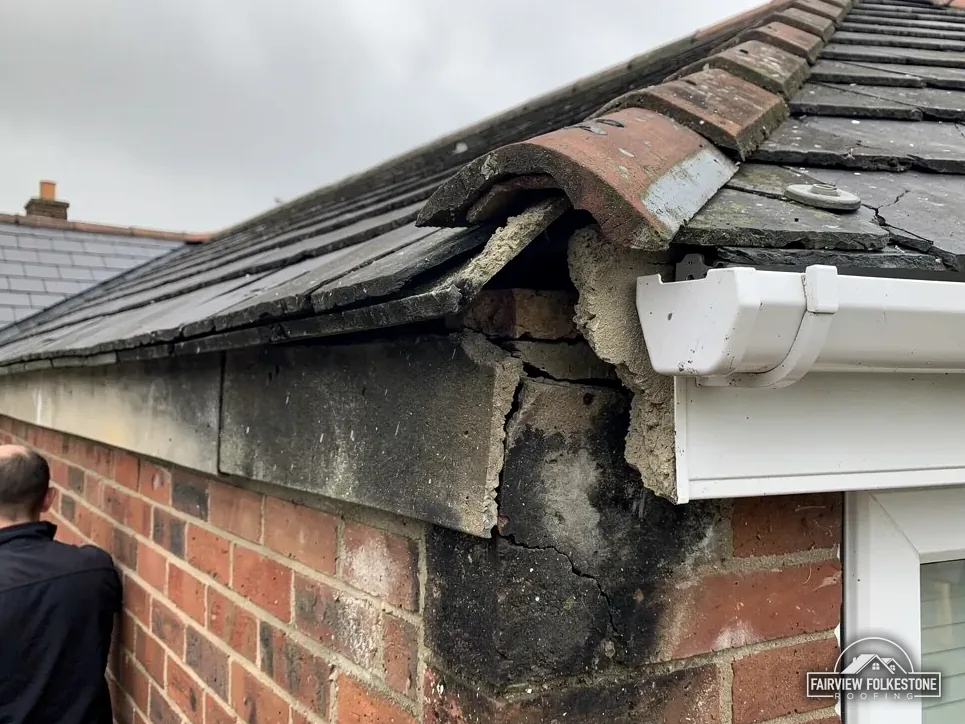
Capping is a thin uPVC cover fitted over the old timber fascia, so the board looks new without coming down. On timber that is dry and firm, it is a fair way to end repainting. On timber that is already wet or soft, it hides the rot, holds damp against the wood and leaves the gutter brackets screwed into boards that are failing behind the plastic.
So before we price either route, we test the existing boards. A blade pushed into the timber at the joints and at the low points shows whether it is sound. We also look at the rafter ends behind the fascia, because water running behind a leaking gutter for years can reach them as well. Where a soffit has to come down to reach those rafter ends, it is replaced in the same visit.
Full replacement takes the old fascia and soffit down, lets us see and repair the rafter ends, and fixes new uPVC fascia boards to the rafter feet. A retailer of the boards says uPVC fascias, when installed correctly, can typically maintain reliable performance for between 20 and 40 years. Our answer on whether capping over is a false economy sets the two routes side by side.
Fascia firm, paint flaking
Capping is a fair option
Fascia soft at the joints
New fascia boards
Rafter ends wet behind the board
Open up and assess
Can new gutters go back on my old fascia?
Yes, if the timber is firm right along its length. If it is soft at the joints, new brackets will pull out the way the old ones did, so we would replace the board first and fit the gutter to that.
Bargeboards along the gable
On a gable end the same job runs up the slope. The bargeboard is the board fixed along the edge of the gable, under the verge where the roof covering stops, and it takes the weather side-on. We test it at the joints and at its lower ends, where water collects.
Replacing a bargeboard can mean lifting the verge, so the verge mortar or dry verge is looked at in the same visit, and the tiles themselves belong with our pitched roofing work. Where a gable carries a decorative timber bargeboard, it can be repaired and painted rather than swapped for a plain white board, and we ask which you would prefer before pricing. At a gable return, the short stretch where the eaves turn the corner onto the gable, the fascia, soffit and bargeboard meet, so all three are measured together.
Entry 05Soffits
Old soffit boards: find out what they are before anything is cut
The soffit closes the gap under the eaves between the fascia and the wall. On an older house, the first question is what the board is made of.
How do I know if my soffits contain asbestos?
Not by looking at them. A small sample, taken with care and tested by a laboratory, gives the answer, and it comes before any price for the work. Until then the board is left whole and undisturbed, and nobody drills or screws into it to fix a gutter bracket.
Asbestos in soffits and rainwater goods
HSE lists AIB white soffit panels to the underside of roof eaves, and damaged AIB soffits, among the places asbestos insulating board is found. Its advice for any building built or refurbished before 2000 is to assume asbestos is present. So on a house of that age we leave an old flat soffit board uncut until its material is known, and a sample is tested first. From below, an old cement or AIB board can pass for painted timber, which is one more reason the sample decides it. The HSE page on where asbestos is found shows soffits alongside the other places it was used.
The result decides the route. Most work on AIB is licensed work; short-duration removal of AIB as part of a refurbishment is notifiable non-licensed work. Asbestos cement is different: HSE names rainwater goods among the cement products whose careful removal, without breaking them up, is non-licensed work. That matters for old grey gutters and downpipes that look like plastic from the ground but are heavier and harder. Asbestos waste goes in a lockable skip and never an open one, and the consignment-note exemption does not extend to household asbestos.
2000
HSE: if a building was built or refurbished before 2000, assume asbestos is present
On an older house, a soffit board is tested before anyone cuts it.
What a soffit does for the roof
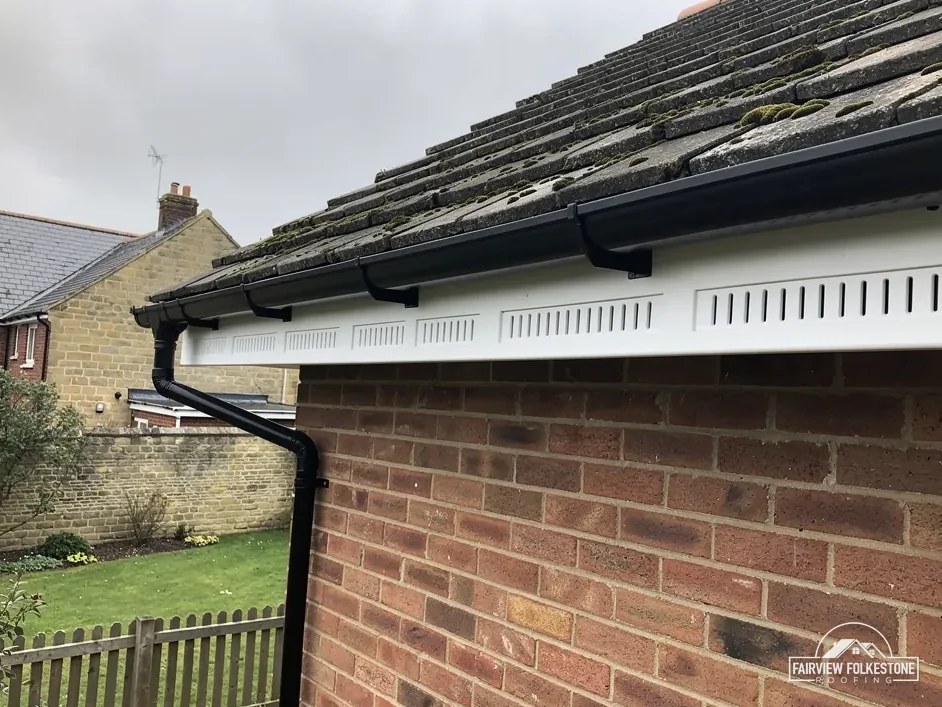
Besides closing the eaves to birds and weather, the soffit is where air enters the roof space on a cold roof, through vents in the board or a gap at its edge. Any replacement soffit has to keep that airflow, and the figures for it come with the full replacement below.
A soffit that has split, sagged or come away at one end also lets birds, wasps and squirrels into the roof space. Where the board itself is sound, refixing it and closing the gap is a small repair. Where it has gone soft or broken along its length, it is replaced with the fascia, so the two are fixed together and line up. Where the loft has been insulated since the soffits went up, we look from inside the loft to see that insulation has not been pushed into the eaves and closed off the vents.
What a full replacement covers
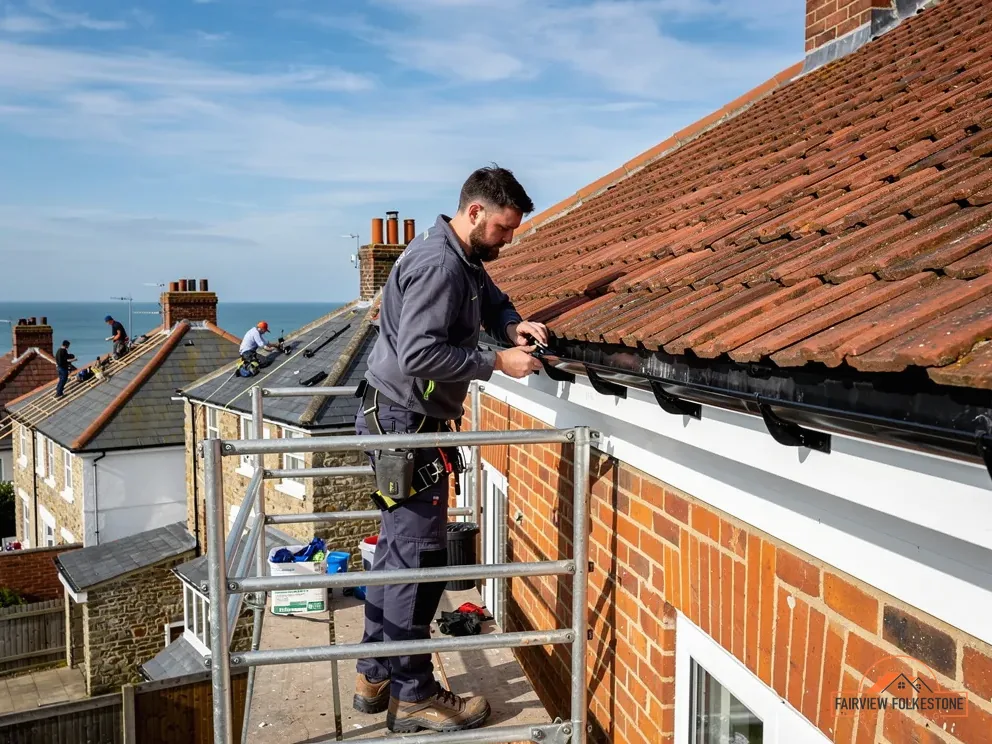
A full roofline job takes down the gutters, downpipes, fascias and soffits on each elevation that needs them, and puts back a matched system. With the old boards off, we check the rafter feet and repair any that are wet or split before the new uPVC fascia goes on. The foot of the roof underlay gets the same look: where old felt has perished at the eaves, an eaves support tray or a strip of new underlay dressed into the gutter carries water that gets under the tiles out into the gutter, clear of the fascia. On a semi or a terrace the run stops at the party line, and we finish it with a stop end or a joint onto the neighbouring gutter, agreed beforehand.
Ventilation comes next. For a cold roof laid with high-resistance underlay, Marley gives 25 mm of eaves ventilation for pitches of 15 degrees or less and 10 mm above 15 degrees. That underlay is not vapour-permeable, so that gap is how the roof space breathes. A vented soffit or an over-fascia vent provides it, and loft insulation pushed hard into the eaves must not block it. The quote states which ventilation the new roofline carries, and the old boards and gutters leave site with us.
Entry 06Whole roofline
A full roofline replacement, and keeping the roof ventilated
When the boards are soft along every elevation and the gutters leak at every joint, replacing the whole eaves line is the sound answer.
Soft fascias on every elevation
Full roofline replacement
Perished felt at the eaves
Eaves tray or new underlay
Nest in use behind a soffit
Wait until it is empty
What sets the price
- How many elevations, and how high
- Gutters and downpipes in the new run
- Rafter feet and eaves underlay
- Ventilation to the roof space
One written total price
Nesting birds and bats in the eaves
Eaves are where birds nest and bats roost, and the law protects both. Section 1 of the Wildlife and Countryside Act 1981 makes a person guilty of an offence if they intentionally take, damage or destroy a wild bird's nest while it is in use or being built, and GOV.UK says there are no licensing purposes to permit development or construction for wild birds. Bats are covered more tightly still: every species and its roosts are fully protected, and for a roost, damage or destruction is an offence even without intent.
So we look for nests and signs of bats before the boards come down. If a nest is in use, work on that stretch of eaves waits until it is empty; if there are signs of bats, work stops and advice is taken before going further. Planning the job around that, rather than finding it on the day, is why we look first. If the job has to pause, the open stretch is closed up for the meantime, so rain and birds stay out until we return. Our answer on bats and nesting birds in soffits covers what that means for timing.
- New fascia on the rafter feet
- Gutter on fresh brackets
- Underlay dressed into the gutter
- Vented soffit board
Not sure which of these is your roofline? Send us a photo.
A photo of the gutter or the eaves is enough to start. Then comes a visit, a verdict with its reasons, and one written total price.
Gutter, fascia and soffit questions
Prices, lifespans, timing and scaffold for roofline work in Folkestone and across Kent.
What does it cost to replace fascias, soffits and guttering?
MyJobQuote, a cost guide, gives two national averages: the average gutter replacement in the UK at around £1,000 to £1,600, and the average cost of capping fascias and soffits at around £800. They are guide figures, not prices for your house. On a real roofline the price moves with the number of elevations, the height of the eaves, capping or full replacement, rafter ends that need repair, and access. After we have looked, you get one written total price. If you hold other quotes, ask each one to state whether VAT and scaffold are in its figure.
How long do uPVC fascias and soffits last?
A retailer of uPVC roofline products says that, when installed correctly, they can typically maintain reliable performance for between 20 and 40 years. That is a range, not a promise, and the words that matter are "installed correctly": boards fixed to sound rafter feet, the gutter on firm brackets, the eaves ventilated. Capping fitted over timber that was already damp is a different case, as the plastic can look fine for years while the wood behind it softens. On an existing uPVC roofline we check the fixings, the joints and the timber behind, not just the white face.
Does a four-bedroom detached house cost more than a smaller home?
Yes, because there is more of everything: more metres of eaves, more downpipes, gable ends with bargeboards, and four sides to reach. Height matters as much as length. A three-storey front needs a taller scaffold than a two-storey one, and a bay or a porch roof under the eaves changes how the scaffold is set out. Each elevation is measured at the survey, and we note the boards that are sound and the ones that are not. The quote then covers the whole house in one figure, so you can see what is included and what was left alone.
What does it cost to have gutters cleared out?
Which? Trusted Traders put clearing out all the gutters at the front and back of a property at £75 to £350, from prices gathered in November 2025 that exclude VAT. Which? adds that South East prices are likely to sit at the upper end, and Kent and East Sussex both fall in the South East. Where your house falls in that range depends on its height, the length of the runs and how much has built up. A clear is also the moment to spot a dropped bracket or a soft fascia, so we report what we saw.
Do you supply and fit new gutters, fascias and soffits?
Yes. We carry out installation and repair across the whole roofline: uPVC guttering and downpipes, cast-iron gutter repairs and replacement, uPVC fascias, soffits and bargeboards, and capping where the timber underneath is sound. Materials are supplied as part of the job. On a full replacement we take the old system down, check and repair the rafter feet, fit the new boards and gutter, connect the downpipes and leave the site clean. If part of the job is not needed, such as replacing a fascia that is still firm, it stays out of the quote, and we explain why.
How long does a fascia, soffit and gutter replacement take?
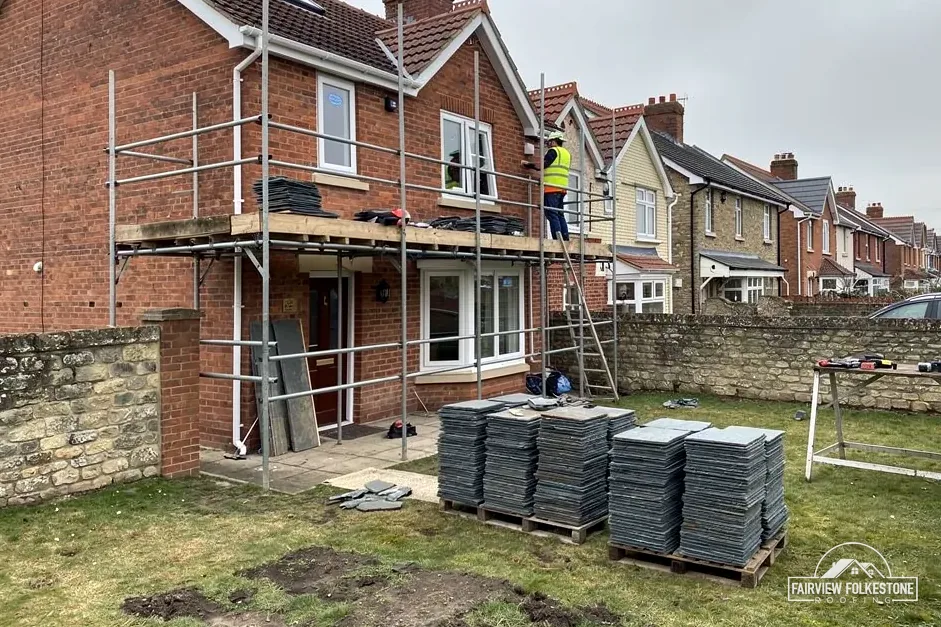
It depends on the size of the house and the number of elevations, so the timescale comes with the quote. Three things decide it. First the scaffold: for Kent addresses, Kent County Council says all applications for a licence, including renewals, should be submitted 5 working days before the licence is due to start. Then the weather, as new boards and gutters go up in dry spells where we can manage it. Then anything found behind the old boards, such as wet rafter ends or a nest in use, which has to be dealt with or waited out.
Do I need scaffolding to replace fascias and soffits?
For a full replacement on a two-storey house, yes: the work runs along each elevation at eaves height, and scaffold gives a steady platform. A short repair on a low eaves may be reached from a ladder. A scaffold standing on the pavement or road needs a licence. On the highway, scaffolding is licensed by Kent County Council at £52 per week for 2026 to 2027. For Rye and Camber, the East Sussex Highways fee table shows £127 for 28 days, though the current fee needs confirming. We arrange the licence with our scaffolder, and scaffold is in the price.
Which towns around Folkestone do you cover for roofline work?
We work up to 30 road miles from Folkestone, across south-east Kent and into East Sussex. Close to home that means Sandgate, Hawkinge and Hythe; along the coast, Dover and Deal; inland, Ashford and Tenterden; up north, Canterbury with Whitstable and Herne Bay; and down on the marsh, New Romney and Romney Marsh, then Rye and Camber across the county line. The local council and the scaffold licence change from place to place, but the roofline work itself is the same. Tell us the town when you send a photo of the gutter or eaves.
Tell us what's wrong with the roof.
You'll get one written total price.