
Garage roofs · Folkestone
Garage roof replacement in Folkestone
Local garage roof work across Folkestone and east Kent: felt, rubber, fibreglass and sheet roofs, old asbestos-cement sheets included. You hear whether yours needs patching or renewing, and the reason.
10-year workmanship guarantee, in writing
Before you replace a garage roof
All guides
The fair ledger
Six garage roof faults, and what each one needs
From a split felt seam to a roof of old cement sheets, these are the garage roof faults we check for, with the verdict on each and the reasons behind it.
Entry 01Felt
Split and blistered felt on a flat garage roof
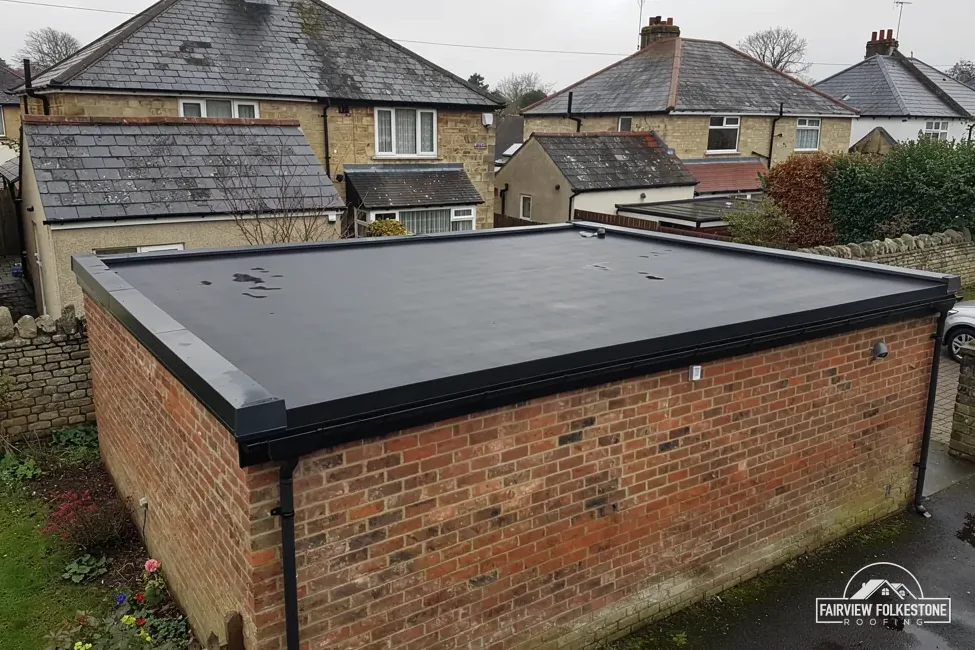
A split seam or a lifted edge on a felt garage roof lets rain into the boards below. Caught while those boards are still dry, it is a patch, not a new roof.
Reading a felt roof from the ladder
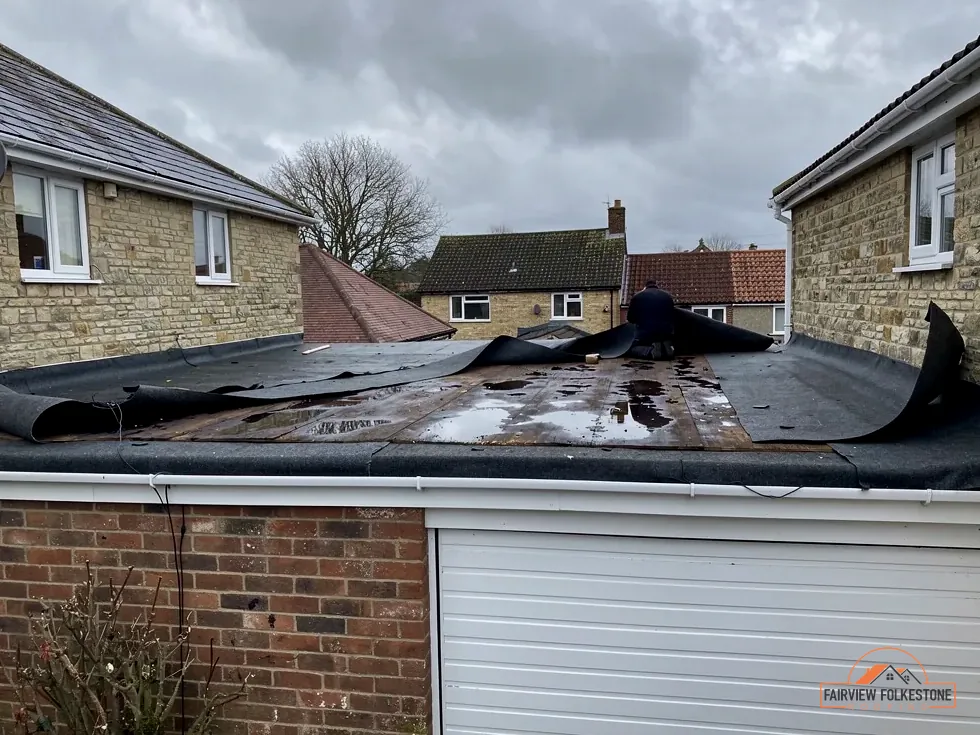
A felt garage roof is bitumen sheet bonded to a timber deck in two or three layers, the top one finished with mineral chippings. Torch-on felt is the modern form: the underside of each roll is softened with a gas torch so it fuses to the layer beneath. When we look at one, we start at the edges and work in. The signs we note are splits along the laps where two sheets overlap, blisters where air or damp is trapped between layers, bald patches where the chippings have washed off and the bitumen has gone dull and crazed, and drip trims lifting at the front.
None of those on its own means the roof is finished. A split along one lap, on a deck that is still firm underfoot, can be cut back, dried and patched in matching felt. A blister that has not broken can be left and watched, or cut open and sealed. What changes the verdict is the deck. If the boards are dry and firm, a repair is sound. If they flex, smell damp or have stained the ceiling of an attached garage, water has been getting in for a while, and a patch on top would only hide it.
- Timber deck boards
- Felt layers bonded down
- Upstand against the house wall
- Drip trim on the front edge
The upstand and the drip trim are the two edges we check before the middle.
Myth: A blister in garage felt means the whole roof has to go.
Fact: An unbroken blister on a firm, dry deck can be left and watched, or opened and sealed.
1:80
minimum finished fall BS 6229:2025 sets for membrane flat roofs
Designed steeper, to allow for tolerances
Can a felt garage roof be patched more than once?
Yes, while the deck stays firm and each patch mends a separate fault. Once splits and bald patches run across the whole roof, every new patch sits beside the next failure, and a new covering is the better use of the money.
Where an attached garage meets the house
An attached garage has one more weak point: the upstand, the strip of covering turned up the house wall, and the flashing that seals its top edge. Where the felt has pulled away from the brickwork, or the mortar joint holding the flashing has opened, rain runs down behind the roof and shows on the garage ceiling or the inside face of the wall. That reads like a roof leak, yet the felt across the middle may be sound.
So we check that joint before pricing anything. Re-dressing the upstand and renewing the flashing over it is a repair. Where the felt is brittle along the whole wall and across the roof as well, the written verdict tells you, because the joint and the covering then need renewing together. After storm damage, the front drip trim and the felt at the low edge are where we look first, since a lifted edge lets wind get under the sheet and peel it back. A loose trim refixed early keeps the felt behind it flat. Inside, we look for drips around any light fitting or cable that passes up through the deck, since those holes can let water through a sound roof. The same faults on a house extension are covered on our flat roofing page.
Can you tell asbestos cement from fibre cement by looking?
Not with any certainty. The two look alike from the ground and from a ladder. A sample from one sheet goes for testing, or the garage is included in an asbestos survey, and until the result is back nobody breaks or drills the sheets.
Entry 02Cement sheets
Corrugated cement sheets, and whether they contain asbestos
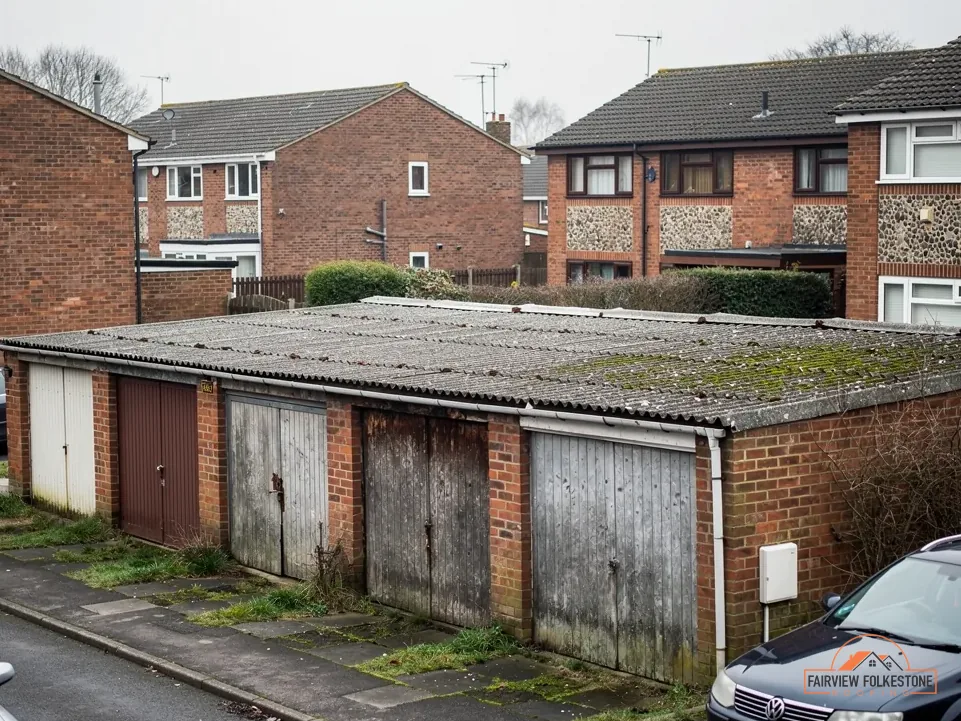
Grey corrugated sheets on a garage may be plain fibre cement or asbestos cement. From the ground they look alike, so we treat them as asbestos until a test says otherwise.
What the sheets show
Sheets whole and weathered, no cracks
Lift whole, non-licensed work
Sheets substantially damaged or broken up
Notifiable non-licensed work
White board panels in the eaves
Test before anything moves
2000
HSE: if a building was built or refurbished before 2000, assume asbestos is present
What the garage's age tells us
Asbestos cement is cement reinforced with asbestos fibres, pressed into corrugated or flat sheets and cast into gutters and downpipes. Newer fibre cement sheet looks much the same from a ladder. HSE's advice to anyone working on a building is clear: if it was built or refurbished before 2000, assume that there is asbestos in it. We apply that to every garage roof until the sheet has been identified.
The garage's age is the first clue, so we ask when it went up or was last re-roofed, and whether there is any paperwork from the sale of the house. A sectional concrete garage, a timber garage with a sheet roof and a brick garage under corrugated sheets can all carry asbestos cement. If the date is unknown, or before 2000, the next step is a sample from one sheet sent for testing, or an asbestos survey, before any sheet is cut, drilled or lifted. Our answer on how to tell if a garage roof contains asbestos sets out what a sample involves.
An older garage roof may have been patched over the years with a newer sheet or two, so one test does not always speak for the whole roof. Where the sheets differ in colour, profile or age, each kind is sampled.
Send us a photo of the garage roof
Ask for a verdictWhite boards under the eaves
The sheets are not the only thing we check. HSE's list of places asbestos turns up includes asbestos insulating board, AIB for short, as white soffit panels on the underside of roof eaves, and a pitched garage with boxed eaves can carry it. HSE treats AIB differently from cement sheet: most work on it is licensed work. If the survey finds AIB on your garage, we leave it untouched and tell you in writing before we price the roof, so you can decide how it is dealt with.
The test result shapes the whole job. Sheets that come back clear are plain fibre cement: they can be cut, drilled and replaced one at a time, and a single cracked sheet is a repair. Sheets that come back as asbestos cement are planned as a removal, with wrapping, a lockable skip and a consignment note built in from the start. Either way, you see the result before you see a price, and the written quote names which route it follows. Even when the roof is coming off anyway, the test matters: it decides how the sheets are lifted, where the waste goes, and which of HSE's categories the work falls in.
Entry 03Sheet removal
Taking asbestos-cement sheets off a garage in one piece
When the sheets are asbestos cement, the way they come off decides how the job is classed. Whole sheets, lowered by hand, keep it within HSE's non-licensed category.
How whole sheets come down
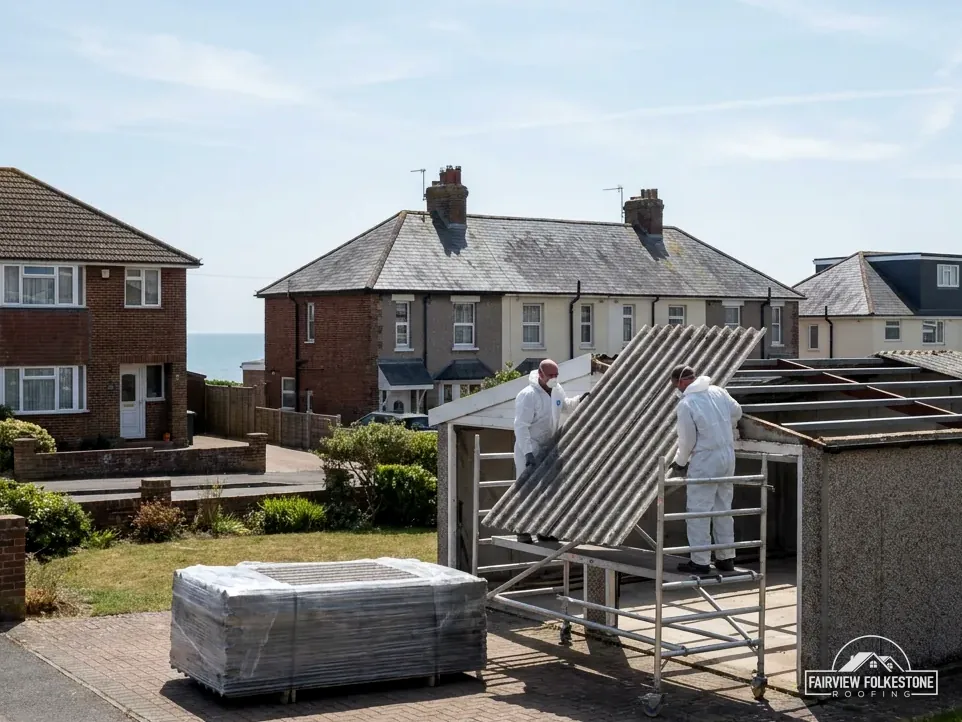
HSE classes the careful removal of asbestos-cement roof sheeting as non-licensed work, provided the material is handled and removed without breaking up. Weathered sheets count too, so long as they are not otherwise substantially damaged. The whole job is planned around that line. The fixings are cut or unscrewed rather than the sheets being levered off, each sheet is lowered whole, and every one is wrapped in heavy-duty plastic as it comes down.
HSE also says asbestos-cement roofs are always fragile, so nobody stands or kneels on the sheets. We work from staging and from below, never from the sheet surface. Where sheets are already substantially damaged or broken up, whether by a fallen branch, a fire or a flood, HSE puts the work into a different category, notifiable non-licensed work. We tell you that before we start, because it changes how the job is run and recorded. A garage roof that was damaged in a storm or a fire gets that check before anyone goes near it.
Once the last sheet is down, the timbers underneath are checked, the ground around the garage is cleared of any fragments, and the new roof goes on over sound timbers. Nothing from the old roof is left in the garage or on the drive.
Myth: Old cement garage sheets can go out with the general rubbish.
Fact: HSE says to use a lockable skip for asbestos, and household asbestos is outside the consignment-note exemption.
5 sacks
Kent County Council's free monthly limit for householders' own asbestos at its tips
Double wrapped; not at Sheerness
Would breaking the sheets get the roof off faster?
It would move the job into notifiable non-licensed work under HSE's rules, so every sheet comes off whole. The fixings are cut or unscrewed, and each sheet is lowered by hand and wrapped before the next one is touched.
Where the old sheets go
Asbestos waste from a roofing job is never general rubbish. HSE's guidance is to use a lockable skip for asbestos; an open skip is never enough, even with sheeting thrown over it. The household exemption from consignment notes covers domestic hazardous waste other than asbestos waste, so the sheets from your garage leave on a consignment note as trade waste, and whoever carries the load must be on the GOV.UK register of waste carriers.
Kent County Council's tips do take asbestos, apart from Sheerness, but only a householder's own small amounts, double wrapped, and only the first 5 sacks a month are free. That route suits a few sheets you have taken down yourself, not a whole garage roof we remove, and our answer on asbestos disposal in Kent covers both. Removal and disposal sit inside the written quote, so the price you agree already includes taking the old roof away.
The consignment note travels with the waste and records where it ended up. Ask for a copy once the job is done and keep it with the house papers: it shows a future buyer, or their surveyor, that the old sheets went to a site that takes asbestos.
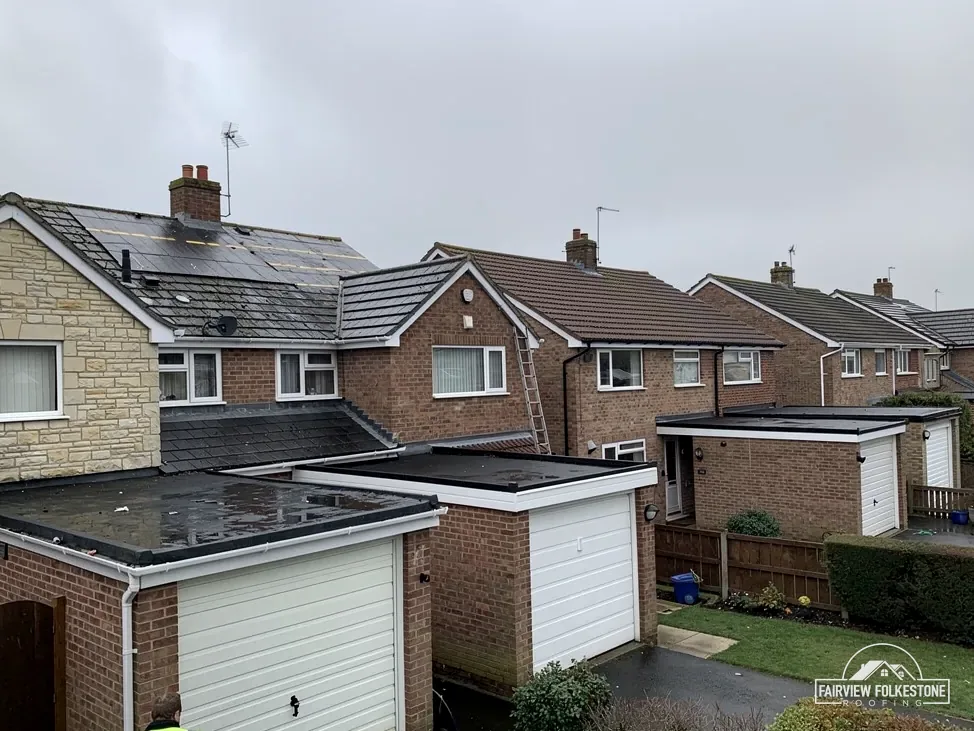
What sets the price of garage gutters
- Length of gutter and number of downpipes
- Cement lengths to lift whole
- The state of the fascia behind
- New trims along the roof edge
One written total price
Entry 04Gutters
Gutters and downpipes on a garage, cement or plastic
Rain off a garage roof has to go somewhere. A gutter that has dropped, or a downpipe that is blocked, sends it down the wall and under the door instead.
Falls, joints and cement rainwater goods
A garage gutter does the same job as one on the house, on a smaller scale. It needs a steady fall towards the outlet, and Brett Martin, a gutter maker, advises 1 mm for every 600 mm. Where a bracket has rusted through or the fascia behind it has softened, the gutter sags, water sits in the dip and spills over at the nearest joint. We check the fall with a level, look at every joint and bracket, and run water through the run.
Older garages can have cement gutters and downpipes rather than plastic. HSE lists asbestos-cement rainwater goods alongside roof sheeting as non-licensed work when they are removed carefully without breaking up, so they get the same care as the sheets: lifted whole and wrapped. When the roof is replaced, the gutter goes with it, and the new one is plastic. Where a gutter is fixed to the edge of an untested cement sheet rather than a fascia, nobody drills that sheet for new brackets; the gutter waits for the test result.
A gutter on its own is a repair: new brackets, the fall reset, a leaking joint resealed or a cracked length swapped. It needs a new roof only when the roof edge it hangs from has failed.
One sagging length, brackets rusted
New brackets, fall reset
Cement gutter cracked along its run
Lift whole, fit plastic
- Bracket on the fascia
- Joint that has dropped
- Outlet into the downpipe
One dropped joint can spill water down the garage wall every time it rains.
When the gutter is the leak
On a flat garage roof the gutter runs along the low edge, under the drip trim, the edge strip that throws water clear of the fascia. If the trim stops short of the gutter, or the gutter has dropped away from it, water runs behind, soaks the fascia board and shows inside as a damp stripe along the top of the wall. From the ground that looks like a roof leak, and on a garage with a felt roof only a few years old it is worth ruling out first. Before we price a new roof for a damp garage, we rule out the gutter, the trim and the downpipe, since each is a repair on its own.
A downpipe that empties against the garage wall, or into a blocked gully, can wet the base of the wall and the floor inside, and that is not a roof fault at all. Clearing the gully or adding a shoe to turn the water away is a small job. If the garage downpipe feeds the house drains and that drain is blocked, water can back up and show at the downpipe joint, so the gully gets a look on the same visit. Gutters and fascias on the house itself are on our gutters, soffits and fascias page.
Entry 05New covering
Choosing what goes on a flat garage roof next
When the deck has gone soft, or the felt has failed right across, the question becomes what goes on next. Each covering lays differently and lasts a different length of time.
Can the new roof have a better fall than the old one?
Yes. With the old deck off, we fix tapered firrings, timber strips cut to a slope, along the joists before the new boards go down. That builds the fall into the structure, so rain runs to the gutter rather than sitting in a dip.
How the three coverings compare
EPDM is a synthetic rubber membrane laid in one sheet over the deck, bonded down, with trims at the edges, so a single garage can be covered without a join in the middle. GRP, glass-reinforced plastic or fibreglass, is laid wet: resin and glass matting over new boards, then a coloured topcoat that cures hard, with formed trims at the edges. Torch-on felt is two or three bitumen layers fused to the deck and to each other. The look differs too, which counts on a garage seen from the house: EPDM is black, a GRP topcoat comes in a choice of colours, and felt carries its mineral finish.
Published lifespans differ by source. HomeBuilding gives EPDM 25-30 years, GRP 25-30 years and felt 10-15 years. Less gives torch-on felt 10 to 20 years depending on quality and installation, EPDM 30 to 50 years, and GRP 25 to 40 years with minimal maintenance. Which suits your garage depends on how it is used, whether you will walk on the roof, its shape, and how the edges meet the house. Our guide to the best material for a garage roof goes through each one, with the edge details that suit a garage joined to the house.
30 to 50 years
Less: EPDM rubber membrane typically lasts 30 to 50 years
HomeBuilding gives 25-30 years
A new covering only lasts as long as the boards and the fall beneath it.
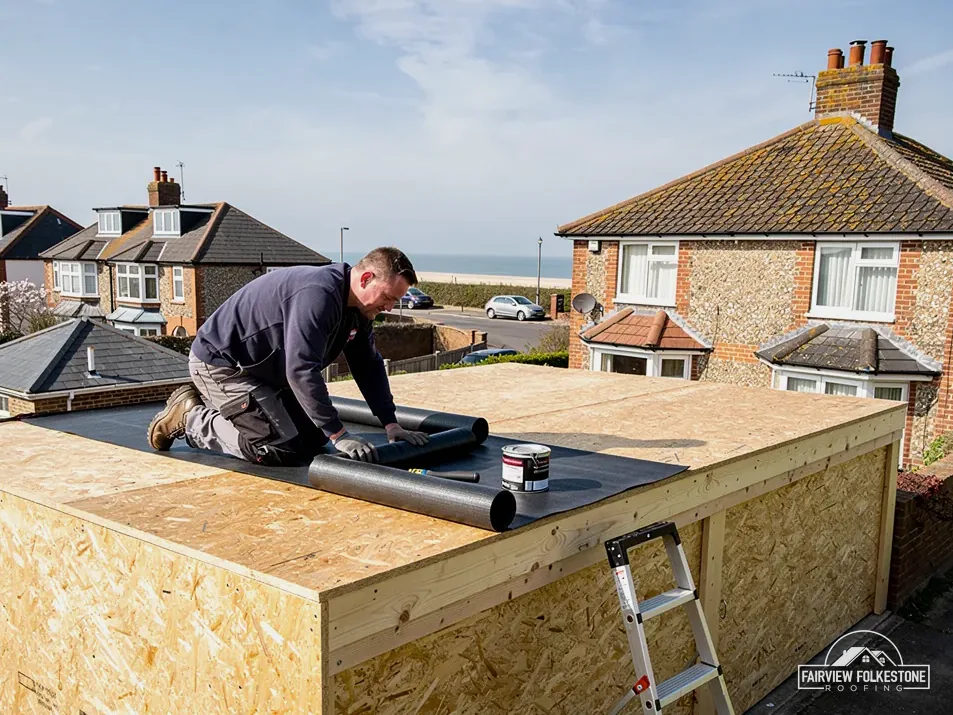
Spending less without cutting corners
On Which?'s single-garage figures, felt laid over the existing structure starts lower than rubber on new boards, and on both sources' lifespans it also lasts less long, so the lower price buys fewer years. The bigger saving is keeping what is sound: firm joists stay, sound fascias stay, and only the soft boards are renewed. Our answer on the lowest-cost ways to replace a garage roof weighs it up. The saving has a limit, though. New boards laid on a joist that sags or has rotted at the wall end give a roof that holds water in the middle from the first rain, so a failing joist is renewed, and you hear about it before the work rather than after.
If the garage doubles as a workshop or a gym, think about insulation while the deck is off. Boards laid straight on the joists leave the space as cold as before; insulation laid over the deck, under the new covering, keeps it warmer without lowering the ceiling. Whether it is worth paying for depends on how you use the garage, and we set out both options side by side in the quote. A garage used only for the car may not need it at all.
What we fit in place of the old sheets
Once the old sheets are down, the purlins and rafters they were fixed to are in plain view. We check each one for rot at the ends and sag along its length, and replace or add timbers before anything new goes up. Then there are three routes. New fibre cement or steel box-profile sheets go back on the same timbers, fixed through the crown of the corrugation with sealed fixings and lapped to suit the slope. Clear sheets can take the place of one or two of them to bring daylight in. Where the slope meets a house wall, a flashing seals the top edge, as it does on a flat roof. Or the roof can be boarded and covered in a membrane, turning a shallow sheet roof into a flat-roof build-up with a proper fall.
Steel sheets can be ordered with an anti-condensation backing, which is worth having over a garage used for storage, where bare steel above a cold space can drip onto whatever is stored below. We tell you which sheet we would fit and why. What each route costs is in our guide to garage roof replacement cost, and mending against renewing is in our repair or replace guide.
Entry 06Sloping sheets
Replacing a corrugated sheet roof on a sloping garage
Not every garage roof is flat. Corrugated sheet roofs on a single slope or a shallow ridge come off and go back on in their own way, and the timbers under them get a look first.
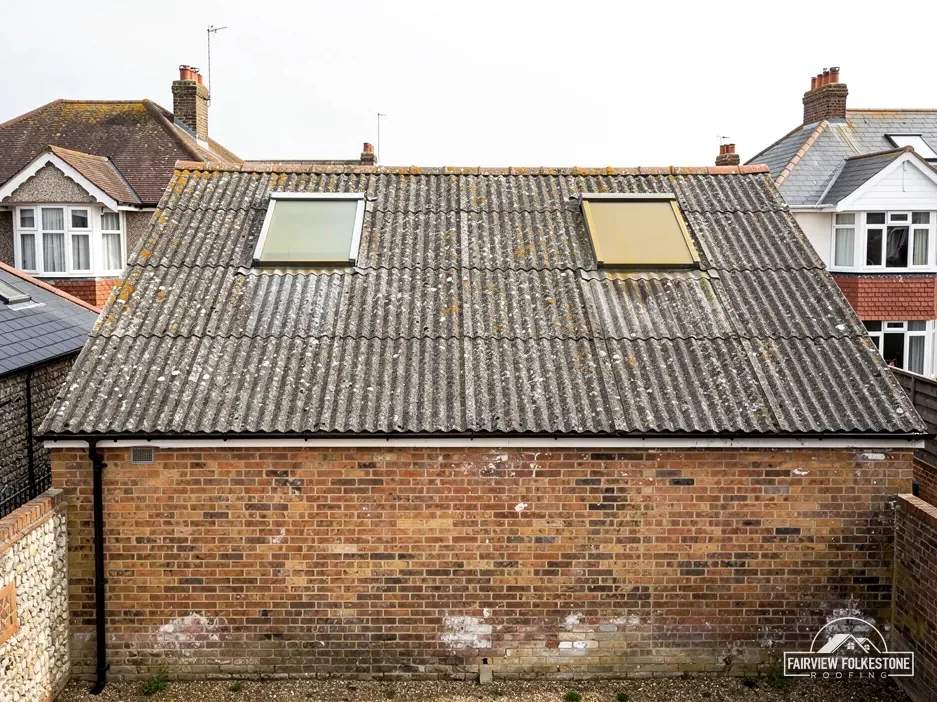
Purlins sound, sheets weathered all over
New sheets, same timbers
Purlin ends soft at the wall
New timbers, then sheets
One cracked fibre cement sheet, tested clear
Swap that sheet
What sets the price
- Size and slope of the roof
- Whether the old sheets are asbestos cement
- Timbers to replace or add
- Sheet type and clear panels
One written total price
Garages in a row or against a neighbour's wall
Garages built in a block, or against a neighbour's wall, raise one more question. Where the new roof needs a flashing cut into the wall of the adjoining owner's building, that is one of the rights the Party Wall etc. Act 1996 gives a building owner, and it is the building owner who serves notice on the neighbour, at least 2 months before work begins on it. Your neighbour may consent in writing to a sooner start, and a surveyor comes in only if they dissent or do not reply within 14 days.
On a block of garages with separate owners, each roof is its own job, and the joint between yours and the next is where we take the most care: the new covering is dressed over the dividing wall or sealed to the neighbour's roof, so neither roof sends rain into the other. If the neighbouring roof is failing too, we point it out, and two owners sometimes choose to have both done together. Where your garage sits in a row on a shared drive, we agree with you beforehand where the wrapped sheets or the skip will stand, and how we reach the roof without crossing other owners' plots.
Not sure what your garage roof is made of, or what it needs?
Photograph the roof, its edges and the ceiling under it, and send them over. We look, tell you what it needs and why, and give one written total price.
Garage roof prices, asbestos sheets and the rules
Short answers on cost, disposal, safety duties and scaffold licences, with the source of every figure named.
What does a garage roof replacement cost in the UK?
MyJobQuote says that in 2026 the average garage roof replacement costs between £750 and £3,500. Which? Trusted Traders priced felt on a typical single garage (6m x 3m) at £1,400 to £3,500, and new boards topped with rubber EPDM or PVC at £1,950 to £4,000, excluding VAT, from traders surveyed in November 2025. Which? expects South East prices, Kent's included, likely to sit at the upper end. Asbestos sheets and soft decking push a figure up. Our quote is one total price, written after we have seen the roof, and it states whether VAT is included.
How much does it cost to take an asbestos roof off a garage?
MyJobQuote puts the average asbestos removal cost for a roof in the UK at around £2,750, and the average cost of an asbestos survey at around £325 in 2026. Those are national averages, not a price for your garage. What moves the figure is the number of sheets, whether they come off whole or are already broken, which changes how HSE classes the work, how the garage is reached, and what goes on in their place. Removal, wrapping, the consignment note and disposal all sit inside the one written total price we give after the survey.
What is the least costly way to replace a garage roof?
The least costly new roof is the one you avoid. If the deck is firm and the fault is a split seam or a failed upstand, a repair costs far less than a replacement. Where a new roof is needed, Which? prices felt (old structure kept) below EPDM on new boards, but HomeBuilding gives felt 10-15 years against 25-30 years for EPDM, so weigh the price against the years it buys. Keeping sound joists, fascias and gutters also cuts the cost, and a sheet roof can go back as new sheets on the old timbers.
Is it worth repairing an old felt garage roof?
It is when the deck is still firm and the faults are few and separate: one split lap, a lifted drip trim, a failed joint at the house wall. A patch in matching felt on a dry deck holds. It stops being worth it when the chippings have gone from most of the surface, splits run across the roof, or the boards flex underfoot, since each repair then sits by the next leak. HomeBuilding gives torch-on felt 10-15 years and Less 10 to 20 years, so an older felt roof may be near the end of its span.
Who is responsible for safety when a garage roof is replaced?
Under CDM 2015, a homeowner having work done on their own home is a domestic client, and the client duties pass to the contractor, or to the principal contractor where more than one contractor is on the job. On a garage roof where we are the only contractor, those duties sit with us. Every project also has a construction phase plan, however small. For asbestos-cement sheets, HSE's rules set how the work is classed: careful removal of whole sheets is non-licensed, broken-up sheets are notifiable non-licensed work, and most work on asbestos insulating board is licensed.
Can I take asbestos garage sheets to the tip myself?
Kent County Council accepts asbestos at its household waste recycling centres, though not at Sheerness, and only from your own home, which you will be asked to declare. Pieces must be double wrapped in heavy-duty plastic bags or sheeting and taped, no larger than 3 metres by 1.5 metres, and kept damp. No more than 5 sacks or the equivalent a month are free. HSE's advice still applies to taking sheets down: they are fragile, so never stand on them, and lift each one whole. For a whole roof, removal by us as trade waste is the safer route.
Do you replace garage roofs outside Folkestone?
Yes, up to 30 road miles out. Sandgate, Hythe and Hawkinge are close by, Dover and Deal lie to the east, Ashford and Tenterden inland, Canterbury, Whitstable and Herne Bay to the north, New Romney and Lydd on Romney Marsh, and Rye and Camber over the county line in East Sussex. The roof work is the same wherever the garage stands; what changes is who licenses scaffold on the road outside and which building control team covers the address. A garage inside the Kent Downs National Landscape or a conservation area gets a check with the district council first.
Do I need scaffolding and a licence for a garage roof?
Not always. A single-storey garage can be worked from staging and towers on your own ground, and then no highway licence is involved. Where scaffold has to stand on a Kent road or pavement, Kent County Council licenses scaffolding on the highway at £52 per week for 2026 to 2027, and says the skip or scaffolding company should submit the application. Rye and Camber falls to East Sussex Highways, whose fee table lists £127 for 28 days, so check the current fee. Either way, we arrange the licence with our scaffolder, and the quote shows if scaffold is in it.
Tell us what's wrong with the roof.
You'll get one written total price.