
Ladder, loft and drone
Roof inspections and surveys in Folkestone
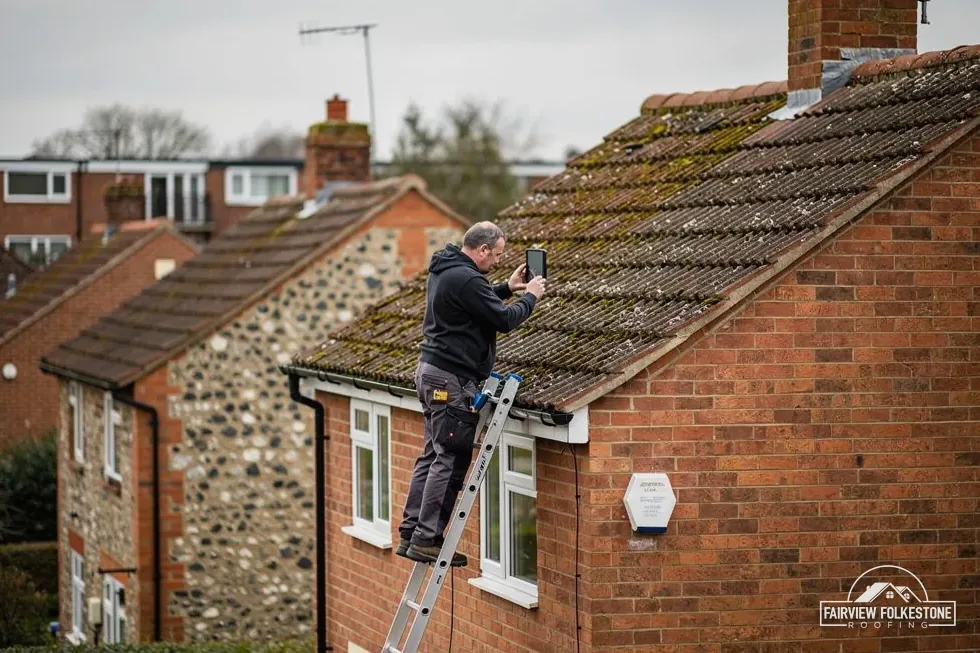
We check the roof from a ladder, from the loft and, where it stands too high, by drone. You get photographs, the findings and a plain verdict on each fault.
10-year workmanship guarantee, in writing
Inspections and reports, explained
All guides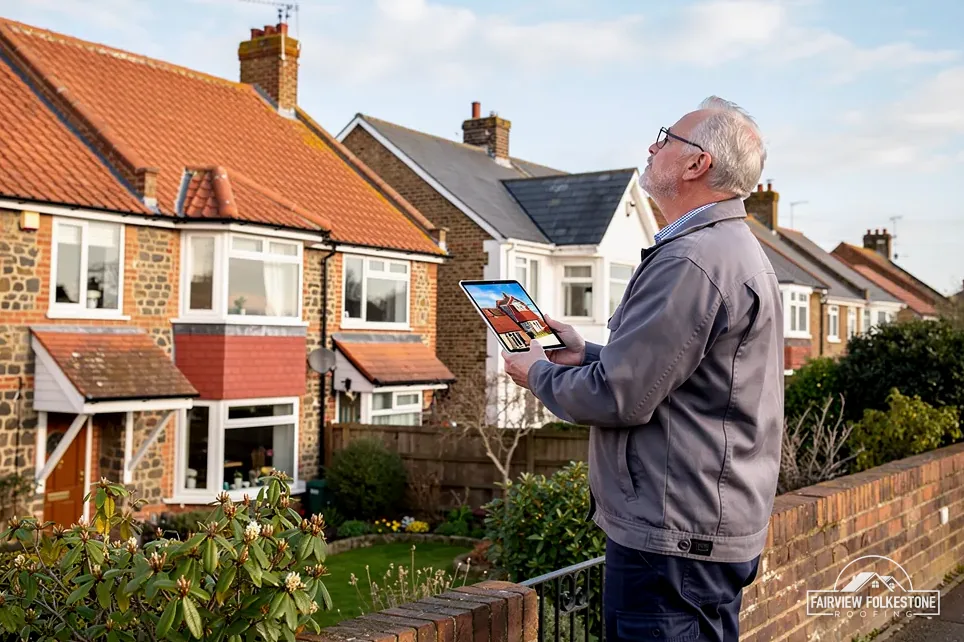

The fair ledger
What an inspection of your Folkestone roof ought to decide
An inspection is only worth having if it ends in a decision. These six entries follow a survey from the ladder to the loft, the drone and the written report, and show how each verdict is reached.
Entry 01Coverings
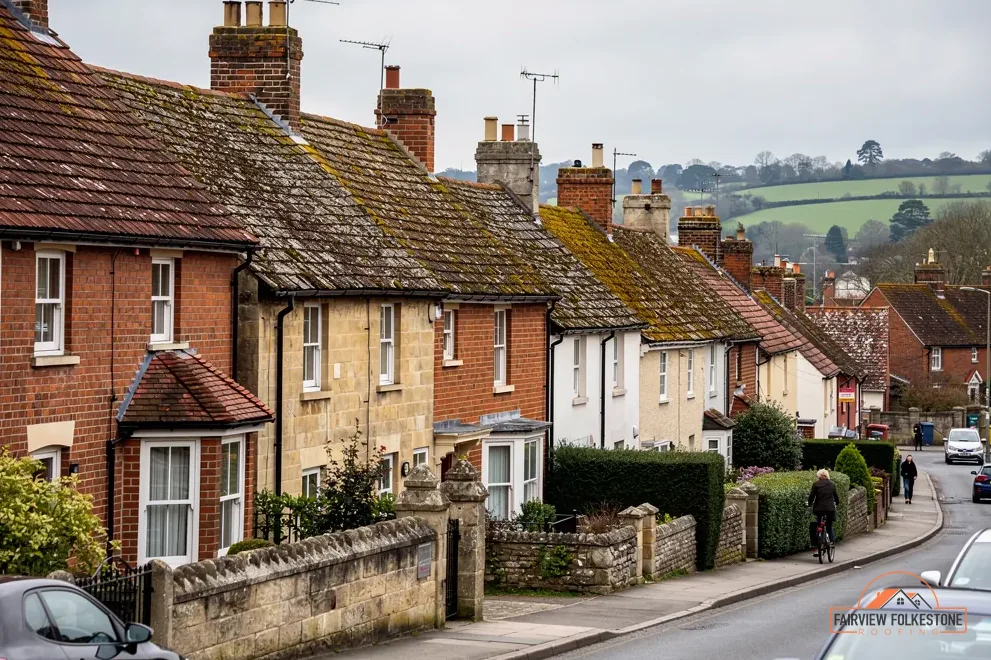
Slipped slates and cracked tiles, seen from the top of the ladder
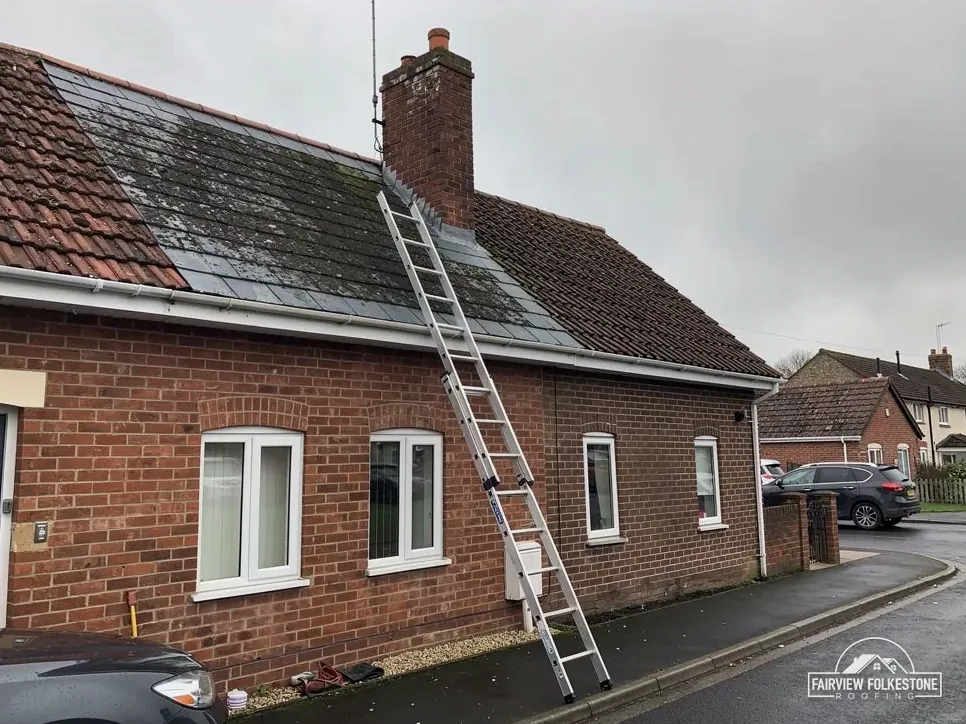
A ladder check puts us within arm's reach of the slates and tiles, close enough to judge a crack, a gap or a lifted edge rather than guessing from the pavement.
What we check from the ladder
From a ladder at the eaves, and from a roof ladder hooked over the ridge where the pitch and the covering allow it, we work across each slope in turn. We look at every course within reach: slates that have slid down, tiles with a cracked nib or a broken corner, gaps where one has gone altogether, and old repairs held with a strip of metal or a dab of mastic.
Then we look at what holds them. Where a slate has slipped, we look at the nails on the courses around it, since one failed nail and a row of rusting nails lead to very different verdicts. Where a tile has cracked, we check whether its neighbours have been knocked loose. The ridge and hips get the same attention: whether the mortar bed has cracked, and whether each ridge tile is fixed down or simply resting in that mortar.
Every fault gets a photograph and a mark on a sketch of the roof, so the report shows you where it is as well as what it is.
- Slate slid out of its course
- Batten the slate hangs from
- Clip that refixes it
Where a slate slips, the batten and the nails around it decide the verdict.
Myth: If nothing drips indoors, the roof covering must be fine.
Fact: Underlay can hold back rain under a missing tile for a while, so a ladder check finds the gap before your ceiling does.
BS 5534
The code of practice we check slate and tile fixings against
Marley: fitting it is not a legal requirement
What sets the price
- How many slopes need checking
- Whether a roof ladder can be used
- The height of the eaves
- Whether a drone is needed as well
One written total price
Repair, or more than a repair
A handful of slipped slates on a sound slope is a repair: each slate is refixed with a metal clip over its batten, and cracked tiles are swapped for matching ones. Where faults are scattered all over a slope, the report says so plainly. A slope where nails are giving up everywhere is heading towards a re-roof, and refixing it one slate at a time only delays the bigger job.
On a coastal roof we also note how the covering is fixed. Coastal homes are graded for higher exposure, so any replacement fixings are specified for that particular site's exposure under BS 5534.
From the ladder we also see the gutters at close range: whether they hold water, sag between brackets or have pulled away from the fascia, and whether moss washed off the slopes is choking them. Those go in the report as maintenance items rather than roof faults, so you can tell what can wait from what cannot.
If you want a sense of what a roof inspection costs before you book, that guide sets out what moves the figure.
- Slate or tile on the outside
- Batten it hangs from
- Underlay, the second barrier
- Rafter we test for rot
Entry 02Loft
From inside the loft: underlay, rafters and the timber you never see
The loft shows what the slates hide. With a good torch we can find daylight, damp and timber decay long before a stain reaches the ceiling below.
Do you need to get into my loft for a roof inspection?
Yes, if there is a hatch we can reach safely. Torn underlay, damp timber and condensation all show up from inside, and a check from outside alone cannot see any of them. Clear a path to the hatch and we do the rest.
Daylight through torn felt at the eaves
Eaves repair, new underlay strip
Droplets on the felt, mould on timbers
Ventilation checked first
Rafter feet soft at the wall plate
Timber repair before re-covering
What the loft tells us
Inside the loft we follow the roof from the ridge down to the eaves. An older roof may have bitumen felt under the battens, a newer one a modern membrane, and some have nothing at all. We look for felt that has torn, sagged or crumbled where it dips into the gutter, for pinpricks of daylight between slates, and for tide marks on battens and rafters that show where rain has been getting in. What a roofer checks in the loft goes through the list in more detail.
Then the timber itself. We test the rafter feet and the wall plate where they sit on the brickwork, since that is where wet rot takes hold, and we look for the small round holes of woodworm. Damp beside the chimney or along a party wall goes in the report with its likely route in, because a stain inside is not always directly under the fault outside.
Condensation is noted too: droplets under the felt, mould on the timbers, wet insulation. That points to ventilation, not to a hole in the roof.
Tell us where the stain on your ceiling is
Book a loft checkSpray foam, bats and ventilation
Some lofts have spray foam on the underside of the roof. RICS says that if the timber roof structure is covered with spray foam "it cannot be fully seen or inspected", and in March 2023 it reported concern in particular parts of the lending market, equity release mortgages among them. We record where the foam is and what we could not see, so a buyer or a lender knows the limits of the check.
Where the underlay is high resistance, which is not vapour-permeable, Marley gives 25 mm of eaves ventilation at 15 degrees or less and 10 mm above 15 degrees in a cold roof. We check the gap is there and has not been packed with insulation, and we name the type of underlay fitted before saying anything about vents.
Signs of bats are recorded and left alone: under the Habitats Regulations a bat roost may not be damaged or destroyed, and that offence needs no intent behind it. Nests in the eaves get the same care. Section 1 of the Wildlife and Countryside Act 1981 applies where someone intentionally takes, damages or destroys "the nest of any wild bird while that nest is in use or being built", so work beside an active nest waits.
Rafters and old felt seen by torchlight in a loft
Entry 03Drone
Tall terraces, chimneys and valleys a ladder cannot reach safely
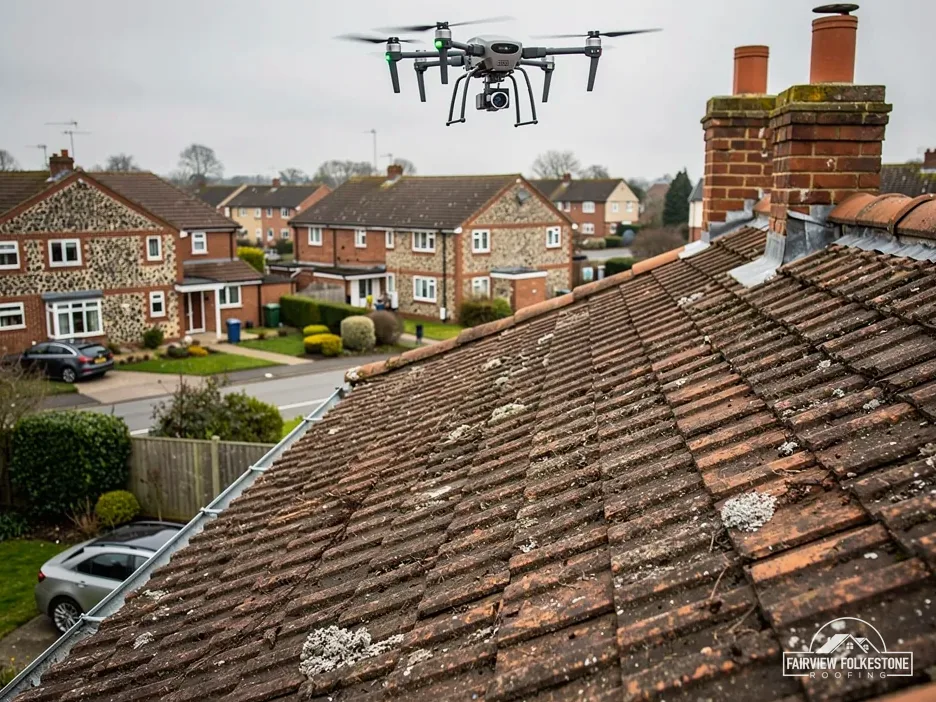
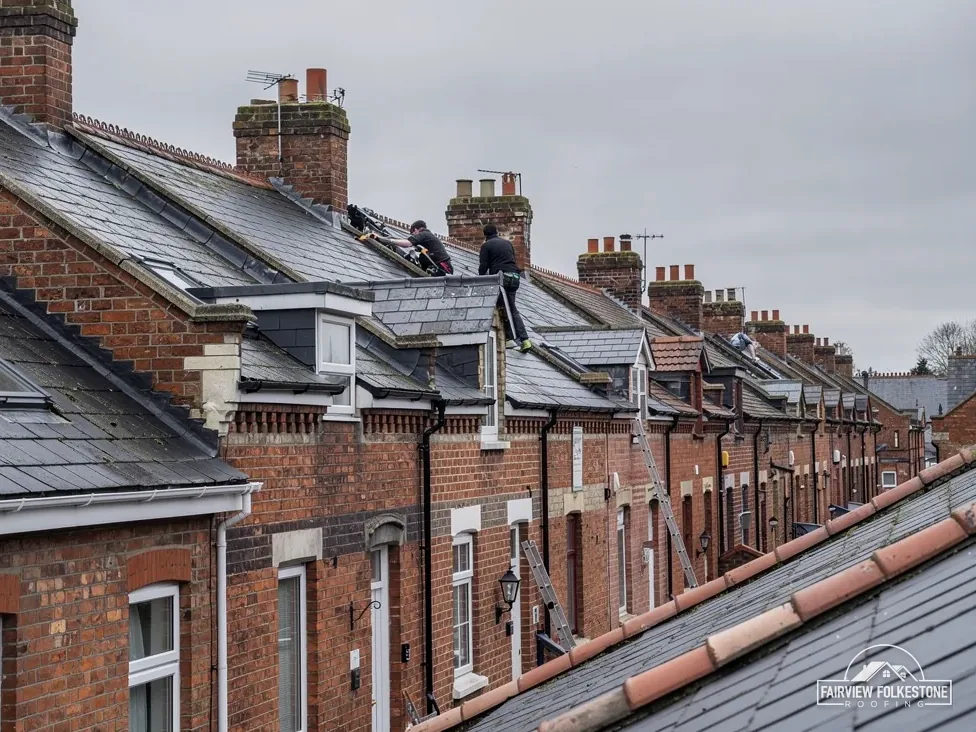
Some roofs are too high, too steep or too fragile to climb onto for a look. A drone gets a camera over every slope without anyone setting foot on it.
When we send up the drone
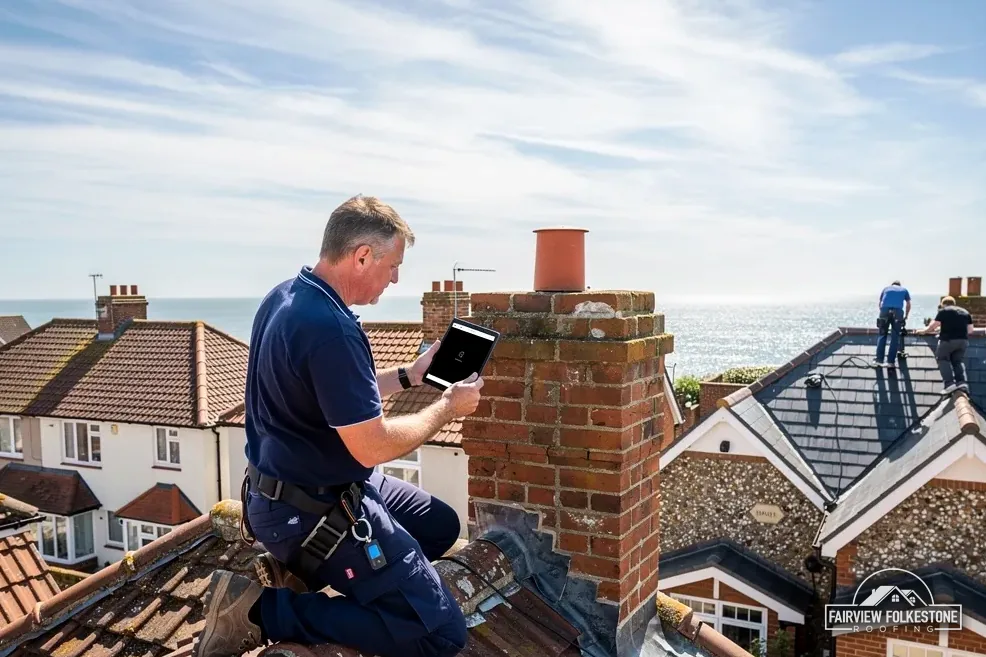
On a three-storey terrace, a tall house on a slope or a roof above a conservatory, a ladder check stops at the gutter, and scaffold just to look would cost more than the look is worth. A drone survey fills that gap. We fly the camera along each slope, round the chimney stack and down into the valleys, taking still photographs close enough to show a cracked tile or a lifted flashing. Inspecting a roof without scaffolding explains the options in full.
A drone sees the surface well: slipped and broken slates or tiles, ridge and hip tiles out of line, moss and debris in valleys and gutters, the lead around chimneys and roof windows, and the top of the stack, where cracked flaunching (the mortar collar round the pots) cannot be seen from the ground.
What it cannot do is feel. It cannot tell a soft batten from a sound one, lift a slate to see the nail, or check timber from inside. So we pair a drone survey with a loft check wherever we can get in, and where a fault needs a hand on it, the report says so.
- Stepped flashing up the stack
- Joint the lead is wedged into
- Soakers under each course
- Flaunching round the pots
Four places a drone photograph checks where a chimney stack meets the roof.
Myth: A drone survey can stand in for a roofer's visit entirely.
Fact: A drone sees the surface. Soft battens, rusted nails and damp timber still need a hand on them or a look from the loft.
Over 80 years
Correctly installed lead flashing can last for over 80 years
Source: MyJobQuote
Lead and chimneys from above
Lead is where a close look pays. Stepped flashings run up the side of a stack, soakers sit under the slates where roof meets brick, and a valley takes the run-off from two slopes down an open channel. From the drone photographs we check whether the lead has lifted from its mortar joints, split along a fold or been patched with tape or bitumen, which hides the metal and holds water against it. We also note how each piece was dressed into the brickwork, because a flashing tucked into a crumbling joint needs repointing as well as lead.
Chimneys get the same treatment: the pointing on each face, the flaunching, the pots and any cowls. A damp chimney breast indoors can start at any of them, so the report names the one the photographs point to.
Roof windows get checked from above as well: the seals round the glass, the flashing kit where it laps the slates or tiles, and the head of the window, where leaves and grit can pile up. A window leaking at the head needs a different repair from one whose glazing has failed, and the photographs show which you have.
What sets the price
- How many flat roofs there are
- Safe access to each roof edge
- Fragile sheets that rule out walking
- Whether the deck needs testing
One written total price
Entry 04Flat roofs
Flat roofs, garages and outbuildings: ponding, blisters and fragile sheets
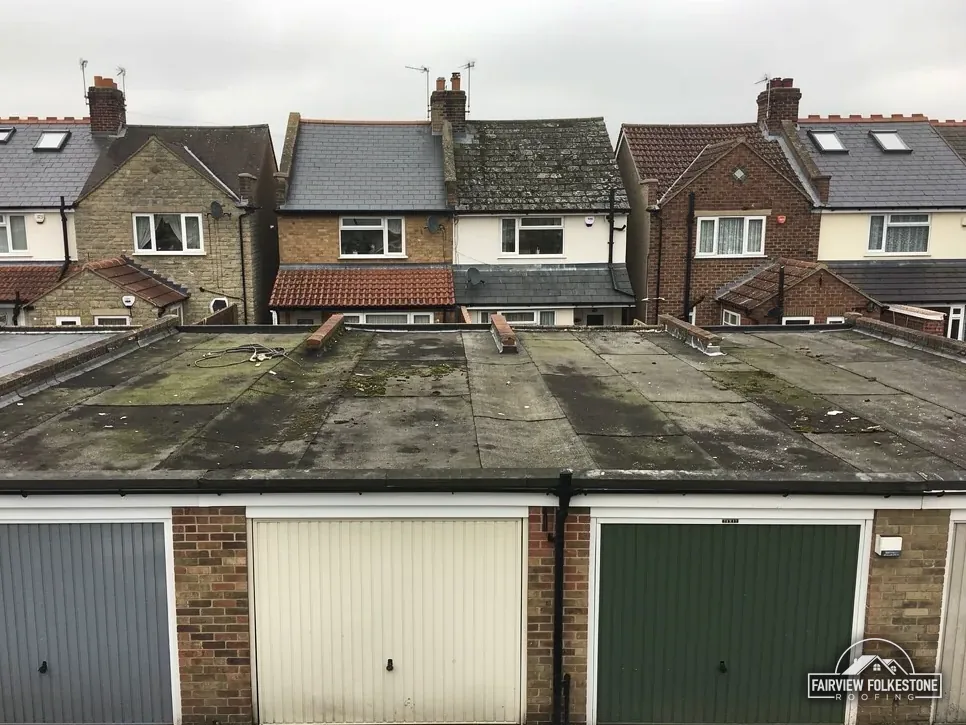
A flat roof over an extension or a garage gets checked differently. We look at how water leaves it, and we never stand on anything that might not take our weight.
Falls, joints and upstands
On a felt, rubber (EPDM) or fibreglass (GRP) flat roof, the first question is drainage. Puddles that sit for days after rain mean the deck has sagged or was laid too flat. BS 6229:2025 sets a minimum finished fall of 1:80 for membrane flat roofs, so a roof holding water across its middle falls short of that. We look for blisters and splits in the covering, at the joints and laps, and at the upstands where the roof meets a wall, a point where rain can get behind the covering. Gravel laid on top is raked aside in a few places, since stones can hide a split underneath.
A lead flat roof or a lead-covered bay is a separate case: BS 6229:2025 covers membranes, not lead, so lead is judged on its own detailing, its joints and its rolls.
The edges matter as much: the drip trim that throws water into the gutter, and the outlet. A blocked outlet can make a sound roof look like a failing one.
Where it is safe, we press the deck near the edges. A spongy feel means wet boards beneath, and that turns a patch into a re-board.
One split lap, deck firm underfoot
Patch and reseal
Ponding across the middle after rain
Falls looked at first
Deck soft along several edges
Re-board and re-cover
- Deck under the covering
- Waterproof membrane on top
- Upstand where roof meets wall
- Drip trim at the gutter edge
Garage roofs and asbestos cement
Corrugated sheet roofs on garages and sheds get a different approach. HSE advises: "If the building was built or refurbished before 2000, assume that there is asbestos in it." Its guidance also says "AC roofs are always fragile". So we inspect them from a ladder at the edge or by drone, and never by walking on the sheets.
The report records what the sheets look like: weathered, cracked, broken or holed. Cement sheets that are carefully removed without breaking up count as non-licensed work under HSE guidance, while broken-up sheets fall under stricter rules. If a garage roof has reached the end, the report says what we found and what the next step is.
If removal does follow, HSE guidance calls for a lockable skip for asbestos, never an open one, and the household exemption from consignment notes does not extend to asbestos waste.
Entry 05Storm damage
After a storm: making safe, photographs and evidence for an insurer
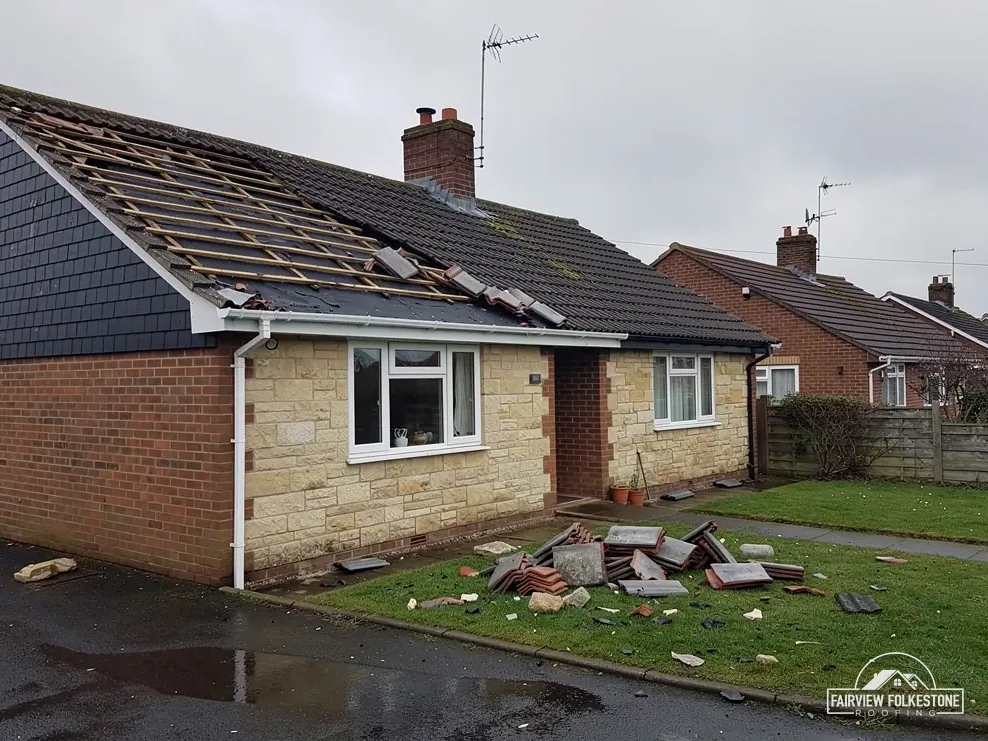
When wind has stripped tiles or lifted a ridge, two jobs run at once: keeping rain out tonight and recording the damage properly for an insurance claim.
- Ridge tile the wind can lift
- Mortar bed under the ridge
- Mechanical fixing holding it down
We record whether each ridge tile is fixed down or bedded in mortar alone.
What to do first after storm damage
Tell your insurer first, before any permanent work. Then the roof is made safe with a temporary repair, through our emergency roof repairs service if you need it, and everything is recorded: the damage before anything is moved, the temporary repair once it is on, and receipts for both. When it weighs a storm complaint, the Financial Ombudsman Service says "we'll usually look at expert reports and photos", and it notes your insurer will normally send a surveyor, who writes up a report of their own. Where an insurer relies on an exclusion, the Ombudsman puts the burden on the insurer to prove that the exclusion applies, for example with an inspection report.
Our inspection after a storm records each fault with its position on the roof, a close photograph and a wider one showing where it sits. We separate what the wind did from wear that was there before, and the report says which is which without dressing it up. Our guide to roof inspections for insurance claims covers the evidence in more depth.
Can your storm report go straight to my insurer?
Yes. It is written for you, with dated photographs, positions on the roof and our findings, so you can send it on as it stands. The decision on the claim stays with your insurer; the report gives them the evidence to decide on.
A dated photograph taken before anything is moved says more than any description written afterwards.
What counts as a storm
In the Ombudsman's wording, violent winds are what a storm usually involves, usually with rain, hail or snow; it adds that, by itself, rain, hail or snowfall can constitute a storm. Some insurers say only winds above a certain point on the Beaufort Scale count as storm-force. That judgement belongs to your insurer; what we supply is a clear record of the roof as we found it.
This stretch of coast has had severe storms before. The Met Office's account of the Great Storm of 1987 mentions a ferry in the Channel that ended up ashore close to Folkestone, and Force 11 winds (56 to 63 knots) across many coastal regions of England's south-east.
Once the wind drops, a few checks are safe from the ground: tiles or slates in the garden, a ridge line that dips, a gutter hanging loose or an aerial leaning. Stay off ladders while it is still blowing, keep clear of the ground under the eaves, and photograph what you can see from the garden before anyone touches it.
Buying a house: the roof before exchange
A buyer's survey covers the whole house, and the roof may only be seen from the ground. If your surveyor's report flags the roof, a roofer's inspection before exchange gives you something firmer: what is wrong, where, and whether it is a repair or a re-roof. That is the moment to raise it with the seller, not after completion. Our post on a roof inspection before buying a house in Folkestone walks through the timing.
A re-roof verdict rests on faults spread across the whole roof rather than gathered in one corner: slates slipping on every slope because the nails have gone, felt that has perished all the way down from the ridge, battens that give under a boot. On some roofs the slates themselves are fine and can be stripped and re-hung, and the report says so. HomeBuilding gives approximate lifespans of 100+ years for Welsh slate, 60 to 80 years for clay tiles and 40 to 50 years for plain concrete tiles, so the age of a covering is one input, never the whole verdict. Where a roof replacement is the answer, that is the page to read next.
Entry 06Whole roof
When the report says re-roof, and what buyers and landlords do next
Sometimes the findings add up to more than repairs. When they do, the report shows why, slope by slope, so you can act on it or take it to a seller.
Nails failing on every slope
Strip and re-cover
Slates sound, underlay perished throughout
Re-hang on new battens
Faults on one slope only
Repair that slope
What sets the price
- Slopes, pitch and the height of the eaves
- Slates reused or a new covering
- Chimneys, valleys and roof windows
- Scaffold and the licence for it
One written total price
Landlords and the condition report
For a landlord or a managing agent, a dated condition report is a record of the roof at one point in time: what was sound, what needed attention, and what was done about it. Repeated at sensible intervals, those reports show a roof being looked after, which counts when a tenant reports a leak, or when a flat roof shared by several flats needs a decision everyone can see the reasons for.
Each report lists the findings in order of priority: what needs doing now to keep rain out, what should be planned for, and what only needs watching. A roof condition report is only useful if you can read it without us in the room, so every item carries a photograph and a plain sentence.
Where several flats share one roof, the report goes to whoever manages the building, and the sketch numbers each slope so every leaseholder can follow which part is which. A maintenance plan drawn from it lets a re-roof be budgeted for years ahead rather than arriving as an emergency.
- Fascia board at the roof edge
- Gutter on its brackets
- Underlay dressed into the gutter
- Soffit and vent below
At the eaves the underlay should run into the gutter, not stop short of it.
Want to know what your roof needs before you spend anything?
Call, send a WhatsApp or use the quote form. We inspect the roof, then explain each finding with photographs.
Roof inspection questions, answered
Cost, timing, what you get in writing and how to tell a sound roofer from a chancer, for homes in Folkestone and nearby.
How much does it cost to have someone check your roof?
MyJobQuote puts the average cost of a roof survey at around £300 (page updated October 2026), and that is a national average rather than a local price. What moves it for one house is the number of slopes, the height of the eaves, whether the loft can be reached and whether a drone is needed. Before you book any inspection, ask what it covers and whether you get a written report with photographs at the end, because a verbal opinion from the drive is a different thing.
Should I pay for a roof inspection, or wait for a leak?
Waiting for a leak means the first sign is a stain, and by then the timber or the ceiling may have been wet for a while. An inspection is worth paying for when you are buying a house, after a storm, before letting a property, as part of regular maintenance on an older roof, or when a re-roof quote seems bigger than the faults you can see. In each case the report gives you something to act on, rather than a guess. It is also a fixed point to compare against next time.
How do you spot a dodgy roofer?
Take care with a caller at the door who says they spotted loose tiles while passing, wants a yes today, will not put a price in writing or gives no address. Ask for photographs of any fault they claim to have found, and get a second look before agreeing to a re-roof. If you sign a contract at home after a survey, you have 14 days to cancel, and work only starts sooner if you ask in writing; that right does not cover an urgent repair visit you asked for. The Citizens Advice consumer helpline is 0808 223 1133.
Can a tall Folkestone terrace be inspected without scaffolding?
Yes. On a three- or four-storey house, a drone takes close photographs of every slope, the chimney and the valleys without anyone climbing, and the loft check covers the underside. Scaffold comes in only if the inspection finds work that needs it, and then it is part of the quote for that work. A scaffold standing on a Kent pavement or road needs a Kent County Council licence, £52 per week for 2026 to 2027, and we arrange the licence with our scaffolder. For a first look, though, the drone and the loft between them cover the roof.
Are coastal roofs in Folkestone and Hythe checked any differently?
The checks are the same, but we pay closer attention to how the covering is held down. Coastal homes are graded for higher exposure, so the fixing specification for any repair or re-roof is calculated for the site under BS 5534. On the inspection we record whether slates and tiles are nailed or clipped, whether ridge and verge tiles rely on mortar alone, and whether any lead has lifted at its edges. Those details decide how a repair should be fixed, and they go in the report even where nothing has failed yet.
What does a written roof condition report include?
Each fault gets a close photograph, a wider one showing where it sits, and its position marked on a sketch of the roof. Then comes a plain finding, a verdict of repair, replace or keep an eye on it, and a priority: now, soon, or with the next planned work. The report also lists what we could not see, such as a slope hidden from every angle or timber covered by spray foam, so nobody reads more into it than it holds. You keep the report and can pass it to anyone you like.
Is a roofer's inspection the same as a mortgage survey?
No. A mortgage valuation is carried out for the lender, and a buyer's survey covers the whole house, so the roof gets a share of the attention. A roofer's inspection looks only at the roof, from the ladder, the loft and, where needed, the air. If your surveyor recommends further investigation of the roof, our report is the kind of evidence you can put in front of the seller, your solicitor or your lender before you exchange, with photographs that show each finding rather than describe it.
Which towns around Folkestone do you inspect roofs in?
We work up to 30 road miles from Folkestone: Sandgate, Cheriton, Hawkinge and Hythe close by, out to Dover, Deal, Canterbury and Ashford, and over the county line to Rye and Camber in East Sussex. If an inspection in Dover or Deal ends in a re-roof verdict, Dover District Council's building control page includes "replacement of roof coverings on pitched and flat roofs even if this is just like for like" in the work needing approval, so we check the route with Dover's building control team before pricing a re-roof there.
Tell us what's wrong with the roof.
You'll get one written total price.