
Spray foam removal · Folkestone
Spray foam insulation removal in Folkestone
Spray foam cut away from the rafters and underlay, every exposed timber checked, then the roof re-felted, ventilated and insulated again, with a plain account of what the foam left behind.
10-year workmanship guarantee, in writing
Spray foam removal, explained in full
All guides

The fair ledger
Six decisions between foam in the loft and a sound roof
Starting with a torch at the loft hatch and ending with new felt and insulation, each entry takes one decision about spray foam, our verdict on it, and the reasons for that verdict.
Entry 01Loft survey
What a spray foam survey can see, and what it cannot
Foam stuck to the rafters hides the very timbers a survey needs to see. So the opening job is working out what can be checked now, and what cannot.
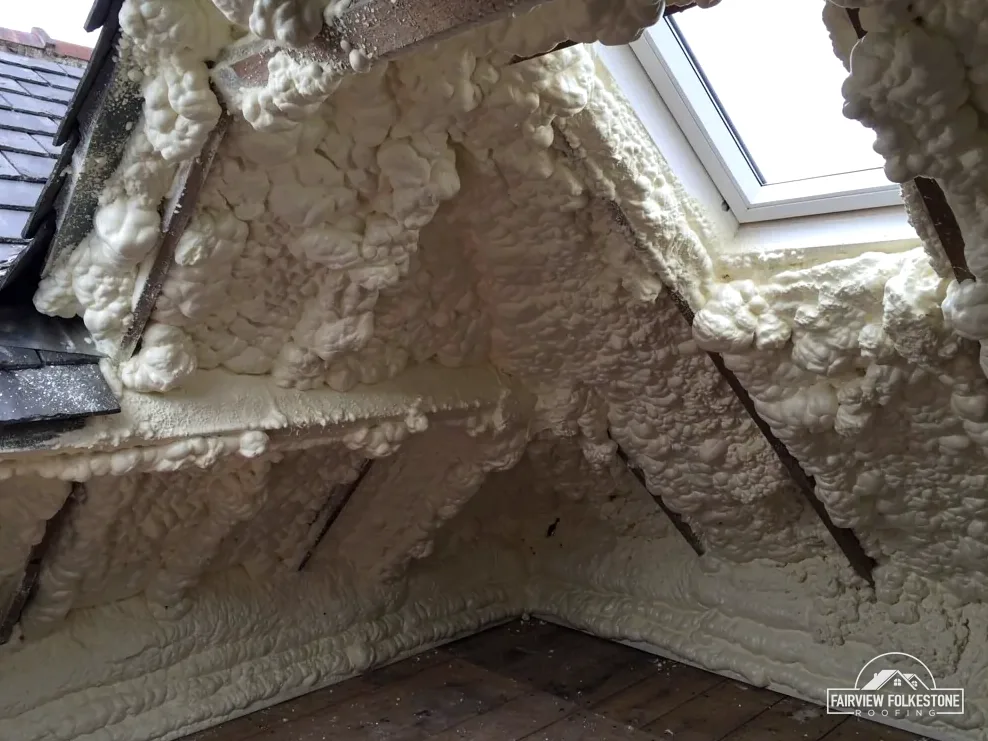
What we look at in the loft
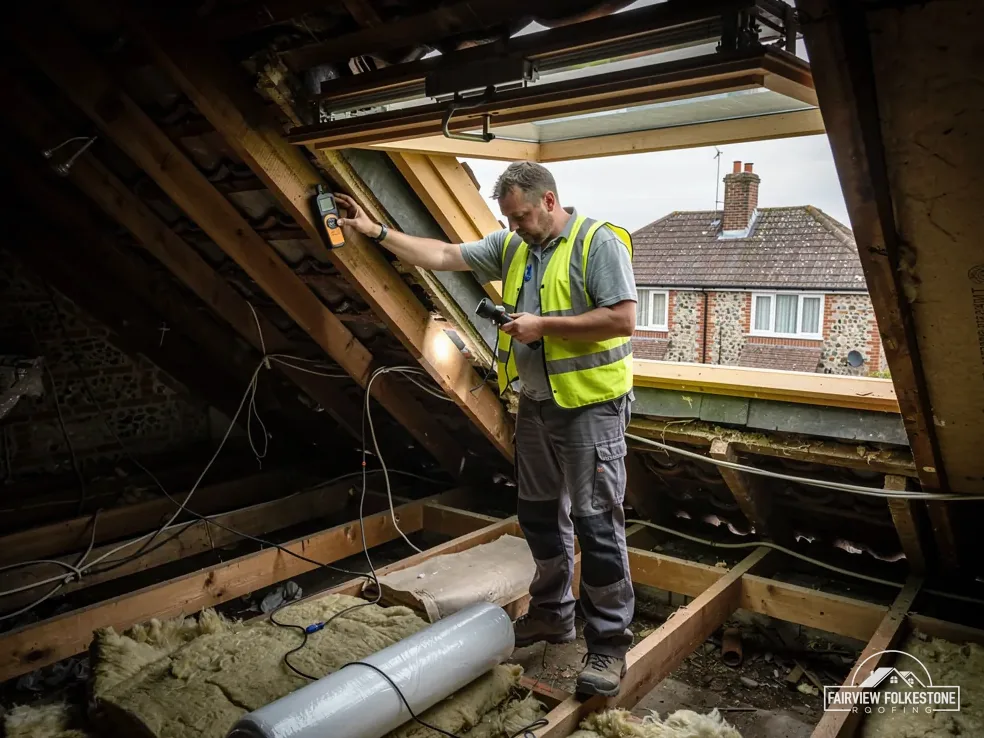
We start inside the loft with a torch and a moisture meter. We note where the foam has been sprayed: onto old bitumen felt, onto a breathable membrane, or straight onto the backs of the tiles or slates on a roof that never had felt. We note how thick it is, whether it runs across the rafters or only between them, and whether it has been pushed down into the eaves, where air needs to move.
RICS, the surveyors' professional body, sets out the difficulty in its consumer guide: timber hidden under spray foam "cannot be fully seen or inspected". A buyer's surveyor runs into exactly that, and so do we. Where the foam stops short, we can look at bare rafters, purlins (the long beams that carry the rafters part way up the slope) and battens. Where it covers them, we can probe and take readings at the edges, but nobody can promise the timber behind is sound until some of the foam comes off. We also look at the ceiling below for staining, and at the loft floor for crumbs of foam that show where it has already started to come away.
- Fascia board at the eaves
- Gutter on its brackets
- Felt dressed into the gutter
- Soffit vent foam can block
Foam packed into the eaves can close the gap that air needs to come in.
Myth: Foam that looks clean means the timber behind it is fine.
Fact: A clean face tells you nothing about the rafter behind it. RICS notes that foam-covered timber cannot be fully seen or inspected.
Can you tell from the loft whether the foam has to come off?
Partly. Where the foam is thin, patchy or sprayed only between the rafters, we can see enough of the timber to judge. Where it covers every rafter, cutting a small test area is the fair way to find out before anyone prices the whole roof. The test area is made good afterwards, whatever you decide.
What sets the price
- How much of the roof is foamed
- Foam on felt, or on tile backs
- Room to work inside the loft
- Whether a test area is needed
One written total price
Outside, and the written account
Outside, we look at the roof the foam sits under: slipped or cracked tiles, the ridge, the flashings and the gutters. A leak at a slipped tile can run behind the foam and stay out of sight from the loft for a long time, so the covering matters as much as the insulation. On a Folkestone roof near the sea front we also note how exposed it is, because that changes how it gets fixed when it goes back.
HSE's rule of thumb is to assume asbestos is present wherever a building was built or refurbished before 2000. So before anyone cuts near the eaves, soffit boards and old sheet materials in the loft are identified rather than guessed at.
You then get a written account of what we saw, what stayed hidden, and which of the routes in the entries below suits your roof. Where the foam hides too much for a firm verdict, we suggest opening a small test area before anyone commits to the whole job. A general roof inspection covers the rest of the roof at the same visit.
March 2023
when RICS reported concern in parts of the lending market over spray foam
Source: RICS press release
Entry 02Lenders
Selling or remortgaging a house with spray foam in the roof
Spray foam can stall a sale or a remortgage. Before you pay for removal, find out what your own lender is actually asking for.
Will taking the foam out settle a mortgage problem?
It can remove the reason for the concern, but only your lender can say what it will accept. Ask what evidence it wants before work starts, so the photographs and the written report you get from us afterwards answer that exact question. If the request changes partway through, send it on and we adjust the report to match.
What the lender asks for
Foam accepted with a roof report
Survey and written report
Lender wants the foam removed
Removal and timber check
Buyer's surveyor cannot see the timbers
Open a test area
What RICS reported in March 2023
In March 2023 RICS reported that "there has been concern within specific sectors of the lending market, such as equity release mortgages, which is now having a wider impact on lenders." That describes concern in parts of the lending market, not a blanket rule, and policies differ from one lender to the next. The same body's consumer guide on spray foam tells owners to check with their mortgage provider before the product goes in, and the same check makes sense before it comes out.
The Energy Saving Trust takes a softer line. It calls the mortgage problems "possibly true for a while", and says there should be less of an issue with getting a mortgage for homes that have had spray foam insulation installed correctly. Both points matter here. A lender, or a buyer's surveyor, will want to know which foam is in the roof, how it went in and what state the timbers are in. Those are the three things our survey sets out to answer. Lenders and surveyors want facts about this roof, not reassurance about foam in general, so the report keeps to what we saw.
Tell us what your lender has asked for
Ask about your roofAsk your lender before you ask us
So the opening call is to your lender or broker, not to a roofer. Ask whether foam in the roof is acceptable, whether they want it removed, and what evidence they need afterwards: photographs of the bare timbers, a written report on the roof, or a fresh survey. Your lender may be content with a report on foam that was put in correctly, or may want it gone. If you are selling, the buyer's lender is the one whose policy counts, and our guide to removing spray foam before a sale covers what their surveyor looks for.
Once you know what is being asked, the work can be sized to match it. If the answer is full removal, the entries below set out how the foam comes off and what the roof needs afterwards. If the answer is a report, a survey of the roof and the foam may be all you need for now. Either way, keep the written request from the lender, so the finished report can answer it point by point. If the request arrives late in a sale, tell us the dates you are working to, and we say plainly whether the survey, the removal and the report can fit inside them.
Entry 03Foam type
Open-cell or closed-cell foam, and why the type changes the job
There are two main kinds of spray foam insulation. Which one is in your roof changes the risk to the timber and the way it comes off.
Two foams that behave differently
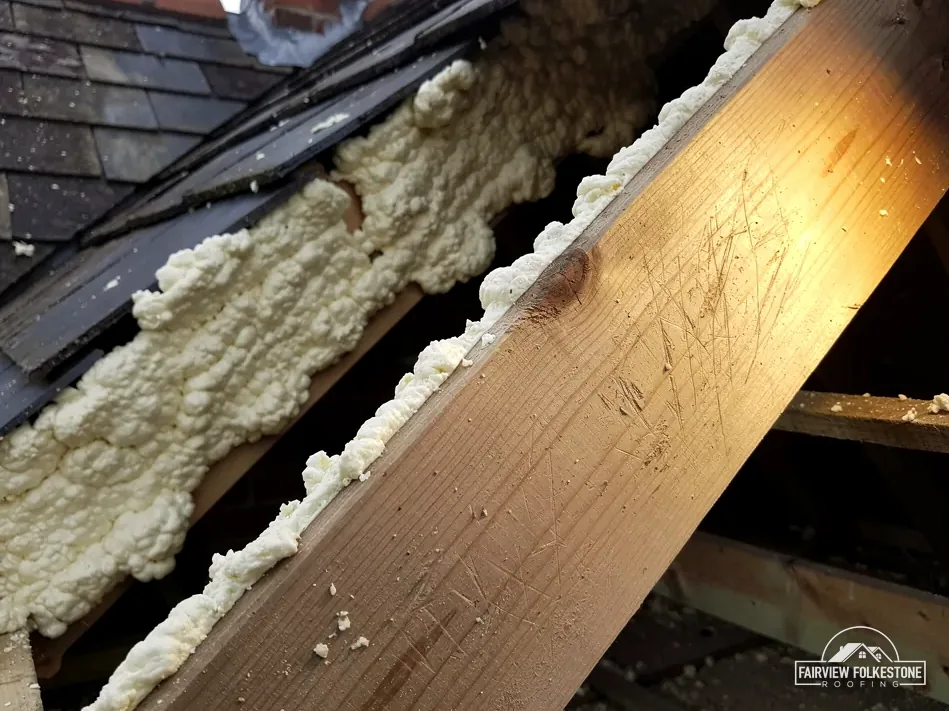
The Energy Saving Trust names the two main types as closed-cell and open-cell. From the loft hatch they can look alike. Close up, we press the surface and cut a small sample: open-cell foam gives under a thumb, while closed-cell feels hard and rigid. The trust gives the main drawback of closed-cell foam in plain words: "it's not vapour permeable."
On the timber risk, its spray foam advice page explains that spraying foam directly to the underside of the roof "will partially seal the timber", so moisture held against a rafter has little chance to dry out, and the wood can rot over time. It then adds that "this risk should be much lower with an open-cell foam". Lower is not the same as none. Open-cell foam over a slipped tile or torn felt can still hold damp against the wood, so we check the timber under both kinds. Our guide to open-cell and closed-cell foam goes further into the differences. Where we cannot tell which foam is in the roof, the sample goes into the report with a photograph, and we describe it as we found it rather than guess.
Myth: Open-cell foam carries no risk of rot at all.
Fact: The Energy Saving Trust says the rot risk should be much lower with open-cell foam, which is not the same as no risk.
2 types
the main kinds of spray foam insulation the Energy Saving Trust names
Closed-cell and open-cell
Open-cell foam, timber dry at the edges
Cut out from inside
Closed-cell foam bonded to old felt
Strip, re-felt, re-batten
Either type sitting over a leak
Fix the leak, then remove
Why the type matters on removal day
Closed-cell foam bonds hard to felt, membrane and the backs of tiles, so it takes longer to cut away cleanly and can pull old felt away with it as it comes off. Open-cell foam cuts out more readily but can leave a crust on the timber faces, which we clean back before the inspection. We record the depth too, since thicker foam takes longer to cut out. Either way, the type goes into your written report, because a lender or a buyer's surveyor may ask which it was.
Condensation is the other question the type raises. Warm, damp air from the house rises into the roof, and a roof needs a route for that moisture to leave. Where a vapour-tight layer sits hard against the timber, damp that gets in from a leak or from the rooms below has fewer ways out. That is why the ventilation plan in the last entry matters as much as the removal itself.
Neither type is a reason on its own to strip a roof. The type, the state of the felt under it and what the timber shows once it is bare decide that between them.
What sets the price
- Inside the loft, or roof stripped
- Closed-cell or open-cell foam
- The state of the felt underneath
- Scaffold, and how many tiles reuse
One written total price
Entry 04Removal
Two ways the foam comes off, and which suits your roof
Foam comes out from inside the loft, or from above with the roof stripped. The felt underneath it decides which route is sound.
What we remove from inside the loft
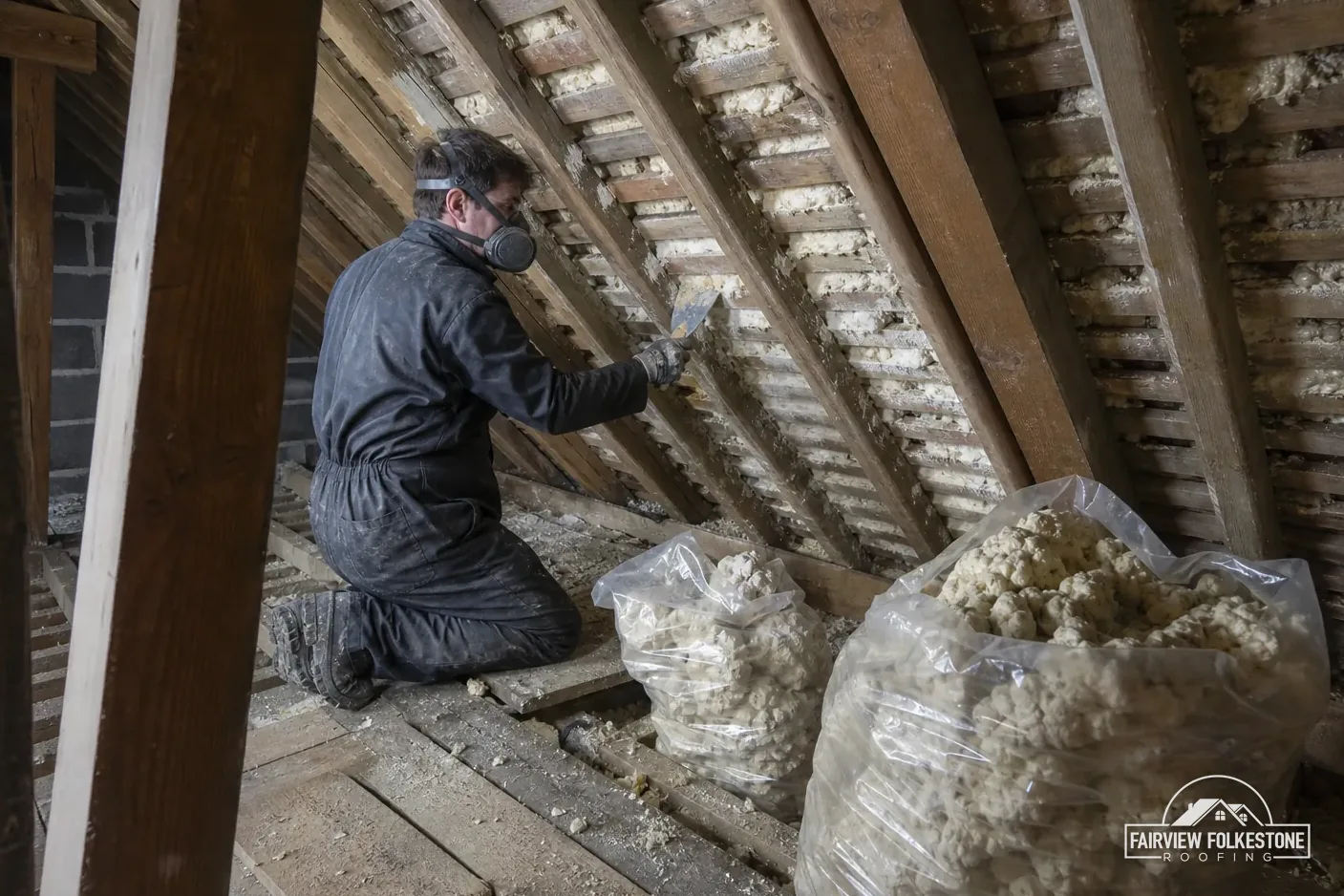
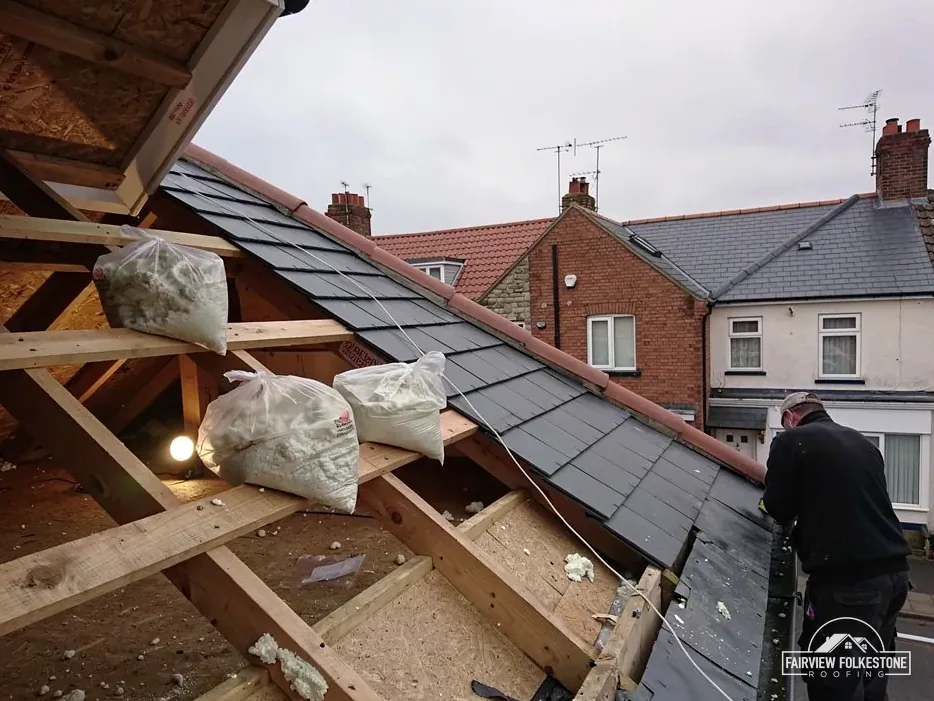
Where the foam sits on a membrane or felt that is still in good order, it can be cut out from inside. We cut it from between the rafters in blocks, then scrape the rafter faces and the underside of the felt clean, working down each bay from the ridge to the eaves. The loft floor is sheeted, the foam is bagged as it comes away and taken off site, and the landing and hatch are protected. It is noisy, dusty work, but the roof covering stays where it is. Water tanks, cables and pipes in the loft are moved aside or covered before cutting starts, and anything fixed into the foam is noted for the report.
The risk is the felt. Old bitumen felt that has had foam stuck to it for years can tear as the foam is pulled away, and once torn it no longer keeps out wind-driven rain. If that starts to happen in the test area, we stop and tell you, rather than finishing the loft and leaving a roof with no working underlay. Our guide to how spray foam is removed walks through each step.
Myth: Spray foam in a loft always means stripping the whole roof.
Fact: Where the felt under it is sound, the foam can be cut out from inside with the tiles left in place.
- Tile left in place
- Batten under the tile
- Felt the foam is stuck to
- Rafter scraped back clean
Working from inside, the foam comes off the felt and rafters below the battens.
From above, with the roof stripped
Where the foam was sprayed straight onto the backs of the tiles or slates, or the felt under it is past saving, the sound route is from outside. The tiles or slates come off and are stacked for reuse, the foam-coated felt and battens are taken away, and the rafters are cleaned from above. That opens the whole roof to the timber check in the next entry, and the roof goes back on new felt and battens.
Stripping a roof needs scaffold, and a scaffold standing on the highway needs its own permit, which we arrange with our scaffolder. Sound tiles and slates go back on; any that break are matched as closely as the roof allows. The pitched roofing side of the job, from battens to ridge, is the same work as any re-cover.
Wildlife can be in a roof as well as foam. Under the Habitats Regulations, damaging or destroying a place bats use to breed or rest is an offence with no need to prove intent, so if we find signs of bats once the covering is open, work on that part stops until the right advice has been taken.
Entry 05Timbers
Checking the rafters and battens once the foam is off
With the foam gone, the timber finally gets the close look it could not have before. This is where the real verdict on the roof gets made.
What happens if the rafters are rotten behind the foam?
We stop and show you before anything else is done. A short length of decayed timber can be trimmed out and a new piece fixed alongside the old rafter. Where the rot runs further, or reaches a purlin, you get the photographs and a revised written total before the work goes on, and you decide.
Rafter by rafter, with readings
We go along every rafter, purlin and batten we have uncovered. We look for dark staining, soft patches that give under a probe, splits, and the small exit holes of wood-boring insects, and we take moisture readings along each length, not only at the foot. Timber that had foam against it can be damp at the face and drier inside, so we read it again once the roof has had time to air. Battens get the same attention, because they carry every tile on the roof.
What we find falls into three groups. Sound timber with surface staining needs nothing beyond drying out. A rafter with decay near its foot, at the eaves or where a leak ran, can have the bad section trimmed out and fresh timber fixed beside it (a sister), so the original rafter stays in place. Rafters soft along their length, or a purlin that has lost its strength, need replacing.
BS 5250 covers how moisture is controlled in buildings, and we use it to plan how the roof will breathe once it goes back together.
BS 5250
the moisture code of practice BSI lists as current and under review
Nobody can give a fair verdict on a roof while its timbers are still hidden.
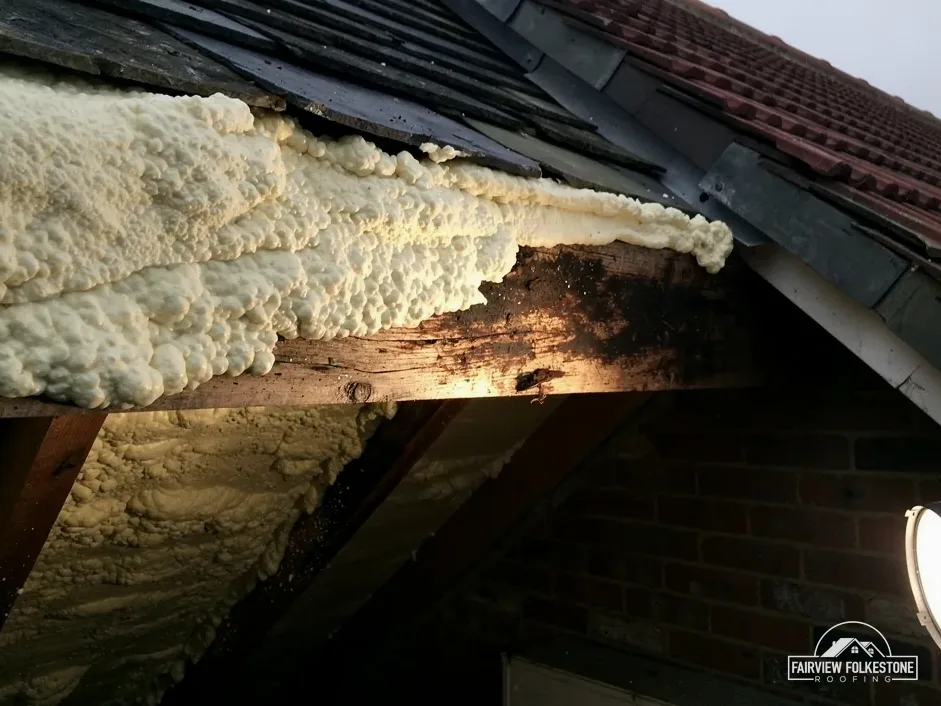
Drying out, and the leak behind it
Damp timber is a symptom, so we look for the cause before anything is closed up again. A wet patch under a slipped tile, a split in the felt or a failed flashing gets put right, otherwise the new insulation simply soaks up the same water. Where readings stay high, the roof is left open to the air for longer before the insulation goes back, and we tell you why the programme has moved. On a roof in Hawkinge or up on the Downs the readings matter just as much as on the sea front: timber stays damp anywhere air cannot reach it.
Every bare rafter is photographed, with the moisture readings beside it, for your written report. That record is what a lender or a buyer's surveyor asks for, and it also helps with routine maintenance years from now, because the next person in the loft can compare what they see with what was there on the day. What drives the final figure is set out in our guide to spray foam removal costs.
Felt, battens and fixings
Where the roof has been stripped, new battens go on over a new underlay, the felt is dressed into the gutter at the eaves, and the tiles or slates are fixed back. Marley points out that installing to BS 5534 isn't required by law, but since the 2015 amendments to that standard, mortar on its own has not been relied on to secure a roof covering, so ridges and verges go back with mechanical fixings. Cupa notes that coastal buildings are graded with higher exposure, so for a roof in Folkestone, Hythe or Sandgate we work the fixings out for that site's exposure under BS 5534.
The underlay you choose sets the ventilation. In a cold roof under a high-resistance underlay, Marley's figure for eaves ventilation is 25 mm where the pitch is 15 degrees or less and 10 mm where it is steeper than 15 degrees, since that type of underlay is not vapour-permeable. With an LR underlay, an air-permeable covering on top and a well-sealed ceiling below, Marley says the 3 mm gap from ordinary eaves construction is enough, provided the UKAS third-party certification conditions are all satisfied.
Entry 06Re-felting
Re-felting, ventilating and insulating the roof again
Taking the foam out leaves the loft without insulation and, on some roofs, without working felt. Putting both back properly is the other half of the job.
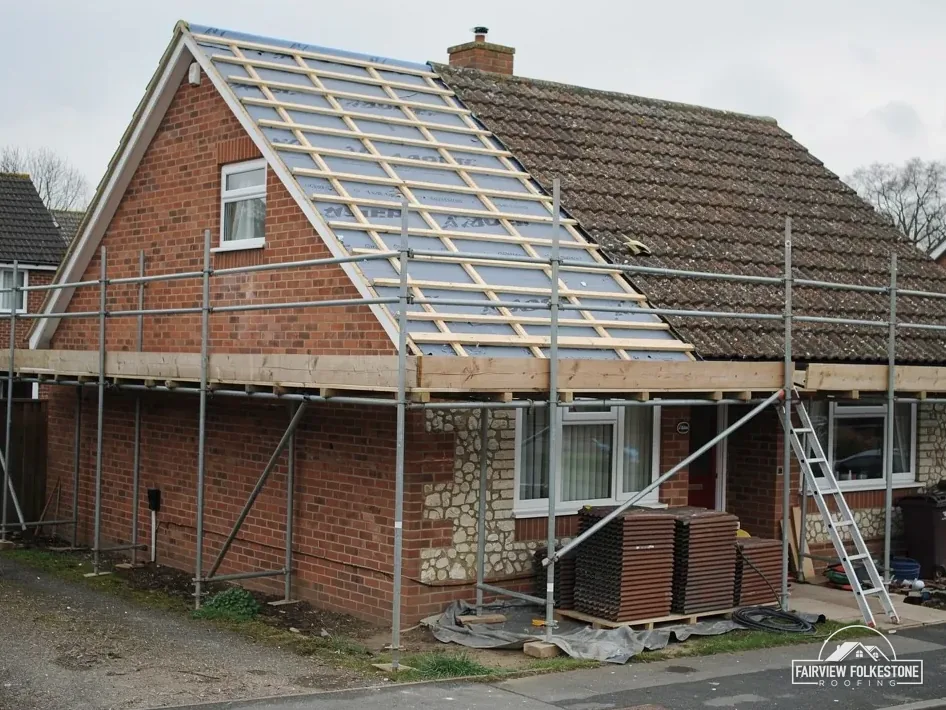
Felt sound, foam cut out inside
Insulate over the ceiling
Felt torn as the foam came away
New underlay and battens
Eaves vents packed with foam
Clear and ventilate the eaves
What sets the price
- Insulation at the ceiling or the rafters
- Underlay type and the ventilation it needs
- Tiles reused or replaced
- The approval route for your council
One written total price
Insulation that lets the timber breathe
The insulation goes back so that air keeps moving where the roof needs it and the house keeps its heat. In a cold roof that means insulation laid over the ceiling, with the space above ventilated as the underlay requires. In a room in the roof it means insulation between and under the rafters, with a clear air gap kept below the felt. Our guide to what happens after spray foam removal sets out both.
Building Regulations apply once the work is large enough. Re-roofing that touches less than 25 per cent of the building envelope and less than 50 per cent of the roof does not normally need a Building Regulations application, on the Planning Portal's guide. If over half of a roof is renovated, AD L 2021 expects the whole roof to reach Table 4.3's improved U-value of 0.16 (the threshold is 0.35), as long as the work is feasible and pays for itself within 15 years. Dover addresses differ: among the work Dover District Council says needs approval is the "replacement of roof coverings on pitched and flat roofs even if this is just like for like", so for a home in Dover, Deal or Sandwich we check with its building control team before starting.
25 mm
Marley's eaves ventilation for a cold roof at 15 degrees or less under high-resistance underlay
Foam in the loft and a lender asking questions? Start with a look.
Send photos of the loft or book a visit, and you get what we found, what the roof needs and why, in writing.
Spray foam removal questions, answered
Costs, lenders, timing, risk to the roof and the parts of Kent and East Sussex we cover.
What does spray foam removal cost in Folkestone?
MyJobQuote's cost guide (updated September 2026) gives an average of £40 per m² for spray foam removal, and its own example, a standard three-bedroom property with roughly 80 m² of roof space, says total removal costs typically come to around £3,200. Those are third-party UK figures, not our prices. Your roof's figure turns on how much is foamed, the foam type, the removal route and what the timbers need. We give one total price in writing after the survey; if you are weighing up other quotes, see whether each one includes VAT and scaffold in its figure.
Can spray foam insulation be taken out of a roof?
Yes. Both open-cell and closed-cell foam can be removed, either cut out from inside the loft or taken off with the felt when the roof is stripped from above. The right route depends on what the foam is stuck to. Foam on a sound membrane can come away from inside with the tiles left alone. Foam sprayed onto the backs of tiles, or onto old felt that tears as it is pulled, means stripping and re-covering the roof. A survey, and a small test area where needed, settles which before you are given a price.
Why are homeowners having spray foam insulation removed?
Three reasons stand out. RICS reported concern in some parts of the lending market in March 2023, giving equity release mortgages as an example, so a sale or remortgage can stall. RICS also notes that timber covered with spray foam cannot be fully seen or inspected, which leaves a buyer's surveyor unable to judge the roof. And the Energy Saving Trust says closed-cell foam is not vapour permeable and that foam sprayed onto the underside of a roof partially seals the timber, which raises questions about trapped moisture, condensation and rot.
What is the best way to remove spray foam insulation?
The best method is the one that suits what the foam is stuck to. Where it sits on sound felt or membrane, careful hand cutting and scraping from inside the loft keeps the roof covering in place. Where it is bonded to the backs of tiles or to brittle felt, cutting from inside can wreck the layer it should protect, so stripping the roof from above is the better answer. The job does not end when the foam is out: the timber check, new felt where needed, ventilation and insulation follow, all in one price.
Will removing spray foam damage my roof?
It can, which is why we test before committing. The main risk is to old felt: foam stuck to it for years can tear it as it comes away, and torn felt stops doing its job. If the test area shows that happening, we tell you and change the route rather than carry on. Tiles and slates lifted to strip a roof are stacked and reused where sound, and breakages are matched as closely as we can. Done this way, the roof ends up with checked timbers and new felt where it was needed.
How long does spray foam removal take?
The time turns on the size of the roof, the type of foam, whether it comes out from inside or with the roof stripped, and what the timbers need once they are bare. Closed-cell foam takes longer to cut away cleanly than open-cell. A stripped roof also needs scaffold up beforehand and the covering put back afterwards. Damp timber may need time to dry before the insulation goes back in. We tell you how long we expect the work to take in the written quote, and straight away if the timber check changes that.
Do I need scaffolding for spray foam removal?
Not when the foam comes out from inside the loft with the roof covering left alone. Stripping the roof from above does need scaffold. On Kent roads a highway scaffold licence from Kent County Council costs £52 per week in 2026 to 2027, and the council's licence page says the scaffolding firm should apply on your behalf. Our scaffolder arranges the licence. East Sussex Highways issues it for Rye and Camber, at £127 for 28 days according to its published charges, though the current fee is worth checking. The scaffold sits inside the one written total.
Do you remove spray foam outside Folkestone?
Yes. We work from Folkestone across south-east Kent, including Hythe, Sandgate, Cheriton, Hawkinge, Dover, Deal, Ashford, Canterbury, New Romney and the rest of Romney Marsh, up to 30 road miles out, and into East Sussex at Rye and Camber. Foam removal is planned work rather than emergency work, but if the roof above the foam is leaking now, we make it safe before anything else. Where the job turns into a re-roof, the building control route depends on your council, and we check it with them before work starts. In Folkestone and Hythe that is the district council's own team.
Tell us what's wrong with the roof.
You'll get one written total price.