
Selling with spray foam
Removing spray foam before you sell: what buyers' surveyors look for
A buyer's surveyor cannot inspect roof timber that is buried in foam, and that is what slows sales. Here is how to decide between removal and a report, and what to hand over.
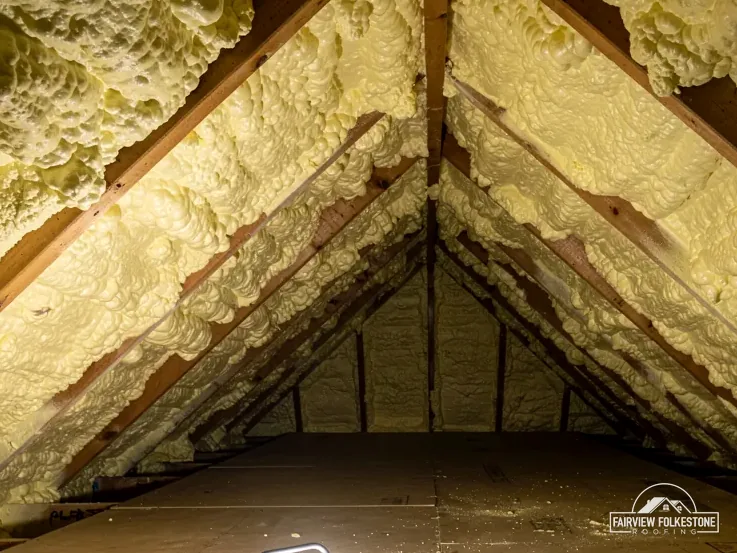
Foam in the roof may not show itself on the day of a viewing. It turns up later, when the buyer's surveyor opens the loft hatch and finds the rafters covered in a hard or spongy layer they cannot see behind. From that point the sale depends on questions that you may not be able to answer on the spot: what the foam is, how deep it is, what the timbers underneath look like, and whether the buyer's lender will accept it.
This guide is for owners who know the foam is there and want to sell without the surprise. It sets out what the buyer's side meets, what the Energy Saving Trust has said about mortgages, the three realistic options, and what belongs in the evidence pack you hand to a surveyor. It also covers timing, since removal done after an offer is a different job from removal done before the house is listed, and a short section for buyers who have found foam in a house they are about to buy.
01Key points
What the surveyor finds at the loft hatch
A buyer's surveyor goes into the loft to look at the structure and the covering from underneath. Spray foam gets in the way of that. RICS's consumer guide puts the difficulty in a sentence: a roof structure of timber that has been covered in spray foam "cannot be fully seen or inspected". A surveyor who cannot inspect something has to say so in the report, and a report that says so gives the buyer and the buyer's lender a reason to ask for more.
Questions that may follow from the buyer's side include these.
- What kind of foam is it, and how thick?
- What is it stuck to: felt, tiles or bare rafters?
- Is there any sign of damp, staining or movement in the timbers or the ceiling below?
- Who installed it, when, and is there any paperwork?
None of those has to be a barrier if you can answer it, and the loft is where the answers are gathered. A seller who arrives with the foam type, photographs of the roof, and a written statement of the timber's condition gives the surveyor something to work with, where a seller with nothing sends the surveyor away with an unanswered caveat.
It also helps to know that the surveyor is not the final word. A lender decides what it will accept, and the surveyor's report is one of the inputs to that decision.
02The detail
The lender's side of the sale
RICS issued a press release in March 2023 about its new consumer guide. It describes concern "within specific sectors of the lending market", equity release mortgages being its example, which is "now having a wider impact on lenders". That is not a blanket refusal, and it is not a promise that your buyer's lender will be relaxed either.
The Energy Saving Trust gives a gentler picture. It calls the mortgage problems "possibly true for a while" and adds that homes with foam installed correctly face less of an issue getting a mortgage. Put the two sources together and you get this: lending policy varies, the position has been moving, and the answer for your buyer depends on their lender.
Selling with foam in the roof
Can I sell a house with spray foam still in the roof?
Foam in the roof does not halt a sale by itself. What matters is what the buyer's surveyor can inspect and what the buyer's lender will accept, and lending policy varies. The Energy Saving Trust points to less of an issue for homes where foam was installed correctly. Ask the buyer's lender early.
RICS's own advice, in its consumer guide to spray foam, is to ask the company providing the home loan, before any foam goes in, whether its policy permits the product. For a seller, that translates into one practical step: ask your estate agent or the buyer's broker which lender is involved, and what that lender wants to see, before you spend a pound on the roof.
Written requests are worth keeping. If a lender asks for photographs of the bare timbers, a roof report or proof of removal, the evidence pack can be shaped to that exact request, answering each point in the order the lender raised it, rather than arriving as a general file of papers that someone has to sort through.
03Price
Remove it, report on it, or price around it
A seller with foam in the roof has three realistic options, and the right one turns on the roof, the buyer and the calendar.
Removal gives the cleanest answer, and it is the only option that changes the roof itself. When the foam is gone and the timbers are photographed, nothing is left for a surveyor to caveat, and the buyer's lender has less to weigh. The cost is real, and the work cannot always be finished before the date a buyer wants.
A survey and report sits in the middle. With open-cell foam, sound felt and timbers that read dry, a written account may be all a buyer's lender needs, and leaving the foam in place can be a fair choice. Where it is closed-cell, bonded to old felt, or sitting over damp, a report will say so, and removal becomes the likelier answer.
Selling as found is sometimes the only practical route when time is short, and it can be fair to choose it where the buyer is informed. It hands the risk to the buyer, who may ask for a price reduction or walk away, so it deserves a conversation with your agent before you choose it.
| Option | What the buyer gets | What it asks of you |
|---|---|---|
| Remove the foam | Bare timbers, a clean record | Cost, time, a finished roof |
| Survey and report | Facts about the foam and roof | A visit, a written report |
| Sell as found | The buyer takes the risk | A price that reflects it |
04In order
Building the evidence pack
Whichever option you pick, the aim is the same: put the facts about the roof in one place, so a surveyor or lender can see them without having to ask twice. What goes into the pack depends on the route taken.
Is a roof report enough, or must the foam come out?
Which of these a lender accepts is the lender's call. A report on the foam type, the felt and the timber condition can be enough where the foam is open-cell and the roof reads dry. Where the foam is bonded to old felt or sits over damp, removal becomes more likely. Get the lender's request in writing before paying for either.
- The foam type and depth, and the surface it was fixed to, written down.
- Photographs of the loft before any work, from the hatch and from inside.
- Photographs of each bare rafter after removal, with a moisture reading beside it.
- A note of any timber cut back, doubled up or replaced, and why.
- A description of the new felt, ventilation and insulation, so the roof is shown to be dry, ventilated and insulated again.
- The written total price and the invoice for the work.
Two further items belong in the pack where they apply. If the roof was stripped, a note on whether Building Regulations applied to the work, and who confirmed it: building control is carried out by the council's building control team or by a registered building control approver. And any correspondence with the lender, so the buyer's side can see what was asked and what was answered.
The pack should read as a record of the roof, not as a sales pitch. Keep it short, keep it dated, and keep the photographs labelled by bay or by room, so that anyone reading it can match a picture to a place in the loft. A surveyor who reads plain facts, dated and photographed, is more likely to trust them than a surveyor who reads reassurance. We prepare this record as part of the work, and a general spray foam survey covers the same ground where you want facts before deciding on removal.
05In brief
Timing: before the listing or after the offer
When the work happens changes how much room you have for surprises. Taking the foam out before the house is listed leaves the most time for the unexpected: a patch of soft timber, a roof that needs re-felting, a delay for scaffold. You then sell a roof with a record, and nothing is waiting to be discovered.
- Give the survey visit your exchange and completion dates up front.
- Ask your solicitor what the buyer has been told about the roof.
- Keep any request from the lender in writing and send it on.
- Decide whether a report is enough before paying for removal.
Doing it after an offer is possible, but the clock is already running, and every week spent waiting for a scaffold slot or a lender reply is a week the buyer may use to think again. A buyer may be working to a date, a lender may be waiting on the surveyor's report, and a chain can be waiting on you. If a survey is to happen at all in that window, the earlier it is booked the better, because it tells you which route is open before you commit to dates.
Whether the survey, the strip and the written record can all fit before completion is something you are told plainly at the first visit. A scaffold on the highway needs its own licence, which we arrange with our scaffolder, and that adds notice time to a strip job in a way a loft-only job avoids. If the dates do not fit, a report with a plan for the work after completion is sometimes a workable middle course, and the buyer's lender decides whether it is enough.
06The short list
If you are the buyer
A buyer who finds foam in a house they want has the same questions as the seller, with less information. The first move is to ask the seller what is known, and to ask your own lender what it requires, before the survey result arrives. RICS's guide advises asking the company providing the home loan about its policy on the product, and the same call is worth making before you commit to a purchase.
What should the evidence pack show a surveyor?
It should show what the foam was, how deep, and what it was stuck to, with dated photographs of the roof and of each bare rafter beside its moisture reading. Add a note of any timber repaired, a description of the new felt, ventilation and insulation, and the written price. Facts about this roof, not general reassurance.
A surveyor who can see the timbers has nothing left to caveat.
What you can reasonably request from the seller is a short list.
- Any paperwork from the installer, with the date and product.
- Photographs of the loft taken before and after any work.
- A roof report, if one exists, on the timber and the felt.
- The reason the foam went in, if the seller knows it.
Where none of that exists, a survey of the roof by a roofer, with a small test area cut at the eaves, can tell you what is behind the foam before you exchange. The result goes to your solicitor and lender in writing. If it turns out the timbers are sound, you buy with facts. If they are not, you have a basis to ask for a price change or a removal before completion.
How the roof is finished once the foam is out is covered in our guide to what happens after spray foam removal, and the whole service is on the spray foam removal page. For what drives the price, read the cost guide.

Tell us what's wrong with the roof.
You'll get one written total price.