
DIY removal
Can you remove spray foam insulation yourself?
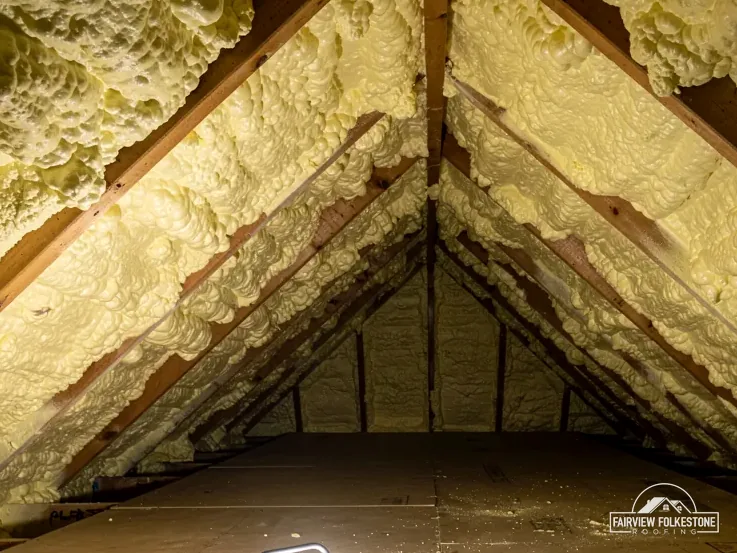
A small patch within reach of the hatch is one task; a whole roof of foam is another. Below: where a householder's limit sits and what lies behind the foam.
The short answer
Not safely across a whole roof, though a householder can try a small patch from inside the loft. RICS points out that a roof timber under foam is only partly visible and cannot be inspected in full, so a rough clearance can leave the real problem, damp or soft wood, still hidden. Old soffit boards near the eaves may contain asbestos, and bats or nesting birds may be using the roof. A torch and a scraper cover none of that.
4 min read · Part of Spray foam removal

Where a first attempt should stop
Sprayed foam starts as a liquid, then cures into a solid crust, so it comes away in lumps and crumbs rather than in neat sheets. Anyone trying a patch should treat it as a trial, not as the start of a clearance. Sensible limits for a first go:
- Work only from boarded floor, never by stepping on the bare ceiling between the joists.
- Stay with foam that sits on the rafters themselves, not foam sprayed onto the underlay.
- Stop the moment the felt moves, tears or lifts with the foam, because a torn underlay no longer sheets off wind-driven rain.
- Keep clear of cables, pipes and the water tank.
- Photograph the patch before you begin and again afterwards, and note where in the loft it sits.
If the patch comes away cleanly and the wood beneath looks dry and sound, you have learned something about that one bay. You have learned very little about the rest of the roof, because the foam in the next bay may be thicker, bonded harder or sitting over a leak.
What the foam may be hiding
Surveyors take care over foam because of the timber, not the foam itself. RICS's consumer guide makes the point that when the roof structure is covered, nobody can see or check all of it. A rafter you cannot see is a rafter you cannot judge, and a scraped patch only shows the few inches you cleared.
The Energy Saving Trust adds a moisture point. Foam applied straight to a roof's underside partly seals the timber, and closed-cell foam's main drawback, it says, is a lack of vapour permeability. With open-cell foam, it says, the risk should be much lower, which is a relative statement and no promise that the wood is safe.
A moisture meter and a probe tell you far more about a rafter than a look at its surface does. A cracked tile or a tired flashing can let water in behind foam for a long time before a stain reaches the ceiling, so dark or soft wood at the edge of a cleared patch is a reason to stop and phone a roofer, not to dig further.
Hazards a householder can walk into
Three rules sit behind a roof that has been worked on over the years, and each one can turn a small job into a serious one. The table sets them side by side.
| Hazard | What the source says | What it means for DIY |
|---|---|---|
| Asbestos | HSE: if the building was built or refurbished before 2000, assume there is asbestos in it | Have soffit boards and old sheet identified before cutting near them |
| Bats | GOV.UK: all bat species, their breeding sites and resting places are fully protected by law | A damaged roost counts as an offence even if nobody meant it |
| Nesting birds | Intentionally damaging a nest that is in use or being built is an offence | Stop work if you find a nest in the eaves |
HSE's list of where to expect asbestos includes insulating board panels fixed under roof eaves, and licensing covers most work on that board. Cement sheets lifted off in one piece, unbroken, fall into a separate non-licensed category. If a board is cracked, or you simply cannot tell what it is, stop and get it identified before anyone cuts or scrapes close to it. The dust from broken board is the worry, and a scraper in a loft makes plenty of dust.
When a roofer is the better call
A roofer is the better call once foam covers every rafter, sits on the underside of the tiles, or runs into the eaves. In those cases a survey, a small test area and a plan for the felt come before any cutting, because the route you pick decides whether the covering stays put or has to come off.
On cost, MyJobQuote gives an average of £40 per m² for professional spray foam removal, and its worked example, a three-bedroom house with about 80m² of roof space, comes to around £3,200 (page dated 17/09/26). Treat both as third-party guides. You get a written price as one total, once we have seen the loft.
If the covering has to be lifted, scaffold goes up. On a Kent pavement that needs a licence from Kent County Council at £52 per week for 2026 to 2027, and we arrange the licence with our scaffolder. Our guide to how spray foam is removed follows the job step by step, and the spray foam removal page covers the whole service.
More questions
Will a failed DIY attempt make professional removal harder?
It can. Foam pulled off roughly may tear the felt behind it, and a roof with damaged felt may then need its covering lifted to put things right. If you have started, stop, photograph what you have done and show us. We will say what the patch tells us about the rest.
What should you photograph before touching spray foam?
Photograph the loft from the hatch, the foam across the rafters, any labels or tins the installer left behind, and the ceilings below. Dated pictures show how the roof looked before anyone disturbed it, which helps a roofer, a surveyor and a mortgage lender alike.
Tell us what's wrong with the roof.
You'll get one written total price.