
Slate roofing · Folkestone
Slate roofing in Folkestone
Natural and man-made slate roofs across Folkestone and Kent: we find out why the slates are slipping, then say plainly whether a repair will hold or the slope needs re-slating.
10-year workmanship guarantee, in writing
Slate roofs, question by question
All guides
The fair ledger
Six slate faults, from one loose slate to a full re-slate
From one slipped slate to a whole slope of tired nails: each entry shows what we look at on a slate roof, what it fairly needs, and why the verdict is repair, re-slate or a closer look.
Entry 01Slipped slates
One slipped slate, refixed with a tingle or a hook
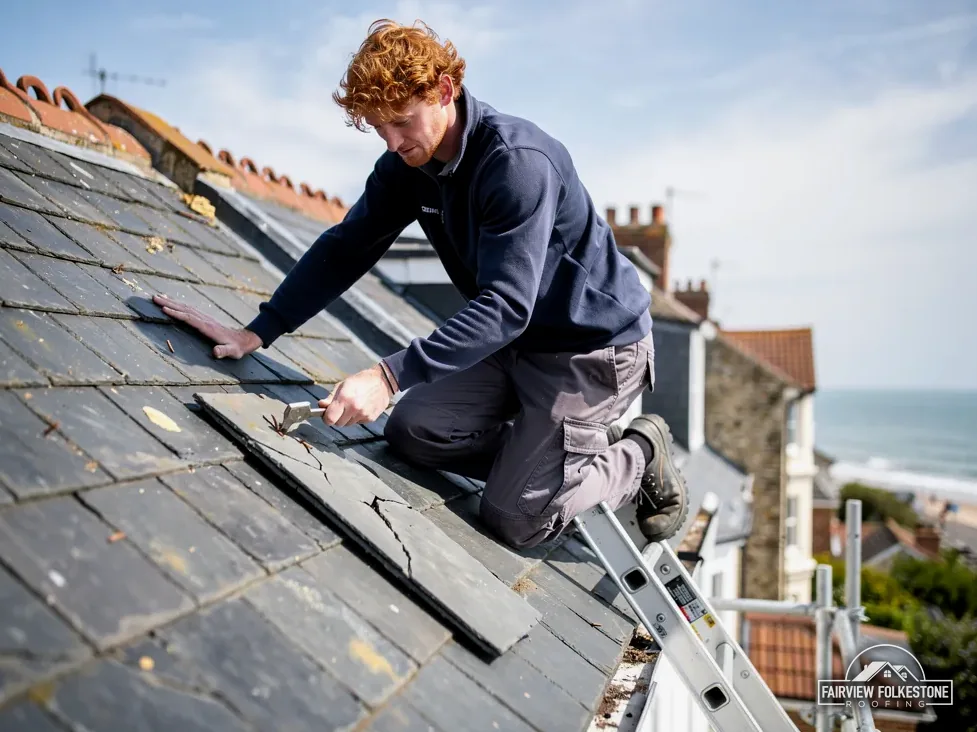
A slate on the path does not, by itself, mean the roof is finished. It means one fixing let go, so the slope around it gets a careful look.
Why a single slate lets go
Each slate hangs from two nails driven through holes in the slate and into the batten behind it. Those nails sit under the course above, out of sight. When one nail rusts through, or the hole it passes through wears wider, the slate swings on the other nail, then slides down until it drops or hangs crooked. Wind getting under the tail of a loose slate speeds that along.
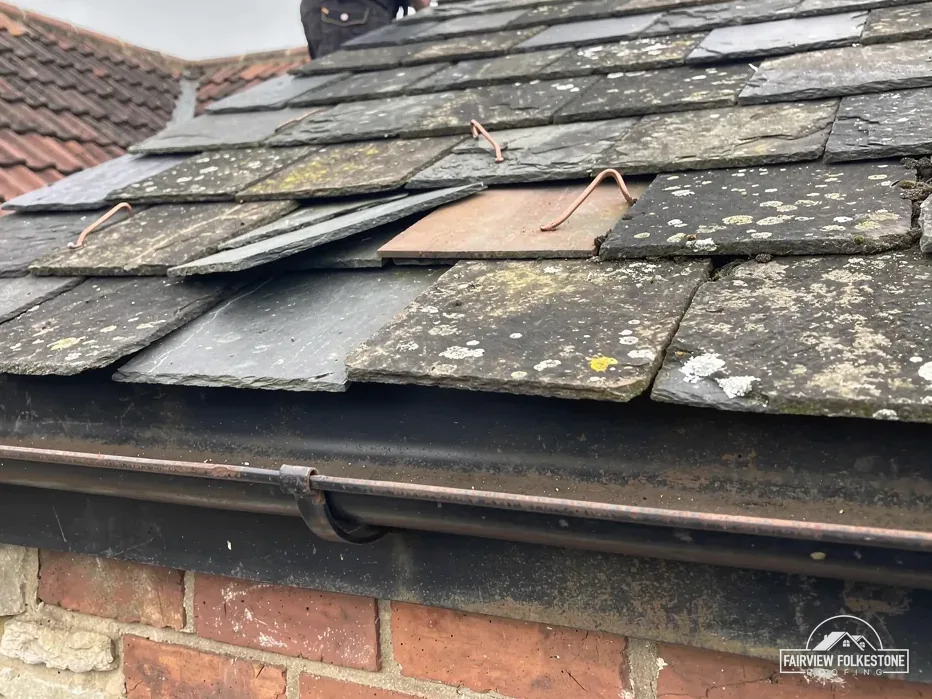
The nails of a slipped slate cannot be replaced where they were, because the slates above cover them. Lifting the course above to reach them would risk cracking sound slates around it. So the refix is done from the face of the roof, with a fixing that holds the slate by its bottom edge instead of its head. Our page on refixing a slipped slate walks through that repair in more depth.
Before any refix we look at the gap the slate left. Through it we can see the batten, the felt or membrane behind, and the heads of the slates in the course below. A dry, firm batten and clean felt say the leak, if there was one, was brief. A dark, soft batten or crumbling felt says rain has been getting in for longer, and the repair has to look past the slate to the timber behind it.
- The slate that slipped
- Batten it hung from
- Tingle or clip at the tail
The new fixing grips the tail, so the course above is never disturbed.
Myth: A single slipped slate means the entire roof has to be replaced.
Fact: When the battens and neighbouring slates are sound, a single slipped slate is a refix with a tingle or clip.
BS 5534
Marley notes BS 5534 isn't required by law; its sums still set the fixings
Worked out for each site
What sets the price
- How many slates have slipped
- How each slope can be reached safely
- Whether replacements must match old slates
One written total price
Tingle, hook or clip
A tingle is a narrow strip of lead or copper. We nail it to the batten through the gap between the slates below, slide the slate (or a matching replacement) back up into line, then fold the end of the strip up and over the tail. It holds the slate from below and stays visible as a small metal tab. Where a neater finish matters, a slate hook or clip can do the same job by gripping the batten and the tail.
A replacement slate has to match the old ones in length, width and thickness, or it will sit proud and catch the wind. We carry a few reclaimed slates for this, and where the colour matters on a front slope we look for a closer match. A steep or high slope is reached with a ladder hooked across the ridge, or from scaffold where it cannot be reached safely any other way.
- Firm neighbours and dry battens: refix the one slate.
- A cracked slate: a matching slate goes in its place.
- Loose slates spread over the slope: read the next entry, on nail fatigue.
If slates have blown off and rain is coming in, start with our emergency roof repairs service; the tidy refix can follow once the roof is weathertight.
- Slate, holed for its nails
- Batten the nails drive into
- Old felt or new membrane
- Rafter carrying the battens
Every layer under the slates is looked at once a few come off.
Entry 02Nail fatigue
When the nails are giving way across a whole slope
Several slipped slates spread over one slope point at the nails, not at bad luck. The question then is whether the slates themselves are worth keeping.
Can I keep refixing slates as they slip?
You can for a while, and on a roof with a few loose slates that is a sensible choice. Once slates are slipping all over a slope, each refix leaves the failing nails beside it untouched, so the visits keep coming and the money goes into a roof that still needs re-slating.
Two or three slates loose, nails sound
Tingles or clips
Slipped slates scattered over one slope
Lift some and look
Nails rusted through on every lifted slate
Strip and re-slate
What nail fatigue looks like
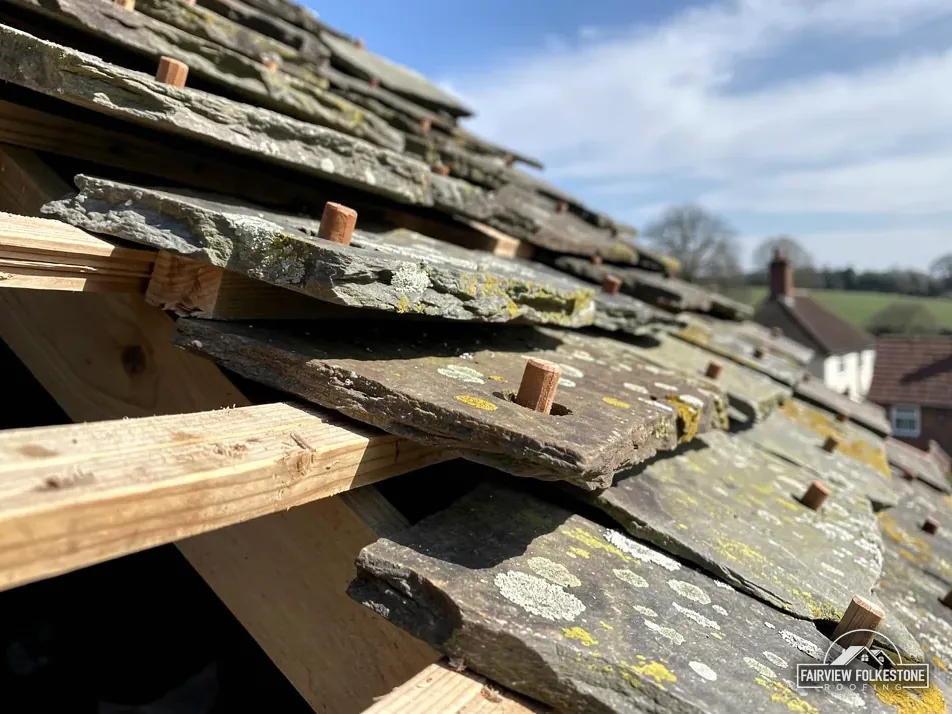
Nail fatigue, which some roofers call nail sickness, is the slow failure of the nails as a set. Iron nails rust, and the rust eats into the shank until it snaps or pulls through. Softer nails can also wear a slot in the slate as it moves in the wind, until the head slips through the hole. There is more on the causes in our guide to what nail fatigue is.
From the ground it shows as slates sliding a little out of line, ragged lower edges along some courses, and gaps where slates have gone. In the loft you may see daylight at a few points, or damp marks on old felt and battens. After a gale, a run of slates may have lifted or fallen in one area. Each sign on its own proves little; together, on one slope, they point at the fixings.
Nail fatigue can affect one slope and leave another alone. A slope that takes the weather harder, or one re-slated at a different time, can be in a very different state from the rest of the house. If you can get into the loft safely, a torch along the underside of the battens can show rust marks where nails come through, and that is worth a look before anyone climbs up.
Send us a photo of the slipped slates
Ask for a verdictWhy tingles stop being the answer
Tingles are a fair fix for a handful of slates. On a slope where the nails are going as a set, a tingle on every slipped slate leaves the roof dotted with metal tabs while the nails holding the rest keep letting go. You end up paying for visit after visit, one slate at a time.
So when we see this pattern, the verdict is a check before a price. We lift a few slates at different points to see the nails, the battens and the underlay, and we note how many slates crack on the way out. That tells us whether the slope can be stripped and its good slates re-hung on new nails and battens, or whether the slates are too worn to use again. Our guide to re-slating or repairing sets out that decision step by step.
Where only one slope has gone, re-slating that slope alone can be the fair answer, with the other slopes kept under watch. You get the findings slope by slope, so you can see why the work stops where it does. Doing one slope now and another later spreads the cost, though each visit then needs its own access, which is worth weighing before you decide.
Entry 03Hooks or nails
Slate hooks or nails: choosing the fixing for your roof
Both are proper ways to fix slate. Which one suits your roof turns on its pitch, its exposure and how you want the finished slopes to look.
How each fixing holds a slate
Nailed slates are fixed through two holes, near the head or towards the middle of the slate, with the nails hidden by the course above. Hooked slates hang in a different way: each hook is fixed to the batten and its lower end bends up round the tail of the slate, so the slate is held at its bottom edge and a small hook end shows under every slate.
Hooks leave the slate whole, with no holes, and a hooked slate can be swapped later without disturbing its neighbours. Nails leave a clean face with nothing showing, which some owners prefer on an older house or where the street matters. Either can be right; the choice is made for this roof, not out of habit. Our page on slate hooks against nails compares the two in detail.
Pitch sets a hard limit. Cupa, which makes slate, advises against hook fixings on any pitch under 25 degrees, so we measure the slope before hooks are even offered.
On a repair we keep to the fixing the roof already uses where it is sound, so a nailed slope stays nailed and a hooked one stays hooked, unless the pitch or the state of the battens rules that out.
- Slate held at its tail
- Batten the hook grips
- Hook end showing below
On a hooked roof the fixing shows as a small tab under each slate.
Myth: Hooks are a cheap shortcut on a slate roof.
Fact: Hooks are a recognised fixing for slate; the limits are pitch and exposure, not the quality of the job.
25°
Cupa's lowest pitch for hook fixings on a slate roof
Measured before hooks are offered
Exposure sets the specification
Wind and rain are the two forces a slate roof has to resist, and how hard they hit depends on where the house stands. Buildings on slopes, on hills or close to the sea, and tall buildings, are graded with higher exposure. BS 5534 covers batten selection, fixing methods and the wind uplift sums used to work out a fixing specification, so the number and type of fixings follow the site rather than the catalogue.
Exposure also governs the overlap. Cupa notes that BS 5534 indicates a 20 degree minimum pitch for natural slate where exposure is moderate, with a slate 500mm long and a 115mm overlap. A more exposed site, a lower pitch or a shorter slate changes those numbers, which is why the slate size is chosen with the roof in front of us.
On a re-slate we work that specification out for your address. On a repair we match what is already there, unless what is there has plainly failed. The verges, the eaves course and the ridge are set out and fixed as part of the same specification, not left to the end, and if you ask why a fixing was chosen we can show you the working behind it.
What sets the price
- How many old slates break coming off
- Natural, reclaimed or man-made replacement
- Matching colour and size to the street
- Scaffold and access to each slope
One written total price
Entry 04Worn slates
Flaking, soft or delaminating slates that cannot be saved
Slate is a natural stone, and some slates age better than others. When the slate itself is breaking down, no new fixing will hold it for long.
Signs the slate itself has failed
Delamination is slate splitting along its own layers. The surface lifts in thin flakes, the edges crumble, and a slate that should give a clear note when tapped sounds dull. Some slates also go soft, so the nail holes widen and the tails break off with very little force. You can read how and why this happens in our answer on slate delamination.
We check for it by lifting sample slates from different slopes and looking at both faces, the holes and the edges, and by counting how many crack on the way off. A few poor slates among sound ones can be swapped out. When poor slates are spread right across the roof, hanging them again on new battens just moves the same fault onto a new frame.
A change of colour on its own is not failure. Weathered slate can fade or pick up lichen and still be hard, flat and whole. We judge a slate by its edges, its holes and its layers, not by how it looks from the pavement. Slates that are thin but still hard can go back on a rear slope or a lower roof, where they are seen less and sheltered more.
A few flaking slates among sound ones
Swap in matching slates
Flaking, soft slates on every slope
New or reclaimed slate
Can flaking slates be sealed or coated to save them?
A coating does not bond the layers of a failing slate back together; it only hides the face for a while. Where the slates are breaking down, the sound verdict is to replace them. If enough good slates survive, we keep them for the slope seen from the street.
Natural, reclaimed or man-made
When slates have to be replaced there are three routes. New natural slate, quarried in Wales, Spain and elsewhere, varies in colour, thickness and grain, so we match it to what the house already carries and to the neighbours where the roof is seen from the road. Reclaimed slate keeps the weathered look of an old roof, but every piece needs sorting, because a reclaimed slate brings its own age with it. Man-made slates, made of fibre cement, are thinner and more regular; they suit some houses and look out of place on others. Our guide to natural against man-made slate weighs them up.
Size matters as much as type. A new slate has to suit the pitch and the batten gauge, so changing slate size on a re-slate is decided with the setting out, not after it. Reclaimed slate gets the same checks as the old slates coming off your own roof: tapped for a clear note, looked over for flaking edges and worn holes, then sorted by size and thickness before it goes up. We avoid mixing slate types on one slope, because the difference shows from the street.
Old man-made slates are tested for asbestos before anyone cuts or breaks them.
Entry 05Valleys and ridges
Where slate meets lead: valleys, ridges and abutments
A leak under a slate roof can start at a join rather than at a slate. Valleys, ridges and the walls a roof meets each have their own detail.
- Lead lining down the valley
- Valley board under the lead
- Slates cut to the valley line
Rain from both slopes meets here, so the lining and the cut slates are checked together.
What we check at the joins
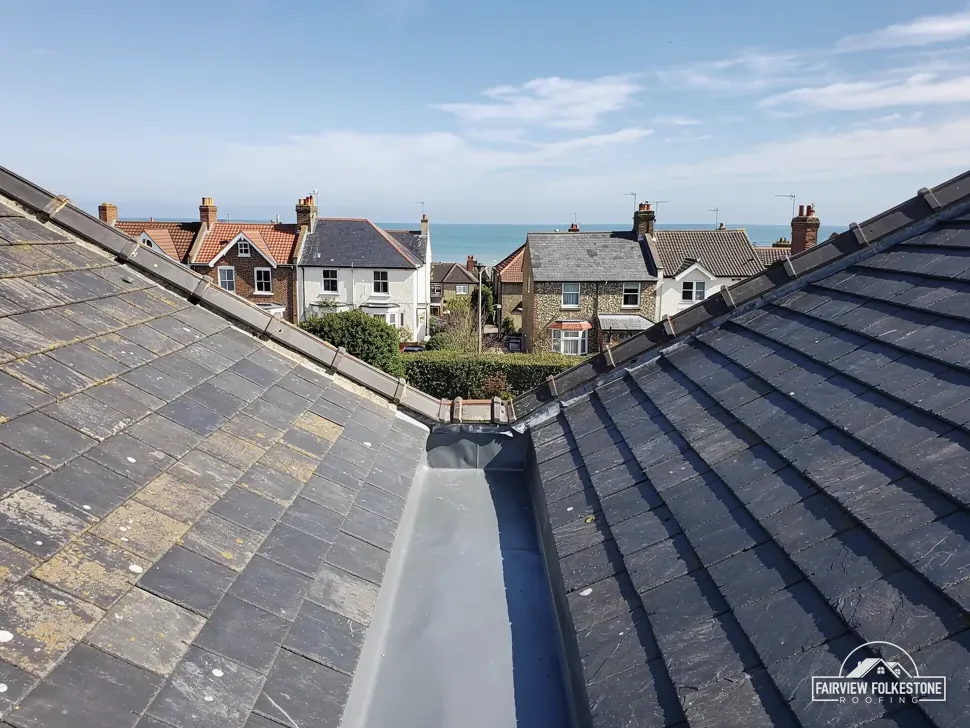
In a lined valley, lead runs down the internal angle where two slopes meet, with the slates cut to a line on each side. If the lead has split, or the cut slates have slipped into the channel, rain from both slopes runs straight in. Where slates meet a chimney or a wall, lead soakers sit between the courses with a stepped flashing over them; at the ridge, the ridge tiles sit on a mortar bed or a dry-fix system.
From inside the loft, a stain running down a rafter beside a valley or a chimney points us to the join before we go up, which saves lifting slates that were never the problem.
Each of these can be put right without touching the main slope. A split valley lining can be relined; slipped valley slates can be re-cut and refixed; soakers and flashings can be renewed while the slates beside them are lifted and put back. BS 5534's 2015 amendments mean mortar is no longer relied on as the only fixing, so when we re-bed a slate ridge we add mechanical fixings too.
- Valley: the lead and the cut slates beside it.
- Abutment: soakers, flashing and the pointing above.
- Ridge: the bed, the joints and the fixings.
Is a leak beside the chimney always the slates' fault?
No. Damp on a chimney breast, or on a ceiling below a valley, can come through split lead, a failed soaker or open pointing while every slate around it is sound. We trace the wet back to where it gets in before deciding anything, because re-slating will not stop a leak that is coming through the lead.
Code 4
the lead Royston Lead lists for soakers, flashings and pitched valley gutters
Code 3 is for soakers only
Verges, hips and sound lead
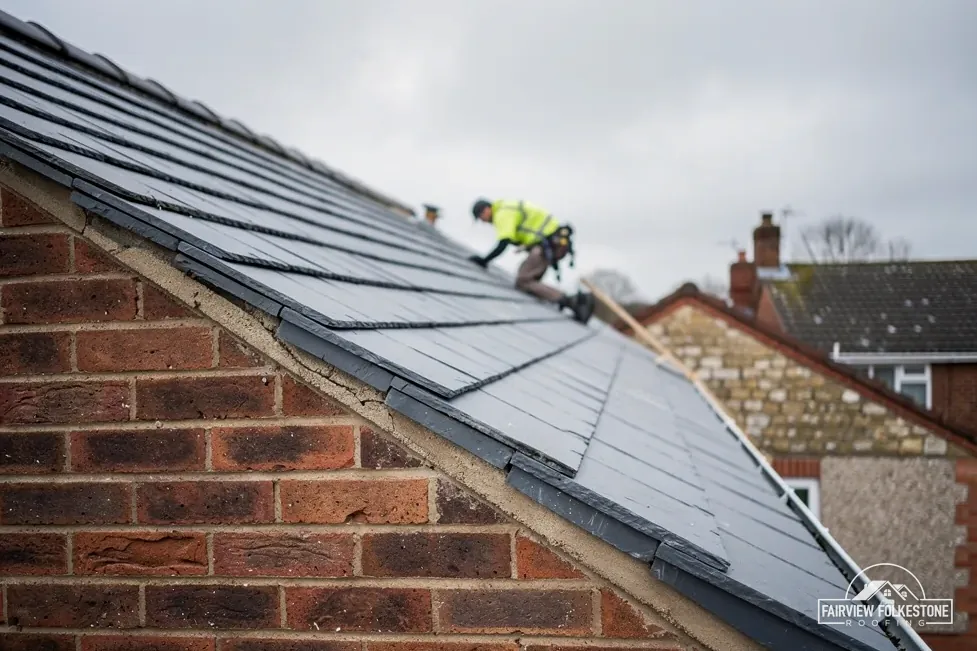
The verge, where the slates stop at a gable, and the hips, where two slopes meet over an outside corner, are the other edges to watch. A verge needs full and half-width slates laid so the edge is weathertight, with a sound bed or a dry verge system along it. A hip needs its slates cut cleanly and its capping held down along the whole run, or wind can work under it. A slate hip can be finished with lead rolls or with ridge-style cappings, and either kind gets the same check along its length. At the eaves, the bottom course sits over a short under-course so rain is carried into the gutter; if that course has slipped, rain can run behind the gutter and down the fascia.
Where a chimney is involved, the stack, its pointing and its flaunching may need work too, and doing that while the slates are open means the access is paid for once.
Lead in good order does not have to go just because the slates beside it are being replaced. During a re-slate we judge each valley, soaker and flashing on its own merits: whole, well-dressed lead can be eased up and dressed back, and split or thin lead is renewed. Our lead work service covers the lead itself in more detail.
How we re-slate a roof, step by step
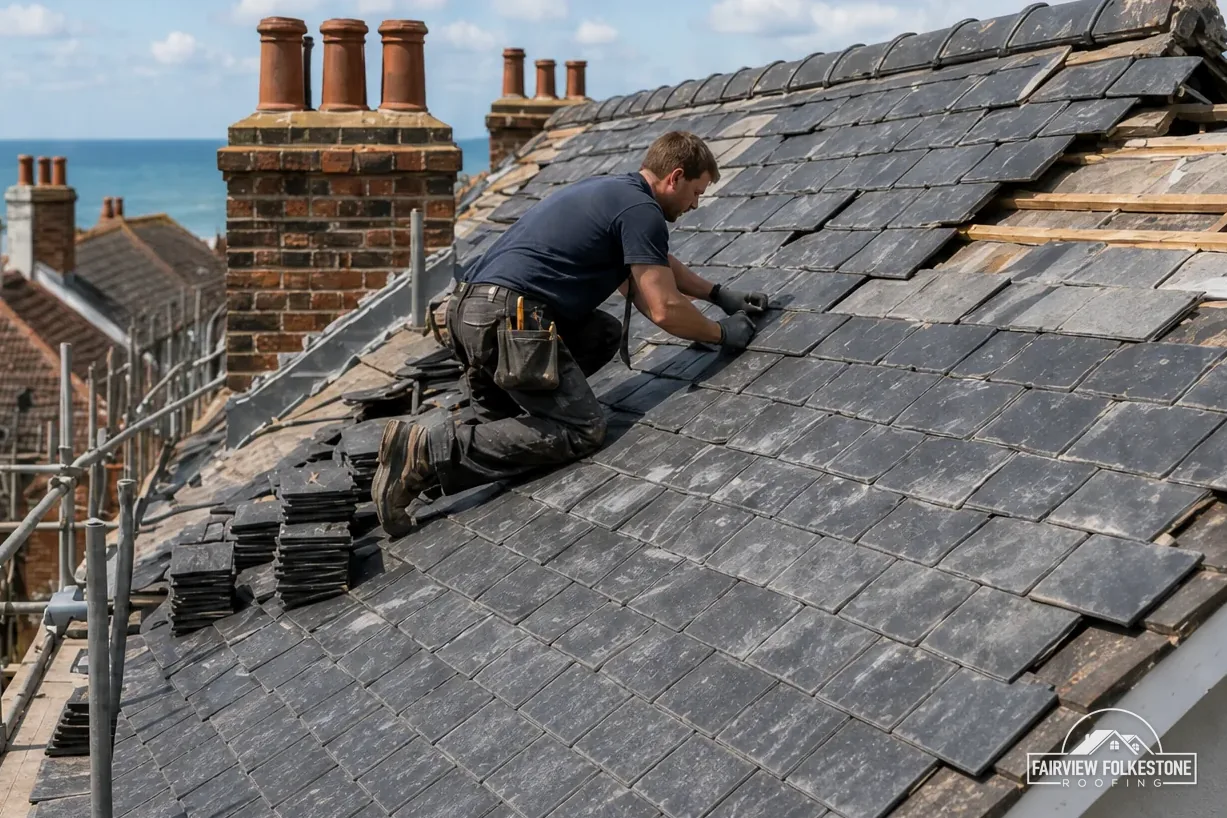
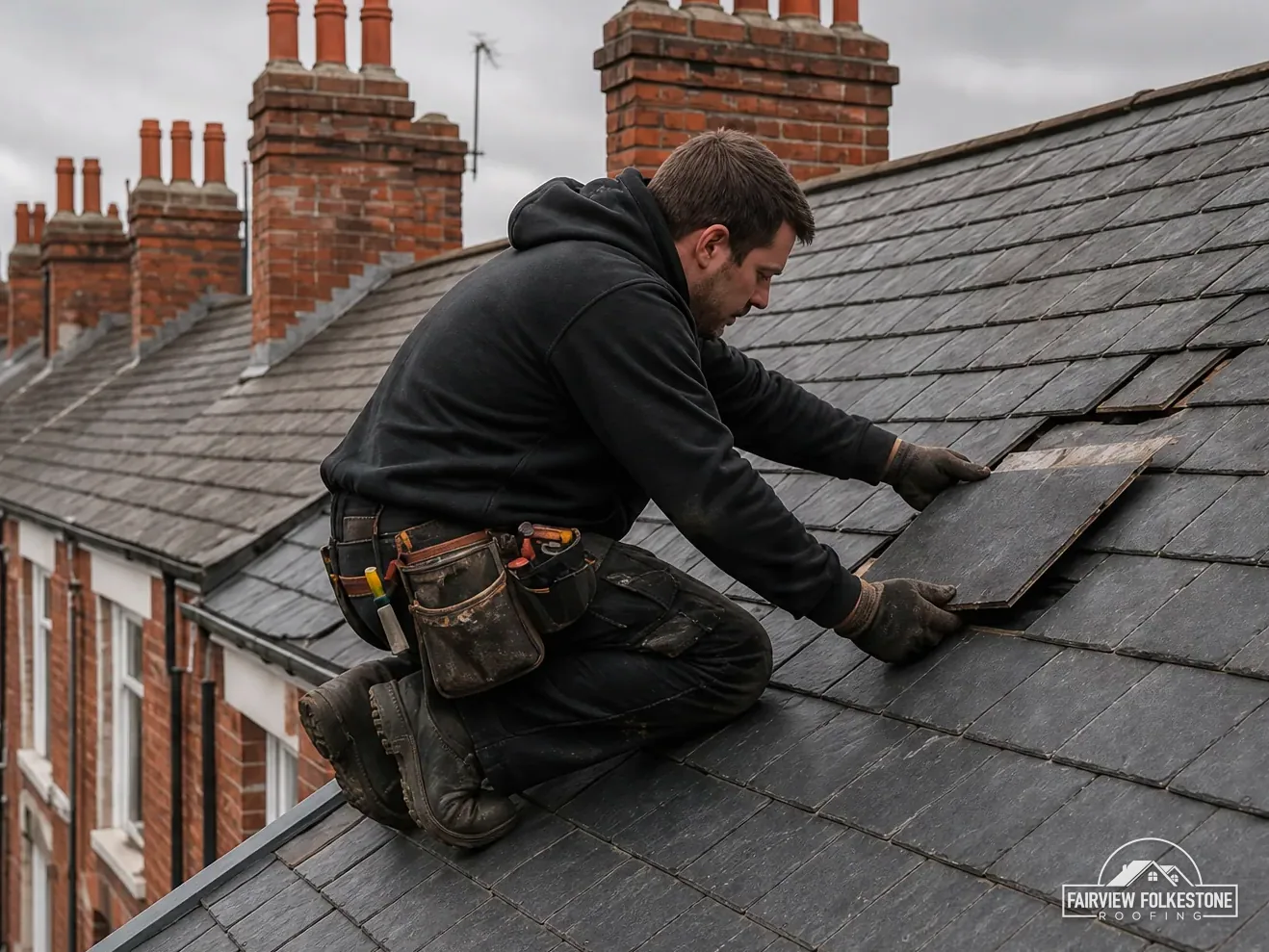
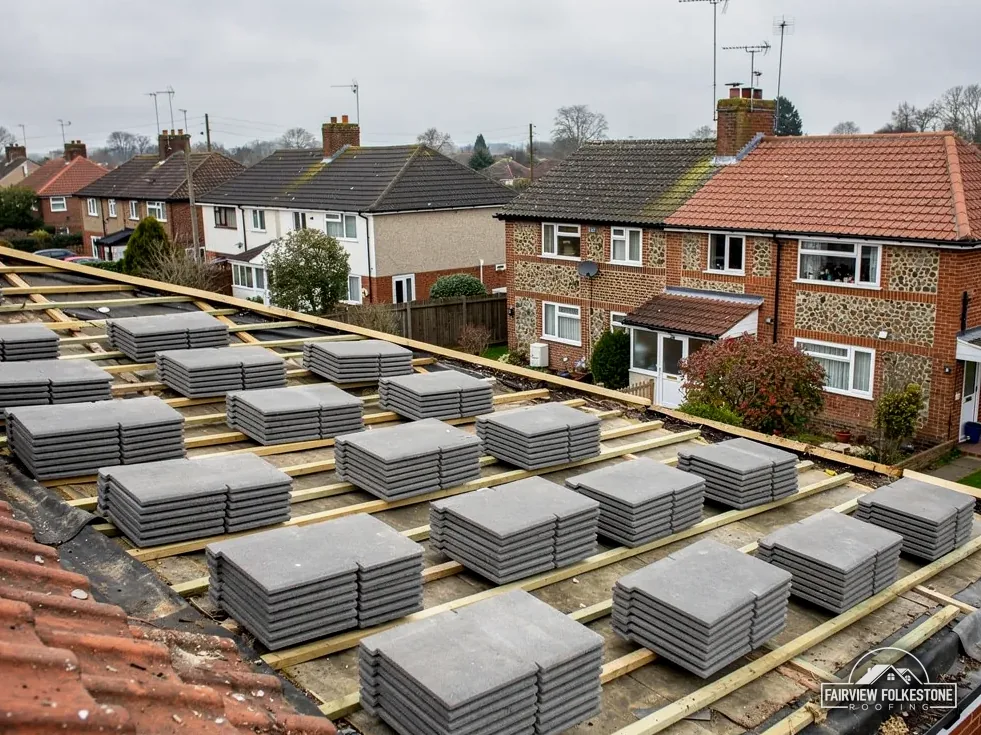
Re-slating means stripping a slope down to the rafters, keeping every slate worth keeping, and hanging them again on new battens and a new underlay with fresh fixings.
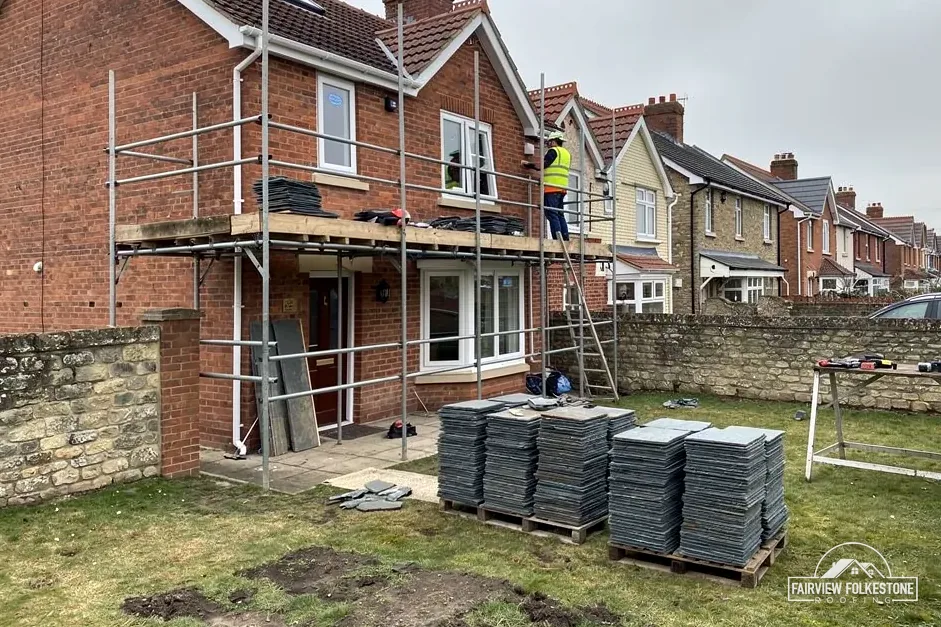
- Scaffold goes up, and if any of it sits on a public road or pavement, we arrange the licence with our scaffolder.
- Slates come off by hand, and sound ones are sorted and stacked by size.
- Old battens and felt come off and the rafters are checked.
- New membrane and battens go on, set out to suit the slate size.
- The slates go back with new nails or hooks, with matching slate making up any shortfall.
- Ridges, valleys and flashings are finished and the site is cleared.
Where there are not enough old slates for the whole roof, the reclaimed or new ones can go on a rear slope, so the front keeps its original look. Each slope is stripped and covered again in turn, so the house is never left open across the whole roof. Before any slope comes off, we agree the start date and the access with you and cover anything stored in the loft below. When you compare prices, make sure each quote states whether scaffold and VAT sit inside its total, and ask about anything left unclear.
Entry 06Re-slating
Re-slating a period house: strip, sort, re-hang and finish
When the nails or the slates have gone across the roof, a re-slate is the right answer. On an older house, how it is done matters as much as when.
Nails failed, slates still sound
Strip and re-hang
Slates flaking on every slope
Re-slate in new slate
One slope worn, the others sound
Re-slate that slope only
What sets the price
- Size and pitch of each slope
- How many old slates can go back
- Which replacement slate is chosen
- Scaffold, licence and access
One written total price
Period houses, permission and wildlife
On a period house, traditional materials and the look of the roof from the street both count. Re-covering a house in slate is normally permitted development under Class C, conservation area or not, though an Article 4 direction may withdraw that right in some streets, so the council is asked before we start. A listed house still keeps those permitted development rights, but listed building consent covers any change to its character. Our planning permission guide sets out the conditions. Flats are different: they have no permitted development rights, so the roof of a block is a planning question for the council. Where a period roof has patterned courses or other details, we record them before stripping so they go back the same way.
Bats and nesting birds use old roofs too. The law protects a bat roost from damage or destruction whatever anyone intended. Section 1 of the Wildlife and Countryside Act 1981 makes it an offence to intentionally damage a wild bird's nest for as long as the nest is in use or being built. So the roof space and the eaves are looked over before stripping begins, and the timing is planned around what we find. If bats turn up during the work, it stops on that part of the roof until proper advice has been taken.
A re-slate keeps every good slate; only the tired fixings and the broken pieces go.
Slates slipping, or a whole slope wearing out on your house?
Photograph the slipped slates from the ground and send them over, or book a visit, and we reply with a verdict on the slates, our reasons, then one written total price.
Slate roofing questions, answered plainly
Costs, lifespans, permission, upkeep and choosing slate for a house in Folkestone or the local villages.
What does slate roof work cost in Folkestone and Kent?
Figures vary by source. MyJobQuote puts the average cost of fitting a slate roof at around £7,800. HomeBuilding says Welsh slate on a 65m2 three-bedroom semi might reach £18,000. For slate roof repairs, Checkatrade lists natural slate at £150 to £220 per m², for areas up to 3 m². Which? Trusted Traders put a whole new roof on an average three-bedroom house at £7,000 to £21,000 excluding VAT (November 2025), adding that homes in the South East are likely to pay toward the upper end. The quote we give is one written total price.
How long can a natural slate roof last?
HomeBuilding gives approximate lifespans of 100+ years for Welsh slate, 75 to 100 years for Spanish natural slate and 50 to 80 years for reclaimed Welsh slate. Those ranges describe the slate, not the whole roof. The nails, battens, underlay and lead around the slates can wear out well before good slate does, which is why a slate roof can need re-slating while the slates themselves are still sound enough to go back on. Regular maintenance and prompt refixing of slipped slates help the rest of the roof keep pace with the slate itself.
Is slate a sensible choice for a house near the sea in Kent?
Yes, when it is fixed for the site. According to Cupa, which makes slate, wind and rain exposure are the two main factors, and a tall building, or one sited on the coast, a hill or a slope, is graded with higher exposure. BS 5534 then sets how the fixings are calculated, so a slate roof in Sandgate or on the Folkestone front can be specified differently from one in a sheltered street inland. On a coastal house we work the fixing specification out for your address rather than copying the last job we did nearby.
Can my old slates go back on when the roof is re-slated?
Yes, where they are sound. Each slate is taken off by hand and checked for flaking, soft edges, cracks and worn nail holes. Good ones are cleaned of old moss, sorted by size and hung again on new battens and membrane with new fixings. Some will break on the way off, so the shortfall is made up with reclaimed or new slate matched to the old. Before work starts we tell you roughly how many we expect to keep, and why, and the sorted slates are stacked on site where you can see them.
Do I need permission to re-slate my house?
For a house, re-roofing is normally permitted development under Class C, but check for an Article 4 direction, and a listed home needs listed building consent for anything affecting its character. Building Regulations are separate: the Planning Portal says an application is not normally needed if the work affects less than 25 per cent of the building envelope and less than 50 per cent of the roof, while a new covering 15 per cent or more heavier needs approval. Within its own district Dover District Council is stricter, where a like-for-like change of roof covering still needs approval.
Are man-made slates a fair alternative to natural slate?
They can be, on the right house. Man-made slates are fibre cement, flatter and more regular than natural slate, and HomeBuilding gives fibre cement tiles an approximate lifespan of 30 to 40 years. On a period house, natural slate may suit the street better. Folkestone & Hythe District Council says conservation area designation means new developments must be appropriately designed, including using traditional natural materials. HSE advises assuming asbestos is present in any building built or refurbished before 2000, so old man-made slates are tested before they are touched, and the test result decides how they are handled.
What maintenance does a slate roof need between repairs?
Look at it from the ground after high winds and once a year, with binoculars if you have them, for slipped or missing slates, lifted ridge tiles and leaves or debris in the valleys. Keep the gutters clear so water is not held at the eaves. Moss can be brushed off by hand from a safe position, but Marley warns that high powered jet washes are not recommended because they can damage the surface of the slate or tile. Small faults caught early, such as a single slipped slate, are simpler and less costly to put right.
Does re-slating mean new felt or a membrane under the slates?
Yes. When a slope is stripped, the old felt and battens come off and a new underlay goes on before the slates go back. Underlays differ: a high-resistance (HR) underlay is not vapour-permeable, so a cold roof needs eaves ventilation, and Marley gives 25 mm along the eaves where the pitch is 15° or less, and 10 mm above 15°. With an LR membrane, a sealed ceiling and an air-permeable covering, Marley says normal eaves construction can be enough, if its certification terms are met. Your quote names the underlay we plan to use, and the reason for choosing it.
Tell us what's wrong with the roof.
You'll get one written total price.