
Slate choice guide
Natural or man-made slate: how they compare
Natural and man-made slates look alike from the pavement and behave differently on the roof. This guide compares them on lifespan, cost, fixing, weight and the rules that apply.
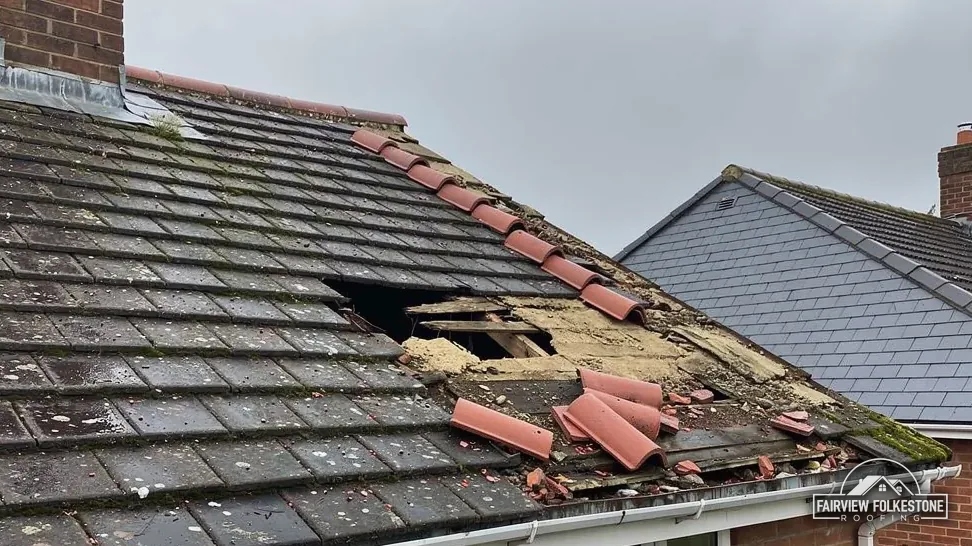
Pick two slate roofs on one street and it can be hard to say which is quarried rock and which is a manufactured copy. From a distance the colour, the size and the neat courses can match. Up close, and over decades, the two behave differently, and the difference is worth understanding before you spend money on either.
This guide compares them where it matters to a homeowner. It starts with what each name covers, then sets approximate lifespans side by side, goes through cost and what moves it, explains the fixing and pitch rules that apply to slate, and covers the planning and Building Regulations points that can steer the choice, especially in a conservation area or on a listed house. It closes with a way of choosing between them for your own roof.
The published figures here are third-party and dated. None of the figures is a Fairview price. Ours come later, once we have seen the roof.
01The detail
What the two names cover
Natural slate is rock split into thin sheets, then cut to size. HomeBuilding's cost guide separates it by origin: Welsh slate, Spanish natural slate and reclaimed Welsh slate, which is slate taken from an old roof and laid again. Origin matters because it affects both the price and the approximate lifespan, as the next section shows.
Man-made slate is a manufactured covering made to resemble slate. The name takes in fibre cement slates and other composite products, and the makers differ in what goes into them and how they are fixed. So a single statement about man-made slate is risky: each product has its own data sheet with its own pitch, fixing and lifespan information.
That is the first practical point. When you compare a natural slate quote with a man-made one, you are comparing a material with a long track record and well-known behaviour against a product whose details depend on who made it. Ask for the maker's name and the product's data sheet at the quote stage, and keep a copy. The word slate on a quote tells you less than you might hope: ask what it is made of, where it comes from and what the supplier says about it, and treat a vague answer as a reason to keep asking. A good quote names the product, not just the look.
Our guide on Welsh against Spanish slate goes into the two main natural origins. This page asks the wider question of natural against manufactured, and leaves the choice of origin to that guide.
02Lifespans
Lifespan side by side
HomeBuilding's cost guide, last updated on 30 September 2025, gives approximate lifespans for coverings. The table shows the slate rows and, for the man-made side, the fibre cement row, which is the closest match it lists.
Slate comparison questions
Can I replace natural slate with a man-made one?
Planning rules for re-roofing a house do not require a match, but a conservation area, an Article 4 direction or a listing can change that. Ask the council before you commit, and keep its answer in writing. Dover addresses also have the council's own approval rule for replacing roof coverings.
A slate that outlives its fixings still means stripping the slope.
| Covering | Approximate lifespan |
|---|---|
| Welsh slate | 100+ years |
| Spanish natural slate | 75 to 100 years |
| Reclaimed Welsh slate | 50 to 80 years |
| Fibre cement tile | 30 to 40 years |
Read these as ranges, never promises. They describe what such coverings can be expected to manage when well laid and looked after, and a roof with poor fixings or damp timber beneath will not reach them.
The gap between the natural rows and the fibre cement row is large. It is the main reason to think of a man-made slate as the shorter-term choice, though the table covers fibre cement only. Other composite products have their own figures, which only the maker can supply, so ask for them in writing and treat a missing figure as an answer in itself.
Lifespan also depends on what holds the slates on. Nails and hooks can fail before the slate does, so a long-lived slate may need refixing before the slate itself is spent. That is a separate question from the one the table answers, and it applies to every row.
Reclaimed slate sits lower than new slate because it has already served one roof. That can still suit a house where the look of old slate matters more than the last few decades of life.
03Costs
What each costs to put on
On cost, HomeBuilding gives a worked example. A standard three-bedroom semi with a 65 m² roof in plain concrete tiles may cost between £10,000 and £15,000, counting labour, scaffolding and insulation, while the same property in Welsh slate might reach £18,000. That example sets slate against concrete tile, not against a man-made slate.
MyJobQuote's average for fitting a slate roof is around £7,800, on a page dated 6 October 2026. The two sources measure different things, so do not set one beside the other as if they agreed. HomeBuilding's is a priced example for one house; MyJobQuote's is an average across jobs.
A price for man-made slate depends on the product chosen, the pitch, the height and the access, and it is settled after a survey like any other job. Scaffold, labour, battens, underlay and removal of the old covering go into any re-roof, so the covering is one part of the total and never the whole. The same goes for natural slate: what sets the total is the area, the covering, the scaffold, the state of the battens and any chimney or valley work.
Cost over time deserves a thought as well. A covering that lasts twice as long may be the better spend even if it costs more to lay, which depends on how long you expect to live in the house. A roof you will leave in ten years is judged differently from one you plan to hand on, and a buyer may look at the covering's age when you sell. For the wider picture, see our guide to slate roof cost.
04Fixings · Pitch
Fixing, pitch and exposure
Slate must be fixed properly whatever it is made of. BS 5534 covers slating and tiling and carries no force of law, but Marley notes that since the 2015 amendments mortar alone has not been relied on to hold a covering, so fixings carry the load. For ridges, hips and verges, BS 8612:2018 is the current standard for dry-fixed systems.
Does a man-made slate need a structural check?
Whenever the weight of the roof covering rises by 15 per cent or more, the Planning Portal says approval is needed, and it advises a structural engineer or surveyor first. Products differ, so the maker's data sheet matters. We check the weight question at the survey, before any covering is chosen.
For natural slate, Cupa, a slate maker, says BS 5534 puts the minimum roof pitch at 20 degrees where the exposure is moderate and the slate is 500 mm long with a 115 mm overlap. It also says hook fixings are not for any pitch under 25 degrees. A low-pitched roof is therefore not a safe place to assume slate will work, and a roof that was built for tiles may sit below the figure. The slope has to be measured first.
Exposure counts too. Cupa says buildings on slopes, hills or coastal ground will be graded with higher exposure, so the fixing specification is calculated for the site. On a coastal roof, the nails or hooks and the lap are worked out for that exposure.
For a man-made slate, the maker's data sheet sets the minimum pitch and the fixings, as it does for tiles. Marley, for example, publishes a lowest pitch for each tile in its range, from 12.5 degrees to 40, and the sheet is the check for any product. A man-made slate fixed outside its data sheet is outside the maker's terms as well. Our answer on the weight of slate against tile covers the loading side.
05Key points
Rules that can steer the choice
Neither material is banned anywhere, but some rules and places make one easier than the other. The main ones:
- Building Regulations: the Planning Portal says approval follows when the weight of the roof covering goes up by 15 per cent or more, and Approved Document A's test for a significant change is a loading increase of more than 15%.
- Planning: Class C of the permitted development order covers re-roofing a house, and England's version has no condition that the new covering match the old.
- Conservation areas: Folkestone & Hythe District Council says new development in one must be designed appropriately, including using traditional natural materials.
- Article 4 directions: Dover District Council says some directions reach alterations to a dwelling's roof where it faces a road, waterway or public open space.
- Listed homes: they keep their rights under permitted development for roof work, with listed building consent required too when the work touches the building's special character.
None of these rules says natural slate is better or man-made slate is worse. They set out where a council will want to be asked, and where the weight of the new covering has to be checked. Each applies to the address, so a rule that suits your neighbour's house may not suit yours.
Dover District Council also lists replacing roof coverings, even like for like, among work needing approval, for addresses in its district.
The pattern is that natural slate is the easier case to defend wherever a council cares about traditional materials, and a man-made substitute is the one to check first. We check with the council before any re-roof in a conservation area or on a listed house, and we take the answer in writing.
06Worth knowing
Choosing for your own roof
Put the comparison into a short list of questions, and answer them for your house.
- How long do you plan to stay? A long stay favours the longer-lived covering.
- Is the house listed, in a conservation area or under an Article 4 direction? If so, ask the council before you choose a man-made product.
- What is the pitch? Slate has minimum pitches, and a low slope narrows the options.
- What can the roof structure carry? Would the new covering add 15 per cent or more to the weight? Approval is then needed.
- What does the maker's data sheet say, for any man-made product?
One warning about old fibre cement. HSE's guidance is direct: if the building was built or refurbished before 2000, assume that there is asbestos in it. On such a house, an old cement-based covering is not something to drill, break or strip until it has been identified. HSE treats careful removal of cement sheets, without breaking them, as non-licensed work, and broken-up material as a stricter matter.
Whatever you choose, the quote should say so in plain words: the covering by maker and product, the fixings, the underlay and the pitch it assumes. A quote that says only slate effect or slate style has left the real question open.
If the existing roof is slate and some of it is reusable, slate roofing covers the options from repair to a full re-slate. If you are torn between the two, ask for both to be priced from the same survey, so the figures compare like with like. Either way, the written price is one total.
Will new slate match my old roof?
Colour, size and thickness all affect how a new slope sits beside an old one, and weathering takes years to blend. A reclaimed slate matches an older roof more closely than new, and we show you samples against the existing slope before anything is ordered.

Tell us what's wrong with the roof.
You'll get one written total price.