
Moss, lichen and algae
Roof cleaning and moss removal in Folkestone
Roof cleaning across Folkestone, Hythe and east Kent: moss lifted by hand, a soft wash with biocide, loose tiles found and the gutters cleared before we go.
10-year workmanship guarantee, in writing
The fair ledger
Six things a roof clean should settle, with our verdict on each
From a thick mat of moss at the eaves to a roof that needs more than cleaning, each entry says what we find up there, what it calls for, and why.
Entry 01Moss
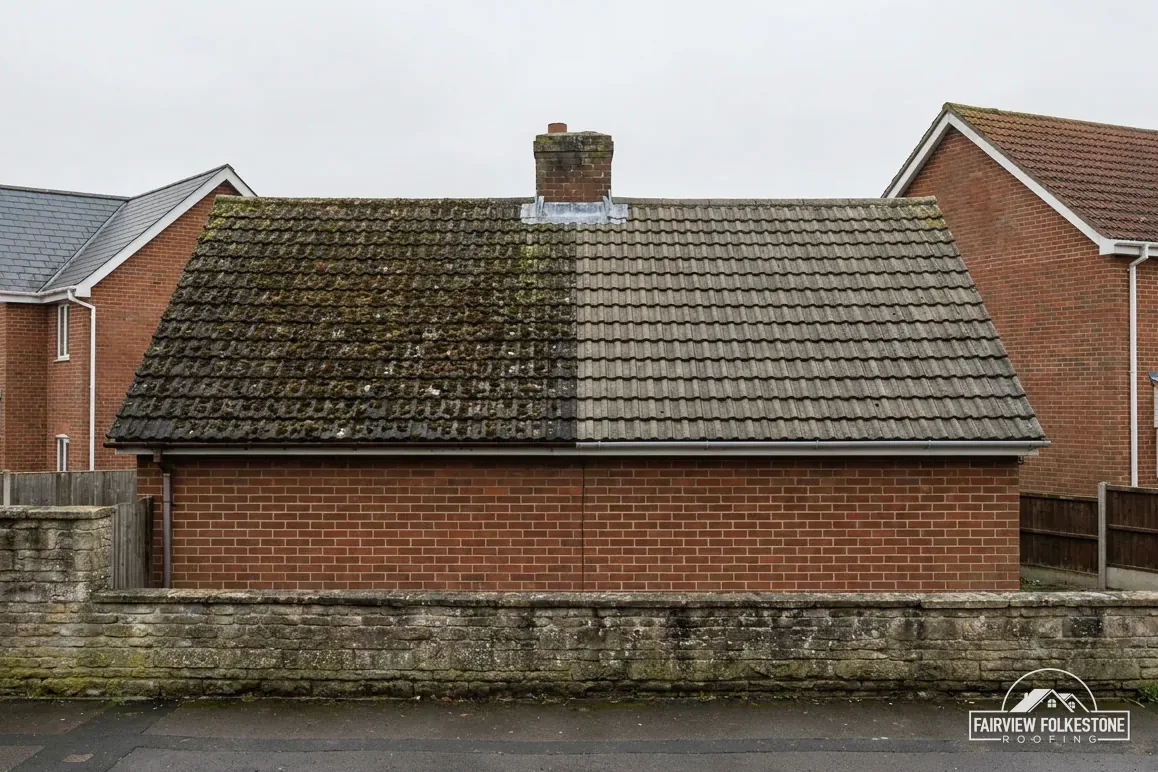
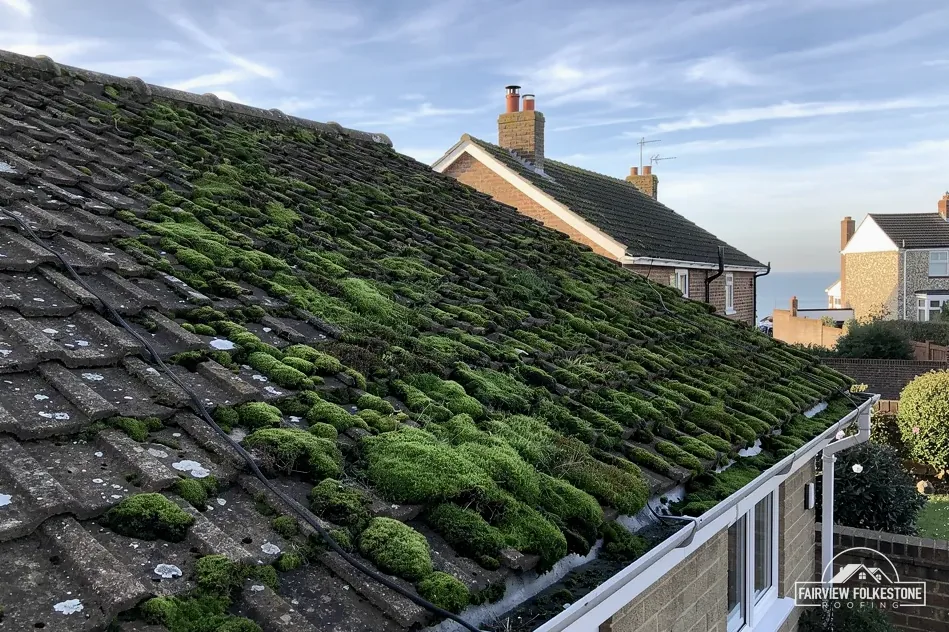
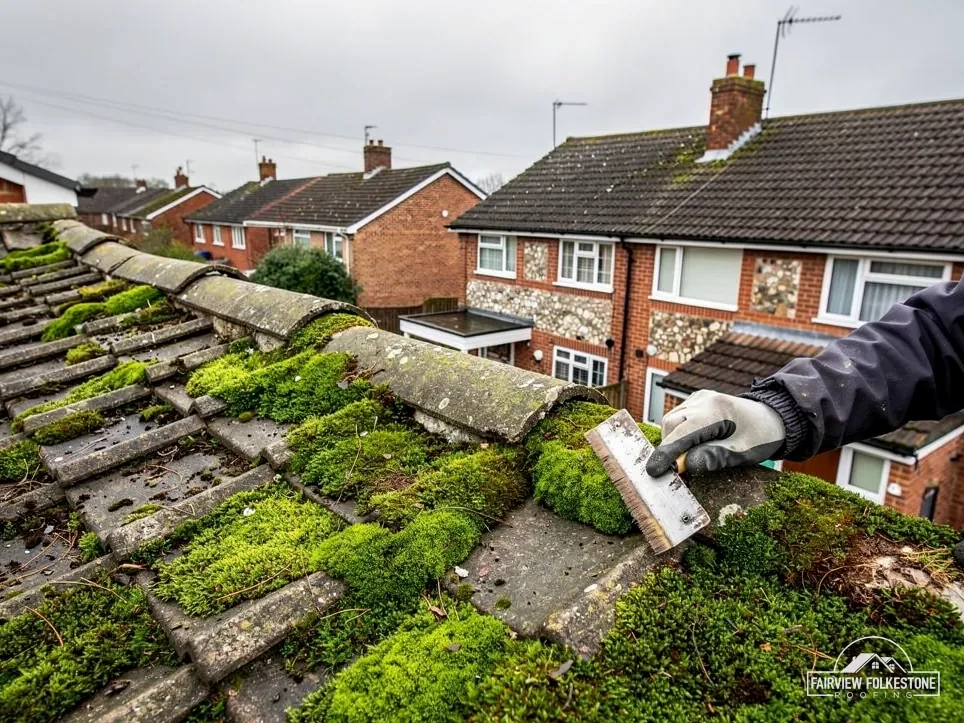
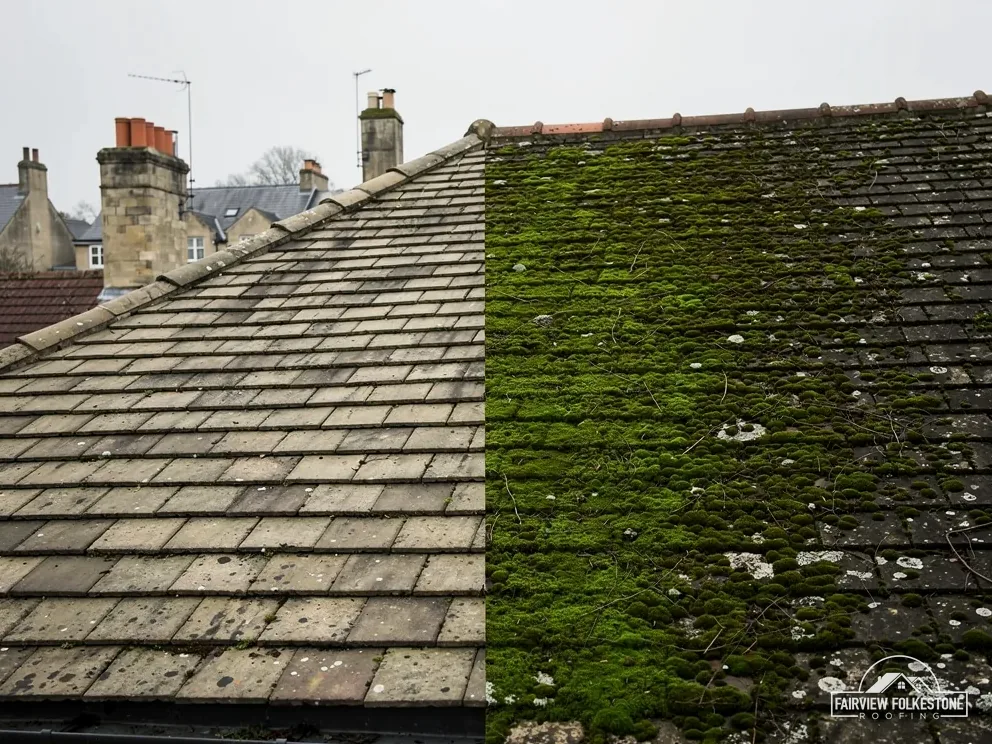
Thick moss, lifted by hand from the ridge downwards
Moss on a roof tells you the surface stays damp and shaded. It does not tell you the roof has failed: that depends on what the moss is hiding.
How we take moss off a roof
The first step is a look from the ground and from the ladder, so we know the pitch, the tiles and what sits below before anyone climbs. Then we start at the top. Moss is lifted off by hand with scrapers and stiff brushes, working down the slope in strips, so loose clumps travel towards the gutter instead of being pushed up under the course above. Nothing is forced. A tile that rocks as the moss comes away is marked and looked at before we move on, and a cracked one is set aside for a matching replacement.
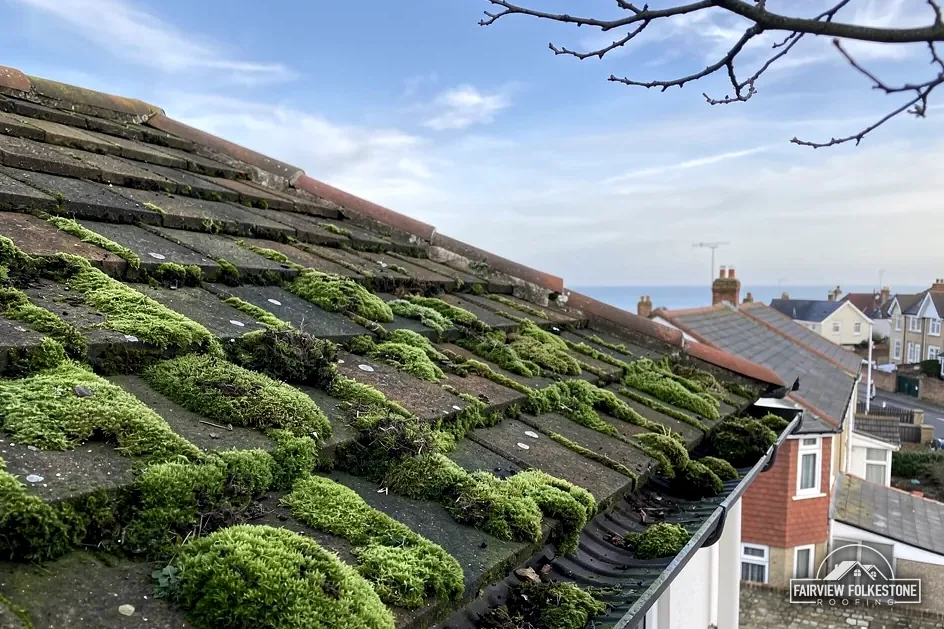
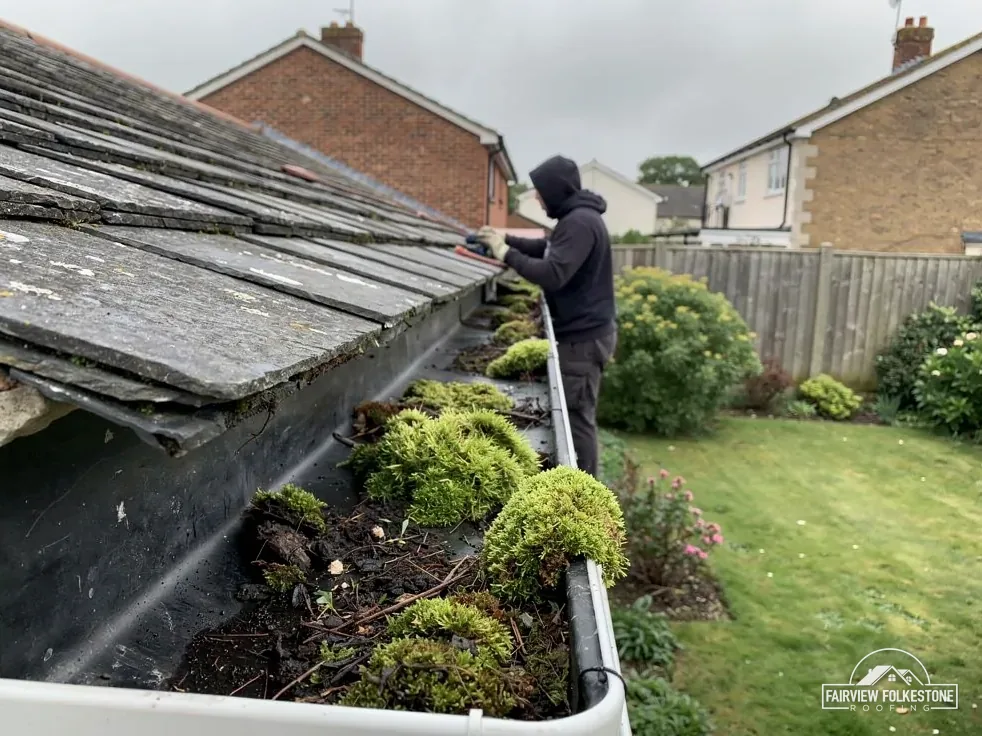
The thick growth along the bottom edge of each tile is the part worth watching. It stays wet long after rain, and where it packs into the joints between tiles it holds water against gaps the tiles were laid to shed it from. All of that cleared moss ends up at the eaves, so the gutters are scooped out by hand at the end of every job and each downpipe is run through to prove it flows. Paths, drives and flower beds below are swept and cleared too, so the moss leaves with us rather than staying in your garden.
- Fascia board behind the gutter
- Gutter catching the cleared moss
- Underlay dressed into the gutter
- Soffit and its vents
Everything lifted from the slope lands at the eaves, so the gutter is cleared last.
Myth: Moss on the tiles means the roof is on its way out.
Fact: Moss grows where a surface stays damp and shaded. The tiles under it can be perfectly sound, and we check each one as it is uncovered.
WCA 1981
intentionally damaging a wild bird's nest, in use or being built, is an offence
Wildlife and Countryside Act 1981
What sets the price
- How much of the roof carries moss
- Height and pitch of each slope
- Access, and whether scaffold is needed
- Glass or flat roofs to protect below
One written total price
Nests, bats and when we can start
Before anyone goes up, we check whether birds are using the roof. Anyone who intentionally takes, damages or destroys the nest of a wild bird while that nest is being built or in use commits an offence, so an active nest under the eaves or behind a gutter is left where it is and the work near it waits. Bats have firmer protection still: damaging or destroying a bat roost is an offence whatever the intent, and the government's bat guidance includes work to repair or replace a roof in the activities it lists. If we see droppings or other signs of bats, we stop and talk to you first.
For the moss itself we want a dry spell, because a dry roof is safer underfoot and the biocide goes on in the dry weather its label asks for. We fix the date with you once we have seen the roof, and our post on the best time of year to remove moss covers the timing question in full, nesting birds included. If the weather turns on the day, we stop and come back rather than work a wet roof.
- Tile slipped down the slope
- Batten the tile hangs from
- Clip holding it in place
Entry 02Tiles
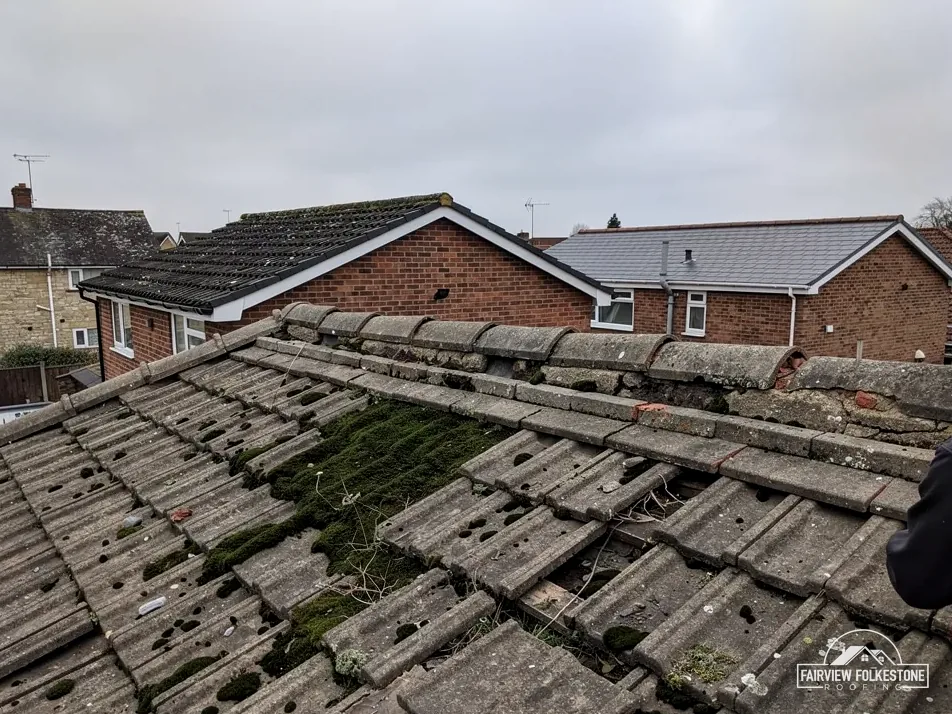
Slipped and cracked tiles that the moss had been hiding
Cleaning a roof is the first time in years that anyone has seen every tile on it. Some may need attention, and we say which before going further.
Will you ask before fixing anything you find up there?
Yes. We stop, show you the photos and explain whether the tile is a repair and what it involves. Any change to the written total is agreed with you before we carry on, and nothing beyond the clean is done without your say-so. Where a tile cannot be matched, you hear the options before one is chosen.
One tile slipped, batten still firm
Refix it with a clip
Corner snapped off a single tile
Swap in a matching tile
Tiles loose across a whole slope
A closer look first
What turns up once the surface is clear
Moss and lichen can sit over a cracked corner, a tile that has slid an inch down the slope, or a nail that has rusted through, and from the pavement the roof still looks whole. Once the growth is off, we show you what we found with photos: each fault, where it sits and whether it is a repair. A single slipped tile goes back and is held with a clip hooked over the batten, so the course above stays where it is. A cracked tile is swapped for a matching one wherever a match can be found.
Refixed tiles follow BS 5534, the British Standard that covers fixing slates and tiles. It is not required by law, but it sets out how a fixing specification is calculated, and coastal homes in Sandgate, Hythe or Dymchurch are graded for higher exposure, so the fixings are worked out for the house we are standing on. A leak that was there before the clean will still be there after it, so if staining in the loft points to one, we trace it before leaving. Anything bigger than a few tiles is written up as a roof repair, photos attached, for you to decide on.
Send us a photo of the moss on your roof
Ask for a verdictRidges, valleys and flashings seen on the way
A clean puts us on every part of the roof, so we look at the details beside the tiles as well. Ridge and hip tiles are checked for loose bedding, lead flashings where the roof meets a chimney or a wall are checked for lifted edges, and valleys are cleared of the moss and leaves that gather where two slopes meet. A valley packed with debris holds rain back on the slope, so it is cleared by hand along its whole length.
None of this is added to the job without asking. If the ridge bedding is sound and the flashings sit tight, that goes into the note we leave you with the photos. If something needs work, you see it first and decide whether it is done now, later or not at all.
Chimneys get a look as well while we are beside them. Moss and lichen on the flaunching, the sloped mortar collar around the pots, are brushed off by hand and any cracks in it are noted. Brick joints that have gone soft are shown to you in the photos, never quietly added to the job, and a stack that needs real work is left for a separate conversation.
Entry 03High pressure
Why a pressure washer never goes on the roofs we clean
A jet strong enough to blast moss off a tile is strong enough to harm the tile itself, and the harm does not show until years later.
What high pressure does to a tile
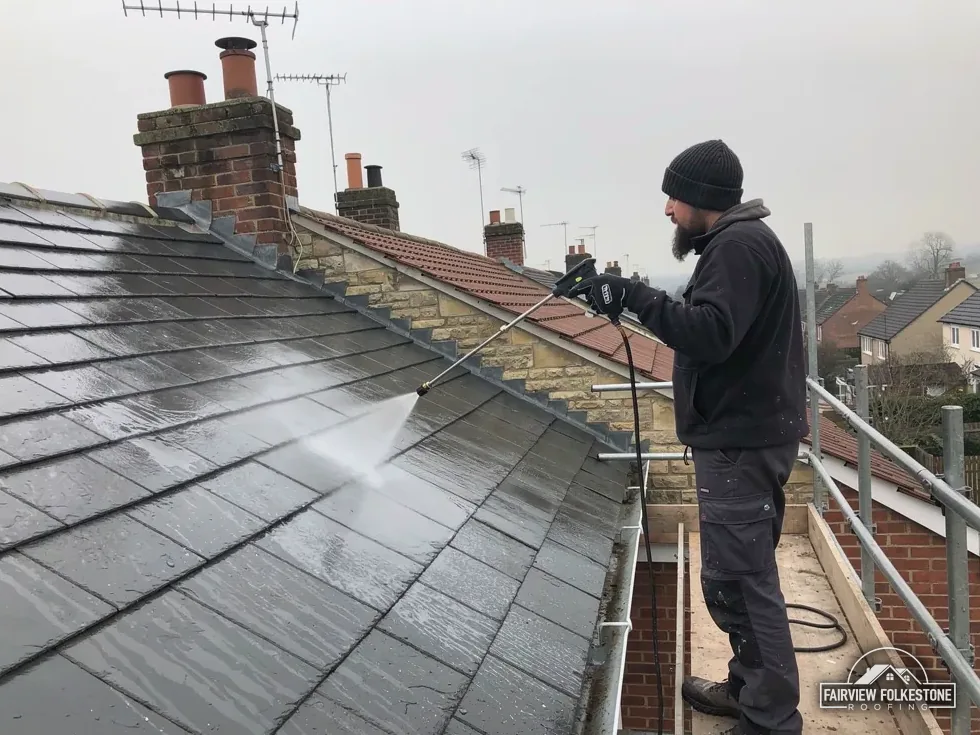
Marley, the tile maker, does not recommend high-powered jet washing, because it can harm the face of a slate or tile and so cut its expected life considerably. That surface is what sheds the rain, and once it has been scoured away it cannot be put back. A roof can look bright and new the week after a blast and still have lost some of its working life in an afternoon.
So we clean by hand and treat at low pressure, the method people call a soft wash. It takes longer on the day, and it costs us more time on the roof. It also leaves the tiles with the face they had, which counts on a roof with plenty of life left in it. If you have been offered a power-washed roof, our answer on whether a roof can be pressure washed without damage sets out what to ask first. The same care applies to the ridge, the verges and any lead: all of them are cleaned by hand, and nothing on the roof is hit with a hard spray to save time.
- Tile, its face kept whole
- Batten under the tile
- Underlay, kept dry
- Rafter carrying the lot
Myth: Blasting moss off with high pressure does a roof no harm.
Fact: Marley advises against high-powered jet washing, because it can damage the surface of a tile and cut its expected life considerably.
60 to 80
years: the approximate lifespan HomeBuilding gives clay tiles, a surface worth protecting
Approximate, never a promise
Slate, clay and cement-sheet roofs
Slate needs its own care. Lichen grips its face tightly, and prising lichen off by force can take thin flakes of slate with it, so on slate we treat first and let the growth weather away. Clay tiles with a soft, weathered face get the same patience. Our page on lichen on roof tiles explains why it is handled differently from moss.
Some garages and outbuildings carry corrugated cement sheets. HSE tells owners to assume asbestos is present where a building was built or refurbished before 2000, so a sheet roof like that is never scraped, wire-brushed or washed hard by us until we know what it is made of. Growth on it is treated with biocide alone, and nothing is done that would break the surface up. If the sheets turn out to need replacing, that is a separate conversation, held before any work starts.
Roof windows set into a slope are cleaned around by hand, and their flashing kits are checked for moss packed against the frame, where it can hold water at the upstand. Glass is wiped with soft brushes and plain water, and nothing is sprayed hard at the seals.
What sets the price
- Area of roof to be treated
- Which growth is on it
- What lies below to protect
- Access and working height
One written total price
Entry 04Algae, lichen
Green algae, black streaks and lichen: a soft wash with biocide
Algae and lichen do not come away under a scraper the way moss does. They are treated where they grow and then left for the weather to finish.
How the soft wash is done
Once the moss is off, the whole roof is treated. The biocide goes on at low pressure from the ridge down, wetting the tiles evenly, at the strength and in the weather its label sets. It deals with what the scrapers leave behind: the green film of algae, the dark streaks running down from the ridge, and the pale crusts of lichen fixed tight to the tile.
None of it vanishes the same afternoon. The treated growth dies back and the rain rinses it off over time, which is slower than blasting, but it does no damage to the tile surface. We keep the spray off plants, ponds and paintwork, and cover anything underneath that needs it. If a ridge or hip is bedded in cracked mortar we note it as we pass, because that is a separate job from the clean.
Not every mark on a roof is growth. Some of the colour changes on old clay tiles or slate are the material itself weathering, and no biocide will shift those. We tell you which marks are which before the treatment goes on, so the roof you expect to see afterwards is the roof you get.
- Moss: lifted by hand, then treated
- Algae and streaks: treated, then left for the rain
- Lichen: treated, never prised off
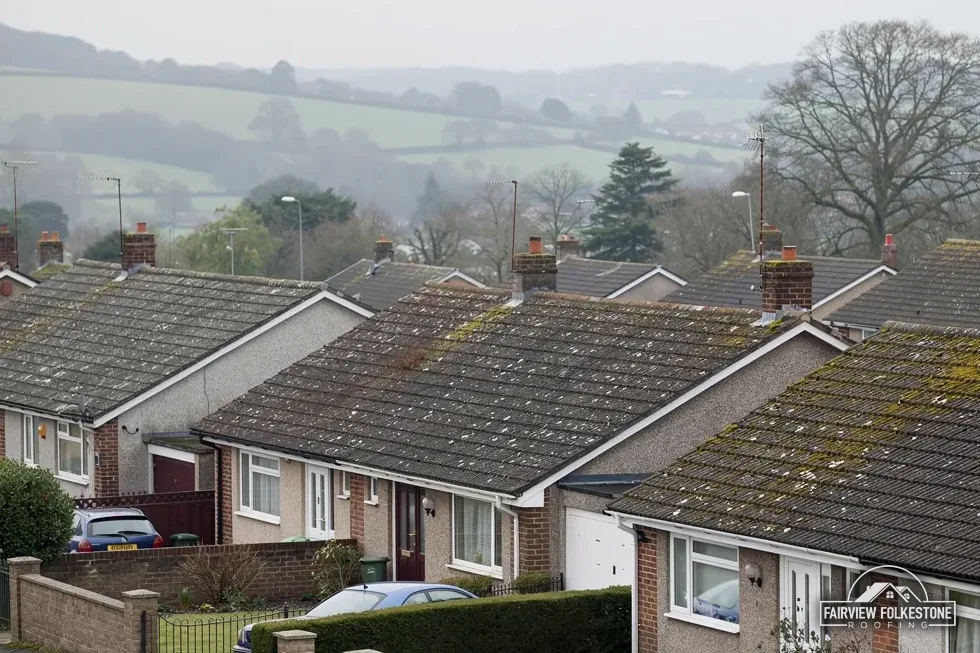
Green algae across a shaded slope
Biocide, then time
Lichen crusts fixed to slate
Treat it, never prise it
- Ridge tile where treatment starts
- Mortar bed checked on the way
- Dry-fix ridge, clipped not bedded
Where we clean: Folkestone, Hythe and the Romney Marsh villages
We clean roofs across Folkestone, Cheriton, Sandgate and Hawkinge, along the coast to Hythe, Dymchurch and New Romney, inland to Ashford and Canterbury, and east to Dover and Deal: anywhere up to 30 road miles from Folkestone. A roof in a sheltered, tree-lined lane and one standing in the wind near the sea are judged on their own terms, so the treatment follows the roof, its pitch, its shade and what lies beneath it. Our page on roof biocide treatment explains what the product does and what it cannot do. Ask about a roof anywhere in that area, including the villages between the towns, and we will tell you whether it needs a clean at all.
Flat roofs over extensions and dormers are treated on the same visit. Growth is brushed off with soft brushes only, since a stiff scraper can cut felt or a membrane, and the outlets are cleared so standing water can drain away. If the clean shows a blister, a split or a lifted edge, we show you it and say whether it is a patch or a flat roof repair.
Entry 05Gutters
Gutters and downpipes, cleared once the roof is done
Every handful of moss that leaves the roof heads for the gutter. Clearing it is part of the clean, never an extra sprung on you on the day.
- Bracket holding the run
- Joint that has dropped
- Outlet cleared to the downpipe
Gutters, outlets and the run to the drain
Moss left in a gutter blocks the outlet, and a blocked outlet sends rain over the front edge and down the wall. Those are the signs we look for from the ground before we quote: a stained band of brickwork under the gutter, weeds growing out of it, or a downpipe that stays dry in a downpour. After the roof is clean, each run is scooped out by hand, the outlets are cleared and the downpipes are flushed until we can see water reach the drain.
While we are at the eaves we check the gutter itself. A run should fall towards its outlet, and Brett Martin, a gutter maker, advises 1 mm of fall for every 600 mm. A run that holds a pool of water, a joint that drips or a bracket that has given way is a small repair, and we show you it with a photo. Rotten boards behind the gutter, or a roofline past saving, belong with our gutters, soffits and fascias service, and you hear that plainly from us instead of a patch.
Can I book a gutter clear when the roof itself looks fine?
Yes. A gutter clear can be booked on its own, and it is a sensible chance to see the state of the roof edge too. If the slopes above need anything we tell you; if they do not, you hear that as well.
1 in 600
the gutter fall Brett Martin advises: 1 mm for every 600 mm towards the outlet
A gutter maker's guidance
Hoppers, gullies and gutter guards
Gutters are not the only place moss collects. Hoppers, the open boxes where two pipes meet, fill with the same debris, and so does the gully at the foot of a downpipe. We clear each hopper, run water through every downpipe and look at the gully to make sure it is taking the flow. A downpipe blocked part way down is rodded through rather than left to overflow at the next heavy shower.
Gutter guards and mesh are fitted on some houses to keep leaves out. Moss and silt can still build up on top of them, so we lift any we find and look underneath instead of assuming the gutter below is clear.
A gutter packed with wet moss is heavy, and that weight bears on the brackets and the joints for as long as it sits there. Once a run is empty we can see whether it has sagged between brackets or pulled apart at a joint. A run that still falls the wrong way after clearing is a small repair we can price for you, and cast-iron gutters are checked along the inside face and the seams, where a long blockage has kept the metal wet.
What a roof coating can and cannot do
Some firms offer a coloured coating after a clean. A coating changes how the roof looks, but it is a surface layer and nothing more. It does not refix a slipped tile, replace a rusted nail or mend underlay that has perished at the eaves, and brushed over a roof with those faults, it hides them from the next person who looks. We tell you whether a coating makes sense on your roof, and if it does not, why not. The question of coatings after cleaning has a page of its own.
Where the clean shows tiles slipping across whole slopes, tiles crumbling at their edges, or felt that tears at a touch from the loft, the clean has done its job by showing you that. The right answer then is a re-roof, and we explain the reasons with photos, exactly as we would for a single cracked tile. Spending on a clean and a coating for a roof in that state would only put off a decision that the roof has already made.
Entry 06Beyond cleaning
When a coating will not help and the roof needs more
A clean shows a roof as it really is. Sometimes that is a roof with years left in it, and sometimes it is one that no amount of cleaning will save.
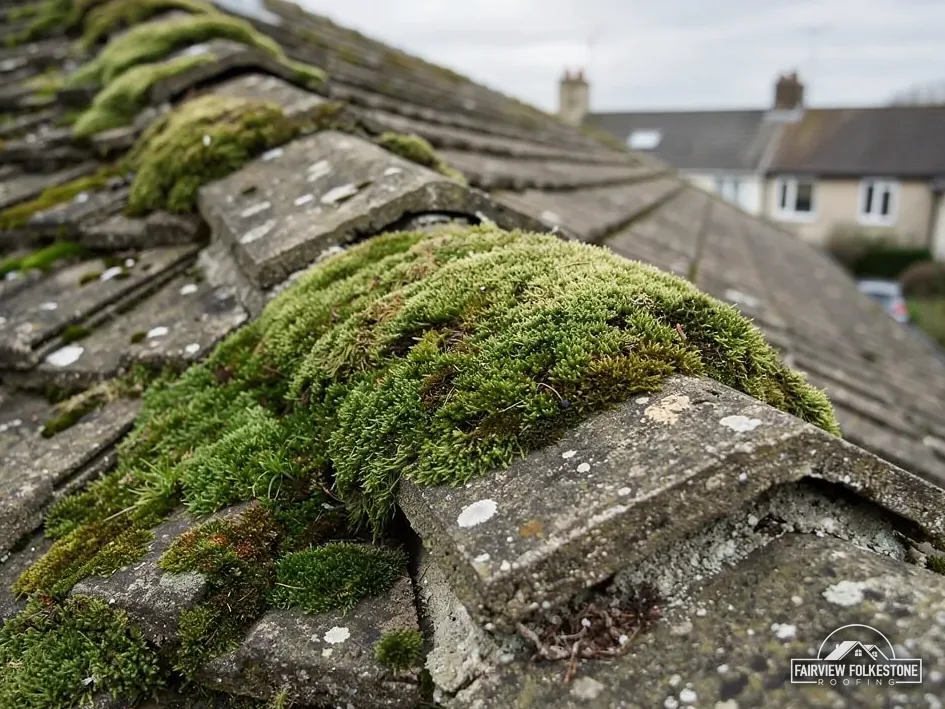
Sound tiles under heavy moss
Clean and treat
Tiles crumbling across whole slopes
Re-roof, reasons shown
Felt torn behind clean tiles
Look from the loft
What sets the price
- Whether the roof needs a clean or more
- Size and shape of the roof
- Repairs agreed before work starts
One written total price
Cleaning as part of looking after a roof
On a roof in good order, cleaning is maintenance: moss off, growth treated, gutters flowing and any loose tile put back. With the roof clear we also look over the flashings and the ridge while we are up there, so small faults are dealt with while they are still small, and the next inspection is quicker because every tile can be seen. After each clean you get a short written note of what we found and anything worth watching, which gives you something to compare against next time. Our guide to roof cleaning costs explains what moves the price up or down.
Some owners book a clean as a regular part of keeping a house in order; others call once, when moss starts showing in the gutters or a tile turns up on the lawn. Either way, the roof is judged as it stands on the day, and the advice follows the same order: clean what is sound, repair what is loose, and say plainly when a roof is past both.
A clean that shows a roof is finished has still told you something worth knowing.
Moss on the roof? Send a photo and get a straight verdict
Book a visit or send us a picture. You hear what your roof needs and why, then get one written total price.
Roof cleaning and moss removal questions
Plain answers on cost, timing and method, and on what a clean can and cannot fix.
How much should I pay to have a roof cleaned in Folkestone?
We price each roof after seeing it, because the size, the pitch, the depth of moss, the access and any scaffold all change the job. You get one written total price, and it states plainly whether VAT and any scaffold are part of it. For gutter work on its own, Which? Trusted Traders put clearing out every gutter on both the front and the back of a house at £75 to £350, excluding VAT (November 2025). Which? says prices are "likely to be at the upper end of the scale" in the South East.
Is getting a roof cleaned worth the money?
It depends what the moss is doing. Where it is thick enough to fill the gutters, hold water in the joints between tiles or hide slipped and cracked tiles, a clean earns its keep, and it lets us see every tile. Where a roof carries a thin film of algae and nothing else, the case is about looks, and you hear that from us. Where a roof needs replacing, cleaning it first is money spent twice, and you will hear that from us before a penny is spent on the clean.
What time of year is best for taking moss off a roof?
A dry spell matters more than the month: a dry roof is safer to work on, and the biocide goes on in the dry weather its label asks for. Birds matter too. Taking, damaging or destroying any wild bird's nest intentionally is an offence whenever a nest is occupied or being built, so we check the eaves, gutters and valleys first and leave any active nest alone, working elsewhere on the roof or coming back later. We agree the date with you once we have looked at the roof.
How can I remove moss from my own roof safely in the UK?
Some of it can be done safely: clearing the gutters you can reach from a ladder footed by someone else, and checking the slopes from the ground with binoculars. Climbing onto the roof itself is a fall risk, and we would not advise it without proper access equipment. Keep a pressure washer away from the tiles, as Marley advises against high-powered jet washing because it can damage the tile surface. If the moss is thick, ask us to take a look instead.
Will a roof clean stop my roof leaking?
Not on its own. A leak comes from a fault: a cracked or slipped tile, lifted flashing, a gutter spilling back, or tired underlay. Moss can cover those faults and a blocked gutter can cause damp of its own, so a clean is a good moment to find the cause. If staining in the loft or on a ceiling points to a leak, we trace it while we are up there and tell you whether it is a repair before anything is done.
Can you clean a conservatory roof and the gutters on the same visit?
Yes. Gutters are cleared at the end of every roof clean in any case, because that is where the moss lands. A conservatory below is protected while we work above it, and its roof can be cleaned on the same visit, with soft brushes and low pressure and no pressure washing on the panels. Glass, polycarbonate and the frame seals are handled gently, and any box gutter between the conservatory and the house is cleared by hand. Tell us everything you want covered when you ask for a visit, and it all goes into the one written price.
How long will my roof stay clean once the moss is gone?
There is no fixed figure for it. A roof under trees, in deep shade or at a shallow pitch can grow moss again sooner than an open slope in full sun, and the biocide slows the regrowth rather than ending it for good. Clearing the gutters once a year and looking over the roof from the ground helps you spot the return early, before it reaches the stage of blocking outlets or hiding tiles again. Cutting back branches that overhang the roof lets in light and drops fewer leaves into the gutters.
Do you need scaffolding to clean a roof?
Not always. Where a roof can be reached safely with roof ladders and edge protection, scaffold may not be needed, while a tall or steep roof, or one above a conservatory, may call for it. Scaffold standing on a road or footway in Kent needs a licence from Kent County Council, at £52 per week for 2026 to 2027, and we arrange the licence with our scaffolder. In Rye and Camber, East Sussex Highways lists £127 for 28 days on its fee table, so we check the current fee.
Tell us what's wrong with the roof.
You'll get one written total price.