
Stacks, flashings and pots
Chimney repairs in Folkestone
Worn pointing, lifted lead, cracked flaunching or a stack that leans: we look at the whole chimney, say what it needs and why, then give one written total price.
10-year workmanship guarantee, in writing
Chimney work, part by part
All guides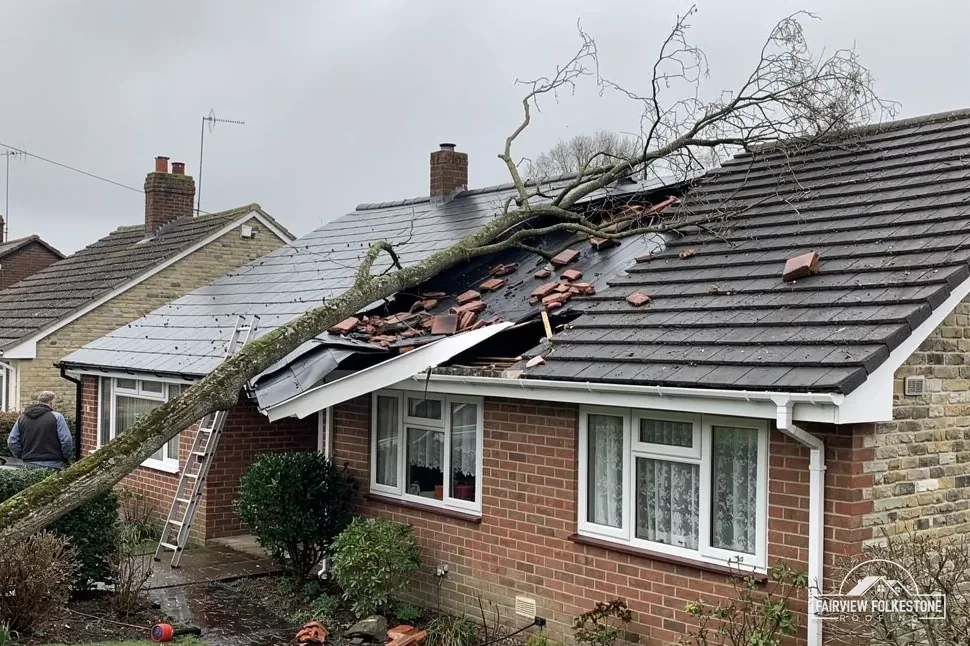 GuideHow much do chimney repairs cost, and what moves the price?9 min read
 GuideDamp on a chimney breast: tracing it to flashings, flaunching or the pots9 min read
 GuideChimney flashing repair: lead, soakers and back gutters9 min read
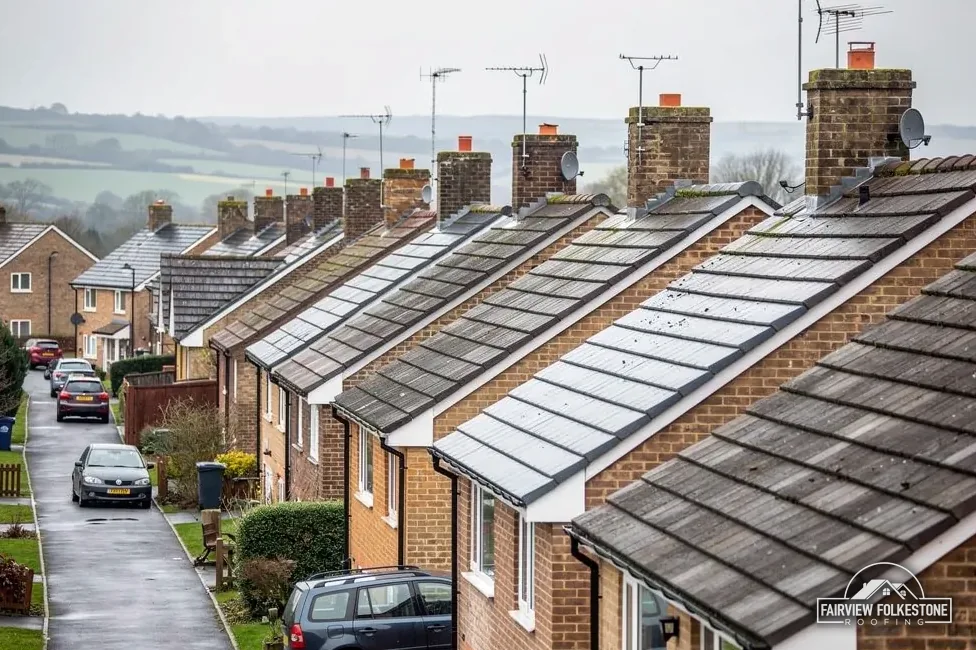 GuideChimney repointing: when it is needed and how it is done9 min read
The fair ledger
From the pointing to the pots: six verdicts on a chimney
A chimney stack has more working parts than it shows from the street. Here are six of them, the faults each can develop, and how we choose between mending, rebuilding or taking a closer look first, for chimney repairs in Folkestone and nearby.
Entry 01Pointing
Weathered pointing on the stack, and when repointing is enough
A chimney stands clear of the roof with all four faces in the weather. The mortar between its bricks takes that first, and it wears back.
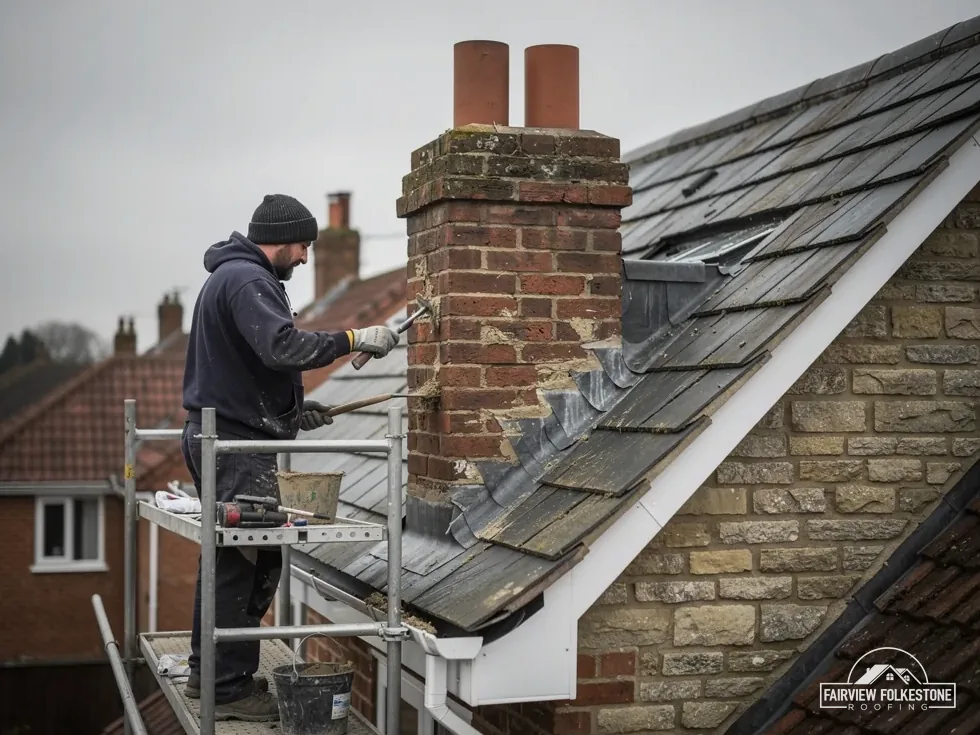
What we repair on a weathered stack
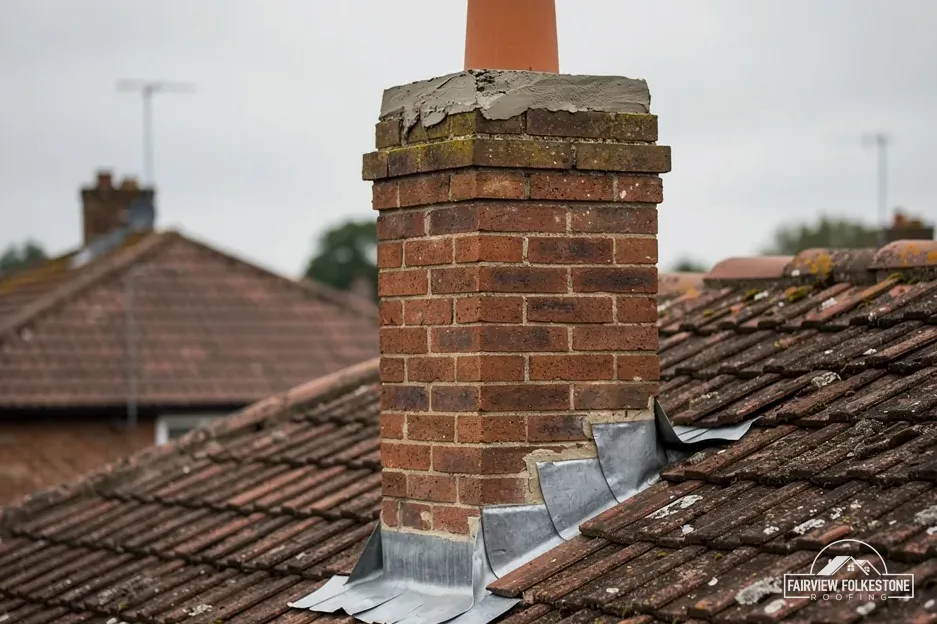
Pointing is the face of mortar in the joints between the bricks. On a chimney it takes rain and wind from every side, with nothing above to shelter it, so over the years it erodes back from the brick face, cracks, and in places drops out. Once the joints are open, rain soaks into the brickwork instead of running off it, and frost works on those wet joints through the winter.
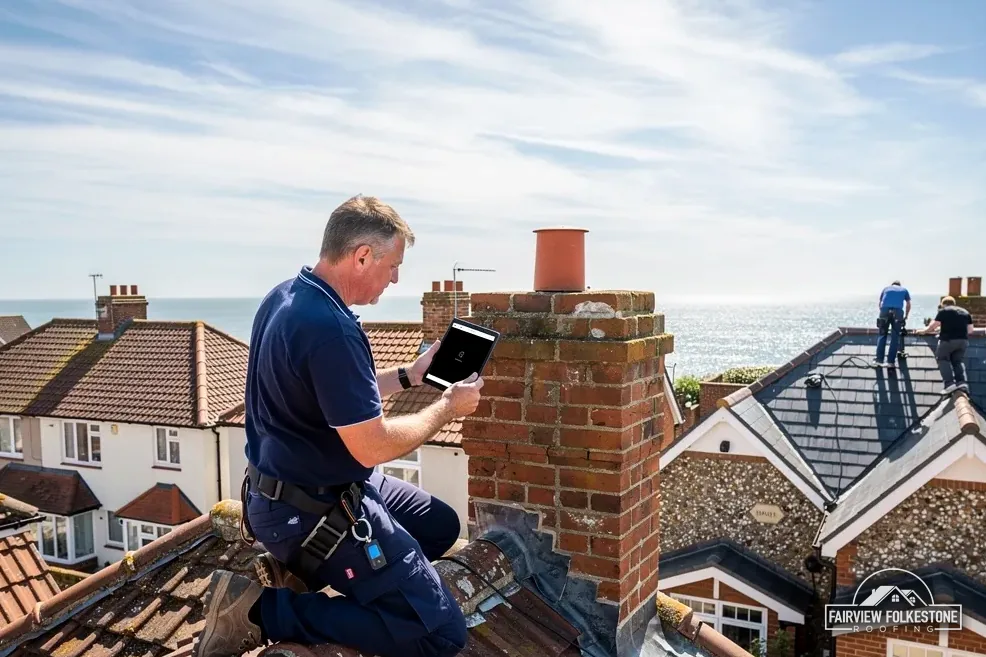
From the ground you may spot recessed joints, sand and grit on the roof below the stack, or plants growing out of the brickwork; a pair of binoculars from the garden shows more than you might expect. Up close we check how deep the decay goes, whether the bricks themselves are sound, and whether the top courses have loosened.
Where the bricks are firm and only the joints have worn, the stack needs repointing: the old mortar is raked out to sound material, and the joints are refilled and finished so they shed water. We choose a mortar to suit the brick, and the quote names it. Our guide to chimney repointing goes through the stages.
Myth: Repointing just means spreading new mortar over the old joints.
Fact: Fresh mortar laid over loose joints soon falls away. The old mortar is raked out to a sound depth before anything new goes in.
What sets the price
- How many faces need raking out
- Flaked bricks to cut out and replace
- The height of the stack
- Scaffold to reach it safely
One written total price
Can one side of a stack be repointed on its own?
It can, where only the weather side has worn. We still look at all four faces, because once the scaffold is up, finishing the other sides on the same visit is simpler than putting a scaffold up twice. The written quote shows which faces we propose to repoint, and why.
Bricks that flake, and stacks that move
Some faults go deeper than the mortar. Bricks whose faces have flaked away, known as spalling, can be cut out and replaced one by one with a close match, provided the rest of the stack is firm. A stack that leans, or has a crack running through several courses, is another job altogether: fresh pointing would only fill the gaps in brickwork that has already moved, so the whole stack gets examined before we give a verdict.
Repointing is work at height, above the ridge line, done from a scaffold. That is one reason to treat all four faces on the same visit. Wear need not be even across a stack: the face that takes the weather can be open while the sheltered side is still tight, and the quote reflects what each face needs. If bricks have already fallen after high winds, making the stack safe comes first, and our emergency roof repairs page explains that step.
- Stepped flashing up the side
- Brick joint holding each step
- Soakers under the roof covering
- Flaunching round the pots
Rain runs off the steps and over the soakers, never into the brick.
Entry 02Flashings
Lead flashings round the base of the stack
Where brickwork meets the roof covering there is a joint that mortar alone cannot keep dry. Lead does that job, on every side of the stack.
Steps pulled out of their joints
Re-wedge and repoint them
Back gutter split behind the stack
New lead at the back
Cement fillet cracked down the side
Proper lead in its place
Code 4
The lightest lead code Royston Lead lists for flashings
Code 3 is for soakers only
Which lead goes where on a chimney
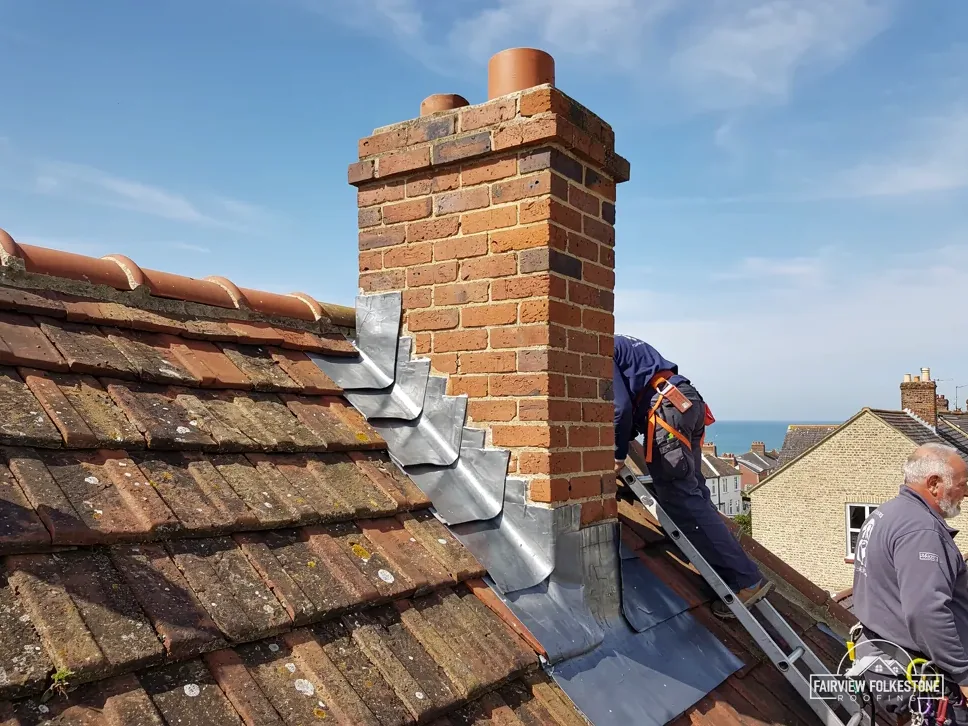
A chimney that rises through a slope carries lead on each side. On the low side, an apron is dressed over the slates or tiles below the stack. Up each side, stepped flashings follow the pitch, each step turned into a brick joint and wedged there, with soakers under the slates or tiles to carry water away from the brick. On the high side, a back gutter catches the rain running down the roof above and turns it round the stack.
Each of those pieces can fail on its own. Steps work loose when the pointing that grips them decays. Old lead can split at its folds. Some stacks have no lead on the sides at all, only a fillet of sand and cement, and a fillet like that cracks away from the brick as the roof and the stack move at different rates.
A flashing repair can be as small as re-wedging and repointing a few loose steps, or as large as stripping the lead and dressing new on all four sides. Either way, the steps go back into joints that are sound, because lead wedged into crumbling mortar works loose again.
Photos of the stack from the street help us
Ask about your chimneyWhy stack and lead belong in one job
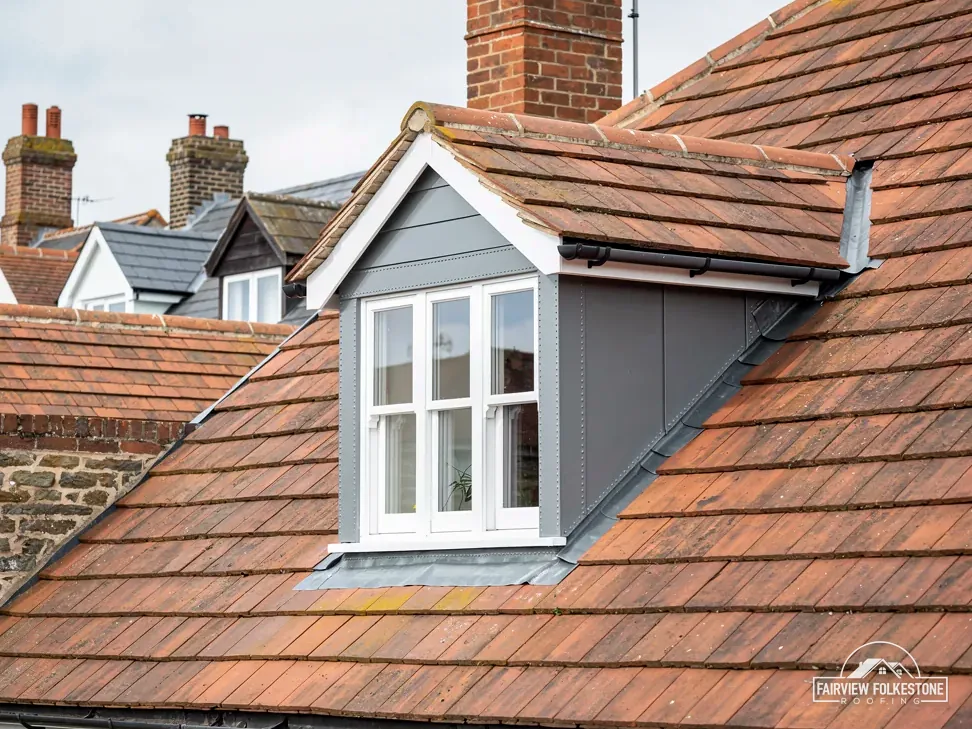
Flashings are where the chimney and the roof covering are joined, so the work means lifting slates or tiles round the stack, laying soakers, dressing lead and then making the covering good. That overlaps with our lead work on valleys and bays, and it is why chimney flashing in Folkestone is best renewed while the scaffold is already up for the brickwork. Our guide to chimney flashing repair takes each piece in turn.
When we renew the lead, each piece is cut to suit the stack and the covering around it: the apron over the slates or tiles below, the soakers and steps up each side, the back gutter behind. Code 3 lead is for soakers only, so the steps, the apron and the back gutter are formed from heavier sheet. The written quote says which code goes where, so you can see what is being fitted before the scaffold goes up. If the slates or tiles round the stack are past reuse, matching ones go back in their place.
Entry 03Flaunching
Cracked flaunching, the collar of mortar that holds the pots
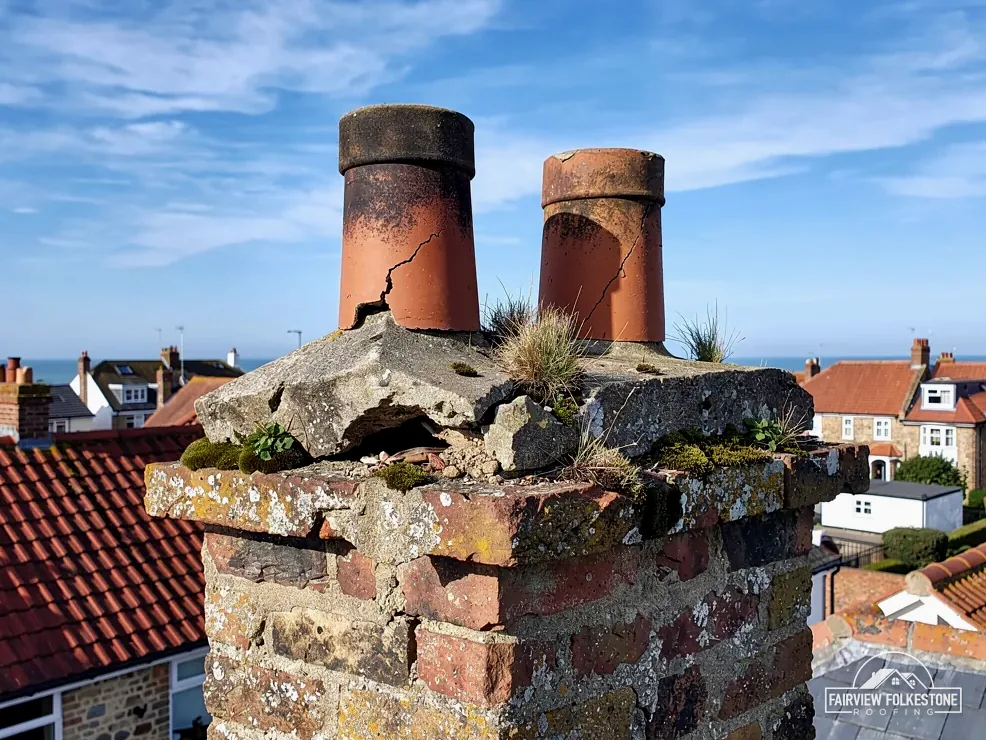
On top of the stack, the pots sit in a sloped bed of mortar called flaunching. It holds them upright and throws rain off the top.
Signs the top of the stack lets water in
Flaunching is the one part of a chimney nobody sees from indoors, and it is hard to make out from the pavement. It is shaped to fall away from the pots towards the edge of the stack, so rain runs off instead of sitting on top. When it cracks, water gets in at the very top and works down through the brickwork, and the first anyone knows of it can be a stain on a bedroom chimney breast two floors below.
Cracks come with age, from frost opening a hairline split, or from a pot that has started to move. Lumps of mortar on the roof slope, or in the gutter under the stack, are worth a look. So is a pot that sits at an angle, or a dark wet patch on the top courses of brick after rain has stopped.
The repair is to break out the old flaunching, check that the top course of bricks is sound, reset the pots and bed them in new mortar shaped to shed water. Our answer page on what chimney flaunching is covers the basics in a few minutes.
Myth: Cracked flaunching is a cosmetic fault you can leave.
Fact: Flaunching is what sheds rain off the top of the stack. Once it cracks, water runs into the brickwork under the pots.
Can cracked flaunching be patched instead of remade?
Where a fine crack runs through flaunching that is still firm and bonded to the pots, a careful repair can be enough. Where it sounds hollow when tapped, lifts at the edge or lets a pot rock, we break it out and bed the pots again, on a top course we have checked first.
Fine crack, flaunching still firm
Seal the crack
Flaunching hollow or breaking up
Break out and remake
A pot rocking in its bed
Look at the top course
Why the pots and flaunching are one job
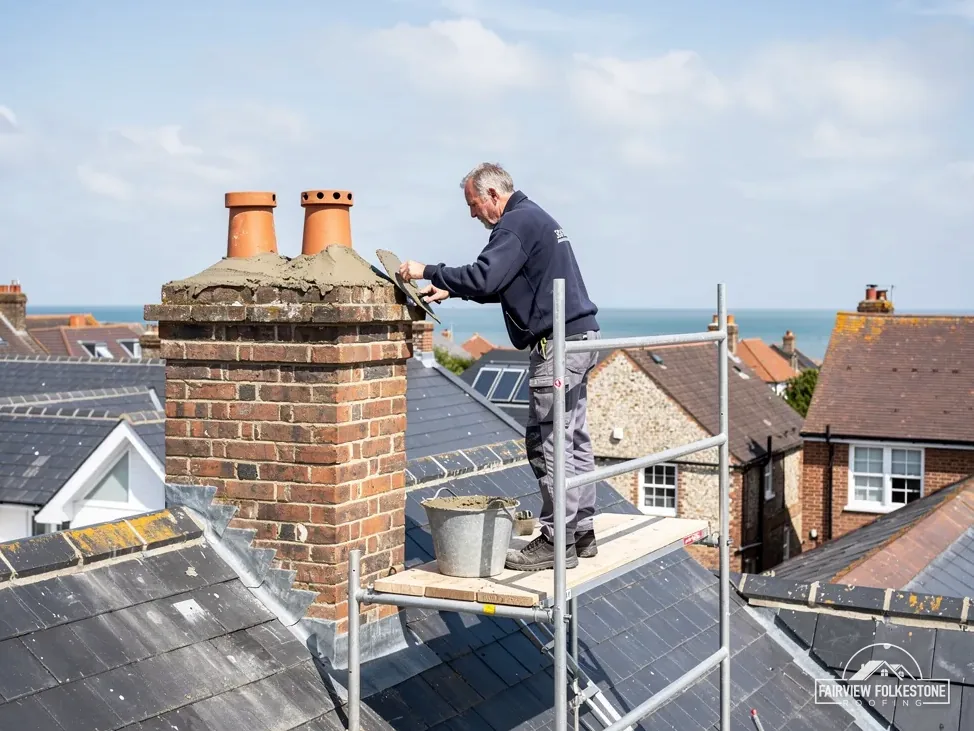
Flaunching and pots are tied together. A pot cannot be lifted out without breaking the flaunching round it, and new flaunching cannot be shaped properly round a pot that is cracked or loose. So when we remake the top of a stack, we look at each pot as well: whether it is sound, whether its flue is still in use, and whether it needs a cap, a cowl or a guard. Doing both together means the top of the stack is opened once, not twice.
The top course of bricks matters too. If those bricks are loose or flaking, new flaunching laid over them has nothing firm to hold on to, so they are rebedded or replaced first, and the new collar of mortar goes onto brickwork that will carry it. We also check the top edge, where the flaunching meets the outer face of the brick, because a crack along that line lets rain run down inside the outer course.
What sets the price
- How many pots, and how large
- Whether the flaunching is remade with them
- Caps or guards on each flue
- Access to the top of the stack
One written total price
Entry 04Pots and cowls
Chimney pots and cowls: what to change, cap or leave alone
A cracked pot, a flue nobody uses any more, birds in the stack: each one needs a look at what lies below the pot before anything is fitted.
Matching the top to the flue below
Every pot sits over a flue, and what goes on the pot depends on what that flue still does, so we ask you which fireplaces are still in use before choosing anything. A pot that has cracked or lost its rim can be lifted out and replaced, which means remaking the flaunching round it. A flue that served a fireplace no longer in use can be capped to keep rain out. A flue that still serves an open fire or a stove is a different matter: what goes on top has to suit the appliance, and that is a question for your sweep or stove fitter as well as for us. A sweep looks after the flue from inside the house; we look after the stack and the pot from the roof.
Cowls and guards do different jobs. Some keep rain out, some keep birds out, some help a flue draw. We fit the one your flue needs, and we will tell you if a pot is better taken off and the stack capped.
One pot cracked, the rest sound
Replace that pot
Flue over a fireplace no longer used
Cap it against rain
Birds using the pot now
Wait, then guard it
Can a chimney pot be changed without scaffolding?
Not safely. A pot sits at the very top of the stack, and changing it means working round the flaunching as well. We put up a scaffold round the stack, and where it stands on the highway we arrange the licence with our scaffolder. The scaffold also lets us check the flaunching and pointing while we are up there.
Birds in the chimney
A chimney pot makes a sheltered place for a nest. It is an offence to intentionally take, damage or destroy the nest of any wild bird while that nest is in use or being built, so a guard goes on only once we are sure the pot is empty. If birds are still coming and going, we tell you, and we come back to fit the guard when the nest is no longer in use.
A guard on a flue that still serves a fire or a stove has to let that flue work as it did before, so we match the guard to the appliance below rather than fitting one pattern to every pot. On a flue that is no longer used, a cap keeps out rain and birds alike, and the pot can stay for the look of the stack. Whatever goes on, it is fixed down firmly to the pot, and the flaunching round its pot is checked at the same visit.
Entry 05Chimney breast
A damp chimney breast, and tracing where the water gets in
A stain on the chimney breast is a symptom, not the fault itself. The water behind it can be getting in at any of four places outside.
Can a damp chimney breast be cured from inside the room?
Not while water is still getting in at the stack. New plaster or a coat of stain block can hide the mark for a time, but the source sits outside. We find the way in first; after that the inside can dry out and be made good, with the cause recorded in writing.
Damp and leaks around the chimney breast
Damp on a chimney breast shows as brown or yellow staining, peeling paint or paper, or plaster that feels cold and soft. It can turn up in a bedroom, on the ceiling beside the stack, or on the bare brickwork in the loft. Where it appears is a clue but not an answer, because water that gets into a stack can travel a long way down before it shows.
So we work from the outside in. A stain that follows the line of the roof slope points to the flashings or the soakers. Damp high on the breast, in the loft or the top floor, with nothing wrong at the roofline, points to the top of the stack: cracked flaunching, an open pot or a flue left uncapped. Damp spread across the face of the breast after driving rain can mean the brickwork itself is soaking it up through open joints or flaked bricks.
From the loft we look at the brickwork where the stack passes through the roof, and at the timbers beside it. From the scaffold we check each part in turn. Our guide to a damp chimney breast goes further into the signs.
Over 80 years
Correctly installed lead flashing can last for over 80 years, says MyJobQuote
Paint over a damp chimney breast and the stain returns: the water is still getting in up top.
Sorting a roof leak from a stack leak
Not every wet patch near a chimney comes from the chimney. A slipped slate or tile just above the stack, or a back gutter choked with leaves, can put water in exactly the same spot. That is why the tracing comes first: the fix for a blocked back gutter is a clear-out, the fix for perished lead is new lead, and you should only pay for the one your roof needs.
If the leak turns out to be the roof rather than the chimney, the repair sits with the slates or tiles around the stack, and we tell you that plainly, with the reason, before any work is booked. Once the way in is closed, give the breast time to dry out before it is replastered or painted, so the new finish goes onto a dry wall. Where the cause is still in doubt once the plain faults are ruled out, running water over one part of the roof at a time while someone watches inside can settle it.
Brickwork of a chimney where it passes through the loft
Rebuilding a stack from a sound course
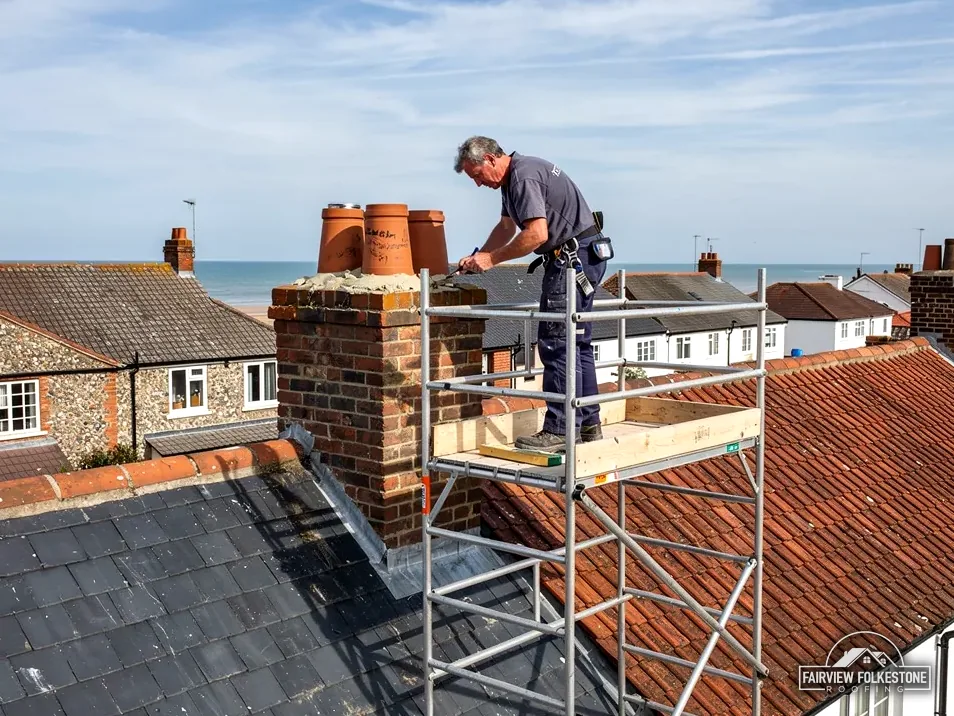
A stack needs rebuilding when the fault is in its structure rather than its surface: it leans, it has cracked through, or the top courses are loose enough to move by hand. We take it down to brickwork that is sound, which can be a few courses or all the way to the roofline, and build it back up, reusing the old bricks where they are firm and matching them where they are not. New flashings and flaunching go on as part of the same job, so the rebuilt stack starts with every joint sound and every piece of lead new. The slates or tiles round the base are lifted and relaid as the new lead goes in, fixed for the exposure of the site.
A rebuild also gives you the chance to decide how many pots the stack still needs, and which flues should be capped while the top is open. Where a stack straddles the boundary with the house next door, we talk the work through with both owners before it starts. Our guide to rebuilding a chimney stack sets out each stage.
Entry 06Rebuild or removal
When a stack needs rebuilding, and when it can come down
Some stacks are past repointing. Then the choice is between rebuilding the part above the roof and taking it down, and both come with rules.
Stack leaning or cracked through
Take down and rebuild
Top courses loose, the rest firm
Rebuild from the sound course
Stack unused, roof sound round it
Rebuild, cap or remove
What sets the price
- How far down the stack comes
- Old bricks reused or new ones
- Whether the breast inside stays
- Roof covering to make good
One written total price
Chimney removal and the Building Regulations
If the chimney is no longer used, removal can make more sense than a rebuild. Taking the stack down below the roof and roofing over the gap is roof work: battens, underlay and slates or tiles are carried across where the stack stood. Taking out a chimney breast inside the house is structural work, and it always needs Building Regulations approval, because the breast is part of the structure of the building.
Where the breast is on a party wall shared with a neighbour, the building owner serves a party wall notice at least two months before the work begins. On a listed house, listed building consent is needed for works that affect its character, and in a conservation area we check with the council before a stack comes down. Capping a stack instead, with the breasts left in place, keeps the structure as it is: the pots come off, the top is sealed against rain, and the stack stays part of the house. Our answer on chimney breast removal and Building Regulations has more.
Two months
Notice ahead of cutting away a chimney breast on a party wall
Party Wall etc. Act 1996, section 3
Tell us what your chimney is doing, and get a straight verdict
Call, message us on WhatsApp or use the quote form. A local roofer looks at the stack, then explains what it needs and the reasons.
Chimney repairs: questions and answers
Scaffolding, costs, approval, insurance and coastal weather, answered plainly for chimneys in Folkestone and Kent.
Does a chimney repair in Folkestone need scaffolding?
Yes, for work on the stack itself, because pointing, flashings, flaunching and pots are all worked at the top of the roof. Where the scaffold stands on the pavement or road it needs a highway licence: Kent County Council charges £52 per week for 2026 to 2027, and on its published page the application is for the scaffolding company to submit. We arrange the licence with our scaffolder, and the scaffold appears in the written quote. For Rye and Camber, East Sussex Highways lists £127 for 28 days on its fee table; check the current fee.
What do chimney repairs cost in Kent?
It depends on the part. MyJobQuote puts a chimney lead flashing patch repair at around £200, with a full replacement averaging around £570. Checkatrade gives lead flashing repairs at £50 to £70 per metre, excluding VAT and access equipment. For chimney removal, MyJobQuote gives an average of around £2,500 for a chimney breast and around £3,000 to £3,500 for the entire stack with the breast. Chimney repointing is priced after a survey, because the published figures disagree. Our quote is one total price, so when you compare quotes, look for a line on whether VAT and scaffold are included.
Is repointing enough, or does my chimney need rebuilding?
Repointing is enough when the bricks are firm, the stack stands true and only the mortar joints have worn. A rebuild is the answer when the stack leans, has cracked through several courses, or has top courses that move under a hand. Between the two sits a partial job: cutting out flaked bricks and rebuilding just the top few courses. We tell you which of the three your stack needs, and why, before any work starts, and chimney repointing in Folkestone is quoted only where the brickwork will hold it.
Do I need Building Regulations approval to remove a chimney breast?
Yes. The Planning Portal says Building Regulations approval will always apply when removing chimney breasts, as they are part of the building's structure. In Folkestone and Hythe district, Folkestone & Hythe District Council's building control team is on 01303 853538. If the breast is on a party wall, the building owner serves notice at least two months before the work begins; a surveyor is needed only if the neighbour dissents or does not reply within 14 days, and the neighbour can agree in writing to an earlier start. We can walk you through the order of the steps.
Can a chimney stack be taken down and the roof closed over?
Yes. Chimney removal in Folkestone above the roof means taking the stack down below the roofline and carrying the battens, underlay and slates or tiles across the gap, matched to the covering around it. Before a stack comes down we check with the council's planning team, and on a listed house listed building consent is needed for works that affect its character. If the breasts inside stay, the flues below are sealed off at the top so no rain gets in, and the job is planned around them, with the roof made good over them.
Is it worth repairing a chimney I never use?
An unused stack still stands in the weather, so it still needs maintenance or a decision. Left alone, its pointing and flaunching keep wearing, and a stack that drops bricks onto the roof is a hazard as well as a leak. You have three fair choices: keep it in repair, with the flues capped against rain; take it down below the roof and close the gap; or, where the breasts go too, plan the structural work with building control. We set out what each would involve for your house, so you can choose with the facts in front of you.
Will home insurance pay for a chimney damaged in a storm?
That is for your insurer and your policy to decide. In the Financial Ombudsman Service's wording a storm usually means violent winds with rain, hail or snow alongside, and expert reports and photos are what it will usually look at. So tell your insurer first, photograph the damage before you move anything, and keep every receipt for a temporary repair that makes the stack safe. If you disagree with the decision, complain to the insurer first; the Financial Ombudsman Service, on 0800 023 4567, comes after that.
Do coastal winds change how a chimney repair is done?
They change the specification around it. Cupa notes that a building on a slope, a hill or the coast is graded with higher exposure, and BS 5534, the British Standard for slates and tiles on pitched roofs, includes a means of calculating fixing specifications. Installing to BS 5534 isn't required by law, but we work to it, so the slates or tiles we relay round a stack are fixed for the exposure of the site, seafront or hilltop. The Met Office records that in the Great Storm of 1987 a Channel ferry was blown ashore near Folkestone.
Tell us what's wrong with the roof.
You'll get one written total price.