
Chimney repair guide
Chimney flashing repair: lead, soakers and back gutters
A chimney flashing is the lead that seals a stack to the roof around it. This guide covers how its parts fail, when a patch is enough and when the lead is renewed.
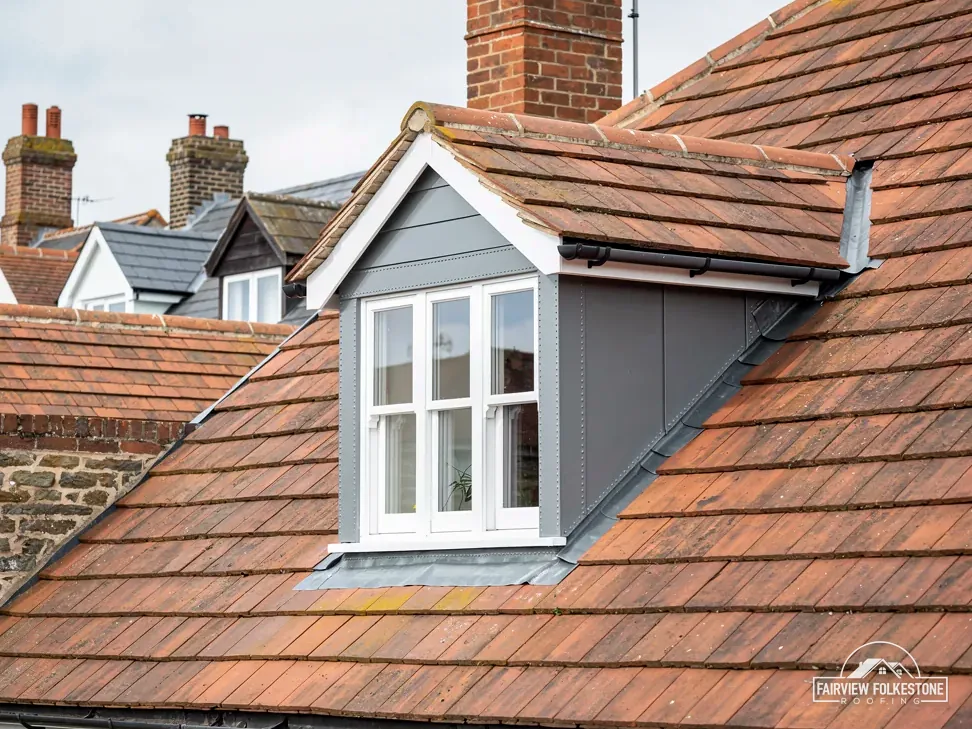
A chimney is the one part of a roof where brick meets tile or slate on every side, and lead seals the joint between them. When that lead lifts, splits or pulls out of the brickwork, rain tracks in behind it and appears as a stain on a ceiling or on the chimney breast, which can be some distance from the real fault. That distance is why a flashing is easy to blame wrongly and easy to repair twice.
This guide explains the parts of a chimney flashing, how each one fails, how we choose between a patch and a renewal, which lead code suits which detail, and what moves the price. It sits under our chimney repairs pages, which cover the pointing, flaunching, pots and the stack itself.
We start from the repair. Lead that is sound stays, lead that has failed is renewed, and in both cases we show you what we found and the reasoning behind the verdict.
01Chimneys · Flashings
The parts of a chimney flashing
People talk about the flashing as one thing, but it is a set of separate pieces of lead, each doing a different job on a different face of the stack. Knowing the names makes a quote easier to read.
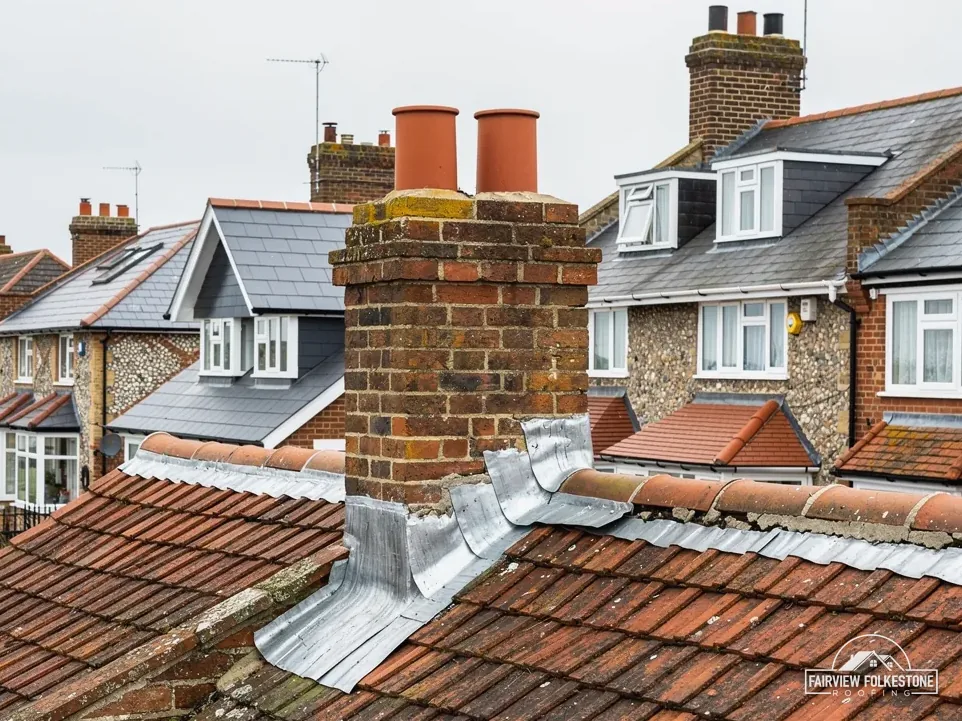
- The apron is the lead across the lower face of the stack, dressed down over the tiles or slates below it.
- Stepped flashings run up each side of the stack, following the slope, with each step tucked into a joint in the brickwork.
- Soakers are small lead sheets bent to an L, one leg lying under the covering and the other turned up against the brick. They are laid course by course with the slates or tiles, and the stepped flashings cover their upstands.
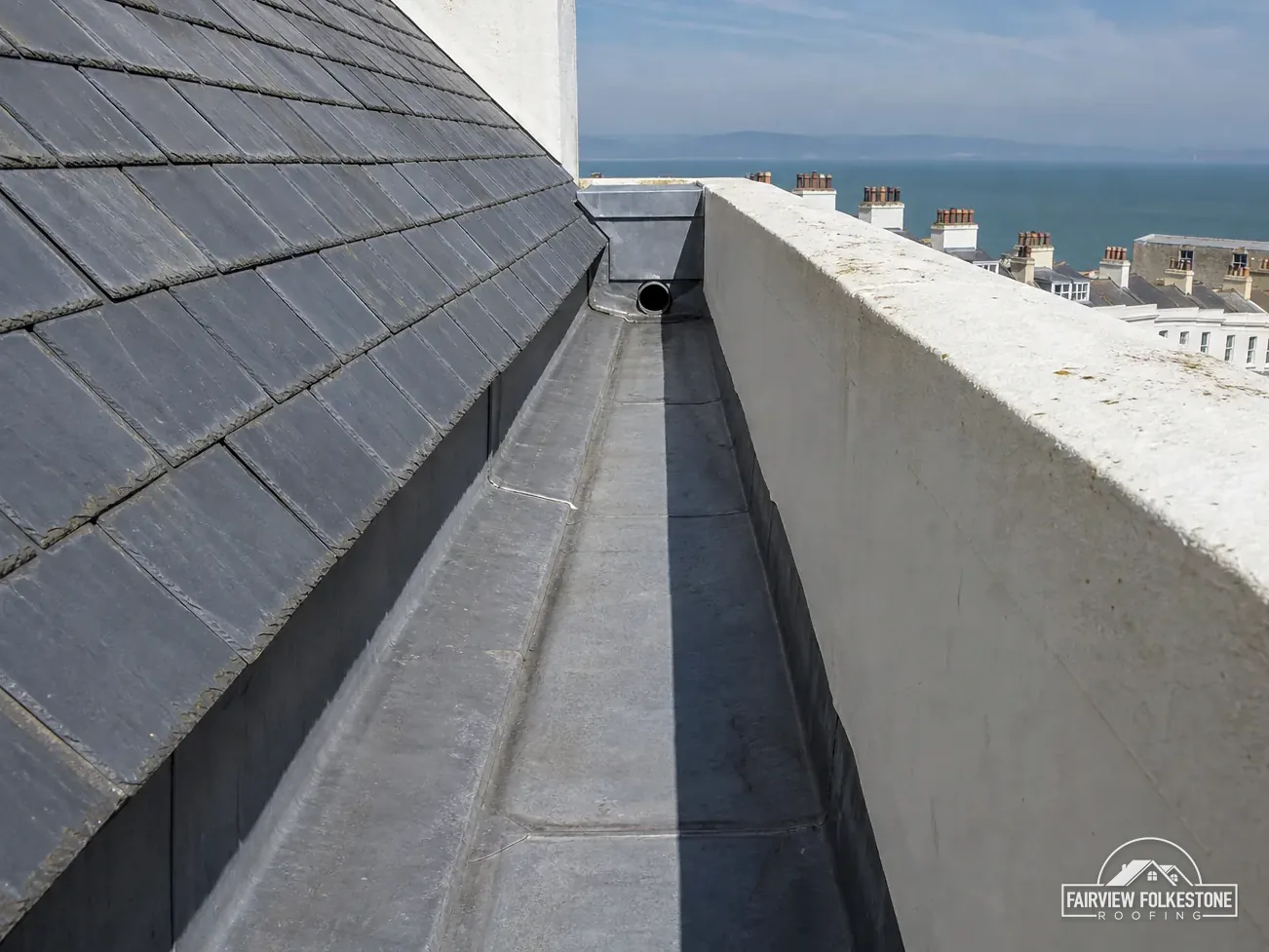
- The back gutter is a channel of lead behind the stack, on the upslope side, that carries water round the chimney instead of letting it bank up against the brick.
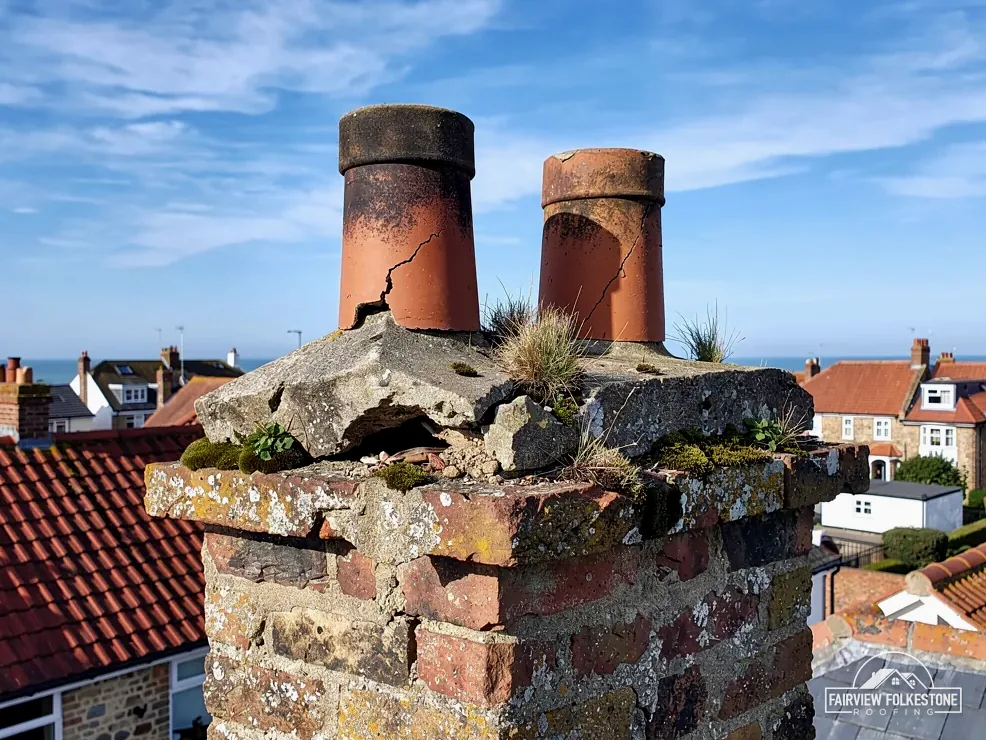
- The flaunching, which sits on top of the stack, is mortar and not lead. It holds the pots in place and sheds water off the stack head.
Each piece depends on the others. A stepped flashing that is sound but rests on tired soakers will let water past underneath, and a perfect apron cannot help a back gutter that has dropped its fall. That is why the survey looks at all four sides, plus the pointing the lead is tucked into, before anyone decides what the roof needs.
A stack that rises at the ridge is arranged differently from one part-way down a slope, because its upslope side is the other half of the roof. We map the lead on your stack before we price it, instead of assuming a standard layout.
Our answer on what chimney flaunching is and why it cracks picks up the one piece that is not lead.
02Side by side
How each part fails
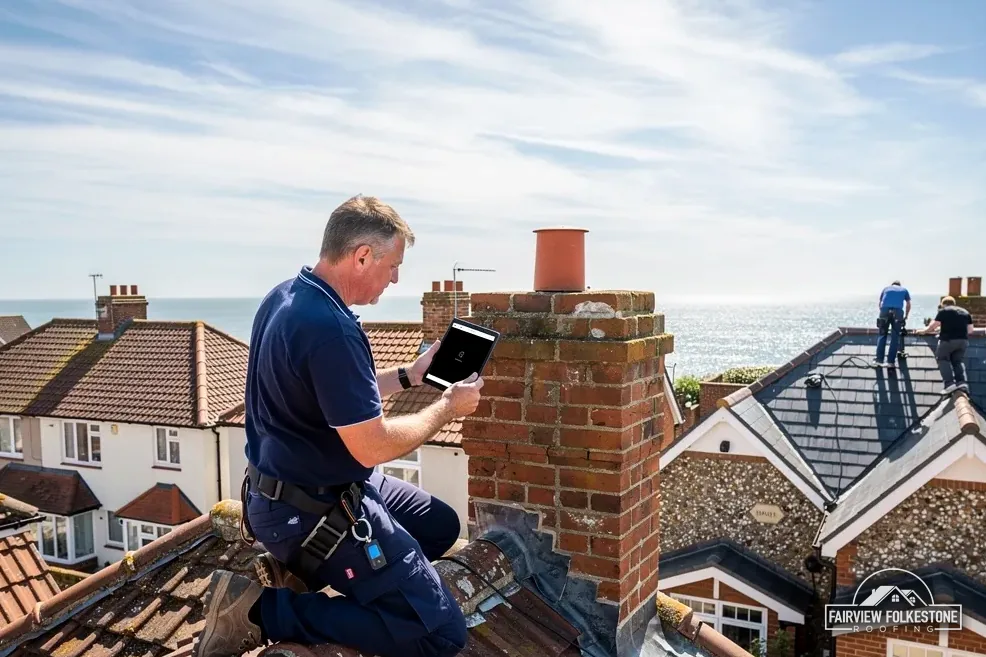
A failed flashing leaves marks, and the marks point at the cause. We look at the lead from the scaffold or a tower, and from inside the loft where the stack comes through, because a stain on timber beside the chimney confirms what the outside suggests.
From the ground, binoculars can show a lifted edge or a gap in a mortar fillet. They cannot show the far face of the stack or what lies under the lead, which is why a close look is needed before any verdict.
The last row matters most. Water seen inside a house does not always tell you where it entered, so we do not replace lead to cure a stain until the evidence points at the lead. A damp chimney breast has several possible sources, and our guide to tracing damp on a chimney breast follows each in turn.
Missing lead is a separate case. Where a flashing has been stolen or has slid away, the roof has no seal at that edge at all, and the first step is a temporary cover while the new lead is ordered.
| Sign | Likely source | Verdict |
|---|---|---|
| Lead lifted out of a brick joint | Pointing or fixings have let go | Repair |
| Split or cracked lead | Metal that has failed along that run | Replace that run |
| Mortar fillet cracked away from the brick | No lead detail at that edge | Replace with lead |
| Debris or standing water behind the stack | Back gutter blocked or without fall | Check the gutter |
| Stain below, lead looks sound | Pointing, flaunching or pots instead | Check the whole stack |
Chimney flashing questions
Why does my chimney leak when the lead looks intact?
Rain can enter through cracked flaunching, failing pointing, a cracked pot or the back gutter, and lead that looks whole from the ground may still be lifted out of a joint on its far face. We check every face and the loft below before saying which part is at fault.
03Leadwork
Patch the lead or renew it
A repair is our starting point whenever the lead is sound enough to keep. A patch means cutting out and replacing a damaged section of lead, re-dressing a lifted run into its joint, or re-pointing the brickwork that holds the lead. It suits a flashing that is otherwise whole.
A full renewal means stripping every piece of lead on the stack and fitting new, and it is the right call when the failures are spread across more than one face. MyJobQuote says correctly installed lead flashing can last for over 80 years, which is why a flashing that has failed early points to how it was fitted or to the brickwork behind it. We look for that cause so the new lead does not go the same way.
Three questions decide between the two:
- Is the damage in one place, or on more than one face of the stack?
- Is the lead itself sound, or is it split, thin or brittle along its length?
- Are the joints the lead is tucked into firm enough to hold it?
A patch on lead that is failing everywhere buys a few months and a second visit. A full renewal on a flashing with one lifted corner spends money the roof did not need. We tell you which one we are looking at, and show what we found, before a price is discussed.
If lifting the old lead exposes soft battens or damaged brickwork, we stop, show you, and give a fresh written price before going further.
04In figures
Lead codes and what each is used for
Sheet lead comes in numbered codes, and each code is a thickness. A higher code is thicker and heavier. The brochure from Royston Lead, which makes cast lead, lists the codes with the details each suits, and each code also has its own colour marking, green for Code 3, blue for Code 4 and red for Code 5, so the weight on a roll is easy to check.
Can a mortar fillet replace lead round a chimney?
A fillet of mortar is rigid, and once it cracks away from the brick or the roof, water gets behind it. Lead dressed into the brickwork is the detail we fit. Where an old fillet is cracked, we replace it with lead and do not patch it with more mortar.
| Code | Thickness | Used for |
|---|---|---|
| 3 | 1.32 mm | Soakers only |
| 4 | 1.80 mm | Soakers, flashings, pitched valley gutters, dormers |
| 5 | 2.24 mm | Flashings, valley gutters, parapet and box gutters, dormers |
For a chimney, the table shows the logic. Soakers are the thinnest pieces, and the brochure recommends Code 3 for soakers alone. Flashings and gutter linings are heavier, so Codes 4 and 5 appear against them. Which code goes on which detail of your stack is fixed in the specification and named in the quote, never left to the day.
A higher code is not automatically better for every piece: soakers have to bend tightly under the covering, and the brochure lists them against the two thinnest codes only. Thickness is not the only factor. How far a piece of lead runs, how it is fixed, and how much it has to move with the stack all affect how it behaves, so no single code serves the whole job.
For the bigger picture on where each code sits across a roof, our post on lead codes explained goes further than a chimney needs.
05Chimneys
How a chimney flashing is renewed
The sequence matters, because each piece covers the one below it. A renewal follows these steps:
- Make access safe. Scaffold or a tower gives safe reach to a stack; if it stands on the highway it needs a licence, and we arrange the licence with our scaffolder.
- Strip the old lead and look at what is under it: the battens, the underlay and the brickwork.
- Fit new soakers, one to each course of tiles or slates alongside the stack, with the covering replaced over them.
- Dress the stepped flashings over the soakers, tucked into the joints in the brickwork, and fix them.
- Form the back gutter with a fall, so water runs round the stack and off the roof.
- Dress the apron over the covering below the stack.
- Point the joints the lead sits in, and leave the roof and the garden clean.
At the end of each visit the stack is sealed or covered, and the scaffold is left secure.
When the stack belongs to a pair of houses, the chimney itself may be shared. A shared stack raises questions about who pays and who must be told, and those are settled with the neighbour before the scaffold goes up.
Listed houses need extra care. They retain permitted development rights for roof work, yet consent for listed building work is required whenever the character of the building changes, so the lead and the pointing mortar are agreed with the council first. In a conservation area, the council's map and its conservation officer are the first checks.
06Price
What sets the price
For a sense of scale, MyJobQuote's lead page (updated 22 September 2026) gives around £200 as the typical cost of a patch repair to chimney lead flashing, and says a full replacement averages around £570. For full leadwork replacement it gives £350 to £920, a range that depends largely on whether scaffolding is required. Checkatrade's repair rates list lead flashing repairs at £50 to £70 per metre, with VAT and access equipment extra. Those are third-party figures and not our prices, and a per-metre rate is never multiplied into a total.
Does fixing a flashing mean repointing the whole stack?
Not necessarily. The lead is tucked into the brickwork joints, so where those joints are failing the flashing cannot stay sealed, and re-pointing the joints it sits in is part of the repair. The rest of the stack is judged on its own condition, which our repointing guide explains.
On your own stack, the price turns on:
- how many faces of the stack need new lead
- whether the soakers and covering beside the stack must be lifted
- the condition of the brickwork the lead is tucked into
- the height of the stack and the access it needs
- whether the scaffold has to stand on the public highway, with its licence
The price you receive is a single written total, issued after the stack has been inspected. If you are weighing several quotes, look for a statement in each of whether VAT and scaffold are included, because a low figure with scaffold left out is not the same job. A patch needing only a short run of lead costs less than a renewal on every face, and the inspection is how we tell the two apart.
Our chimney repair cost guide sets out the wider picture, including the highway licence fees for Kent and East Sussex.
More on chimney repairs
All guides and posts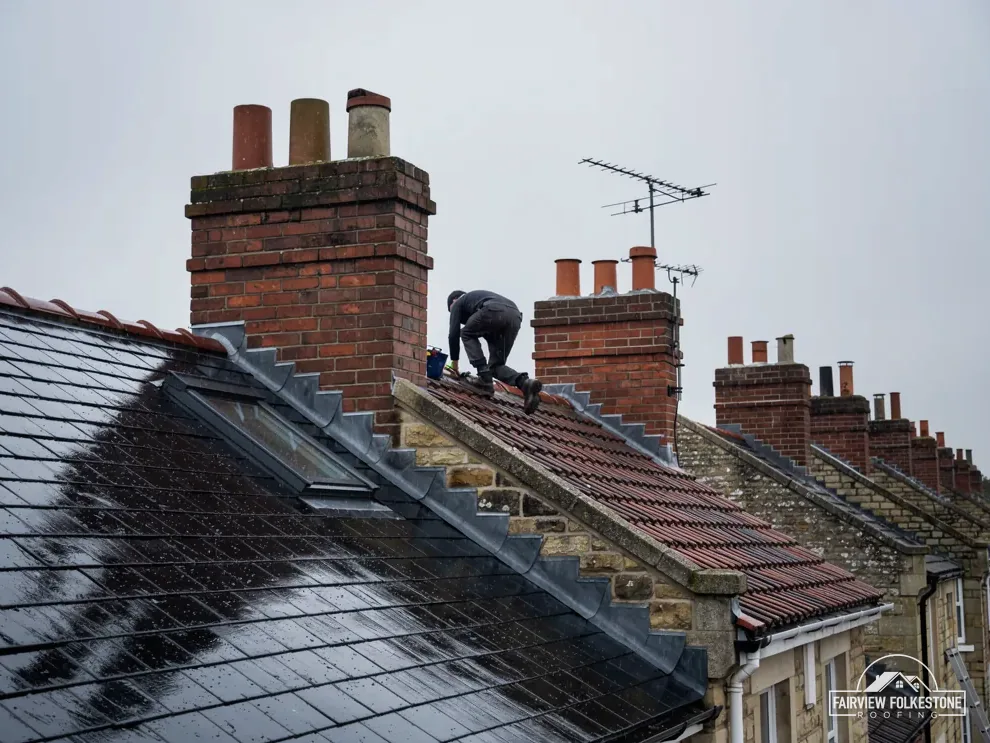

Tell us what's wrong with the roof.
You'll get one written total price.