
Chimney damp guide
Damp on a chimney breast: tracing it to flashings, flaunching or the pots
Damp on a chimney breast shows where water reached the room, not where it got into the roof. This guide traces it back through flashings, flaunching and pots.
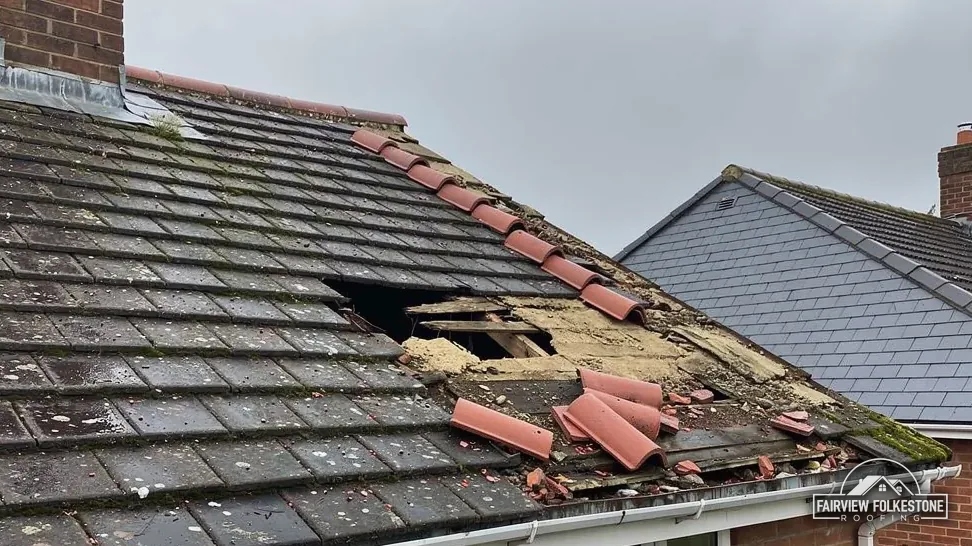
A brown stain or a bloom of white powder on a chimney breast is easy to notice and hard to read. The breast is the mass of brickwork that carries the flues up through the house, and anything that wets it from above will show on the plaster below. By the time the mark reaches the wall you can see, the water has already travelled through the stack, and the point where it came in can be a floor or two higher.
Three places on the outside deserve a check first: the lead flashings at the foot of the stack, the flaunching that beds the pots, and the pots themselves. This guide takes them in the order we check them, shows how to separate a stack leak from a leak in the roof beside it, and explains why repainting the breast without finding the source gives you a clean wall for a season at best. We find the entry point first, and the repair follows from what we find.
01Side by side
Reading the stain before anyone climbs a ladder
The mark on the breast tells us where to start looking, though it never settles the cause by itself. Where it sits, how big it is and when it appears all narrow the search.
Timing helps as much as position. A patch that grows after rain and fades in a dry week points to water from outside. A patch that stays put whatever the weather sends us back to look for a source inside the house. A patch that comes and goes with the wind direction, showing on one wall after a blow from one quarter and not another, tells us which face of the stack to climb to first.
If you can, note the date and the weather when it appears, and take a photograph with something beside it for scale. Photographs sent before we visit let us arrive knowing which side of the stack to inspect first, and a few of the room as well as the close-up help us place the breast against the roof above it. Our page on chimney repairs shows how the whole stack is checked, from the pointing to the pots, once we are on the roof.
| Where it shows | What it can suggest | First look |
|---|---|---|
| Top floor, high on the breast | Water entering at the top of the stack | Pots and flaunching |
| Loft, at the roofline | Water entering at the flashings | Lead where stack meets roof |
| Only after wind-driven rain | An opening on the exposed face | Pointing and the windward flashing |
| Low on the breast, any weather | A cause that is not the stack | Gutters, pipes, ground levels |
02Flashings · Chimneys
Flashings, where the stack meets the roof
Flashing here means strips of lead (a soft, dense metal that can be shaped to the brickwork) that bridge the joint between the stack and the roof covering. Four parts matter on a chimney: the apron across the front, the stepped pieces up the sides, the back gutter behind the stack that carries water round it, and the soakers, the small lead tabs that lie under the tiles and lap the stepped pieces.
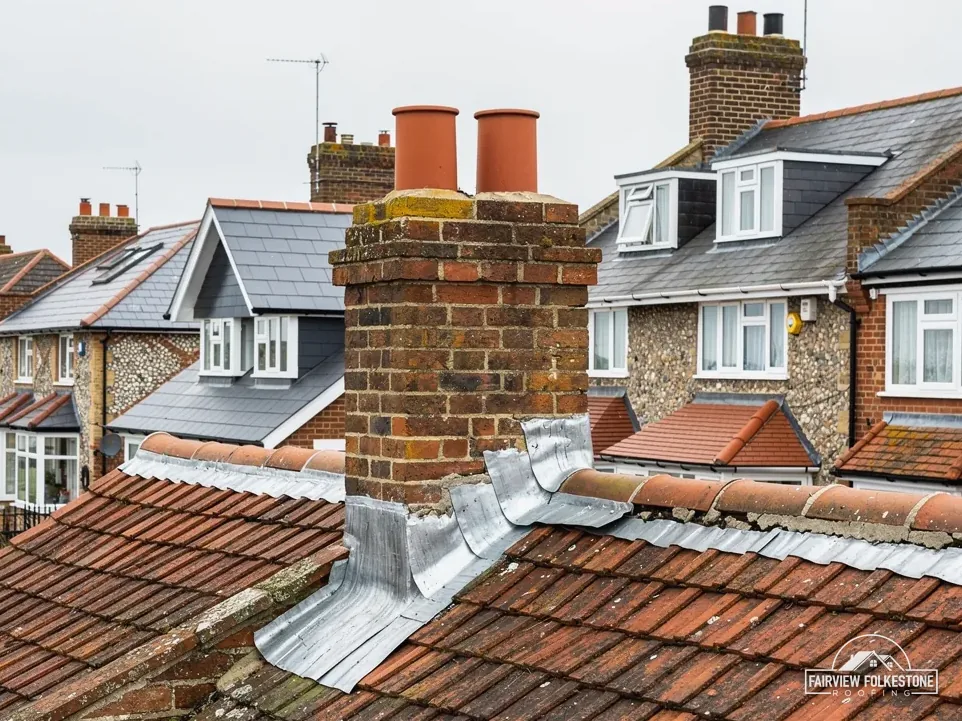
Here is how they let water through:
- An edge lifts where the lead has pulled out of the brick, which leaves a gap that wind-driven rain can enter.
- The lead splits along a fold after years of expanding and contracting with the weather.
- A mortar fillet laid in place of lead cracks away from the brick, because mortar cannot follow the movement between stack and roof.
- The back gutter silts up with moss and debris, so water stands behind the stack instead of running off.
Lead that is fitted correctly lasts a long time: MyJobQuote says correctly installed lead flashing can last for over 80 years. So a failed flashing leads us to ask how it was fitted, or what has moved since, and not straight to worn-out metal.
Where a stack is shared, the lead may need to be let into a neighbour's wall. Under the Party Wall etc. Act 1996, a building owner may cut into the neighbouring owner's wall to set in a flashing, within the notice rules. Our page on chimney flashing repair covers the repair and the renewal in detail.
Damp breast questions
Does a damp chimney breast always mean a failed flashing?
No. The flashing is one of several places water can enter, alongside the flaunching, the pots, the pointing and the roof covering beside the stack. A pipe or condensation inside the house can also mark a breast. That is why we trace the damp upwards and outwards before proposing any repair.
03Key points
Flaunching, the collar under the pots
Flaunching is the sloped mortar collar that fixes the chimney pots to the top of the stack and throws rain outward, away from the flues. Because it sits at the very top of the stack, it takes the weather from every side, and it is the part a homeowner is least able to inspect from the ground.
When it fails, water has a short way to travel: straight down between the pot and the brick, and then into the stack. The signs are easy to confirm from the roof and hard to read from the street:
- Hairline cracks that run round the base of a pot.
- A gap where the mortar has shrunk away from the pot or from the brick top.
- Pieces missing, so the pot rocks when it is pressed.
- Flat or hollowed mortar that holds a pool of water, not one that sheds it.
- Moss or plant growth rooted in the collar.
- Brick edges around the collar that have crumbled, so the new mortar would have nothing firm to grip.
Patching a cracked collar is possible when the rest of it is sound and well bonded to the brick. Once the mortar sounds hollow, or the pot has begun to lean, the sensible repair is to take the pot off, remove the old collar and make a new one in a mix suited to the exposure. Pots are reset at the same time, on a fresh bed, so the work is done once.
We explain the material and the shape in our page on what chimney flaunching is.
04In brief
Pots, cowls and the open flue
A chimney pot carries the flue above the stack and helps the smoke leave cleanly. It is also an opening in the top of the building. Rain falls straight into an open pot, and in wet weather that water runs down the flue and can wet the breast from the inside, with no fault in the brickwork anywhere.
Can I check the flaunching myself from the ground?
You can look through binoculars for cracks, gaps or a pot that sits crooked, and photograph what you see. Please do not climb up to it, and do not go onto the roof. The collar is out of reach and often out of sight from below, so a roof visit is the only reliable way to judge its condition.
What we check on the pots and the top of the flue:
- Whether a cracked or chipped pot is letting water into the brickwork round it.
- Whether a pot has been blocked by nesting material, which holds water and stops the flue working.
- Whether the flue is still in use, because that decides what kind of cover is suitable.
- Whether a redundant flue has been left open at the top and shut at the bottom, with nowhere for any moisture to go.
A cowl is a cover that sits over the pot, and a cap is a cover that closes it. Which one is right depends on what the flue below is for. A flue serving a working fire or boiler needs air and a clear way out, while an unused flue wants rain kept off and some ventilation retained. We confirm what is connected to each flue before we recommend anything, and we do not cap a flue that is still carrying fumes.
If birds are nesting in a pot, the work waits for them to leave, and the pot is cleared before the cover goes on. Where a pot has to be replaced, we take the old one down whole so we can see the state of the flue lining at its top, since a cracked lining there is something you would want to know about.
05Leaks · Chimneys
Ruling out a leak that only mimics the stack
Not every wet breast comes from the stack. A chimney sits where the roof slopes meet it, and a fault nearby can send water down the same line. Finding the true entry point matters, since a repair on the wrong part of the roof leaves the damp exactly where it was.
Water can also reach a chimney breast from inside the house. A pipe in or near the wall, a leaking radiator valve or condensation on a cold flue wall can all leave a similar mark. When the stack and the roof around it are sound, we tell you that and suggest you ask a plumber or damp specialist to look at the inside, because telling you the roof is at fault when it is not would be no help to you.
Where the cause is a slipped tile beside the stack, our guide to pitched roofing explains how that is repaired, and the same visit shows whether the lead beneath it has been disturbed too.
The order we check things in, and the reason for each step:
- The covering beside the stack, for slipped or broken tiles and slates that let water reach the lead from underneath.
- The valley or abutment next to it, where two roof planes meet and water collects.
- The gutters and downpipes near the base of the stack, in case water is spilling back onto the wall.
- The pointing on the exposed faces of the shaft, which can let weather in sideways.
- The inside of the breast in the loft, for staining that traces a line up to the entry point.
06Price
Drying out, repainting and the price
Once the entry point is fixed, the wet brickwork still has to dry, and that takes longer than the repair. Soaked plaster dries slowly, and new paint put on it early can blister or stain. Leave the wall alone, and keep it ventilated, until it has dried before you redecorate. Painting over a damp patch traps the moisture and the mark returns, which makes people think the repair failed when the wall was simply never given the time.
Published figures give a sense of scale for the lead work. MyJobQuote gives around £200 for patching the lead on a chimney, and around £570 as the average for replacing it in full. For wider leadwork replacement it gives £350 to £920, depending largely on whether scaffolding is needed. Flaunching and pot work are priced after a survey, since they depend on what the roof visit shows.
You receive one written total after the survey, and it names the scaffold if one is needed.
What changes the price on your own stack:
- How many parts have failed: lead only, flaunching only or both.
- Whether the pots can be reset or must be replaced.
- How high the roof is, and what access that calls for. For a Kent address, a scaffold licence is £52 per week from Kent County Council in 2026 to 2027, and our scaffolding for chimney repairs page goes into the licence.
- Whether tiles beside the stack need relaying.
What should I note when the damp patch appears?
Write down the date, the weather and whether the wind was strong, then photograph the mark with something beside it for scale. Note whether it dries in a spell of dry weather. This helps us decide which part of the stack to inspect first and whether the cause is likely to be outside or inside.
More on chimney repairs
All guides and posts

Tell us what's wrong with the roof.
You'll get one written total price.