
Moss and timing
The best time of year to remove moss from a roof (and the nesting-bird rules)
There is no single perfect week for moss removal. The right moment is a dry, still day when no bird is nesting under the tiles and the roof is sound enough to be worked on.
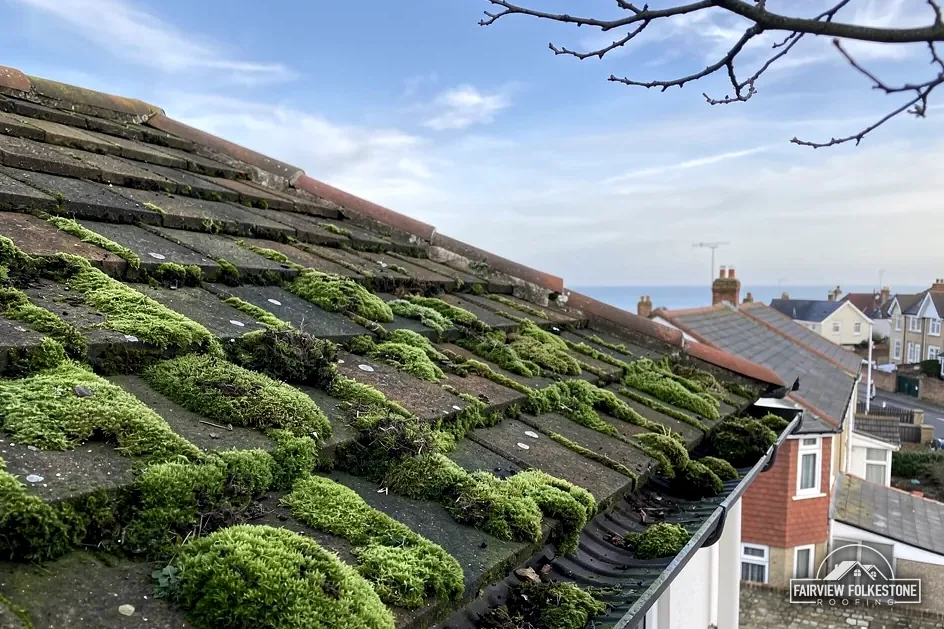
Ask three people when to clear moss and you will get three seasons. The calendar matters less than three things on the day: the weather, the state of the roof and whether a bird is using it. Get those right and the job can be done well in most months; get one wrong and it is better to wait.
Birds are the part people forget. A wild bird's nest is protected by law while it is in use or being built, and a moss clean means brushing and working across the very spots where nests sit: behind chimneys, under ridge tiles, along the eaves and in the gutter. This page sets out the rule in plain terms, so you know what to expect from any roofer who comes to quote.
Below you will find the weather conditions that help and hurt, the nesting rules, what a roofer checks before touching the roof, how the moss comes off without harming the tiles, and what to do afterwards. The cleaning side of the work is covered on our roof cleaning and moss removal page.
01Key points
What decides the right moment
People want a month. A roofer wants a list of conditions, because two February days can be completely different jobs. Before booking anything, run through these questions about your own roof.
- Is the forecast dry for the day, and for a day or so either side?
- Is the wind light enough for a person to work on a ladder or scaffold without being pushed about?
- Is the roof dry underfoot, or at least not coated in frost or wet leaf mould?
- Has anyone seen a bird going in and out of the roofline, or heard chicks?
- Is the covering sound, with no slipped, cracked or loose pieces that a brush could dislodge?
Four of those five are about safety, and one is about the law. None of them is about a particular month. A roof cleaned in a dry spell in the cooler part of the year is no worse off than one cleaned in summer, provided the checks come out clean.
The other side of the coin is that moss does not turn into an emergency overnight. If the weather is poor, or a nest is in use, nothing is lost by waiting for a better day. A rushed clean in bad conditions is how tiles get cracked and how people get hurt.
If you are not sure the roof is sound enough to clean at all, ask for a survey first. A survey tells you whether the answer is a clean, a repair or, now and then, something bigger.
02Side by side
Weather and conditions, one at a time
No Folkestone weather figure is used here, because none is needed. What matters is how the conditions on the day change the work.
Timing and nesting questions
Is it illegal to clean a roof if birds are nesting?
Under the Wildlife and Countryside Act, anyone who "intentionally" harms a wild bird's nest commits an offence, if the nest is in use or being built. So the work cannot go through a live nest. If you can see or hear birds using the roofline, tell the roofer, and the job waits until the nest is finished with.
| Condition | Effect on the job | What a roofer does |
|---|---|---|
| Dry, still spell | Safest footing; moss comes away cleanly | Goes ahead, after the nest check |
| Frost on the roof | Slippery surfaces; brittle tiles | Waits until the roof is clear and dry |
| Strong or gusty wind | Debris scatters; access is unsafe | Rebooks the day |
| Persistent rain | Wet, slick covering; moss stays heavy | Waits for the next dry window |
| Heavy leaf fall | Gutters fill as soon as they are cleared | Clears the gutters after the roof, once leaves have dropped |
Notice what is missing: a rule that says clean in one named season. Moss is a living thing, but how fast it regrows depends on shade, trees, the pitch of the slope and how damp the site is. A north-facing roof under a tree is a different case from a sunny south slope, so a fixed calendar would only be a guess.
What does help is looking at your roof at the same point each year, such as after the leaves have come down, so you see change as it builds. Moss that is thickening along the lower courses, or lifting at the edges of tiles, is telling you it is time to arrange a visit.
If you want the question of how long a clean lasts, the answer is on our page about how long roof cleaning lasts.
03English
The nesting bird rules in plain English
The law here is short. Section 1 of the Wildlife and Countryside Act 1981 creates an offence for anyone who "intentionally" harms a wild bird's nest, and it bites only on a nest that is "in use or being built". Those two phrases carry the weight.
You may be wondering whether a licence can cover a roof clean. GOV.UK's wild birds guidance says there are "no licensing purposes to permit development or construction". Nothing in it lets a householder or a roofer remove a live nest to finish a job, so the plan has to move around the nest, not through it.
You will not find nesting-season dates here, and birds do not read calendars in any case. The test is what you can see on your own roof. Check the ridge ends, the gaps behind the chimney, the verges and the gutter before anything is brushed or sprayed.
Bats are a separate matter. The law protects their roosts whatever the intent, so a gap that bats use is not something to clear. If you see signs of bats, stop and take advice before going further.
What that means for a moss clean, in practice:
- An empty, old nest is not covered in the same way, but nobody should assume a nest is empty without looking.
- A nest with eggs, chicks or a bird still building is in use, and the work near it has to wait.
- Knowing a nest is there and carrying on regardless is exactly the kind of act the word "intentionally" describes.
04In order
Checks before anyone touches the roof
A good clean starts on the ground. Before a ladder goes up, a roofer should be able to tell you what has been checked and what has been found. Here is the order we would follow.
Can moss be removed in winter?
Yes, if the day is dry and still, the roof is clear of frost and no nest is in use. The weather and the roof's condition on the day matter more than the month. Frost, strong wind and persistent rain are reasons to rebook, not to give up on the clean.
- Look for nests and roosting birds. Binoculars from the ground show a lot, and a second look from the ladder or scaffold confirms it.
- Check the covering. Slipped, cracked or missing tiles are noted first, because a brush can move a loose piece.
- Check the ridge and hips. After the 2015 amendments to BS 5534, Marley says, bedding mortar stopped counting as a fixing by itself, so a ridge held on old mortar alone gets a careful look before anyone works along it.
- Plan the access. A tall or steep roof may need scaffold, not a ladder.
A scaffold on the road or pavement needs a county licence. Kent County Council charges £52 per week for 2026 to 2027, and says the scaffolders send in the application. East Sussex Highways lists £127 for 28 days, though the table may not show the latest figure. We arrange the licence with our scaffolder, and the written quote covers the scaffold.
A moss clean on a low, sound roof may need none of this, and a quote that says so is a good sign. What you should not be offered is a price over the phone for a roof nobody has seen.
If you want to know what a roofer is judging on your behalf, our page on whether moss damages roof tiles goes through what is visible on the surface.
05Moss · Tiles
How the moss comes off without harming the tiles
The method matters as much as the timing. Marley, a tile maker, is blunt about one tool: "The use of high powered jet washes is not recommended as it can damage the surface of the slate or tile, thus reducing its expected life considerably." That is why we do not treat pressure washing as our method.
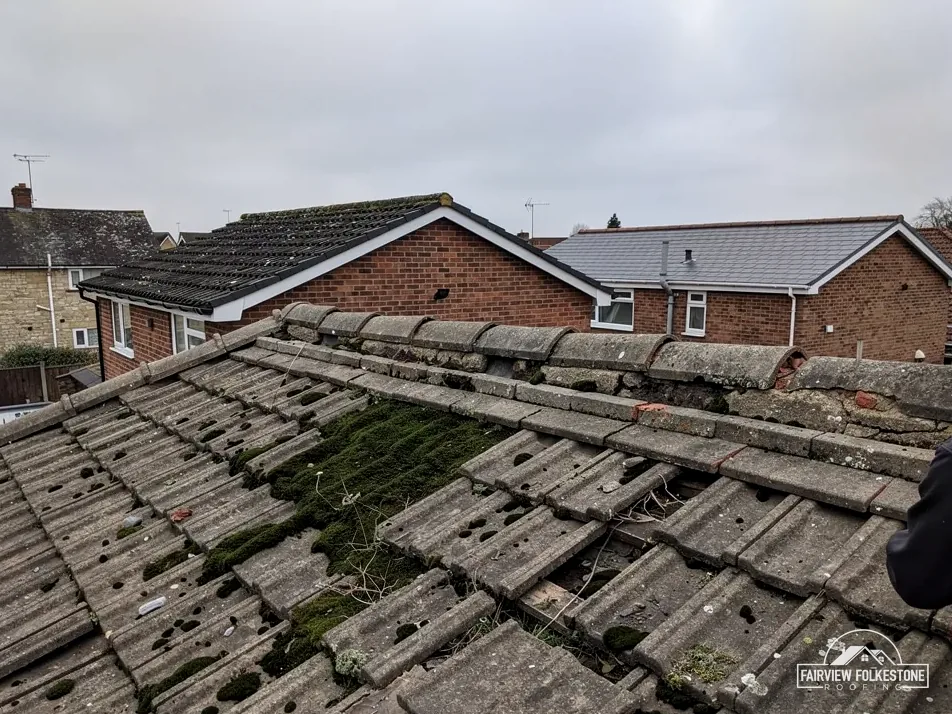
What we do instead is work to suit the covering:
- Loose moss is taken off by hand with brushes and scrapers, working down the slope so the debris does not sit on the lower courses.
- Moss and growth that has taken hold is treated, and the roof is left to clear as the treatment works.
- Gutters, valleys and flat areas are cleared by hand so nothing is washed into the drainage.
Dry moss is lighter and easier to lift without grinding it into the surface. That is one reason a settled dry spell helps, and why the day's conditions are worth more than the month.
Under the moss there is sometimes a surprise. A tile that was held together by growth can crack as the moss comes away, and a hairline crack that was sealed by it can open. Telling you what was found is part of the job: photographs, a list of any tiles that need replacing and a plain view of whether they are repairs or something bigger.
Repair first applies here too. If three tiles are cracked on a sound roof, the answer is three tiles, not a new roof.
06Gutters · Repairs
After the clean: gutters, repairs and the next look
The clean is not finished until the debris has been dealt with. Moss, dirt and loose granules end up in the gutter, so that is the next job. Which? Trusted Traders lists £75 to £350 for clearing every gutter on a house, front and back (November 2025, excluding VAT), and expects South East jobs to sit towards the top of its scale. Kent and East Sussex are both in the South East.
Our own price for a roof clean is one written total, given after a survey. That is deliberate: whether the job is a brush-down on a low roof or a multi-day clean with scaffold depends on the roof itself.
Should I clear moss myself with a ladder?
We would ask you not to. A roof is slippery, moss makes it worse, and a ladder placed against a gutter can crack it. A scraped tile can also be a cracked tile. A roofer has the access, the way of checking for nests, and a view of whether the covering can take the work.
Once the roof is clean, it is worth a short routine.
- Look at the roof from the ground after strong winds and after leaf fall.
- Check the gutters and downpipes for overflow marks on the wall.
- Note any new patch of growth, and where it is, so you can tell whether it is spreading.
- Keep photographs from the clean, because they show what condition the roof was in on the day.
If the visit turned up repairs, they are best done while the access is still in place. That saves a second scaffold and a second visit.
For a fuller view of what you get from cleaning against what it cannot fix, see is roof cleaning worth it, which also covers the cases where cleaning does more harm than good.

Tell us what's wrong with the roof.
You'll get one written total price.