
Slate roofing guide
Re-slating or repair: deciding what an old slate roof needs
A slate that slips does not always mean a worn-out roof. The decision rests on whether one fixing has failed or whether the fixings across the slopes are giving up together.
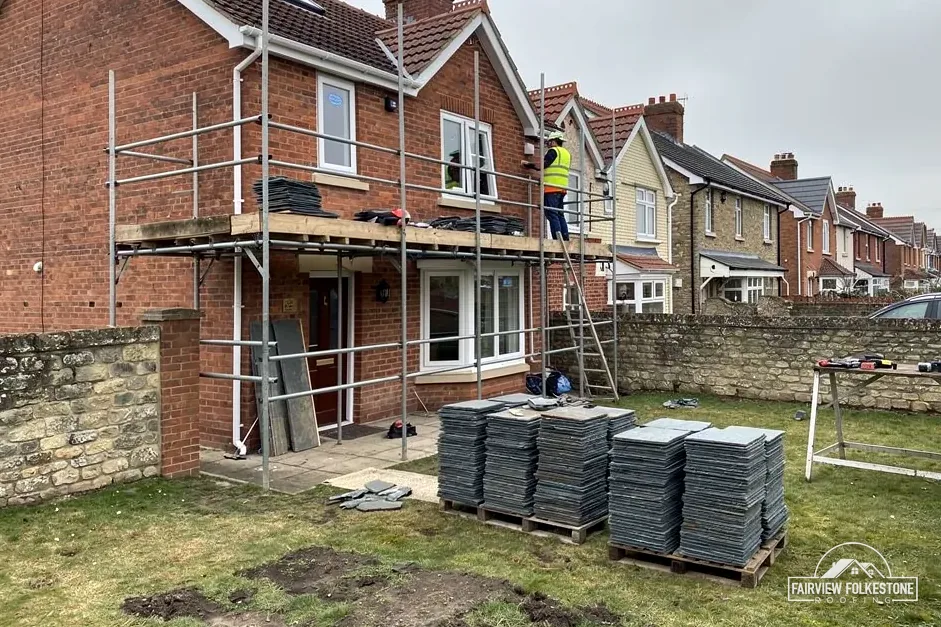
A slate roof gives its warning in small ways. A slate slides a few centimetres down its course, a broken piece turns up in the gutter, or a slope shows a patch of daylight from the loft. Each sign raises the same question: is this a repair, or has the roof reached the point where it needs stripping and re-slating?
The two answers cost very different amounts, and the wrong one hurts in either direction. Repair a roof that is failing everywhere and you pay for a run of call-outs that never settle anything. Re-slate a roof that only needed a few fixings renewed and you spend a great deal of money on slates that had years left in them.
This guide sets out how we separate the two. It covers what a survey looks at, when repair is the sound answer, the signs that repair has stopped paying, what a re-slate keeps and what it replaces, the rules that arrive with a re-slate, and how the years left in a roof weigh against the price. We start from repair, and we recommend stripping a roof only when what we found on it points that way.
01Key points
Is the fault local or across the whole roof?
Every slate is held by a fixing: a nail through the slate into a timber batten (the strip that runs across the rafters), with a metal tingle or hook added on some roofs. When a slate drops, one of those holds has failed. The useful question is whether it failed alone or whether the same thing is happening to the fixings around it.
A local fault has a visible cause. A ladder knocked a slate, a branch scarred one slope, or a failed flashing let water into a single batten. The damage stops where the cause stops, and the slates around it still sit tight. A general fault has no single cause. It shows as slates slipping in several places, on more than one slope, with nothing nearby that would explain it.
We read the roof in three passes.
- From outside, looking along each slope for slates out of line, gaps in the courses and broken pieces
- From the loft, where there is a hatch, looking for daylight, damp marks on the timber and slate fragments lying on the insulation
- From the ground and the gutters, where fallen pieces show what has been coming off and in what condition
Where there is no way into the loft, we tell you, and we tell you how much weaker the verdict becomes. A roof seen only from outside can still be judged, but we mark where a closer look might change the answer.
Our page on the signs a slate roof is failing explains what each of these findings means in more detail.
02Repairs
When repair is the sound answer
A repair is the right call where the trouble is contained and the roof around it is healthy. We lift the slates beside the fault, find out what let go, renew that fixing, and put the course back. Nothing else on the roof is disturbed.
Re-slating and repair questions
Can half a slate roof be re-slated and half repaired?
Yes. Each slope is judged on its own findings, so a north slope with soft battens can be stripped while the south slope gets a few fixings renewed. We tell you which slopes fall where, and why, before anything is priced. A split job suits a roof whose condition genuinely varies from slope to slope.
- One slate or a small group has moved, and the cause is plain
- The slates either side are firm when pressed and show no broken nails or cracked edges
- The batten behind the gap is dry and holds a nail
- The underlay or lining beneath the slates is whole at that spot
- A sound slate, reclaimed or new, can be matched in size and thickness to fill any gap
Matching deserves care. A slate fitted into an old course has to meet its neighbours in size, thickness and lap, so the right one may come from a quiet part of the roof or from reclaimed stock. Where a repair touches a valley or a chimney, the lead round it gets inspected at the same time, since a failed junction can loosen the slates beside it.
A good repair also leaves a record. We tell you what we found, which fixings we renewed and which parts of the roof we judged sound, so that if more slates move next year you can see whether it is the same spot or a new one. Whether the lead at a junction can stay or needs renewing is settled at the same visit, and the written account names each part we touched or left alone, so you can compare it with any later visit by another roofer.
03Side by side
When repair has stopped paying
Some roofs show that their fixings are going together. A repair there shifts the trouble along the batten to the next slate. You pay for each visit and get little time back for it. These are the findings that turn a repair into a conversation about re-slating, and the table sets them against what each one suggests.
Sound slates can outlast the nails that hold them, and a re-slate puts that right.
| Finding | Meaning | Call |
|---|---|---|
| One slate out, neighbours firm | A single fixing has failed | Repair |
| Slates slipping on several slopes | Fixings giving up together | Check the whole roof |
| Soft or split battens | Timber too weak to hold a nail | Re-slate that slope |
| Slates flaking into layers | The slate itself has failed | Replace those slates |
| Torn lining, daylight showing | Nothing left under the slates | Re-slate with new lining |
The pattern matters more than any one row. A roof that shows one of these things in one place is a repair, kept under watch, and we say what to look for at the next gutter clean so you are not guessing. A roof that shows three of them, on more than one slope, is telling you that stripping it may cost less across the next ten years than patching it would.
The fixing problem has its own name in the trade, nail fatigue. Our answer on what nail fatigue is explains how it works and why refixing one slate at a time cannot cure it.
04Reusing slates
What a re-slate keeps and what it replaces
A re-slate strips each slope back to the rafters, renews whatever has aged out, and lays the roof again. The point of doing it properly is that the slates themselves are worth keeping where they are sound, so the job is a sort as much as a strip.
- Slates that are sound and match their course are cleaned, sorted by size and re-hung
- Broken, flaking or thinned slates are rejected, and new or reclaimed slates make up the shortfall
- Battens are renewed where they are soft or too weak to carry the fixings
- New underlay or lining goes beneath the slates, with the eaves detail rebuilt to suit
- Fixings are renewed throughout, so every slate hangs on new metal
The fixing specification belongs to the site, not to a catalogue. Cupa, a slate maker, says a building that stands on a hill or slope, near the coast, or is tall will be graded with higher exposure. Marley describes BS 5534 as covering wind uplift calculations and the fixings a roof needs, though it adds that working to the standard is not required by law. We work from it regardless.
Cupa's own advice is that hook fixings should stay off any pitch below 25°, and its quoted minimum is 20° for natural slate laid in moderate exposure at a 115 mm overlap on a 500 mm slate. Ridges and hips are rebuilt to BS 8612:2018, which covers ridge, hip and verge systems fixed dry and is current, so mortar is not left to do the holding alone.
Will a repair affect how long the rest of the roof lasts?
A sound repair leaves the rest of the roof as it was, so the remaining years depend on the slates, battens and fixings around it. What a repair cannot do is slow general nail failure elsewhere. That is why we record what we found, so any later movement can be compared against it.
05In brief
The rules that come with stripping a roof
A repair brings no paperwork. A re-slate can, and the rules are best known before the scaffold arrives.
- Building Regulations. The Planning Portal sets its test at under 25 per cent of the building envelope together with under 50 per cent of the roof; below both, an application is not normally required. If the new covering adds 15 per cent or more to the weight, approval is required, and a word with a surveyor or engineer comes first.
- Energy rules. Under AD L 2021, renovating more than 50% of a roof means the whole roof is expected to meet Table 4.3's improved figure of 0.16 W/(m²·K), against the 0.35 threshold, provided that is feasible in practice and the simple payback is no more than 15 years.
- Planning. Class C of the General Permitted Development Order covers any other alteration to the roof of a dwellinghouse, so re-slating a house is normally permitted development.
- Listed homes keep that right, though work altering the character of the building also needs listed building consent.
- Article 4. A direction can withdraw permitted development across an area, so in a conservation area we check with the council first.
Wildlife counts too. GOV.UK lists mending or renewing a roof as a job that can disturb bats, which it describes as fully protected by law along with the places they breed and rest, so we look for signs of them before a strip begins.
In a flat, the freeholder or managing agent has a say, so ask them before any roof work.
06Costs
Weighing years left against what each costs
The fairest way to weigh a repair against a re-slate is to set the cost against the years the roof has left. HomeBuilding gives approximate lifespans of 100+ years for Welsh slate, 75 to 100 years for Spanish natural slate and 50 to 80 years for reclaimed Welsh slate. They are ranges, not promises, and they describe the slate, not the nails or the battens, which can give out sooner.
Do I need a survey before deciding between the two?
Yes, because the choice rests on what is under the slates, which cannot be judged from the street. We look from outside and from the loft where there is a hatch, then tell you what the roof needs. The price follows the survey as one written total, so it is not guessed beforehand.
On the repair side, Checkatrade lists natural slate repairs at £150 to £220 per m², for areas up to 3 m², with VAT and access equipment left out, in its June 2026 table. A per-m² rate for a small patch is not a price for a roof, and we never multiply one into a total. At the other end, MyJobQuote's average for a fitted slate roof is around £7,800, while HomeBuilding says Welsh slate on a three-bedroom semi with a 65 m² roof "might reach £18,000" and adds that labour runs higher in the South East.
Where a roof is young for its slate and has one local fault, repair is the fair spend. Where the roof is well into its range and shows the general pattern from the table, re-slating costs more now and buys years that repairs cannot.
Either way, the figure that matters arrives as one written total after we have surveyed the roof. For what moves it, read what a slate roof costs, and for the wider service, our slate roofing page.

Tell us what's wrong with the roof.
You'll get one written total price.