
Slate roofing guide
Signs a slate roof is failing: nail fatigue, delamination and slipped slates
Slate roofs fail in two separate ways, through the fixings that hold the slates and through the slates themselves. Each shows its own signs, and knowing which one you are looking at changes the answer.
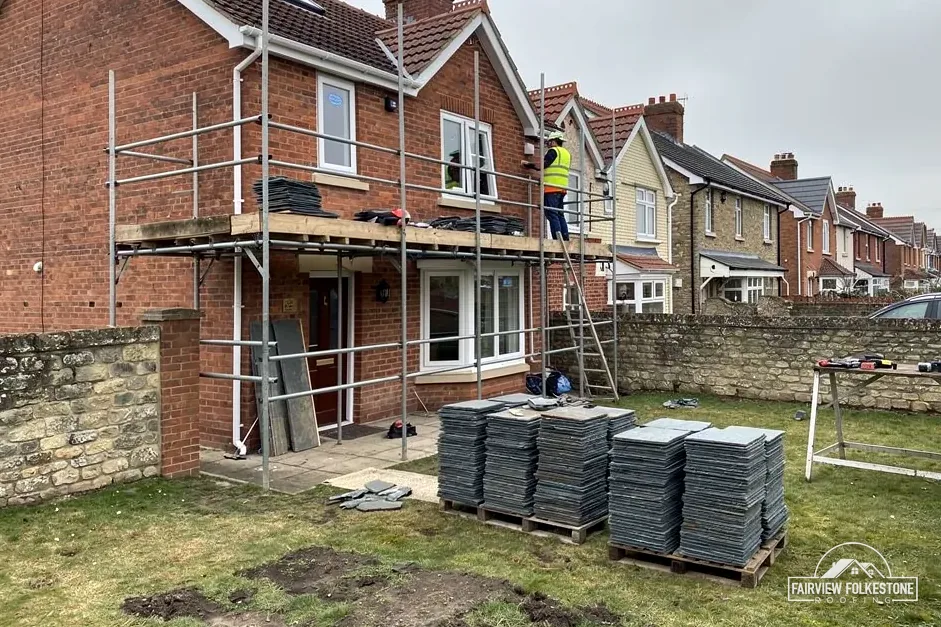
A slate roof does not usually fail in one dramatic event. It gives notice in pieces: a slate that has crept out of line, flakes of grey in the gutter, a brown mark that appears on a bedroom ceiling after rain. Taken one at a time, each of these is easy to put off. Taken together they describe a roof whose condition is changing.
Two different things wear out on a slate roof, and they need different answers. The first is the fixing, the nail or hook that holds each slate to its batten. The second is the slate itself, which can split into layers or thin at the edges. A roof can lose one without the other, so a slate that looks perfect can still be hanging by a corroded nail.
This guide goes through the signs in the order you are likely to meet them, from the garden, from the loft and from the ceilings below. It explains what slipped slates, nail fatigue and delamination mean, what each points to, and what to do when you see one. None of it needs a ladder, and we would rather you stayed off the roof.
01Key points
Signs visible from the lawn and the path
Most of the early signs are visible from the ground, in good light, with a pair of binoculars if you have them. Stand back far enough to see a whole slope, then look along it rather than at it. Slates are laid in straight courses, so anything out of line stands out.
- A slate sitting lower than its neighbours, leaving a gap at the top of its course
- A dark gap where a slate has gone altogether
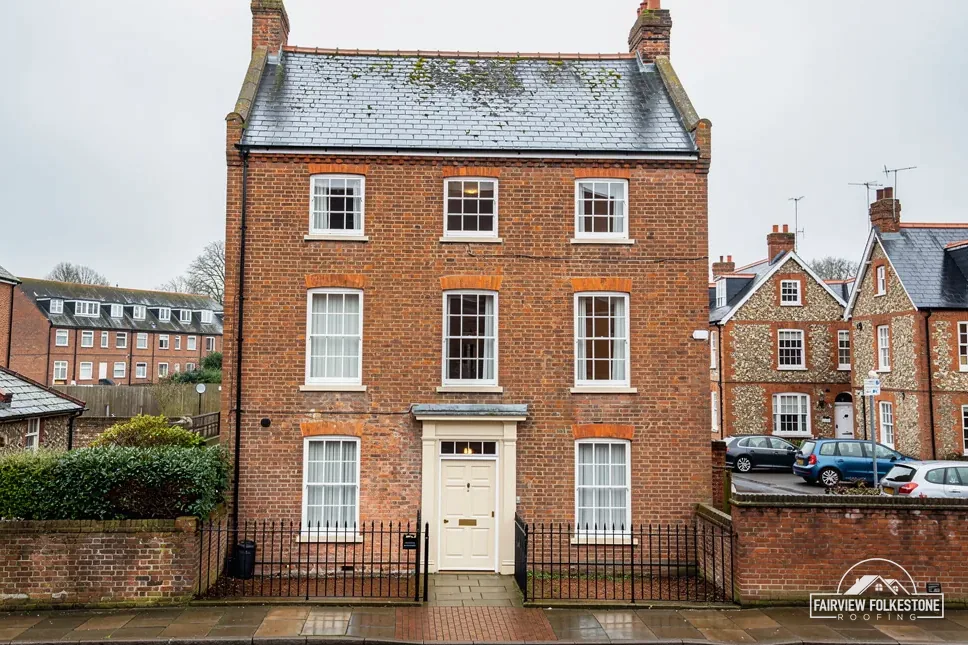
- Slates that look ragged at the lower edge, or show a lighter, flaky patch
- A ridge line that dips or a ridge piece that has shifted
- Moss or staining that follows a line down the slope, which can mark where water runs
Look in the gutters and on the ground below the eaves. Small grey fragments mean something on the slope is breaking up. Whole slates in a border or on a lower roof mean a fixing has let go, and the slope above is worth a closer look.
Write down what you see and when, and which slope it is on, by the compass point or by the street side and the garden side. A dated photo of a gap or a run of fallen pieces gives a roofer something to compare against, and it helps show whether the roof is changing slowly or quickly.
Please do not climb up to look. Slate is slippery, and a slate you stand on can slide or snap, so the close inspection is best left to a survey with proper access and edge protection.
02Slate
Slipped slates: reading the pattern
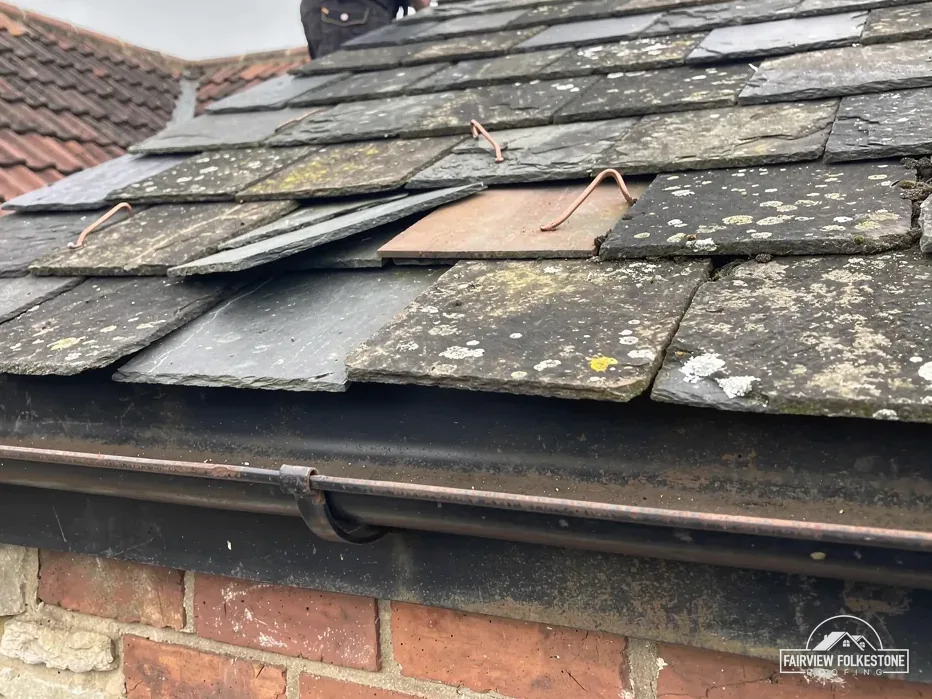
A slipped slate is a symptom, not a fault in itself. It tells you the nail that held the slate has stopped doing its job, and what matters next is how many other slates are in the same state.
The pattern is the useful clue. One slipped slate beside a chimney, in a roof that is otherwise tidy, may have a local cause such as a ladder knock, a disturbed flashing or a bird. Slipped slates scattered over a slope, or repeating on more than one slope, have no local cause to find. The fixings across the roof are weakening together.
| Where | Suggests |
|---|---|
| One slate, near a fitting | A local knock or disturbance |
| A few in one course | A batten or run of nails failing |
| Scattered over one slope | That slope is ageing out |
| Spread across several slopes | Fixings failing roof-wide |
A slipped slate also exposes what lies beneath. Where one has dropped clear, the lining below it is open to rain until the gap is closed. That is why a single missing slate is worth dealing with soon, even when the rest of the roof is sound, and why we cover the gap temporarily if the full repair has to wait for dry weather or access.
If you can see several in a pattern, the sensible next step is a survey, not a repair of each one. Our guide on re-slating or repair sets out how we weigh the two once we have seen the roof.
Failing slate roof questions
Are a few missing slates a reason to re-slate?
Not by themselves. A few missing slates with firm neighbours and sound battens point to a repair. The case for re-slating builds when slipped or flaking slates appear across a slope, the timber behind them is soft, or the same faults come back after a repair.
03Fixings
Nail fatigue: the fixing that wears out
Nail fatigue is the name roofers give to the fixings holding slates giving up. Each slate hangs from a nail, and over a long life that nail can corrode, loosen in its hole or break, leaving the slate resting on the one below with nothing to hold it. The slate may be perfectly sound while the nail is spent.
It matters because it does not stay local. Nails of the same age, in the same conditions, are exposed to the same wear, so the ones nearby are likely to be tiring too, even where nothing has moved yet. Once a few have gone, the neighbours are close behind, and each slate that slides adds load to those that remain.
The signs that point to it:
- Slates slipping down their courses with no sign of damage to the slate
- Slates that lift or rattle when pressed, found during a survey rather than a test you should try yourself
- Nail heads or shanks showing, or rust marks running down the face of a slate
- Slipped slates found again after a repair, in nearby courses
A slate can be sound and still be hanging by a nail that has nothing left.
A refix can mend a slate and leave its neighbours on the same ageing nails. That is why we look at the pattern, not at the gap, and why a roof with spreading nail trouble is a candidate for re-slating. Our answer on what nail fatigue is sets out how it works in a bit more detail.
04In brief
Delamination: when the slate itself fails
Slate is a rock that splits into thin sheets, which is what makes it useful on a roof. Delamination is that same quality working against it: a slate that peels or flakes apart along its layers. Once it begins, the slate loses thickness and strength, and it cannot be put right.
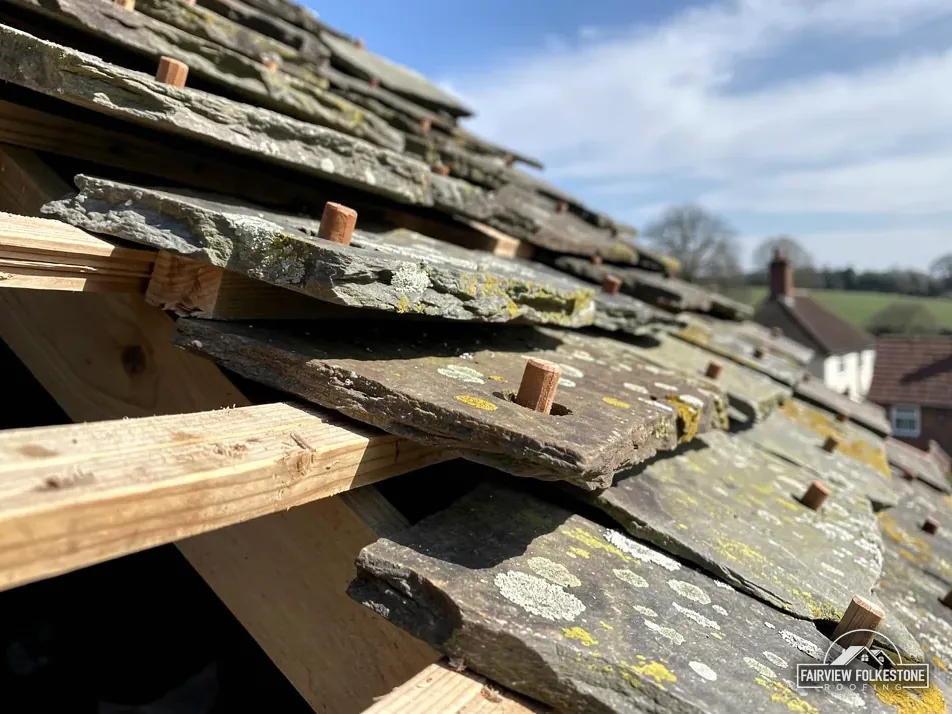
What it looks like from outside and close up:
- Flaking at the tail of the slate, the exposed lower edge, where thin layers lift away
- A slate that has thinned or developed a rough, stepped edge
- Fragments in the gutter that are flat, thin and layered rather than a clean break
- A slate that has split across or along its length, with the pieces still hanging
A slate with these faults is replaced, not refixed. New nails in a flaking slate hold a weak sheet. How the rest of the roof is judged depends on how many are affected and where. Where only a few slates flake and the rest are sound, those few are swapped for matching ones. Widespread flaking on a slope is a different conversation, since the slates left cannot be trusted to carry the roof much longer.
Reused slates need sorting for this reason. When a roof is stripped, each slate is inspected, and those with flaking or thinning edges are rejected. Our short answer on slate delamination goes into what it is and how it is judged.
Delamination is a different problem from nail fatigue, and renewing one does nothing for the other. A roof can need both, which is another reason the survey covers fixings and slates separately and says what it found for each.
Can I test slates by pressing on them from a ladder?
We would rather you did not. A slate with a weak fixing can slide, and a flaking one can snap under a hand or a foot. That testing is part of a survey, done with the right access, so the roof is not made worse by being checked.
05Side by side
Clues from the loft and the ceilings
The loft gives the other half of the picture, because the underside of a slate roof is where failures that have already let in water show themselves. If you can get in safely with a torch, you can see a good deal without touching anything.
A stain on a ceiling and a missing slate on the roof are not always in the same place. Water can run along a rafter or a batten before it shows, so the leak and the stain can be a metre or more apart. That is one reason we trace a leak from the loft and the rooms below as well as from the slopes, rather than fixing the first thing we see.
If a batten looks dark, soft or split, tell us when you book. A torch beam raked along the underside of the slates shows far more than a beam pointed at them, because a gap lights up and a sound joint does not. Timber that has been wet for long enough stops holding nails, and that points to a stripped slope, not a patch.
| What you see | What it can mean |
|---|---|
| Pinpricks of daylight | Gaps in the slating or lining |
| Dark tide marks on timber | Water has reached the rafters or battens |
| Slate fragments on the insulation | Slates breaking up above |
| Sagging or sodden insulation | A leak that has been running |
| Brown stain on an upstairs ceiling | Water travelling from the roof |
06In order
What to do when you spot a sign
You do not need to decide anything on your own. What helps most is to record what you have seen and get the roof looked at before the weather settles the question for you.
Should I photograph slate pieces found in the garden?
Yes. Photograph them where they lie, with something in the shot for scale, and keep the pieces. Flat, layered flakes suggest a different fault from a clean break or a whole slate, and the photos help show when the damage appeared if you ever need to explain it to an insurer.
- Photograph the sign from the ground, with a date, and any fragments that have fallen.
- Note where water has come in inside the house, and keep any drips contained.
- Keep off the roof and keep ladders away from the slope.
- Do not jet wash it. Marley advises against powerful jet washes on slate, which it says can damage the surface and shorten the expected life considerably.
- Book a survey so the roof is read as a whole.
If a storm caused the damage, take your photographs before anything is moved. The Financial Ombudsman Service, by its own account, will usually weigh photographs and surveyors' reports in a dispute, and it says rain, hail or snow on its own can be enough to count as a storm. Tell your insurer first and arrange a temporary repair to stop further water getting in.
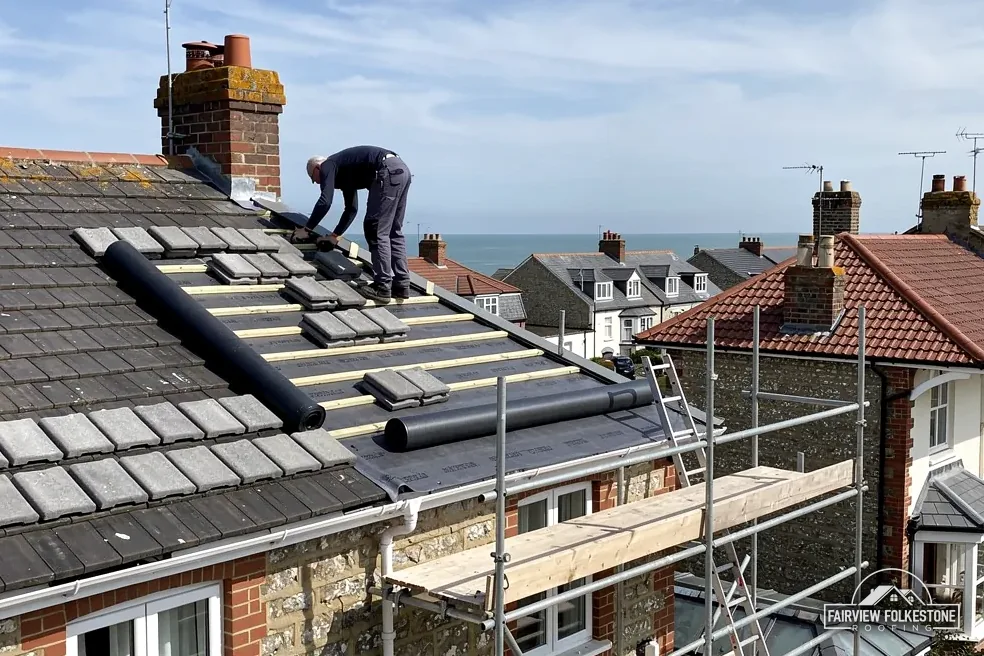
On the day we go over the whole roof, outside and inside the loft too when it can be reached, and we say what we found and what each sign means. The roof may need a repair, a patch of replaced slates or a re-slate. You get a written account first and one written total price after, with the scaffold included. For the service as a whole, see our slate roofing page.
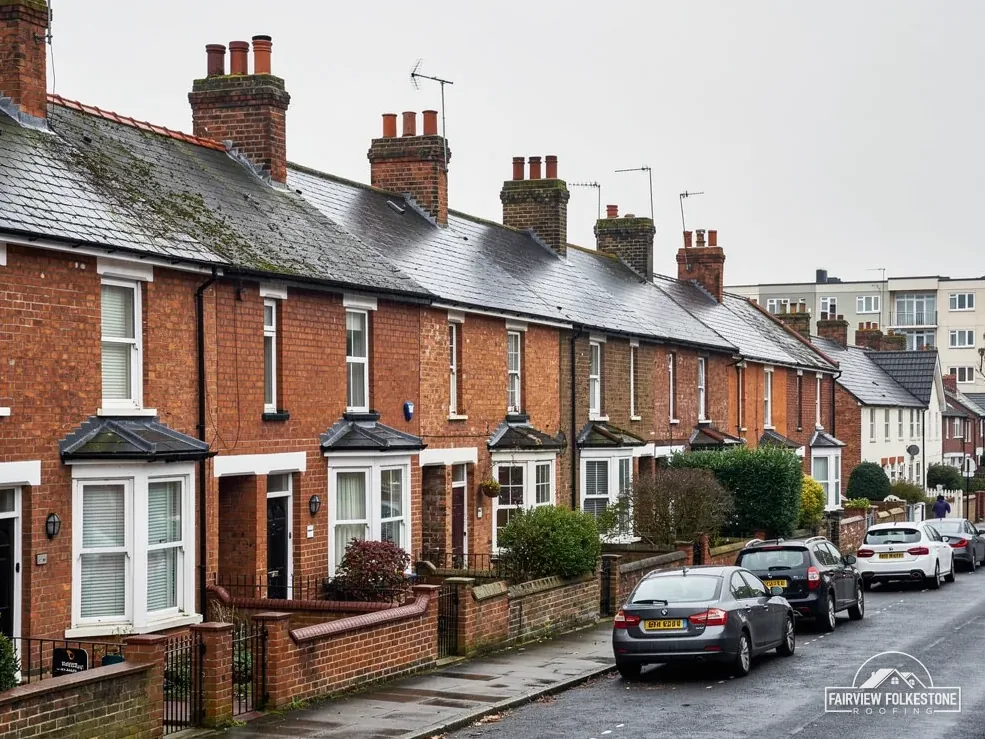

Tell us what's wrong with the roof.
You'll get one written total price.