
Nail fatigue
What is nail fatigue on a slate roof?
On a slate roof, the nail can wear out long before the slate does. Here is how that shows, and what it means for repair against re-slate.
The short answer
Nail fatigue is the gradual failure of the nails that hold slates to their battens, so slates slip while the slate itself is still sound. A roofer quoted by MyJobQuote says the nails start to decay long before the slate does, which is why a roof that could last for decades can still shed slates. One slipped slate is a repair; slipping across a slope is a sign the fixings are failing together.
4 min read · Part of Slate roofing

How the nail gives way
Every slate hangs from a nail that passes into the timber batten behind it. The nail is a small thing carrying a heavy load for a very long time. MyJobQuote names decayed nails that let slates work loose as one of the things to look for, and quotes a roofer saying the nails that hold the slates start to decay long before the slate itself.
When a nail lets go, the slate slides down until its tail catches on the course below, or it falls out altogether. The slate may be perfectly good: only the hold on it has failed. That is why nail fatigue is a fixing problem and not a slate problem, and why a long-lived slate such as Welsh slate, at an approximate 100+ years in HomeBuilding's table, can still need refixing well inside that span.
The same table gives Spanish slate 75 to 100 years and reclaimed Welsh slate 50 to 80 years, but each of those figures is for the slate, not for what holds it. How long the fixings on a particular roof will last cannot be read off a table, so the nails are inspected when the roof is surveyed, never assumed.
How to spot it
From the ground, nail fatigue shows as slates that have dropped, gaps in the courses and slates missing from the slope. Inside, it can show as daylight through the roof, stains on the ceiling and fragments of slate in the loft. None of these proves the cause. A slate can slip for one-off reasons, so the survey looks at the nails themselves.
- Slipped, cracked or missing slates on several courses, not just one.
- New slips appearing after an earlier repair.
- Nails that are rusted through, thin or absent when a slate is lifted.
- Slates that come away freely in the hand.
These are the signs MyJobQuote points to, and they are the ones we check. Please keep off the slates while you wait for a visit: slate cracks under a person's weight. A dated photograph from the ground, showing where on the slope each slipped slate sits, helps the survey, and so does a note of any ceiling stain.
Our guide to the signs a slate roof is failing covers the other faults that look alike.
When refixing slate by slate stops working
A single slipped slate with sound neighbours is a fair repair. It can be refixed with a tingle or a clip, and the survey confirms that the battens and the slates either side are in good order. Nail fatigue is a different matter, because the slates beside the one that slipped hang on nails in the same state.
| What the survey finds | Verdict |
|---|---|
| One slipped slate, sound neighbours | Refix with a tingle or clip |
| A few slips, sound nails elsewhere | Refix, and check again |
| Slipping across a slope | Consider a re-slate |
| Slips plus soft or rusted nails | Re-slate, renewing fixings |
Repairs at that scale are fair when they are few. When they become frequent, the written price for a re-slate can be better value than the third patch, because every call-out brings its own access, its own visit and its own disturbance to the courses around the repair. A re-slate deals with the cause once and the roof is then covered by one specification. Our answer on refixing a slipped slate covers the small jobs.
What a fix looks like
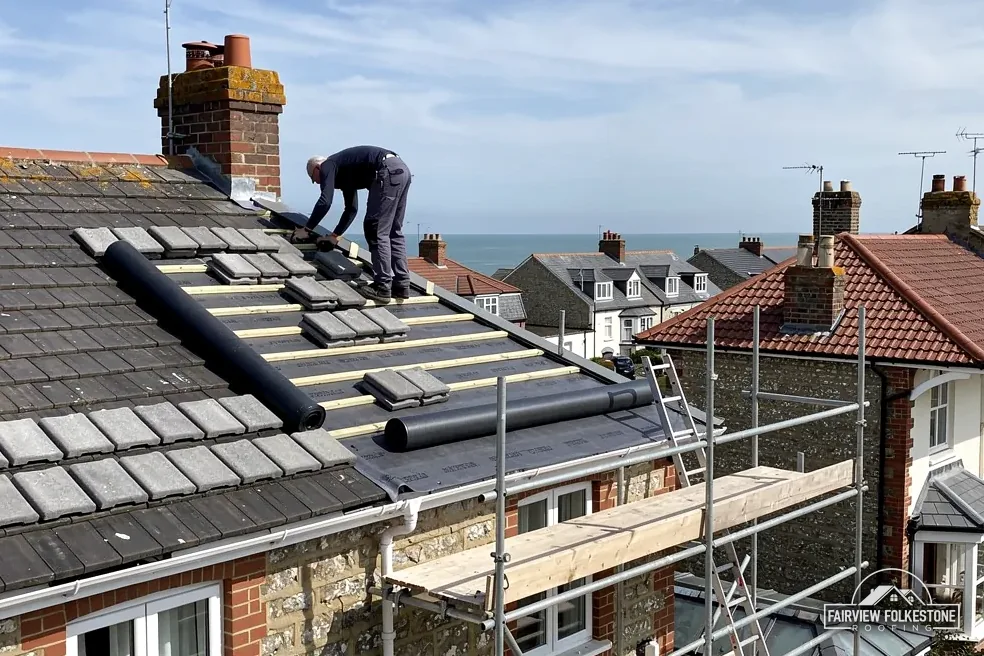
When the verdict is a re-slate, the work follows an order. Slates are stripped by hand, sorted and sound ones set aside for reuse, which is how old slates come to be reused. The battens are checked and renewed where they are weak, new underlay or lining goes on, and the slates are hung again on new fixings, chosen for the pitch and the site. Taking the roof back to the battens also gives the chance to see every nail and every batten in turn, instead of the handful that a survey can reach.
That choice is part of the specification. Cupa advises against hooks below 25 degrees, and it says buildings on hills, slopes or coastal areas, and tall buildings, will be graded with higher exposure. Under BS 5534, the fixing specification is calculated for the site, so a coastal roof is checked for its exposure and not given a stock fixing.
A single written total follows the survey, and the fixing specification goes with it, so you can see what each slate will hang on. The slate roofing page shows the full job, and the answer on slate hooks or nails shows how the fixing is chosen.
More questions
Does nail fatigue mean the slates themselves are worn out?
Not necessarily. The roofer quoted by MyJobQuote says the nails decay long before the slate does, so the slates can be sound while their fixings are tired. The survey checks both, one slope at a time, and sound slates can be sorted and hung again on new fixings.
Can nail fatigue be seen from the ground?
Its effects can, such as dropped slates and gaps in the courses, but the nails themselves cannot. A survey lifts a few slates and looks at the nails and battens, and checks the loft for daylight and stains, before any verdict is given or any price is written.
Tell us what's wrong with the roof.
You'll get one written total price.