
Spray foam removal
Can spray foam insulation be removed?
Spray foam can be taken off a roof, but the difficulty turns on the surface the foam has bonded to. Here is what sets the route.
The short answer
Yes, spray foam can be removed from a roof, either cut and scraped from the loft side or cleared from above once the covering is lifted, depending on the layer the foam has bonded to. The Energy Saving Trust calls spray foam a permanent installation and says that removing it later might also mean replacing the structure it was applied to. A survey settles which route your roof allows.
4 min read · Part of Spray foam removal

What decides how hard removal is
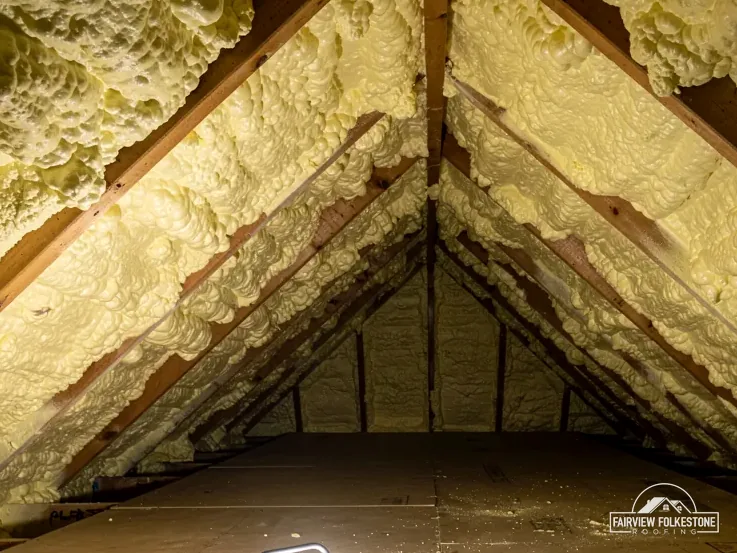
The foam is applied wet and cures hard, so it cannot be rolled up and carried out like a quilt. Removal is cutting and scraping, and the effort depends on a few things that can only be read in the loft.
- The type: the Energy Saving Trust describes closed-cell and open-cell foam as the two main kinds.
- What it is stuck to: sound underlay, torn felt, or the backs of the slates and tiles themselves.
- How thick it is, and whether it blankets the rafters or sits only between them.
- How much room there is to work inside the loft.
MyJobQuote says open-cell foam is less dense and quicker and easier to remove, while closed-cell foam bonds more strongly to surfaces and can cost more to remove. It adds that the two can be told apart by touch, open-cell being soft and spongy and closed-cell rigid and dense. The Energy Saving Trust gives closed-cell foam's main drawback as its lack of vapour permeability.
RICS adds a warning that matters at survey stage: where foam covers the roof timbers they cannot be fully seen or checked.
The two routes
Almost every job takes one of two routes, and the survey chooses between them. Which one applies is set by the foam and the layer beneath it, not by preference. Lifting the covering is the bigger job, with more access and more disturbance to the roof, so it is used only where the loft route cannot clear the foam properly.
| Foam is stuck to | Route |
|---|---|
| Sound underlay | Cut away from the loft; covering stays on |
| Torn or failing felt | Clear from above; covering lifted |
| Backs of slates or tiles | Clear from above; covering lifted |
Working from the loft is the lighter option, so it comes first where the survey allows. It suits the job only while the felt will survive the pull, because foam peeled off old felt can tear it, and a torn lining has to be replaced before the roof is closed up again. If that happens the price can change, and you see photographs of the cause before any extra work starts.
Our guide to how spray foam is removed follows each route step by step, and the spray foam survey answer shows how the choice is made.
Why people take it out
The reasons are practical, and they are worth separating, because each one points at a different next step.
Rot is the first. The Energy Saving Trust warns that foam applied straight to the underside of a roof partly seals the timber, so any rainwater that collects there can eventually cause rot, though this risk should be much lower with an open-cell foam. It adds that coated timbers, and tiles or slates with no felt between them and the foam, are harder to replace.
Lending is the second. In March 2023 RICS reported concern within specific sectors of the lending market, such as equity release mortgages, which it said was having a wider impact on lenders. That describes concern in some parts of the market, not a rule. Check with your mortgage provider before any spray foam work, whether you mean to keep the foam or take it out. The Energy Saving Trust adds that homes where the foam was installed correctly should have less of a mortgage problem.
Ask your lender what evidence it wants before you pay for removal, so the paperwork is ready when the work is done.
What it costs and what to do first
Prices are published by third parties, so read them as guides to the unit and not as a quote. MyJobQuote's average for removal is £40 per m², and for a standard 3-bedroom property with roughly 80 m² of roof space it puts the total at around £3,200. Those are MyJobQuote's figures, not ours. What we give you is a single total in writing, after the survey.
The sensible order for any roof is short:
- Ask your lender or broker whether foam on the roof is acceptable to them and what evidence they need.
- Have the roof surveyed, with the foam type and the route settled.
- If the timber cannot be seen, cut a small test area before the whole job is priced.
The test area is worth having because foam can hide the condition of the timber, and a price based on guesswork is no use to anyone. Our cost guide on spray foam removal cost sets out what moves the figure, and the spray foam removal page shows the whole job.
More questions
Is a survey needed before spray foam is removed?
Yes. RICS says timber that foam covers cannot be fully seen or checked, so a survey reads what it can, notes the foam type and the layer beneath, and where the timber stays hidden a small test area is cut before the whole job is priced. You then get the findings in writing.
Should I tell my lender before removing spray foam?
Yes, ask first. In March 2023 RICS reported concern in some parts of the lending market, such as equity release mortgages, so check with your lender before any spray foam work, and ask what evidence they want afterwards, such as photographs of the bare timbers or a written roof report.

Tell us what's wrong with the roof.
You'll get one written total price.