
Foam survey
What does a spray foam survey or inspection report cover?
A survey turns a loft full of foam into facts about the type, the timber and the route. Below: what is checked, what the report holds and its limits.
The short answer
A spray foam survey records what the foam is, how thick it lies, what it is stuck to, the condition of the felt and timber it covers, and which removal route the roof allows. It ends in a written report with photographs and one total price. Foam hides part of the roof structure, so the report also says plainly which parts could not be seen.
5 min read · Part of Spray foam removal

What is checked in the loft
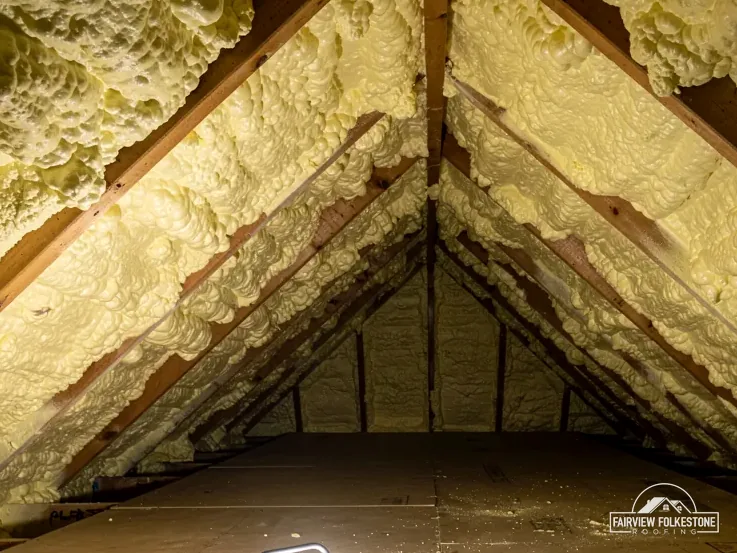
The visit starts with looking, before any tool touches the foam. The aim is to describe the installation so that nobody has to guess at it later.
- The type: closed-cell or open-cell, which the Energy Saving Trust names as the two main kinds.
- The extent: one slope, the whole roof, or the gable and party walls as well.
- The thickness, and whether the foam sits only between the rafters or runs across them too.
- The surface it grips: whole felt, felt that is perishing, or the undersides of tiles and slates.
- The eaves, where ventilation may be blocked and old soffit boards may be present.
- Any sign of bats or nesting birds, and of past leaks.
The loft is also measured and photographed as it stands, with the access route to the hatch noted. Everything carried out of a house has to go through that opening, so it sets how the work is staged and how many skips are needed. A narrow hatch on a long roof is a different job from a wide one, and the report says so.
Readings and the test area
Looking is not enough where the timber is covered, so the visit goes on to measurement. A moisture meter is run over the timber that can be reached, and a probe is pushed into any patch that looks dark or feels soft. The readings are written against a position on the roof, not averaged, because a damp rafter end tells a different story from a damp loft.
Then a small test area is opened in a place where a failure would matter least. The foam is lifted, and the result shows whether it peels from sound felt, tears the felt, or holds the tile backs. That one result chooses between the loft route and opening the roof from above.
Old board near the eaves is not disturbed. Soffit boards and sheet material are identified before anyone cuts near them, since HSE says that if the building was built or refurbished before 2000 you should assume there is asbestos in it. Any bat roost is fully protected by law, and under the Wildlife and Countryside Act an intentionally damaged nest is an offence while it is in use or being built. Either finding stops work in that spot until the way forward is clear.
What the report contains
The written report is the thing you keep, whatever you decide to do next. It is arranged so a lender, an insurer or a buyer's surveyor can follow it without having been in the loft, with a plain heading for each part and the photographs placed beside the readings they support. Anything that was not reachable is listed on its own so it cannot be overlooked, and the report names the person who carried out the visit and the date of it.
| Part | What it records |
|---|---|
| Description | Type, extent, thickness |
| Photographs | Each slope, eaves, test area |
| Readings | Moisture and probe results by position |
| Route | Loft or above, with the reason |
| Total | One written price |
The total is one price for the whole job, set only after the survey, covering the removal, the repairs the readings point to, and what goes back. It is not split into parts. If the work later needs a different route, you see the photographs that explain the change first, and nothing proceeds on that basis until you agree.
What a survey cannot show
Every survey has edges, and a good report marks them. In the RICS consumer guide, covered roof timber is described as something that cannot be fully seen or inspected. Moisture meters read a few centimetres into the wood, a probe tests only where it is pushed, and some of the roof is under foam until it comes off.
The report therefore separates what was seen from what was inferred, and says which timber will be read again once the rafters are bare. That second reading is what finally settles any repair, and the written total is updated if it differs from the first.
Sign at home after the visit and the 14-day cancellation period applies, so an earlier start has to be requested by you in writing. A copy of the report is yours whether you go ahead or not, and it can go to your lender or a buyer, who may ask what the roof timber looked like when the foam was found. Our guide to spray foam removal before selling shows where it fits in a sale, and the spray foam removal page covers the service.
More questions
How long does the survey visit take?
Roof size, the spread of the foam and the ease of moving about the loft all change it, so a figure given in advance would only be a guess. The visit is one session, with the test area and readings taken on the day, and the written report and price follow after it.
Can I use the report if I decide not to remove the foam?
Yes. It records the type, thickness, photographs and readings on a named date, so it can go to an insurer, a lender or a buyer's surveyor. It also gives you a baseline to compare against if the roof is checked again, which is useful because foam stops most of the timber being seen.
Tell us what's wrong with the roof.
You'll get one written total price.