
Roof moisture
Does spray foam insulation cause condensation in a roof?
Foam makes no water of its own, but it changes where moisture can go. Below: how that happens, what the eaves must do, and what to check in your loft.
The short answer
It can contribute, depending on the foam and how the roof was built. The Energy Saving Trust says foam bonded beneath a roof covering partly seals the timber, and that closed-cell foam passes no vapour, so damp air reaching the rafters has fewer ways out. Foam is not proof of condensation, though, and a roof wet from a leak can look much the same. Readings taken from the timber settle which one you have.
5 min read · Part of Spray foam removal

How foam changes the way a roof dries
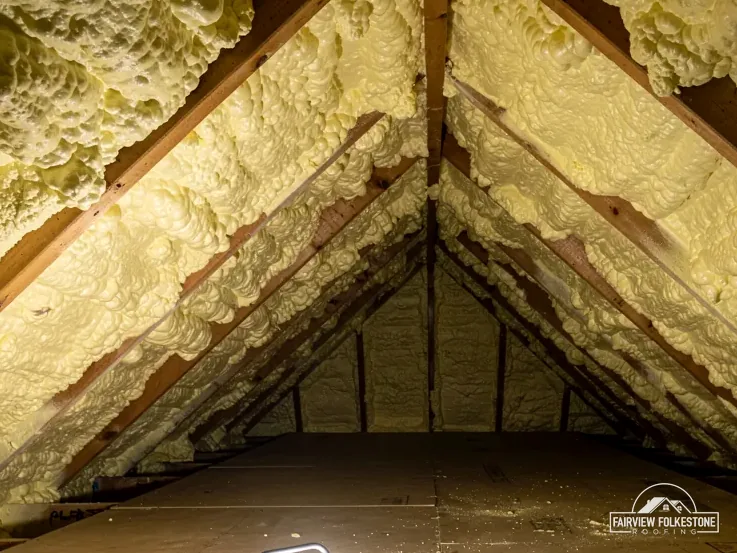
A pitched roof is built so that a little damp, from cooking, washing and breathing in the rooms below, can leave through the roof structure instead of settling on cold timber. Foam laid against the underside of the covering interrupts that route. The Energy Saving Trust names two effects. Foam applied straight to the roof leaves part of the timber sealed in, and closed-cell foam's main drawback, in its words, is that it does not let water vapour through.
Timber that cannot dry out can stay damp, and damp timber is where decay starts. The same source says the risk of decay should be much lower where the foam is open-cell. That is a comparison between two products, so open-cell foam is not a reason to stop checking.
None of this means every foamed roof has a moisture problem. It means someone altered how the roof handles moisture, and the owner needs to find out whether the change has been harmless in that particular house. Only readings and a look at the timber can show it, and a clean surface proves nothing about what lies behind.
Ventilation, eaves and the underlay
Ventilation is the second half of the question. BS 5250 is the British Standard on managing moisture in buildings, and BSI shows its 2021 edition as current but under review. Marley works from that standard for a cold roof, meaning one with insulation at ceiling level and a cold space above it, and it gives different eaves openings for different underlays. A roof's underlay is the sheet beneath the battens, and its type changes the answer.
| Underlay | Roof pitch | Eaves opening |
|---|---|---|
| High-resistance (HR) | 15° or less | 25mm along the eaves |
| High-resistance (HR) | More than 15° | 10mm along the eaves |
| Breather (LR), sealed ceiling, air-permeable covering | Not pitch-specific | 3mm from normal eaves construction |
HR underlay passes no vapour, which is why its openings matter. The 3mm case also needs an air-permeable roof covering, and holds only where the UKAS Third Party certification requirements are fully met. Foam pushed into the eaves can shut the openings that these figures rely on, so the eaves are the first place we look in a sprayed loft, before we touch a rafter.
Signs to look for in your own loft
A few checks need only a torch and a safe footing on boards, with no touching of the foam. Look for:
- Rafters that look dark, grey or tide-marked where the foam stops.
- Foam that has pulled away from the timber, leaving a gap with a damp edge.
- Water marks or drips on the underside of the felt.
- A musty smell that was absent before the foam went in.
- Staining on the ceilings below, particularly beside the eaves.
- Foam packed hard into the eaves with no gap left for air.
Timing helps separate damp air from a leak. Marks that show in cold weather and fade in summer point towards moisture from inside the house, while marks that follow a downpour point towards water coming in from outside. Our condensation or roof leak page goes through the clues. Whichever it turns out to be, foam over the top can hide the cause, so a tidy-looking surface is no comfort on its own. If you spot any of the signs above, photograph them with the date on the phone, and keep the pictures for the survey.
What we do about foam and damp timber
We begin with a moisture meter and a probe, take readings around the edges of the foam, and look at the felt, the eaves, the ceiling below and any staining on the plasterboard. We also check whether any foam has been blown or pushed along the eaves, because a blocked gap there is the simplest fault to put right. Where foam covers every rafter, we open one small area first so the timber behind can be read directly instead of guessed at. The foam's type also matters, and our guide to open-cell and closed-cell spray foam explains the difference.
The readings decide the advice. Dry timber and clear eaves may mean the foam can stay, and we will tell you so. Damp or soft timber, or foam blocking the eaves, points towards taking the foam off, drying the roof out and insulating again with proper ventilation. That is the bigger job, and the survey ends in one written total price. The whole process is set out on the spray foam removal page, and the cost side has its own guide.
More questions
Is condensation in a foamed loft a sign the foam must come out?
Not by itself. We look for the cause first, which may be blocked eaves, a leak or damp air coming up from the house. Foam sitting on dry, sound timber with clear ventilation can stay where it is. If the timber is damp or soft, removal becomes the sensible next step, and the reasons go in writing.
Can I stop condensation just by adding vents to the loft?
Vents help only where the roof can use them. Marley's eaves figures assume the opening stays clear along the whole length of the eaves, and foam packed into that gap defeats them. Check the eaves before adding anything, and avoid fitting any vent that opens straight into foam.

Tell us what's wrong with the roof.
You'll get one written total price.