
Spray foam types guide
Open-cell or closed-cell spray foam: why it matters for removal
Spray foam in a roof is either open-cell or closed-cell, and the two behave differently around timber, moisture and a cutting tool. Knowing which you have shapes every decision after.

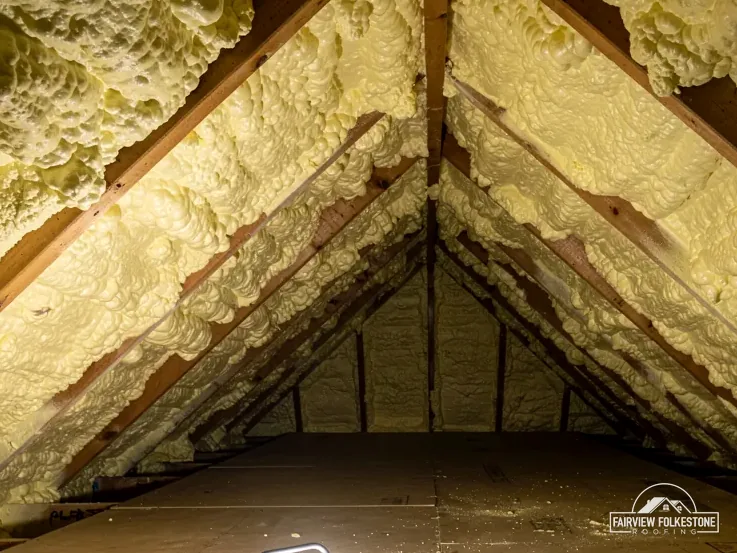
Two roofs can carry spray foam that looks the same from the loft hatch and still call for different plans. One foam is soft and spongy under a thumb. The other is hard and set like a board. They are sold under the same name and applied the same way, and a homeowner who was never told which was used has no reason to know the difference. Yet the type decides how the foam treats the rafters behind it, how it comes away when it is removed, and what a surveyor or lender is likely to want to see.
This guide takes the question in the order a reader meets it. It starts with what the two types are, then how to tell them apart without special equipment, what each means for moisture in the timber, how the type changes the cutting, and what it changes when a house is sold or remortgaged. It finishes with a narrower question: whether the type alone is a reason to take foam out. The answer is no, and the reasons follow.
01Side by side
Two foams sold under one name
The Energy Saving Trust puts it plainly: there are two main types of spray foam insulation, closed-cell and open-cell. Both are polyurethane foams that are sprayed as a liquid onto the surface to be insulated, and both set into a layer that clings to whatever is underneath. On a roof that surface is usually the underside of the covering, the felt, or the rafters themselves, so what the foam is stuck to matters as much as the foam.
Where they part company is in how they handle moisture and how they feel once set. The table sets the two side by side, using the Energy Saving Trust's own wording where it gives one.
The last two rows of that table describe how the work goes on site, while the moisture row follows the Energy Saving Trust. None of it is a reason to condemn one foam and approve the other. It is a reason to know which one you have before anyone prices the work, because a quote written for the wrong foam will be wrong on time and on method.
| Point | Closed-cell | Open-cell |
|---|---|---|
| To the touch | Hard, rigid | Soft, gives under pressure |
| Moisture | Not vapour permeable | Rot risk should be much lower |
| Cutting it out | Slow, bonds hard to felt | Quicker, can leave a crust |
| Timber behind it | Sealed against drying | Still needs checking |
02Key points
Telling them apart from the loft
You do not need instruments to make a first guess, though a guess is all it is. In a loft with a torch and a steady footing on the joists, press a gloved thumb into a patch of foam that is easy to reach and look at what happens.
Open-cell and closed-cell questions
Which type of spray foam is harder to remove?
Closed-cell foam takes longer, because it is set hard and bonds firmly to felt and tiles, so it has to be cut in smaller pieces. Open-cell foam cuts out more easily, though it sheds a crust that needs scraping off the wood. The deciding factor is what either foam is stuck to, which is why a small test area comes first.
- If the foam dents and springs back, or crumbles slightly, it points to open-cell.
- If the surface is hard and resists the thumb, with a smooth skin, it points to closed-cell.
- If it is a mixture, with hard foam in some bays and soft in others, the roof may have been sprayed in more than one visit.
Never lean on the rafters to get a better look, and never cut into foam with a knife to see inside, as you may slice through a cable or open up the underlay. If the installer left an empty tin or a data sheet in the loft, photograph it: the product name can settle the type outright. Photographs of the foam taken from the hatch are more useful than a sample you have hacked out, because they let a surveyor see its colour, depth and how far it spreads.
At the survey we press the surface, cut a small sample from an edge, and record the depth in several bays. Type, thickness and a photograph all go into the written report. Where the foam cannot be told apart with confidence, the report records that and describes it as found, which is better than a confident label that turns out to be wrong. A lender or a buyer's surveyor who later asks which foam was used is then answered from the record, not from memory.
03Keep the hedge
Why moisture matters to the timber
A pitched roof is built to let a little air move through it, so that any damp that gets in can dry out again. Foam applied along the rafters, beneath the covering, changes that. The Energy Saving Trust warns that foam put straight onto a roof's underside "will partially seal the timber", and it gives closed-cell foam's chief weakness as being not vapour permeable, so moisture in the surrounding air or building materials cannot travel through it and escape.
The rot question follows from that. A rafter that cannot dry is a rafter that can stay damp, and damp wood is where decay begins. For open-cell foam its judgement is that the risk "should be much lower". Those words are careful, and they are worth keeping that way: much lower is a comparison, not a clean bill of health.
- Closed-cell foam over a sound, dry rafter leaves that rafter sealed in.
- Open-cell foam over a rafter that was already damp can still hold the damp against the wood.
- Either foam over a leak hides the leak and the damage it is doing.
The leaks are the part people miss. A cracked tile or a patch of perished felt can let water in for years, and foam stuck over the area means nobody sees the stain spreading. That is why timber under foam gets readings and a probe whatever the type, and why a clean-looking surface proves nothing about the wood behind it.
04In order
How the type changes the cutting
The type does not decide whether foam can come off. Both kinds can be removed: taken apart from inside the roof space, or lifted off together with the felt during a strip. What the type changes is the pace, the method and the risk to the layers underneath.
- Identify the foam and its depth in the survey.
- Cut a test area where the foam covers every rafter.
- Choose the loft route or the strip route from what the test shows.
- Scrape and clean each rafter before any timber is judged.
Closed-cell foam is set hard and grips the surface it was sprayed on. On felt that is brittle with age it can tear the felt as it is pulled away, and on a tile it bonds so firmly that the tile has to be cleaned or replaced. It is cut in smaller pieces and more slowly, and that extra time is one of the things that moves the written price.
Open-cell foam is lighter and yields as it is cut, so it comes out in softer lumps. The trade-off is that it crumbles, and the remnants can cling to the wood as a crust or a fuzz that has to be scraped and brushed back before the rafters can be read properly.
Our guide to how spray foam is removed follows each of those steps through the loft and from above, and the test area is the one place where the type of foam turns from a label into an answer.
Does closed-cell foam always trap moisture?
The Energy Saving Trust says its main drawback is that it is not vapour permeable, so moisture in the air or in the building materials cannot pass through it. Whether that causes harm depends on how much moisture is present and where it comes from. A dry rafter under sound felt is a different case from a damp one under a leak.
05In brief
What the type means in a sale or remortgage
In March 2023 RICS reported concern in some parts of the lending market, such as equity release mortgages, over spray foam in roofs. That concern is about lending, so it is for your lender to say what it will accept, and it does not mean every lender treats every roof alike. The Energy Saving Trust is less alarmed. It says the mortgage problems were "possibly true for a while" and that there should be less of an issue with getting a mortgage for homes that have had spray foam insulation installed correctly.
Neither of those statements names a foam type, but both turn on facts about the roof that the type helps answer. Three questions come from the buyer's side.
- Which foam was used, and how deep it is.
- Whether the timbers behind it can be inspected.
- What condition the felt and covering are in.
Inspection is the sticking point: RICS says timber under foam "cannot be fully seen or inspected". Open-cell foam is no exception, so the type alone does not clear a roof. What it does is shape the questions asked: with closed-cell foam the first question is usually about trapped moisture, and with open-cell foam it is about hidden damage.
A written note of the foam type with a set of photographs answers those questions directly. Our guide to removing spray foam before you sell sets out what a pack for a buyer's surveyor holds.
06The short list
When the type alone is not a reason to strip
The type of foam is not, taken alone, grounds for removal. A hard foam sealed against a sound, dry rafter may sit for years without trouble, and a soft foam stuck over a leak may be doing damage the whole time. The type, the felt beneath and the state of the wood once it is bare settle the matter together, and a visit to read the roof is the only way to weigh those three.
So the useful first step is not to ask for removal. It is to find out what you have, and that takes a short list of jobs.
- Photograph the foam from the hatch, and note any bays where it looks different.
- Look at the ceilings below for staining, especially under the eaves and around chimneys.
- Find any paperwork from the installer that names the foam and the date.
- Ask your lender whether it has a policy on foam in the roof before you decide anything.
Two foams can look identical from the hatch and need different plans on the day.
With those in hand, a survey becomes a conversation about facts. If the foam is open-cell, the timber is dry and the felt is sound, that goes in the report, and leaving it in place with a written report may be the right answer for now. If the foam is closed-cell and bonded to ageing felt, or if there is damp behind either type, removal starts to look like the fair spend. We tell you which, and why. The question of whether any foam can be taken out is covered in can spray foam insulation be removed, and the full service is on the spray foam removal page.
Can a surveyor tell which foam I have from a photograph?
A photograph shows the colour, depth and spread of the foam, which helps, but it cannot confirm the type on its own. Pressing the surface and checking a small sample from an edge is a firmer test. Where the type still cannot be pinned down, the written report describes what was found and does not guess.

Tell us what's wrong with the roof.
You'll get one written total price.