
Buying a house
Buying a house in Folkestone? Should you pay for a roof inspection first?
A homebuyer's survey spreads one surveyor's attention across the entire house, roof included. This post shows what to ask before deciding whether a separate roof inspection is worth paying for.

A roof is an expensive part of a house to be surprised by. Once the house is yours, a leak, a tired covering or a patched flat roof is yours to deal with as well, and the cost of dealing with it can change what the house was worth to you. The time to find out is before you exchange contracts, while the price is still open to discussion.
A homebuyer survey takes in the whole property, from drains to damp, so the roof shares its pages with everything else. Surveyors write about what they can reach and see, and on a roof that can mean the slopes from the ground and the loft from the hatch. Parts they could not see are meant to be listed as such, and those unlisted gaps are exactly where a separate roof inspection earns its fee.
Here is how to read what a survey says about the roof, which questions it leaves open, when a second look is worth paying for, and what is particular to buying in Folkestone, where some addresses sit in conservation areas and some close to the sea. None of this replaces the advice of your own surveyor or solicitor. It helps you ask better questions of both.
01Survey
What a survey report says about the roof
A survey report is a record of what one person could see on one day. The roof section normally describes the covering, notes any defects visible from the ground or the loft, and says where access was limited. The wording that matters most is the wording of restraint.
- Phrases such as "not inspected", "limited access" or "could not be seen" beside the roof or loft.
- A recommendation for further investigation by a specialist roofer.
- A note of previous repairs, patches or mismatched tiles.
- Remarks about stains on ceilings, damp in the loft or a sagging roof line.
- Silence about a part of the roof that the house plainly has, such as a flat extension roof or a chimney.
None of these is a fault in the report. A surveyor who writes that the loft could not be entered is being straight with you. A report that says the roof covering could not be examined closely and recommends a specialist is asking you, in plain terms, to go and get one.
Surveyors can describe the covering they see without being able to say how it is fixed. Whether tiles are nailed, clipped or sitting on old mortar cannot be told from the ground, and the same goes for the state of the underlay.
Read the roof paragraphs twice, then read the terms of the survey. They say what the surveyor was asked to cover and what was left out, and they tell you how far the roof section can be relied on.
02Side by side
Questions a survey leaves open
Even a thorough survey stops where sight stops. Each row of the table sets one part of the roof against what a surveyor can say from the outside and the loft hatch, and what a roofer's closer look can add.
The right-hand column is where the surprises sit. Tiles that look sound from the pavement can sit on underlay that has split. A flat roof that looks flat and dry in dry weather can hold water for days after rain. A stack can stand straight while the lead at its foot has lifted off the masonry.
It also helps to know what a roof inspection is, as opposed to a full survey of the house. Our answer on roof inspection versus roof survey draws the line.
A seller's own account helps as well. Ask when the roof was last worked on, who did the work, and whether any invoices or paperwork survive. Sellers sometimes remember a repair that no survey could see.
| Roof part | A survey can say | Still open |
|---|---|---|
| Covering | Visible slips, cracks, moss | Fixings, underlay, remaining life |
| Loft timbers | Stains, if the loft can be entered | Anything under foam or boarding |
| Chimney | Lean, cracks, loose pointing | Flashings, pot tops, flaunching |
| Flat roof | Standing water, rough age | Membrane, falls, deck beneath |
| Gutters | Overflow marks, loose lengths | Falls, joints behind the fascia |
Roof checks when buying: your questions
Can I have a roof inspected before I own the house?
Yes, with the seller's permission, which usually comes through the estate agent. Ask early, because access to the loft and the garden needs arranging. Never go onto someone else's roof yourself. A roofer who can reach the loft hatch and the eaves can often give a clear picture without going any higher.
03Key points
When a separate roof inspection earns its fee
You do not need a specialist for every purchase. Some situations make one worth the money.
Set the cost against what is at stake. MyJobQuote gives around £300 as the average cost of a roof survey (its page dates from October 2026), though the figure shifts with the roof and the access. Which? Trusted Traders price putting a new roof on an average three-bedroom house at between £7,000 and £21,000 excluding VAT (November 2025), a range likely to run higher in the South East. A fee of a few hundred pounds can tell you which end of that range you may be buying into.
If the answer is nothing needs doing, you have lost an afternoon and bought certainty. If the answer is a repair, you have a documented reason to talk about the price. Either result beats finding out in the first winter. A third result is possible: the inspector cannot say, because the roof cannot be reached or the loft is boarded over. That is also worth knowing, and it is a fair reason to ask the seller for access or for a lower price to cover the unknown.
- The survey report recommends further investigation of the roof, or says the roof or loft was not inspected.
- Nobody can tell you how old the covering is, or when it was last worked on.
- The house has a flat roof, whether as an extension, a porch or a garage.
- There are roof windows or a loft conversion, which means extra openings, extra flashings and extra paperwork.
- The loft shows signs of spray foam, or ceilings show old stains.
- The house has stood empty, or the seller has done little to it in recent years.
04Asbestos
Spray foam, asbestos and paperwork for past roof work
Three things can sit behind a roof that looks fine, and each deserves a question before you commit.
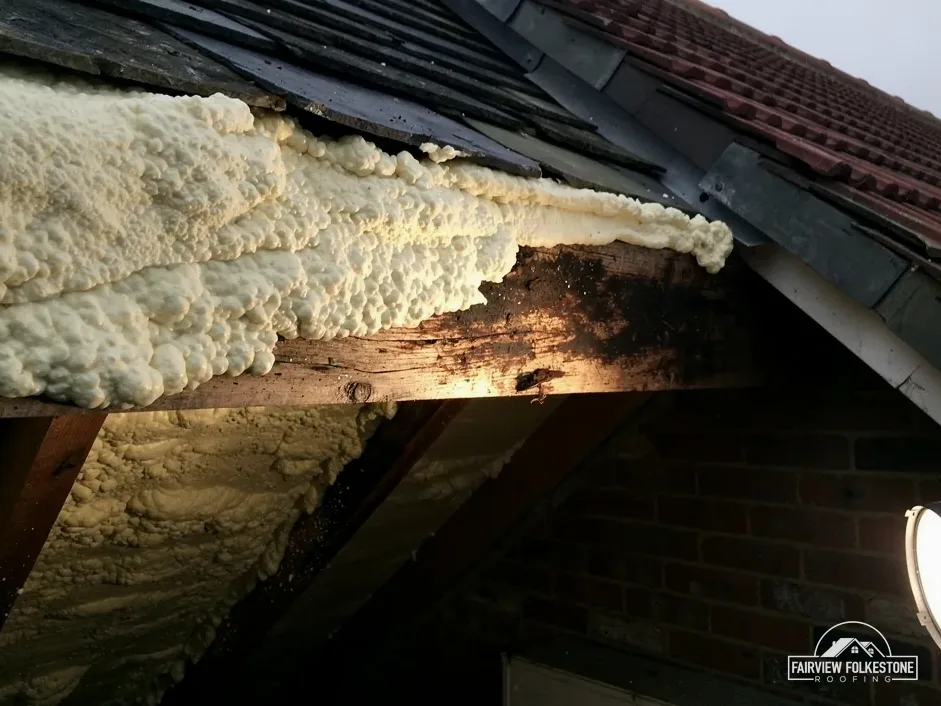
Spray foam in the loft. If the underside of the roof has been sprayed, the rafters are hidden from view. RICS's consumer guide says covered timber cannot be properly inspected, and in March 2023 RICS reported concern within specific sectors of the lending market, such as equity release mortgages, so ask your own lender whether foam is acceptable to them. The Energy Saving Trust takes a calmer view: it says foam installed correctly should make mortgages less of an issue. Ask the seller who fitted it and whether there is any paperwork.
Asbestos. HSE advises assuming asbestos is present in any building built or refurbished before 2000. Garage roofs and old outbuildings of cement sheet are the usual place to look. Asbestos cement roofs are fragile, so nobody should walk on one, and the seller or surveyor should identify it before you buy.
Past approvals. If the roof has been re-covered, a loft converted or roof windows fitted, ask what building control paperwork exists. Work of that kind is signed off either by the council's building control team or by a registered approver, and a seller should be able to say which it was. Keep whatever the seller hands over with your survey papers. A folder of invoices, plans and certificates for the roof is useful when you come to sell yourself, and it settles arguments later about who did what.
Is a roof inspection worth it on a newer house?
It can be. A newer house still has flat sections, roof windows or an extension roof that can fail on their own timetable, and any cover that came with the house has limits and dates you should find out. An inspection while that cover still runs gives you facts to work from.
05Buying · Conservation areas
Buying in Folkestone: conservation areas, listing and exposure
A few local points can change what you may do with a roof after you buy, and they are worth checking before you plan any work.
- The Folkestone & Hythe District Council conservation area page offers an interactive map for checking an address, and explains that designation brings a requirement for appropriate design, traditional natural materials included, in new development.
- Listing does not remove permitted development for roof work, but listed building consent is needed wherever work would affect the building's character.
- In a conservation area a dormer needs planning permission, and an Article 4 direction can remove further freedoms, so ask the council before you plan one.
- Re-covering a house roof is normally permitted development under Class C, and the Planning Portal's guide says a re-roof does not usually need a Building Regulations application if it affects under 25 per cent of the building envelope and under 50 per cent of the roof.
Ask your solicitor to check for any restriction recorded against the property as well as for what the council holds.
Flats and maisonettes have no permitted development rights, so an upper flat sharing a roof has more to ask than a house. If you are looking at a listed or conservation area address, our answer on a listed building roof survey covers what a survey does differently.
Closer to the sea, exposure matters. Cupa, a slate maker, writes that coastal buildings "will be graded with higher exposure", so a roof near the seafront should carry a fixing specification worked out for its site.
06In order
Turning the findings into an offer
A finding is only useful if it leads somewhere. Once you hold a roof report, work through these steps.
Can roof findings change the price I pay?
They can open the conversation. A written finding with photographs, and a written price for the work, give you facts to put to the seller through the agent and your solicitor. Whether the price moves is up to the seller, and your solicitor can advise on the legal side of any change to the offer.
- Get the findings in writing, with close photographs and a note of anything not seen.
- Ask a roofer for one written total price for any repair or replacement the report names. Check that each quote states whether VAT and scaffolding are in the price, so two quotes can sit side by side.
- Give the report and the price to your solicitor and the estate agent, and ask the seller how they wish to respond.
- Decide what you will accept: the price adjusted, the work done before completion, or your own plan for the work after it.
Whether a seller moves on price is their decision. A written finding and a written price give you something concrete to put in front of them, which is stronger than a general worry.
A new build is a different case. NHBC's Buildmark gives two years of builder warranty and then eight years of insurance cover against defects to certain parts of the home. Ask which stage the house is in and when it began, because the dates decide who to call about a roof problem.
When the report and a quote are in front of you, our roof inspection cost guide helps you judge the figures, and our roof inspections page explains how we survey a roof before we price anything.

Tell us what's wrong with the roof.
You'll get one written total price.