
Garage roofing guide
Felt, EPDM, GRP or sheets: the best material for a garage roof
Felt, EPDM, GRP and sheets all keep a garage dry for a different length of time. Which one suits yours depends on the shape of the roof and the state of the boards under it.
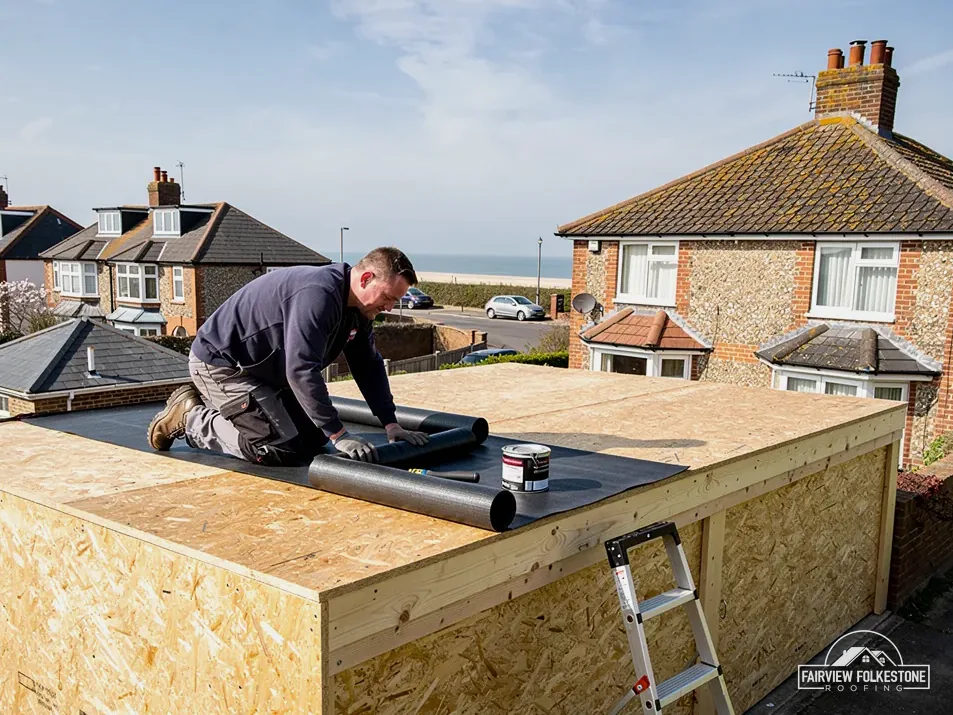
A garage roof asks less of its covering than a house roof does, which is exactly why the choice can go wrong. Nobody sleeps under it, so the temptation is to pick whatever costs least to lay and then forget the roof exists. Yet the same roof still has to shed water from a wide, shallow surface, take the weight of someone on a ladder, and keep a freezer, a workbench and a lawnmower dry for years. The material you choose decides how well it copes with all of that.
This guide compares the four coverings that suit a garage: felt, EPDM rubber, GRP fibreglass and sheets. It gives the published lifespans and costs with their sources, explains what each covering needs from the boards beneath it, and sets out how we choose between them once we have seen the roof. Whichever one you lean towards, the structure under it matters as much as the sheet on top, so we start there.
01Key points
What the roof needs before any covering goes on
Every garage roof is either flat, meaning it has only a slight slope so the water can run off, or pitched, meaning it slopes like a house roof. That one fact narrows the choice at once. Felt, EPDM and GRP are all flat roof coverings, each laid as a continuous waterproof skin over a deck (the timber boards or sheets across the joists). Sheets belong on a sloping roof, where each one overlaps the next and the water runs down the slope.
For a flat garage roof, three things beneath the covering decide how long the new one lasts:
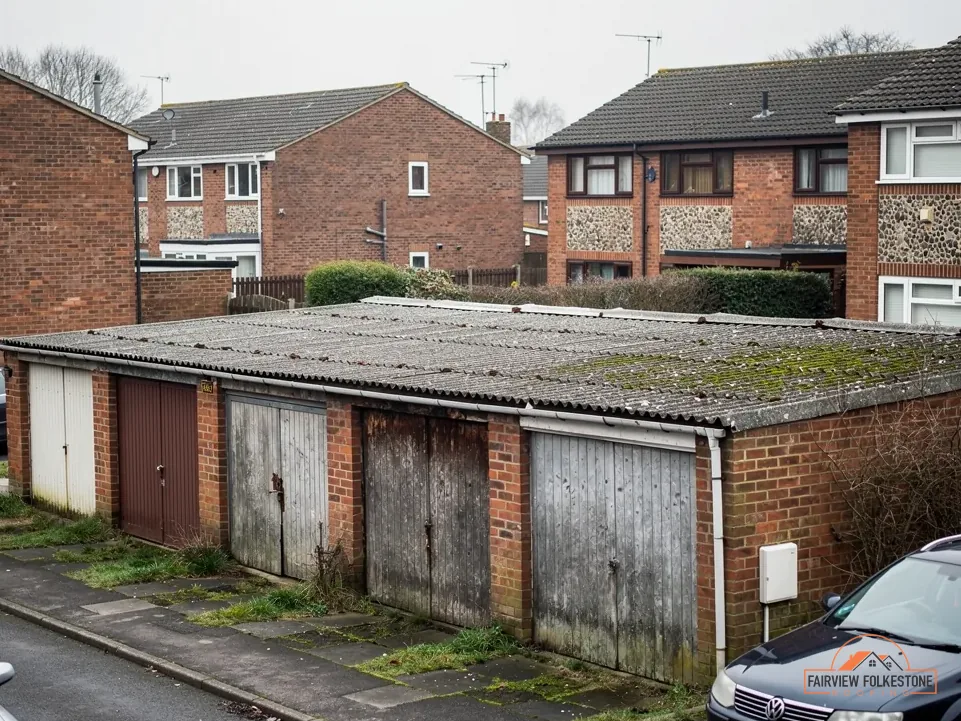
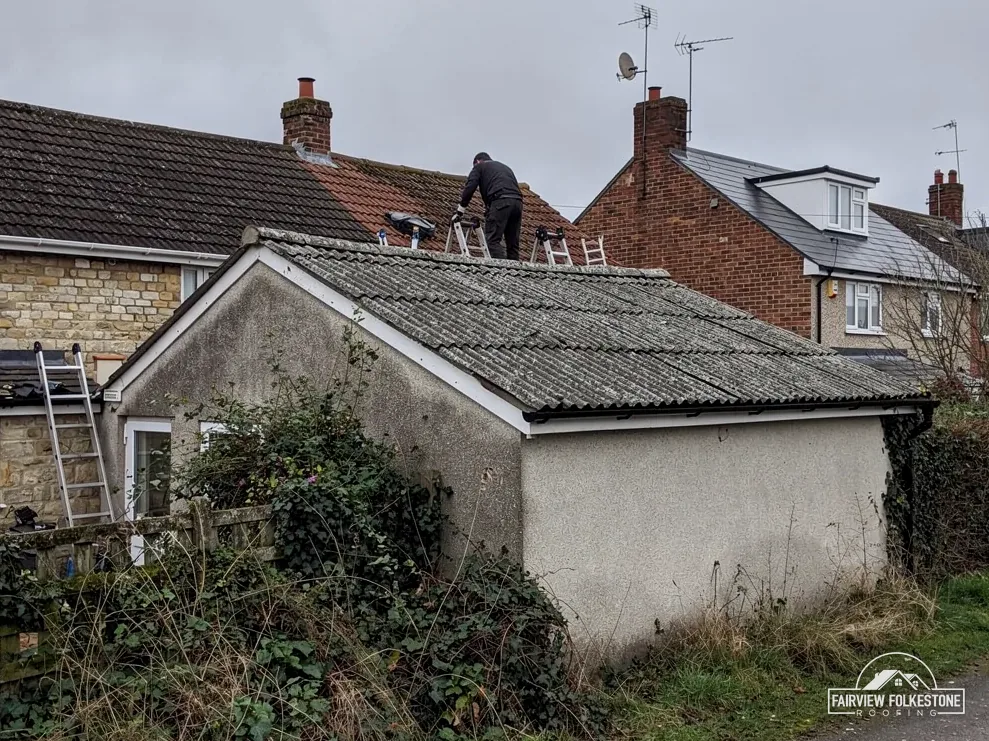
For a sloping garage roof, the first question is what the old sheets are made of. HSE's advice is to assume asbestos in any building built or refurbished before 2000, so an old corrugated cement roof is treated as asbestos cement until a test says otherwise. Our page on telling whether a garage roof is asbestos explains how that check works. The material question comes second to the safety one.
- The deck. Boards that have been wet for years go soft, and a covering stuck to soft boards moves and splits with them. Sound boards can stay; soft ones are replaced before anything is laid.
- The fall, which is the slope towards the gutter. BS 6229:2025 sets a minimum finished fall of 1:80 for membrane flat roofs, so the design aims steeper to allow for tolerances in the build. A garage that holds a pool of water after rain has a fall problem that no covering will cure.
- The edges. Where the roof meets the house wall and where it ends at the gutter, the covering turns up or over a trim, and those details need as much care as the middle of the roof.
02Felt
Felt: the familiar option and its trade-offs
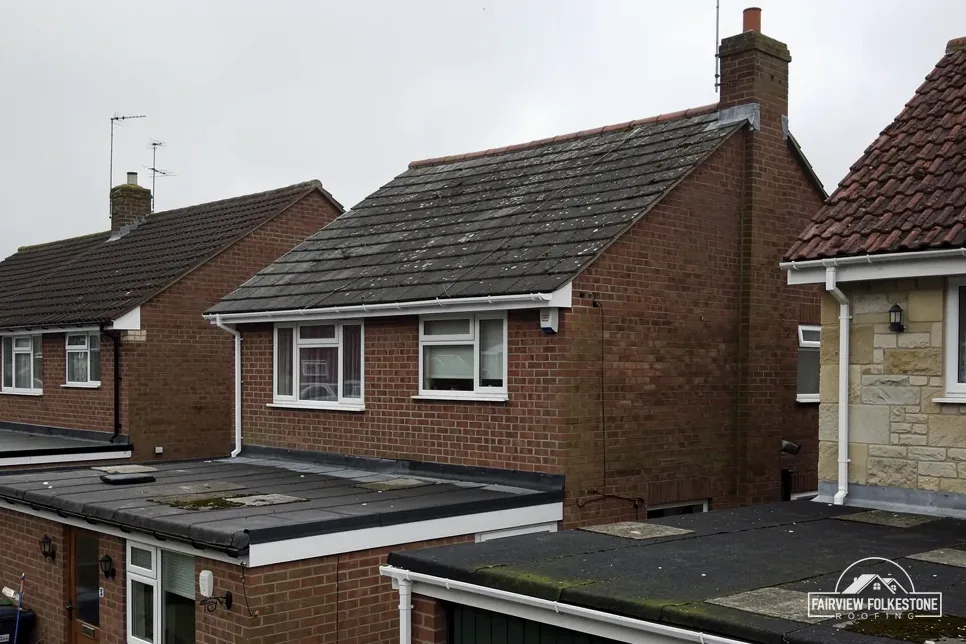
Felt, usually laid as torch-on sheets (a bitumen membrane melted onto the deck with a gas torch), is the covering people picture on a garage. It is light, it follows awkward shapes, and it can be repaired in patches. Its weakness is age: the bitumen dries and cracks, and the seams open.
The published lifespans are short next to the other coverings. HomeBuilding gives torch-on felt 10 to 15 years, while Less says it lasts 10 to 20 years, and that figure depends on quality and installation. The two sources agree on a band that starts at ten years and stops well short of the others, so anyone choosing felt should expect to look at the roof again within a couple of decades at most.
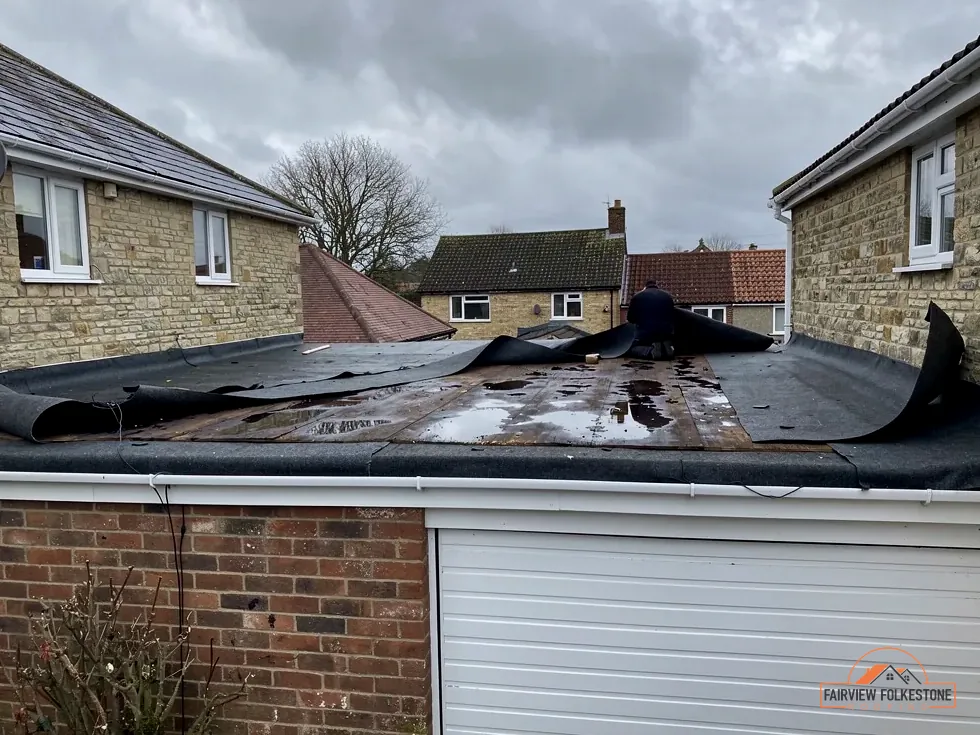
On cost, Which? Trusted Traders put a felt roof on a typical single garage of 6 m by 3 m at £1,400 to £3,500, excluding VAT. Which? gathered those prices from 11 Trusted Traders in November 2025 and says prices are likely to be at the upper end of the scale in London or the South East, which includes Kent and East Sussex. MyJobQuote, from a separate source, gives £750 to £3,500 for the average garage roof replacement in 2026, without stating a VAT basis. The two do not line up exactly, and neither is a quote for your roof.
Felt suits a garage where the budget is tight, the roof has a simple rectangular shape, and the owner accepts a shorter life. It is a poorer choice under overhanging trees, where leaf litter holds damp against the seams.
Garage roof material questions
Can a new covering go over the old one?
Sometimes, but only where the existing covering and deck are sound and dry. Laying over a soft deck or wet felt traps the damp and shortens the new roof's life, so we check the boards first and tell you plainly if the old layer needs to come off.
03EPDM
EPDM: one sheet of rubber
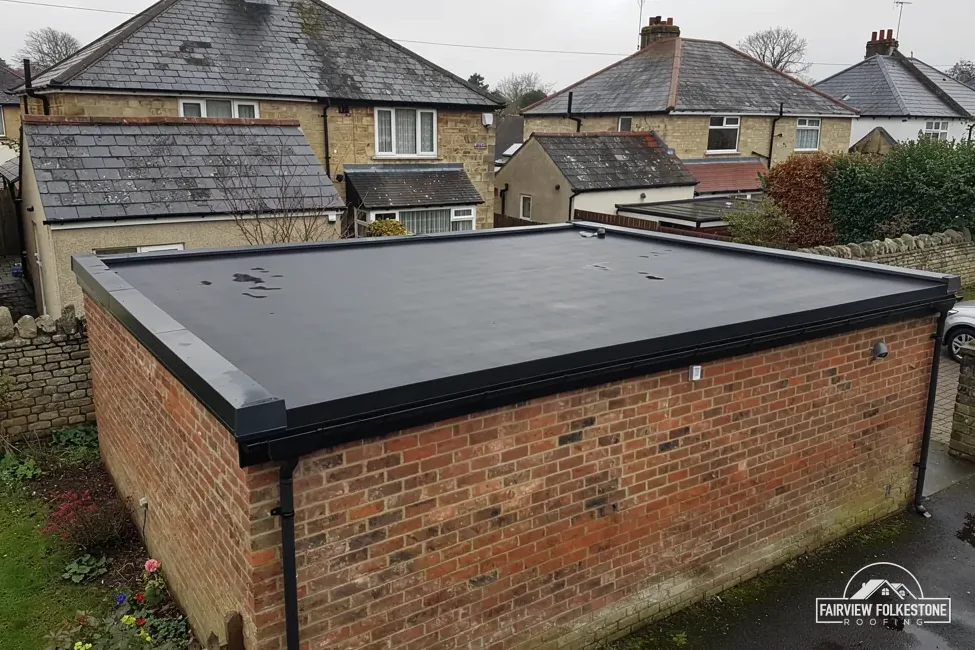
EPDM is a synthetic rubber membrane. On a garage it is normally cut from a single sheet to cover the whole deck, then bonded down and turned up at the edges, so no joins run across the middle of the roof to open. That is its main advantage on a small, simple roof, and our page on repairing or replacing a garage roof shows when a rubber roof is worth keeping.
Lifespans are published more generously than for felt, and the sources disagree on how much. HomeBuilding gives EPDM 25 to 30 years; Less says an EPDM rubber membrane typically lasts 30 to 50 years. Both are general figures for the material, not promises about any particular roof, and both depend on the deck beneath being sound.
On cost, Which? gives £1,950 to £4,000 for PVC or rubber EPDM on that same typical single garage with new boards, excluding VAT. MyJobQuote's rubber roofing page says the average rubber roof costs £1,050 fully installed. The two figures describe different jobs and different surveys, which is why we quote both with their sources rather than picking one.
- A large sheet is easiest to lay in one piece on a dry, calm day, so the weather window matters.
- The upstand (the turned-up edge) where the roof meets a wall has to be formed with care, because a poor one lets water in behind the sheet.
- A puncture can be repaired, but a dropped tool or a fallen branch can cause one, so keep the roof clear.
04GRP · Flat roofs
GRP, and how the three flat coverings compare
GRP stands for glass reinforced plastic, or fibreglass. It is laid wet: resin goes over layers of glass matting on the deck and sets into one hard shell, with a trim finishing each edge. Because it is formed in place, it copes with a roof that has corners, a skylight or an irregular outline better than a rolled sheet does.
The covering is rigid, so it relies on a stiff, well fixed deck. If the boards flex, a hard shell can crack along the line of the movement, and a crack is a path for water. It also needs dry boards and a mild day to cure properly, because resin laid onto damp timber will not bond. We have not found a published garage price for GRP that we are prepared to quote, so we price it after a survey like everything else.
Every figure is a general range for the material and none promises anything about your garage. Read across the rows and the ordering is clear: felt is the shortest-lived, while EPDM and GRP overlap in the middle. Less puts GRP's range at 25 to 40 years with minimal maintenance.
| Covering | HomeBuilding | Less |
|---|---|---|
| Felt (torch-on) | 10 to 15 years | 10 to 20 years |
| EPDM rubber | 25 to 30 years | 30 to 50 years |
| GRP fibreglass | 25 to 30 years | 25 to 40 years |
Does a garage roof need insulation?
Only if you use the space as a workshop or store things that suffer from cold or damp. A warm flat roof puts insulation beneath the covering, and the arrangement has to avoid trapped moisture. We advise once we have seen how the garage is used.
05Side by side
Sheets on a pitched garage roof
A garage with a sloping roof may be covered in profiled sheets, the ridged panels that overlap and run from ridge to eaves. If the old sheets are corrugated cement and the building was built or refurbished before 2000, assume asbestos until a test says otherwise. HSE's guidance is that asbestos cement sheets removed whole, without breaking, are non-licensed work, and that a lockable skip is used for the waste, never an open one. We cover that side on our garage roofs page.
Marley, for instance, publishes a minimum pitch for each tile it makes, from 12.5° for some products to 40° for others, and tells owners to check the data sheet for any product. The same habit applies to sheets: the pitch of the existing frame decides which products are even possible.
HomeBuilding gives fibre cement tiles 30 to 40 years, for anyone who wants a tiled look on a pitched garage. We do not have a sourced lifespan for profiled metal or plastic sheets and will not quote one.
Replacement sheets come in several materials, so before choosing, check each of these:
| Question | Why it matters | Where to check |
|---|---|---|
| What is the pitch? | Each product has a minimum pitch below which it should not be laid | The maker's data sheet |
| What spans the rafters? | Sheets need supports at set spacings | The data sheet and the existing purlins |
| Is the frame sound? | A rotten purlin cannot hold fixings | A survey of the timbers |
| Is insulation wanted? | Condensation forms on cold metal in a damp garage | The product range |
06In order
How we choose for your garage
We choose after a survey, not from a price list. The order of questions is the same each time:
- Is the roof flat or pitched, and could the sheets be asbestos cement?
- Are the boards or purlins sound, and what is the fall?
- How is the roof used and reached: parked under trees, a workshop below it, a gutter someone climbs to clear?
- How long will you keep the building?
Once we know those answers, the covering usually follows. A short, simple, dry-boarded roof where you plan to move in a few years can take felt. A roof you want to forget for a couple of decades suits EPDM or GRP. A pitched roof with old cement sheets needs the asbestos question settled before anything else. Metal coverings sit above all three on paper: VMZinc, the maker, says a correctly designed and installed zinc roof can last in excess of 100 years, but weight and skill rise with it, so weigh them carefully for a detached garage.
A short-lived covering on a poor deck is the worst of both: the deck rots, the covering splits, and the work is repeated. A longer-lived covering on a sound deck is the better use of money. Our garage roof replacement cost guide sets out what moves the price once the material is chosen.
Which covering copes with trees overhead?
Whichever one you can keep clear. Leaves and branches hold damp against any seam or edge, and a branch can puncture a soft membrane. EPDM and GRP have fewer joins for litter to work on, but trimming the trees helps every material, and a gutter beneath branches needs clearing more often whatever the roof is made of.
You get one written total price after the survey, and the roof is left clean. If the garage joins the house, check with building control before changing the roof's structure, because a structural change can bring Building Regulations into play even when a straight re-cover would not. Tell us at the survey about any leaks you have noticed, any damp patches on the ceiling or walls inside, and anything stored beneath the roof that cannot get wet, since each of those shapes how the work is planned and in what order it is done.
Tell us what's wrong with the roof.
You'll get one written total price.