
Garage roof decision guide
Garage roof repair or replacement: how to decide
A damp patch inside a garage can mean one failed edge or a covering that has reached the end. Where the water comes in, and what the deck looks like, settle which it is.
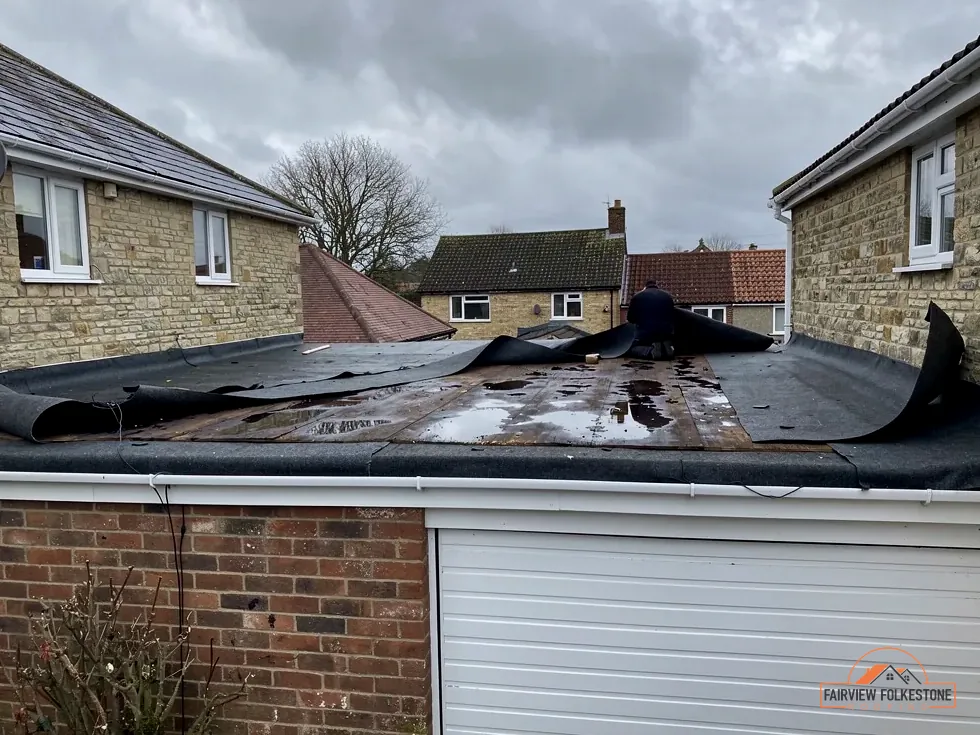
Nobody wants to replace a garage roof if a repair would do, and nobody wants to pay for a repair on a roof that has finished. The trouble is that a stain on the garage ceiling looks the same in both cases. A single split at an edge and a covering that has gone brittle across its whole surface can drip in exactly the same spot after exactly the same shower.
This guide takes the decision in the order we take it on site: find where the water enters, see whether the area around it is healthy, weigh the covering's age against what is published for its type, and handle the special case of old cement sheets separately, because there the rules change. It ends with how we give you a verdict, and what a repair or a new roof costs according to published sources rather than our own list.
01Leaks
Tracing the leak to its entry point
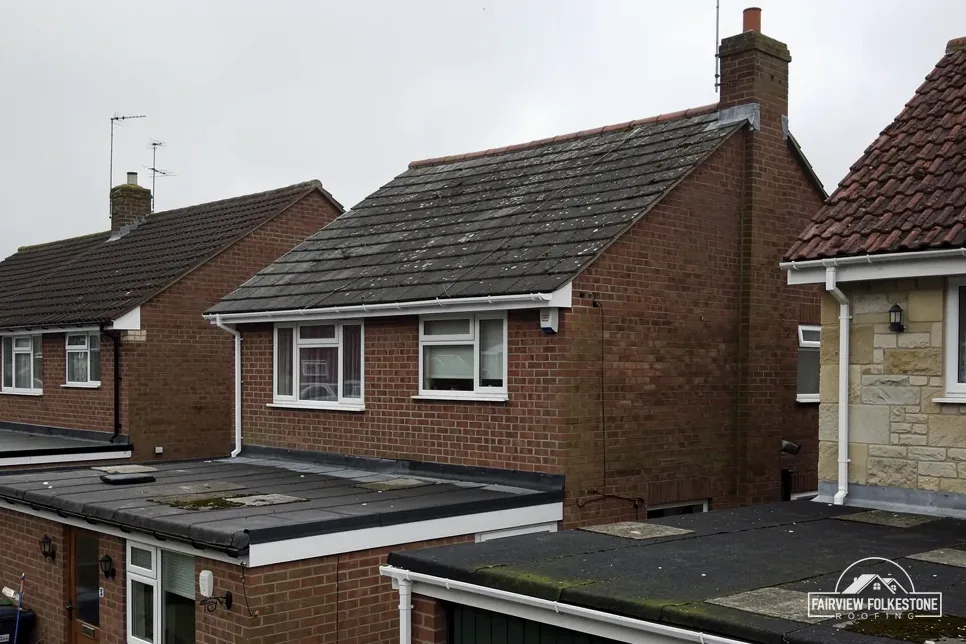
On a flat garage roof the drip inside may not sit under the hole outside. Water runs along the boards or a joist before it appears, so the first job is tracing it back, and the roof surface is only part of the story. The usual entry points on a flat roof are:
- the upstand where the roof meets the house or a boundary wall
- the drip edge or trim at the gutter
- a seam, lap or blister in the covering itself
- a rooflight or vent that has been cut through the deck
- a pooled area where the water sits instead of running away
On a pitched garage roof with sheets, the entry points are different: a cracked sheet, a fixing that has pulled through, a gap at the ridge or the verge, or a slipped lap where one sheet no longer overlaps the next. A garage gutter that sags or a downpipe that blocks can also soak the wall below it and pass for a roof leak, so we check the rainwater goods in the same visit.
We trace the water from the inside first, looking at the line of the stain and the side of the joists, and then from outside. It is a quick job where the roof is accessible, and it matters because a repair at the wrong spot costs money and leaves the leak going. Our page on a leaking garage roof goes through the checks an owner can safely make from the ground and from inside the building.
02Repairs
Signs that a repair will do the job
Repair is the sound call on a garage roof whose fault sits in one place while the remainder stays healthy. In practice that means we can see the cause, we can reach it, and the material either side of it is in good order. We lean towards repair when we find these together:
- The leak traces to one identifiable spot: a split seam, a lifted edge, a failed upstand or a damaged patch.
- The deck either side is dry and firm underfoot, with no soft or spongy boards.
- The covering around the damage is still flexible and bonded down, not brittle, cracked or crazed.
- The roof drains properly, with no standing water after rain.
- The age of the covering falls inside the published life for its type.
Repairs of this kind are short visits. A felt roof can take a patch or a re-bonded seam; an EPDM sheet can be spliced where it has been punctured; a GRP shell can be cut back and re-laid in the damaged area. In each case the aim is to make that part as good as the rest, not better, and we say plainly that the remaining roof is old and will need replacing in its turn.
Matching matters on a felt or rubber roof. A patch laid in a different material from the covering around it can fail along its own edge within a season, so we use the same type of membrane, bond it onto a clean, dry surface, and lap it well beyond the damage.
A repair is also the right first step when the leak is urgent but the roof is dubious. A temporary seal buys time to survey properly and plan a replacement without water getting into the garage while you decide.
Repair or replace questions
Is it worth patching a flat garage roof every year?
No, not past the second or third patch. Each one adds an edge that can lift, and the money is better held towards a covering that deals with the whole surface. A single repair on a roof otherwise within its life is a different matter, and we say which case yours is.
03Side by side
Signs that the covering has finished
A replacement becomes the sound answer when the problem is the roof itself, not a spot on it. The table sets out what we find, which way it leans and why. None is a rule on its own; it is the combination that decides.
Standing water deserves its own mention. BS 6229:2025 sets a minimum finished fall of 1:80 for membrane flat roofs. A roof that holds a pond after rain has fallen short of that, or has sagged, and a new covering laid over the same dip will pond in the same place. A replacement is the moment to correct the fall, which is why a roof with a ponding problem points one way even when the surface looks sound.
The patching history matters too. One neat patch tells us the roof has had a known fault, dealt with. A roof with four or five tells us the covering is failing faster than people have been fixing it, and each new patch adds one more edge that can lift.
| What we find | Leans towards | Why |
|---|---|---|
| One lifted seam, firm deck | Repair | The fault is local |
| Cracks across the whole surface | Replace | The covering has aged throughout |
| Soft or stained boards | Replace | Nothing holds a repair |
| Water pooling after rain | Check | The fall may need correcting |
| Several earlier patches | Replace | The patches are spreading |
04Lifespans
What the published lifespans say about age
Age is the tie-breaker. The published lifespans are general ranges for a material and never a promise about one roof, but they tell you roughly where a covering stands.
Can I fix a garage roof leak with a bucket of sealant?
A brush-on sealant can slow a leak briefly, but it hides the real cause and can stop a proper repair bonding. On a roof with a soft deck, it simply traps the damp. We would rather trace the source and tell you honestly what it needs.
- Felt: HomeBuilding gives torch-on 10 to 15 years, and Less says 10 to 20 years depending on quality and installation. A felt roof in its late teens is at or beyond the band, so a repair buys little.
- EPDM: HomeBuilding says 25 to 30 years and Less says it typically lasts 30 to 50 years.
- GRP: HomeBuilding gives 25 to 30 years and Less says 25 to 40 years with minimal maintenance.
A rubber or fibreglass roof in its second decade is well inside its range, which makes repair far more reasonable if the deck is sound.
On the price of a repair, Checkatrade's repair rates give EPDM rubber at £120 to £170 per m² and, separately, GRP fibreglass at £130 to £180 per m². Its note is that the rates apply up to a maximum of 3 m², exclude VAT, and do not include access equipment, in a table last updated in June 2026. Those are per-m² repair rates for small areas, and you cannot multiply them into the price of a roof.
For replacement, MyJobQuote's average for a garage roof replacement in 2026 runs from £750 to £3,500, with no VAT basis stated. Against that, a run of repairs on an ageing roof can add up to a sizeable proportion of a new one, which is why we ask about the patching history before anything else.
If the published sources put your covering near the end of its range and the deck has been wet, treat the repair price as a stop gap and weigh it against the written price for a new roof, which covers the whole job in one figure and removes the next winter's worry.
05Key points
Old cement sheets are a separate question
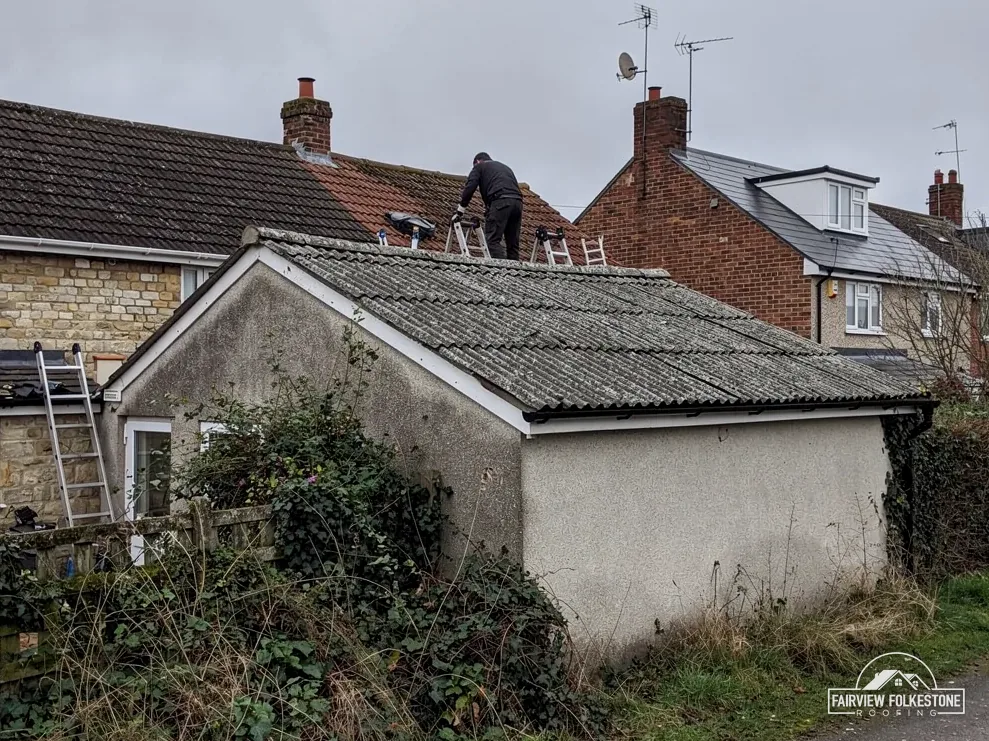
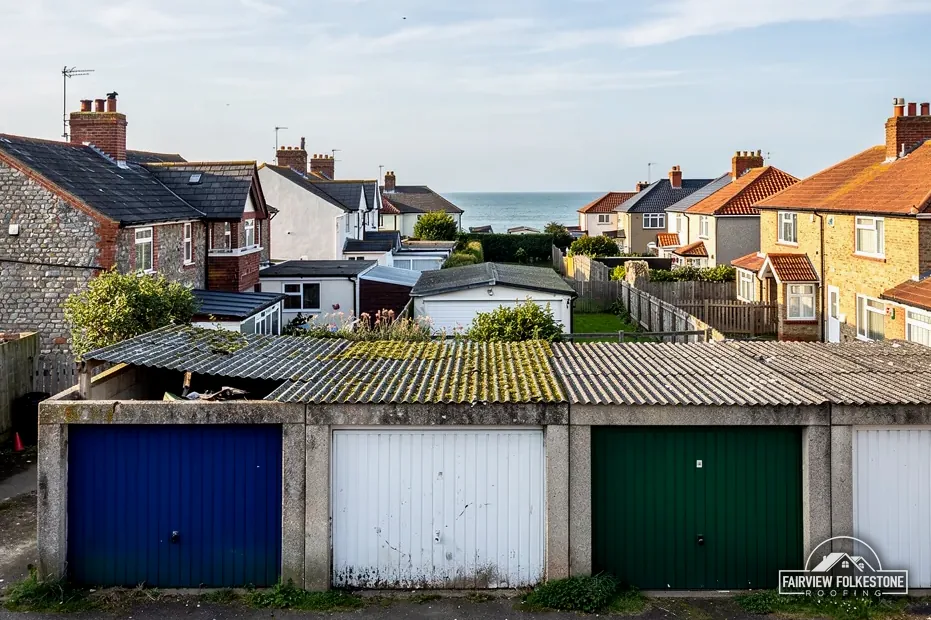
If the garage has a corrugated cement roof and the building was built or refurbished before 2000, HSE advises assuming asbestos is present. The decision then stops being about leaks and starts being about safety, and the options narrow.
HSE's guide A14 puts it bluntly: AC roofs are always fragile, so nobody should walk across them or lean a ladder on the sheets. Careful handling matters more than the choice of repair. When sheets are weathered but otherwise intact and come off whole, HSE treats the job as non-licensed work. Sheets that have been substantially damaged or broken up, for instance by fire or flood, fall under notifiable non-licensed work, which carries extra duties.
Never break sheets up to make them easier to carry. Breaking cement releases fibres, and it moves the job from non-licensed work into the notifiable category. We confirm what the roof is first, then lay out the three routes, and you choose with a written total price for the one you want.
That shapes the three routes open to an owner of a sheet roof:
- A repair means working on or beside fragile material, so it is not a quick patch, and it may not be the lower-cost route once the precautions are counted.
- An overlay, a new sheeted roof fixed above the old one, has its own conditions, set out on our page on overlaying an asbestos garage roof.
- Full removal means taking the sheets off whole and disposing of them through a lockable skip, never an open one.
06The detail
How we give you the verdict
We look before we price, and we explain before we recommend. For a garage roof that means tracing the leak, testing the deck, checking the fall, asking about the history, and identifying the covering. You then get a verdict in one of three forms: repair, replace, or check further where something cannot be judged from the survey alone, such as a loft space we cannot reach.
Does an older garage roof need a survey before any repair?
Yes, in the sense that we look at the whole roof before touching one part of it. A repair done blind can sit beside a failing area and be wasted within a season, so we check the boards, the edges and the fall before agreeing any scope of work.
If the verdict is repair, we tell you what the repair is, what it will not fix, and what we expect of the rest of the roof. If the verdict is replace, we tell you why a repair would not hold, and the written total price covers the whole job. Either way, the quote is one total price, set after the survey, and we leave the site clean.
The garage roof service page lists the problems we cover, and our garage roof replacement cost guide sets out what moves the price when the answer is a new roof. The verdict also covers what surrounds the roof: a sagging gutter, a rotted fascia board behind it, or a wall top that needs attention are listed, so you see the full picture before agreeing the scope.
If you can get safely to a window or hatch above the garage, photograph any stained joists or boards inside, dated, before anything is moved. It helps us see the history, and it helps you if an insurer ever needs to see the condition before the work.
Tell us what's wrong with the roof.
You'll get one written total price.