
Garage roof leaks
Why is my garage roof leaking?
A leak shows where the water ends up, not where it got in. Tracing it back, on a flat roof or a sheet roof, is the first job.
The short answer
A garage roof leaks where the covering, an edge or the drainage has failed, and the stain inside need not sit directly under the hole. A flat roof that holds standing water, a split seam, a poor edge or a blocked gutter are the places to look first. An old roof of cement sheets is a different case: HSE's A14 guidance lists AC roofs as always fragile, so do not climb onto one to look.
4 min read · Part of Garage roofs
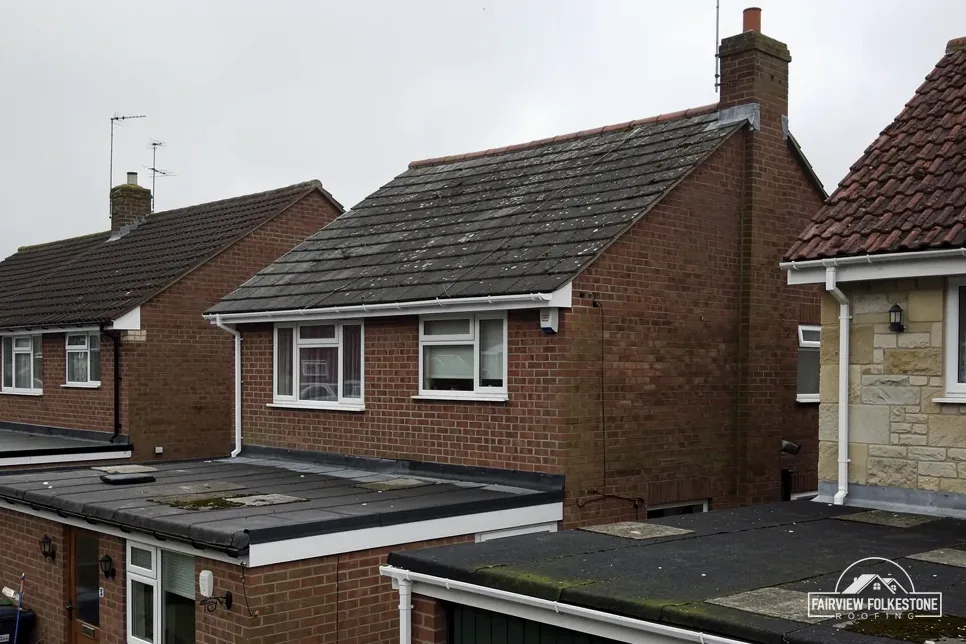
Reading the signs from inside
Start inside the garage, with a torch and the rafters or deck in view. Where the water shows tells you where to look outside, and a few photos taken in daylight help whoever visits later.
| What you see | Where to look |
|---|---|
| Stain at the wall edge | Edge trim, upstand or the join to the house |
| Wet patch mid-roof | Seam, split in the covering or a low spot |
| Drips below the gutter line | Outlet, gutter joint or an overflow |
| Droplets across the whole ceiling | Condensation, not a hole |
Water can run along a rafter before it drips, so the entry point may sit well away from the stain. Marking the position of each stain and the date it appeared gives the roofer something to check against, and it shows whether a leak grows after rain or stays the same. If you mean to make an insurance claim, the Financial Ombudsman Service says it will usually look at expert reports and photos of a property's condition, so take dated photos before anything is moved or dried out. Droplets across the whole underside point to moisture in the air of the garage, and BS 5250 sets out how moisture is managed in buildings.
Flat roofs: standing water and failing edges
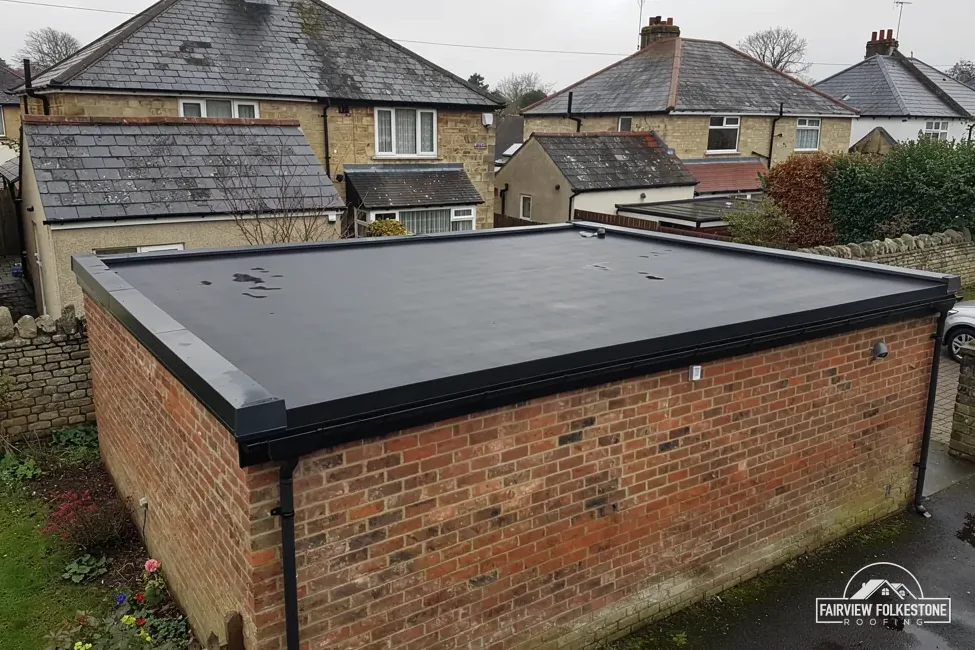
A flat roof is meant to drain. BS 6229:2025 sets a minimum 1:80 finished fall for general roof areas and internal gutters, according to NFRC, and IKO adds that a design fall of 1:40 is what gets a roof to 1:80 once it is built. A garage roof that holds a pool after rain has lost that fall somewhere.
Standing water works on weak points, and a pool that stays for days after rain is a sign to ask for a survey, not to wait for the next downpour. A membrane edge, an upstand, a seam or a drip trim that would stay dry on a sloping roof can fail under a pool. Felt ages on its own timetable too: HomeBuilding gives it 10 to 15 years and Less says torch-on felt lasts 10 to 20 years, depending on quality and installation.
Our page on EPDM garage roofs covers the rubber alternative and why falls matter to it, and the page on condensation or a roof leak helps with the last row of the table above.
Gutters, and sheets you must keep off
A garage gutter that sags or has lost its fall sends water to the wrong place. Brett Martin, a manufacturer, advises that guttering should fall towards the outlet at 1 mm for every 600 mm. Blocked outlets and slipped joints push water over the back of the gutter and into the wall or the roof edge, where it can look like a roof leak.
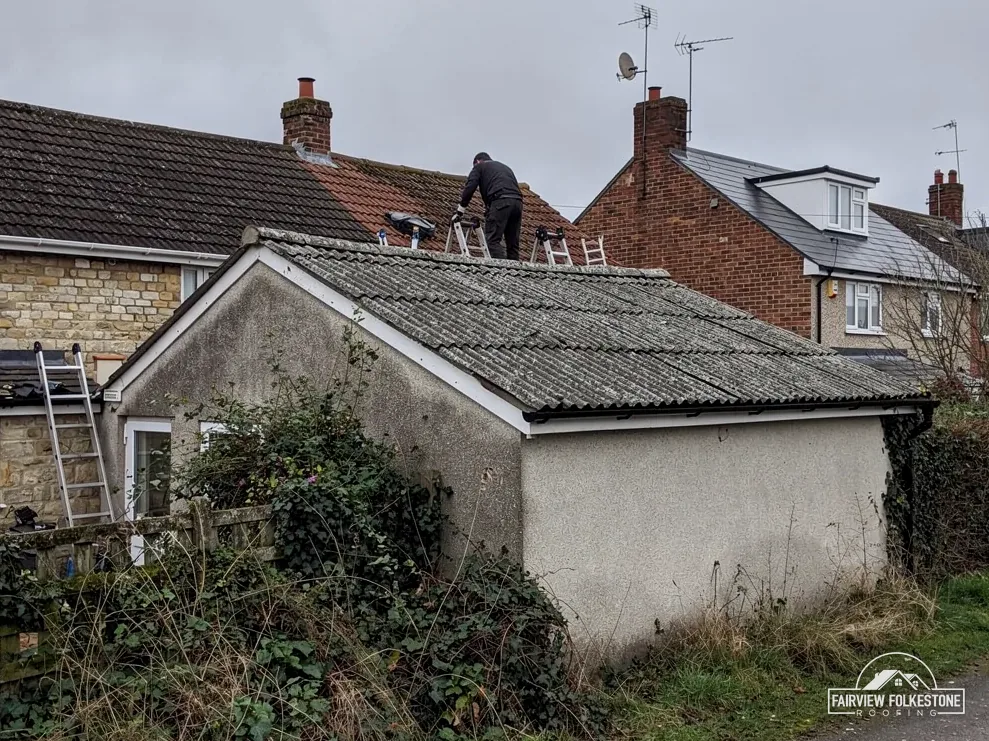
Pitched garage roofs of old corrugated sheets need more care. If the building was built or refurbished before 2000, HSE says to assume asbestos is present, and its A14 guidance (AC roofs are always fragile) is the reason nobody goes up there. Never stand on the sheets, never drill or scrub them, and never pressure wash them. Leave the sheets alone until someone has identified them, because a survey comes before any cover or repair.
If you suspect asbestos, our page on how to tell if a garage roof contains asbestos is the next step. Keep off the roof, and let a roofer deal with any temporary cover, whether the garage is flat-roofed or pitched.
Repair, or a new covering
A local fault on an otherwise sound roof calls for a repair, and the survey tells you whether the rest of the covering will carry on behind it. Checkatrade's repair rates are £120 to £170 per m² for EPDM and £130 to £180 per m² for GRP, based on areas up to 3 m² and excluding VAT, so they suit a patch and never a whole roof.
Where the covering is old, the published lifespans help to read it:
- felt: 10 to 15 years (HomeBuilding) or 10 to 20 (Less)
- EPDM: 25 to 30 years (HomeBuilding) or 30 to 50 (Less)
- GRP: 25 to 30 years (HomeBuilding) or 25 to 40 (Less)
These are typical figures, not promises. A repair on a covering near the end of its published range may not hold, and the survey says whether it will. We tell you which it is and why, with photos of what we found, so you can see the fault for yourself and not just take our word for it. Our repair or replace guide walks through the verdict, and the garage roofs page has the full service.
More questions
Is it condensation or a leak inside my garage?
Droplets across the whole underside of the roof, with nothing running from one spot, point to condensation. A wet patch that grows after rain points to a leak. Our page on telling condensation from a roof leak has the checks, and a survey settles the cases that overlap.
Can I cover a leaking garage roof with sealant myself?
A small tube repair on a sound flat covering is within reach from a ladder at the edge. Do not go onto the roof, and never work on cement sheets, which HSE's A14 guidance calls always fragile. Sealant over a failed seam or a ponding area hides the symptom and leaves the cause.
Tell us what's wrong with the roof.
You'll get one written total price.