
Living in Folkestone
Is Folkestone a good area to live? A roofer's view of the town's houses
Schools, prices and the high street are for others to judge. A roofer can say what the town's houses ask of whoever owns them: coastal exposure, protected streets and a few rules worth knowing.
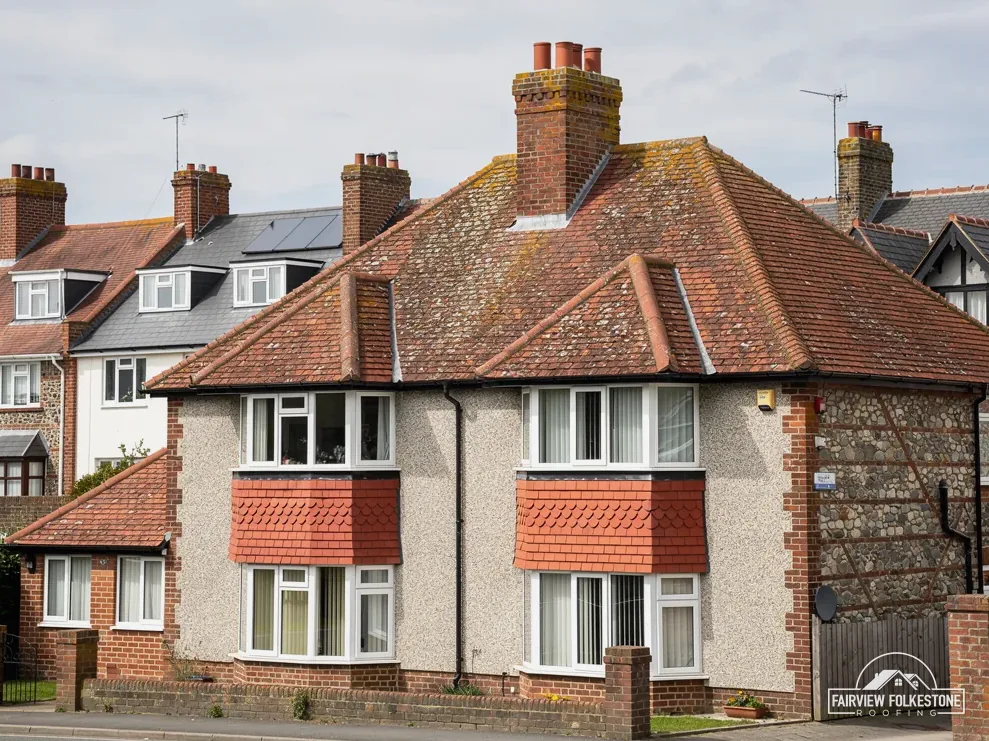
A question about whether Folkestone is a good place to live wants a verdict. We are roofers, so we are not the right people to give one. We have no figures to offer on schools, crime or house prices, and we will not invent any. What we can describe is the part of living here that sits above your head: what the houses in and around the town ask of an owner, and what a buyer should look at before signing.
The answer depends on which part of the area you mean. Folkestone, Sandgate, Hythe and the villages on the Marsh share one district council but sit in quite different settings. Some are on the shoreline, some a mile or more inland, and some within sight of the Kent Downs. A roof that suits one setting may need different thought in another.
This post sets out the facts that apply to a roof in this area, and what each means for someone deciding where to buy or whether to stay. It names no housing era, no typical roof material and no estate, because none of that has been counted, and a survey of the actual roof tells you far more than a general claim about the street.
01Side by side
What the town looks like in numbers
The Office for National Statistics counts people by civil parish, and the 2021 Census gives a sense of scale for the places a Folkestone roofer works in. The parish figures describe the whole parish, not only the part you might be thinking of buying in.
One thing in those numbers matters for a roof. Folkestone & Hythe District Council covers every place in the table, so the planning and building control questions in the sections below go to the same council whichever you choose. Its building control team is on 01303 853538.
Distance from the middle of town varies a good deal. Morehall and Foord sit under a mile away by road, Cheriton just under two miles, Hythe a little under five and Dymchurch about thirteen. Lympne lies within the Kent Downs National Landscape, the designation formerly known as an AONB, or Area of Outstanding Natural Beauty. That spread is why a one-line verdict on the whole area would mean little, and why a buyer is better served by asking about one street at a time.
Low ground adds a further check. Hythe's centre and Dymchurch's centre both fall in Flood Zone 3 on the Environment Agency's mapping. A roofer cannot change a flood map, but a buyer in either place should read it alongside the survey, and ask the seller what the property's history has been.
| Parish | Residents | Covers |
|---|---|---|
| Folkestone | 47,356 | Morehall, Foord, Cheriton |
| Hythe | 14,980 | Hythe, Seabrook, West Hythe |
| Sandgate | 4,928 | Sandgate village |
| Dymchurch | 3,536 | Dymchurch |
| Lympne | 1,483 | Lympne village |
02Exposure
Near the sea: what exposure asks of a roof
Four of the places above lie within about 0.25 mile of the shoreline: Sandgate, Seabrook, Hythe and Dymchurch. Morehall and Cheriton sit a little over a mile back, so a sea-facing roof is not the only kind in the area. Where a house stands relative to the water is the one coastal fact we can state, and it carries a clear consequence for the roof.
Cupa says buildings on coastal sites, hillsides and slopes, and tall buildings, will be graded with higher exposure. BS 5534 gives roofers a method for calculating the fixings, so a roof on a coastal street should have its fixings worked out for that address rather than copied from a job in another road.
Buying a house here: roof questions
Is it a problem to buy a house with an older roof near the coast?
Not by itself. An older roof needs a proper look, and on a coastal street the fixings should be worked out for the site under BS 5534. A survey tells you whether the covering, ridge and lead are sound or need repair first, and that evidence gives you something to weigh against the asking price.
Marley notes that following BS 5534 "isn't required by law". It adds that bedding in mortar alone has not been relied upon to fix a covering since the 2015 amendments. For a buyer, that makes the ridge worth a look: a line of tiles bedded only in old mortar suggests dated fixing.
Writing about the Great Storm of 1987, the Met Office mentions a ferry driven ashore near Folkestone, and gives Force 11 (56-63 knots) for many coastal districts of the south-east. We use it as a reminder of what the Channel can do, not as a forecast for any one house. Be wary of anyone who quotes a precise wind rating for a Folkestone street without showing where it comes from.
03Listed homes
Protected streets, listed homes and what they change
Morehall and Foord have the Folkestone conservation area close by, and others lie around Sandgate, Hythe and Lympne. Folkestone & Hythe District Council offers an online map, so you can look up an address, and its page states that inside a designated area new building has to be appropriately designed in traditional natural materials.
For an owner, the practical effects come in a short list.
- Re-covering a house roof is normally permitted development, even in a conservation area.
- A dormer needs planning permission in a conservation area and inside the Kent Downs National Landscape.
- An Article 4 direction can remove further rights, and which streets carry one is a question for the council.
- Permitted development rights remain with a listed house, though work that would change its character also needs listed building consent.
None of that stops anyone buying. It means a buyer should ask, before exchanging contracts, whether the house is listed and whether the street is protected, and should weigh any plan for a dormer or roof window with that in mind. Our guide to planning permission for roof work sets out the questions to put to the council.
A seller who says the roof has "always been fine" has told you nothing a survey cannot test, so check for yourself. If the roof was re-covered in the past, ask for the paperwork: whether building control was involved, and who did the work.
04Buying
Buying here: what to check on the roof
A homebuyer's survey will comment on the roof from the ground, but it cannot see everything. A separate look from a roofer or a loft inspection fills the gap. MyJobQuote gives an average of around £300 for a roof survey, and our post on roof inspections before buying a house in Folkestone covers the options.
Do flats in Folkestone have the same roof rights as houses?
No. Permitted development rights belong to dwellinghouses, and the legal definition leaves out flats and buildings of flats, so changes a house owner might make under those rights need planning permission for a flat. A block's roof is also usually shared under the lease, so read that first.
- Look along the ridge and the hips for gaps, dips or loose tiles.
- Check the flashings at any chimney or wall for lifting or splits.
- Look at the gutters and downpipes for stains on the wall beneath.
- In the loft, a torch shows damp marks, stained timber and light coming through the covering.
- Ask whether anyone has sprayed insulation onto the roof's underside.
That last question matters. In March 2023 RICS reported concern within specific sectors of the lending market, including equity release mortgages; its consumer guide says to check with your mortgage provider about lender policy on such products. The Energy Saving Trust says mortgage trouble should be rarer where foam went in correctly.
A newer home may carry the NHBC Buildmark cover: a builder warranty and guarantee for two years after completion, then eight years of insurance cover against defects to certain parts of the home. Ask the seller which cover applies and for the paperwork.
A roof that fails a check is not necessarily a reason to walk away. It is a reason to negotiate the price with the facts to hand, and to ask for a written quote for the repair before you exchange.
06Costs
What keeping a roof in order costs over the years
Whichever house you choose, the roof will need attention eventually. These figures are only a guide to scale, and none of them is a price for your roof: a survey gives the price, as one written total, once someone has looked.
Should I ask about spray foam in the loft before buying?
Yes. Foam over the timber roof structure hides it from inspection, according to RICS, so the timbers cannot be checked. Ask the seller what was fitted and when, get the answer in writing, and ask a surveyor to say what could not be seen before you commit to the purchase.
| Work | Figure | Source |
|---|---|---|
| One to six broken tiles replaced | £75 to £400 ex VAT | Which?, November 2025 |
| Gutters cleared, front and back | £75 to £350 ex VAT | Which?, November 2025 |
| An average roof repair | Around £650 in 2026 | MyJobQuote |
| Whole roof, three-bedroom house | £7,000 to £21,000 ex VAT | Which?, November 2025 |
Which? expects the South East, Kent and East Sussex included, to land near the upper end of its range. Each quote should show whether the total takes in VAT and the scaffold.
On lifespans, HomeBuilding gives approximate figures: 100+ years for Welsh slate, 60 to 80 years for clay tiles and 40 to 50 years for plain concrete tiles. Marley's own estimate is around 60 years for roof tiles, with the caveat that it is neither a guarantee nor a warranty. The sources differ, so treat each as a typical figure, not a promise, and let the survey say where your own roof stands. A roof near the end of a typical life is not a fault in the house; it is a cost to plan for, and the written quote tells you how big.
The answer on how long a roof lasts goes into more detail. If you are still weighing up the move, our roofing page covers the work we do across the area.
More from the blog
All guides and posts
Tell us what's wrong with the roof.
You'll get one written total price.