
Roof replacement signs
When does a roof need replacing? The signs a repair will not fix
A roof needs replacing when the fault runs through the whole covering or the timbers under it, not one spot. These are the signs that separate the two, and what to check next.
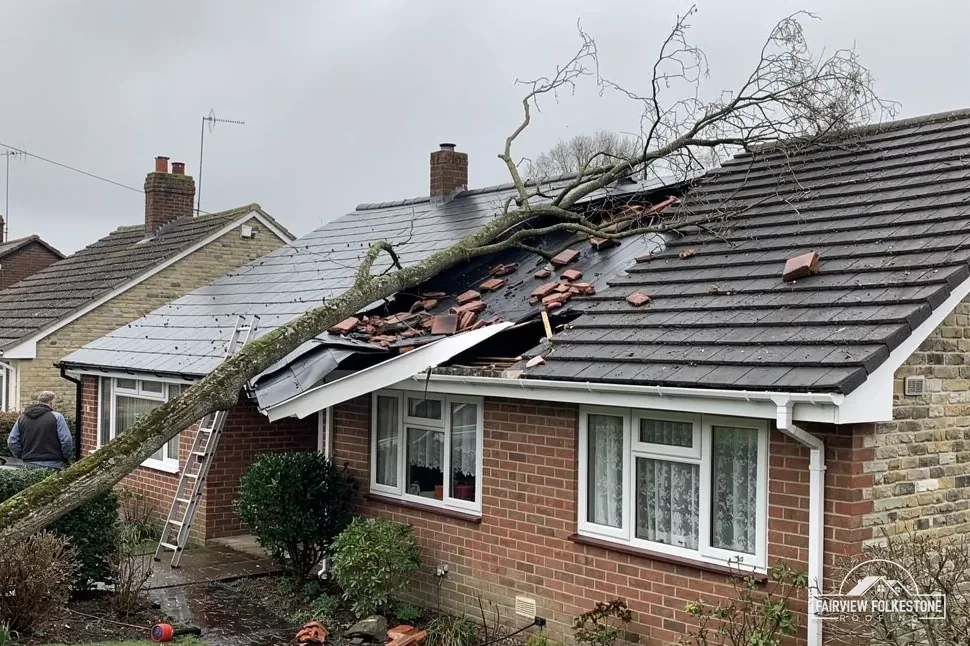
A roof that leaks once is a repair job. A roof that fails in several places, or that has lost the timbers holding it up, is a different problem, and patching it only buys a short wait before the next leak. So when does a roof need replacing? When the damage is spread across the covering, or when the layers underneath have gone.
You can see most of the evidence without a ladder. A torch in the loft after a wet spell, binoculars from the pavement and a look at the gutters tell you a good deal. Below you will find what to look for, which findings point to a repair and which to a new roof, what the rules say about a re-roof and what published cost guides put on the work.
Nobody should be sold a bigger job than the roof needs. Where a repair is sound we tell you, and where it is not we explain why, with the findings in front of you. The quote is a single figure on paper, produced after the roof has been surveyed.
01Replacement
Signs in the loft that point to replacement
The loft is where a roof gives itself away. Go up with a torch a little after rain has stopped, and step only on the joists. What you find sorts into faults a repair can reach and faults that mean the layers themselves have failed.
- Damp staining or dark water marks across a wide area of the rafters, not one patch beneath one tile.
- Battens (the thin timber strips the tiles hang from) that feel soft, crumble at the edge or split when a screwdriver is pressed in. Tiles cannot be fixed to decayed timber.
- Underlay (the sheet laid over the rafters, under the battens) that has torn, perished or slumped between the rafters, or is missing in places.
- Daylight showing through the covering in several spots at once.
- Rusted or snapped nail heads lying on the insulation or the ceiling below.
- A rafter or purlin (the horizontal timber that carries the rafters) that has bowed, or a ridge that has dropped along its length.
Any one of these may still be repairable. Several together, spread across a slope, are the pattern that points to replacement.
Condensation is a separate case. Damp timber with no leak above it can be a ventilation fault, and Marley's cold roof advice, for a high-resistance underlay, is a 25 mm opening along the eaves at pitches of 15° or less and 10 mm above 15°. A bowed rafter or a dipping ridge needs a structural look before anyone prices a covering, because a new roof on a weak frame fails the same way.
02Repairs
Signs on the slopes that a repair will not fix
From the pavement or a bedroom window, the slopes show what the loft cannot. Look along each one in good light and compare it with the others.
Replacing a roof: your questions
Can a roof be replaced one slope at a time?
Yes, where the other slopes are sound. Replacing one slope is still re-roofing, so the Planning Portal test of under 25 per cent of the building envelope and under 50 per cent of the roof applies. Ask for the quote to state which slopes and which layers are included, so nothing is assumed.
| What you see | What it points to |
|---|---|
| A few tiles slipped or cracked in one area | A repair, if the battens under them are sound |
| Slipped slates scattered across a whole slope | Fixings failing: re-slate the slope or the roof |
| Tiles flaking or breaking up across a face | A covering that has worn out |
| A dip along a slope, or a sagging ridge line | Timbers to be checked before anything else |
| Flat roof splitting, blistering or holding standing water | A local repair, or a new covering on a sound deck |
No set number of slipped tiles turns a repair into a replacement. Where they are, why they moved and what lies under them decide it, which is why a survey looks at the battens and underlay as well as the visible damage. Slipped slates are a good example: one slate that has dropped because its fixing rusted is a repair, but slates dropping all over a slope point to fixings that are failing everywhere.
On a flat roof, a membrane (the waterproof skin) that has split along its seams in several places is a different job from one puncture. A deck that feels soft underfoot has gone further, and the boards beneath the covering then belong in the quote.
03Side by side
Age is a clue, but condition decides
Published lifespans give a rough frame. They are approximate, and the makers and guides do not always agree, so the table names each where they differ.
A roof inside those ranges can still need replacing early if its timbers have rotted or its fixings have failed, and one beyond them can carry on if it is sound. The figures are a reason to book a survey, not a replacement for one.
When you ring about an older roof, give its age if you know it and say what you have seen: where the stains are, whether tiles have dropped into the garden and when the last repair was done. Photographs taken from a window or the loft hatch help too. That saves a wasted visit and lets the surveyor arrive with the right questions, and it gives the survey something to compare against when the covering is lifted.
| Covering | What is published |
|---|---|
| Plain concrete tiles | HomeBuilding: 40 to 50 years. Marley: around 60 years is what tiles are expected to reach, with no guarantee attached |
| Welsh slate | HomeBuilding: 100+ years |
| Clay tiles | HomeBuilding: 60 to 80 years. Marley: a BRE minimum life expectancy of 60 years |
| Torch-on felt | HomeBuilding: 10 to 15 years. Less: 10 to 20 years, varying with the quality of the felt and the fitting |
| EPDM rubber | HomeBuilding: 25 to 30 years. Less: typically 30 to 50 years |
04Key points
Faults that look worse than they are
Some things alarm people more than they should. A repair is the right call if the damage stays in one place and the layers beneath are sound.
On price, Which? Trusted Traders gave £75 to £400 for fitting new tiles in place of one to six broken or missing ones, excluding VAT (November 2025). Separately, MyJobQuote gives around £650 as the average roof repair in 2026. Both are third-party figures, not ours.
Repair first is the rule wherever a repair is sound. If the same roof has needed work in several places, or a repair would sit on rotten battens, we tell you plainly instead of patching it again. A patch on rotten timber holds only until the next gust loosens it, and the scaffold or ladder access has to be paid for a second time. The post on repairing or replacing a roof explains how that call is reached.
- A handful of tiles slipped or lost after a gale, with sound battens under them.
- Ridge tiles loose on tired mortar. They can be re-bedded or refixed, and Marley says the 2015 amendments to BS 5534 made it clear that mortar "could no longer be relied upon as the only means of securing the roof covering".
- Lead flashing lifted at a chimney or wall joint. MyJobQuote says correctly installed lead flashing can last for over 80 years, so refixing a lifted section comes before any bigger conclusion.
- Overflowing or dropped gutters wetting the eaves, where the cure is at the gutter.
- One split or puncture in a flat roof membrane over a firm deck.
Should I wait for a leak before replacing an old roof?
A leak is a late sign, because battens and underlay can fail well before water reaches a ceiling. If the loft already shows widespread staining, soft battens or daylight in several places, get a survey now. Repairs on a failing roof can come back, and each one needs access again.
05Re-roofing
What the rules say about a re-roof
A re-roof is building work, so the rules apply even when the new covering matches the old. The Planning Portal says a re-roof does not normally need an application with under 25 per cent of the building envelope affected and under 50 per cent of the roof. Approval is still required if the new covering adds 15 per cent or more to the weight, or would behave very differently in a fire.
Approved Document A says "A significant change in roof loading is when the loading upon the roof is increased by more than 15%." That brings a structural check. Councils word their own rules differently. Dover District Council's building control page lists "replacement of roof coverings on pitched and flat roofs even if this is just like for like" as work needing approval, and that applies to Dover addresses. Folkestone & Hythe District Council also flags the re-covering of a roof as something that may need approval, and points people to the Planning Portal. We confirm the route with the right council before work begins.
Insulation follows the renovation. Where the work covers more than 50% of the roof surface, AD L 2021 wants the whole roof brought to 0.16 W/m²K (Table 4.3, column b), with 0.35 as the threshold figure for a retained roof. Paragraph 4.13 eases the target where reaching it is impractical, or where the saving would take longer than 15 years to repay.
Planning permission is a separate question. Class C of the permitted development rules covers "any other alteration to the roof of a dwellinghouse", which takes in re-roofing a house. On a listed home, listed building consent is a further step for anything touching its special character, and an Article 4 direction may take rights away, so both go to the council first. The building regulations answer walks through the steps.
06Costs
What a new roof costs and what to check first
Published figures depend on the house, the covering and the date. In a November 2025 Which? survey of 11 Trusted Traders, taking the whole roof off and renewing it on an average three-bedroom house came to £7,000 to £21,000, excluding VAT. Which? adds that prices "are likely to be at the upper end of the scale if you live in London or the South East". HomeBuilding's worked example, a three-bedroom semi with a 65 m² roof covered in plain concrete tiles, may cost between £10,000 and £15,000 with labour, scaffold and insulation counted, while Welsh slate on the same house might reach £18,000. MyJobQuote's average new roof is around £5,250 in the UK. The sources count different houses and different inclusions.
What moves your own price: the area and pitch, the covering, how much timber needs renewing, access for scaffold and whatever the survey finds under the old covering. The quote is one total price, and check that it spells out if VAT and scaffold are counted in the total. The new roof cost guide goes further.
Our roof replacement page follows a job from the first survey to the final tidy.
- Where scaffold stands over the road or pavement, a highway licence comes first. Kent County Council charges £52 per week for 2026 to 2027 and says "the skip or scaffolding company should submit the application for you". East Sussex Highways shows £127 for 28 days. We arrange the licence with our scaffolder.
- HSE says "If the building was built or refurbished before 2000, assume that there is asbestos in it."
- Taking out a shared chimney breast means a party wall notice from the owner, served at least two months ahead.
- If you sign at home once the survey is done, you get 14 days in which to cancel.
Does a new roof mean the loft insulation changes too?
It can. Where more than 50% of the roof surface is renovated, AD L 2021 expects the whole roof to reach 0.16 W/m²K, against a threshold of 0.35, unless that proves impractical or the saving takes longer than 15 years to repay. We look at what is already in the loft and explain the position before quoting.
More on roof replacement
All guides and posts

Tell us what's wrong with the roof.
You'll get one written total price.