
New roof choices
A new roof and your home: what changes in looks and in use
A new roof changes how the house looks and how it behaves in the weather. These are the choices that are yours, the ones the street decides, and the things that stay the same.
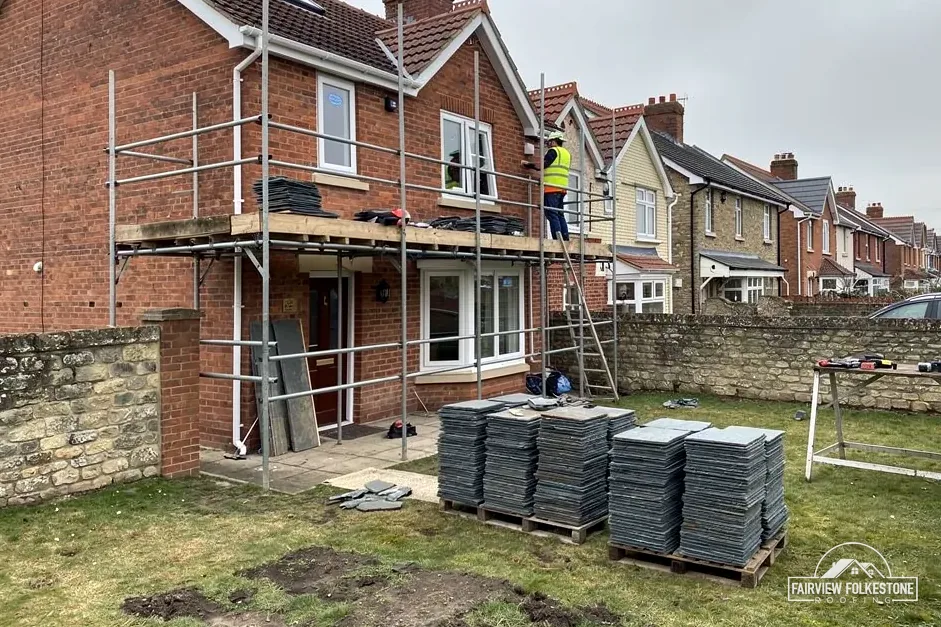
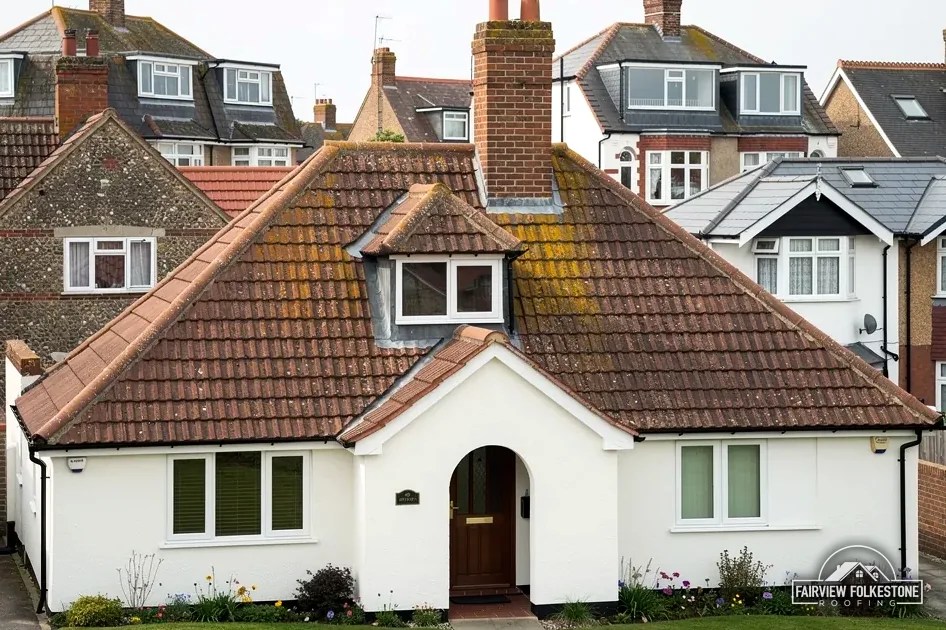
Roof work is the one job on a house whose result the whole street can see. Colour, profile and the small details at the ridge, the verge and the eaves decide how the house sits among its neighbours, while the layers beneath decide how it behaves in rain, wind and winter.
A new roof therefore changes two things together: how the house looks and how it works. This post takes them in turn. It starts with colour, profile and detail, then moves to the street and the rules that govern it, then to the warmth, ventilation and drainage that a re-roof can alter. It also says plainly what a new roof does not change.
Nothing here promises a rise in the value of your home. What you get instead is the list of choices that are yours, the ones that belong to the council or a neighbour, and the questions to put to anyone who quotes. The aesthetic side of a new roof is worth getting right, and it is easier to do while the scaffold is still up.
01Key points
Colour and texture: your choices and the street's
Most of the look of a new roof is set by choices made before a tile is ordered. Some are yours alone; others are tied to the house next door or to a council.
- The colour and finish of tiles, within the range a maker publishes.
- The type of natural slate, its size and its laying pattern.
- The colour of ridge and hip pieces, which can match the main field or contrast with it.
- The colour of fascias, soffits and gutters, which frame the roof from the pavement.
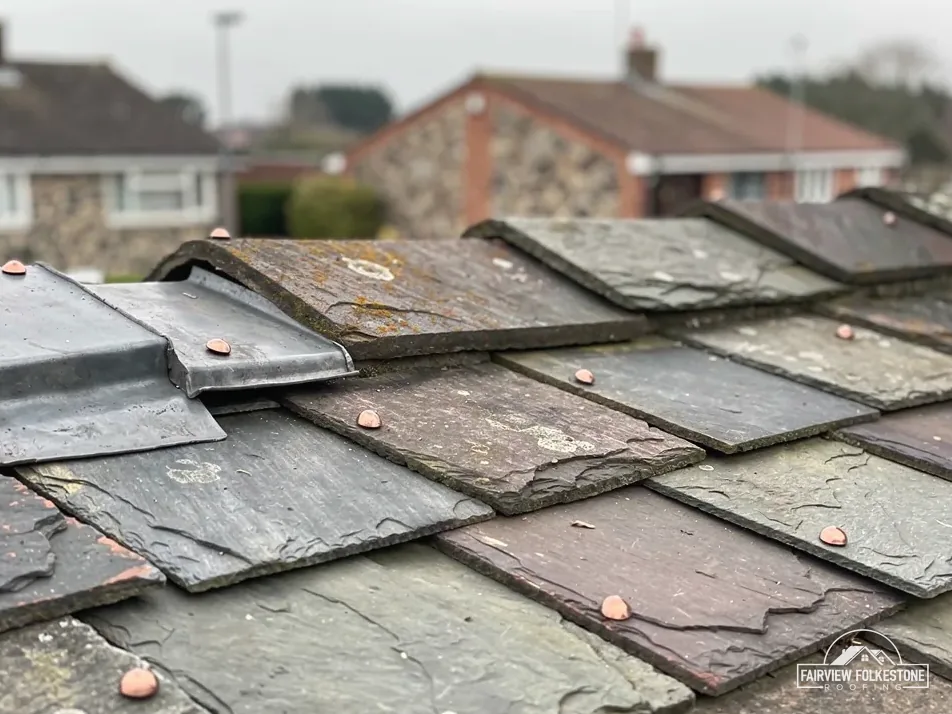
- Whether valleys and abutments are lead, which weathers to a grey, or tile and mortar.
A small sample on a table tells you little. A tile that looks warm and even in a showroom can read darker, flatter or more varied once it covers a whole slope, and wet weather changes it again. Ask to see samples laid out in daylight, and if you can, look at a finished roof in the same material on a nearby house, because a real slope shows what a brochure cannot.
The street also has a say. In a conservation area the council can say what applies to materials. At Dover district addresses its list of work needing permission in conservation areas includes roof dormers, and its Article 4 directions can reach a home's road-facing, waterside and open-space elevations. Wherever you live, a quick word with the council before choosing costs nothing and can save a redesign.
02Tiles · Slate
Profile: small plain tiles, bold interlocking tiles and slate
Profile is the shape of the covering, and it changes how light falls across the roof. Small plain tiles lap in many narrow courses and give a fine, close texture. Larger interlocking tiles lay out in broad bands with deep shadow lines. Pantiles make a wave. Slate sits flat and sharp, in a regular pattern. Each profile also carries its own minimum pitch, which limits where it can go.
| Profile | Look | Minimum pitch |
|---|---|---|
| Marley plain concrete tile | Fine courses | 35 degrees |
| Marley Double Roman | Broad bands | 22.5 degrees |
| Marley Edgemere | Flat, low profile | 17.5 degrees |
| Marley Lincoln pantile | Clay wave | 15 degrees |
Natural slate is a separate case: Cupa reports 20 degrees as the minimum under BS 5534 for a 500 mm slate in moderate exposure, with a 115 mm overlap. Ask for the maker's sheet for the exact product, and for the exposure grade of the site.
Colour and profile work together. A dark, deeply ridged tile throws more shadow than a pale, flat one and can make a roof look heavier, and a steep slope shows far more of its covering than a shallow one does. Judge a choice against the pitch you actually have.
These limits matter most where roofs meet. A pitched main roof and a low extension roof often cannot share one covering, so the join between them is where the eye notices a mismatch. Planning the two together, and choosing a covering for each that sits well with the other, gives a more settled result than treating them as separate jobs.
A new roof and your home: questions
Can I choose a different colour of tile from the old roof?
In most cases the covering is your choice, because Class C does not require new materials to match the old. A listed building, a conservation area or an Article 4 direction can change that, so check with the council first. Where the roof joins a neighbour's, think about how the two will look side by side.
03In brief
Details that change how a roof reads
The small parts do much of the work of making a roof look finished or not. Each can be chosen as part of the job instead of left to default.
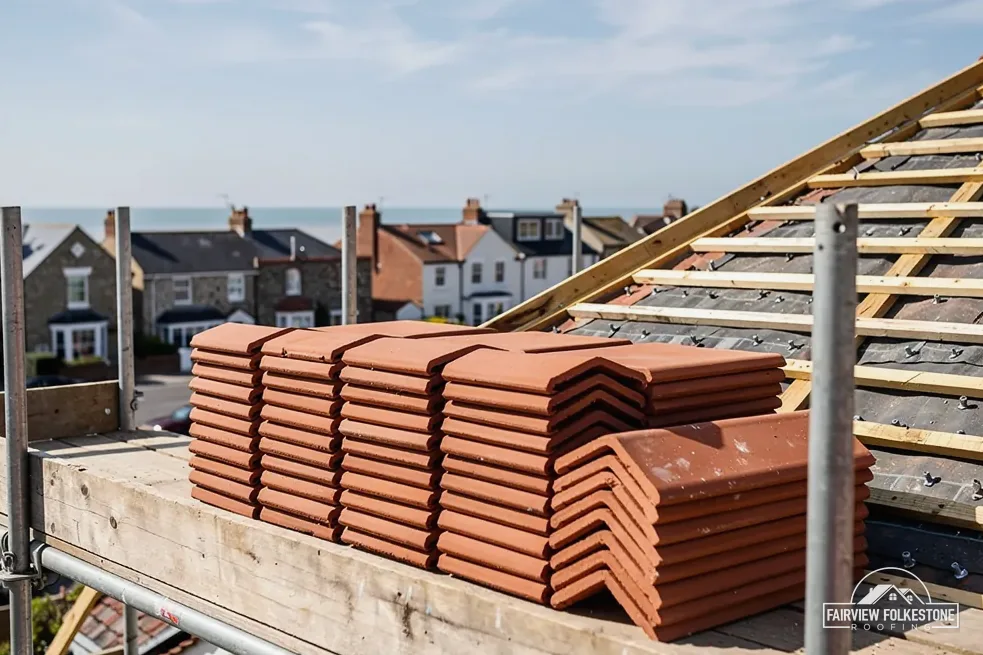
- Ridge and hip: mortar-bedded and dry-fixed pieces look slightly different close up. BS 8612 covers the dry-fixed type, and because mortar can no longer be the sole means of holding the covering on, a dry-fixed system is worth pricing beside the mortar one.
- Verge: a dry verge gives a clean line at the gable, with no mortar fillet to crack or stain.
- Eaves: fascia, soffit and gutter frame the roof. A plastics retailer says uPVC boards, installed correctly, can typically hold reliable performance for 20 to 40 years, and Brett Martin advises a fall of 1 mm for every 600 mm towards the outlet, so the line you see also has to drain.
- Valleys and abutments: Royston's brochure suits Code 4 to soakers, flashings, pitched valleys and dormers, and Code 5 to flashings, valleys, parapets and dormers; the specification fixes which code goes where.
- Roof windows: their size, position and number change the roofscape. Under AD L 2021 Table 4.2 a roof window has to reach a U-value of 1.4 W/m²K or sit in WER Band B, and only rooflights get the 2.2 figure.
A side-slope roof window has a further rule: it must be obscure-glazed and, unless the opening part is more than 1.7 metres above the floor, fixed shut. That affects how the window looks from the neighbour's side as well as from inside.
04Neighbours
Matching the street, the neighbours and the rules
Class C, the permitted development class for roof alterations, carries no condition that new materials must match the old. So for a house the new covering is a design choice, unless a listing, a conservation area or an Article 4 direction says otherwise. Matching is still worth thinking about, especially where the roof is shared.
On a shared roof, the building owner serves the party wall notice. Where a chimney breast on the shared wall is to be cut away, the notice goes to the neighbour two months or more ahead of the start, and written consent from the neighbour can bring the start forward. Speak to a neighbour before the scaffold goes up: a shared roof is easier to re-cover well when both owners know what is planned. Flats and maisonettes have no permitted development rights at all, so the usual freedoms do not apply to them.
Our answer on re-roofing a listed building covers the consent route in more detail. In every case the first step is the same: find out which row of the table you are in before you fall for a colour.
| Situation | What to check | Who decides |
|---|---|---|
| Semi or terrace | The join with the neighbour's roof; notice for work to a shared chimney breast | You, with the neighbour |
| Conservation area | Materials, dormers, any Article 4 direction | The district council |
| Listed home | Anything that affects its character | The council, by listed building consent |
| Flat | No permitted development rights | The council, for planning permission |
Will a new roof make my house warmer?
It can, if the insulation is improved at the same time. Where a roof is renovated, AD L expects the improved U-value where that is workable and repays itself within 15 years. The covering alone does not insulate the house, so ask what insulation and ventilation the quote includes.
05The short list
What changes in use: warmth, air and water
A re-roof is the natural moment to improve how a roof behaves, because the covering is already off. Three things change most.
- Warmth: under AD L 2021 Table 4.3 a retained roof is judged against a 0.35 threshold, and a renovated one should reach the improved 0.16 where more than 50% of its surface is renovated or the work is a major renovation. If that value cannot be reached in practice, or would take longer than 15 years to repay, the roof is taken to the lowest value that can.
- Air: Marley's cold roof guidance for high-resistance underlay asks for a 25 mm eaves gap at pitches of 15 degrees or less, and 10 mm above 15 degrees. That underlay lets no vapour pass, so the gap does the drying and is not a matter of choice.
- Water: new gutters, new falls and new flashings change where rain goes. Re-covering a flat roof by replacing its waterproof layer is renovation in AD L's terms, so insulation belongs in that discussion too.
Space changes too. A loft that becomes a room adds roof windows, and AD B says an escape window must have a minimum area of 0.33 m² and serve a storey up to 4.5 m above the ground; above that height the rules ask for a protected stairway or an alternative escape route.
Each of these treats the roof as a working part of the home, not just a finish. Our answer on insulation when re-roofing explains the warmth side in more depth.
06
What a new roof does not change
A new roof makes the house watertight again and gives it a fresh look. It does not rewrite the rest of the house, and it is better to know the limits.
It also costs what it costs. Which? Trusted Traders give £7,000 to £21,000, excluding VAT, for an average three-bedroom house (November 2025), and HomeBuilding adds that labour rates run higher around London and in the South East. The choices in this post move that figure by amounts that only a survey can pin down, so treat every number as a range and get one written total price for your own roof.
Repair comes first where a repair is sound, and if the roof needs replacing we tell you. If it does, our new roof cost guide and the roof replacement page are the two to read before you ask for quotes.
- It does not come with a promised rise in value.
- It does not change what lies beneath the covering. Sound rafters and a well-kept loft stay as they were, while any rotten timber found once the old covering is off is a separate job, and a survey cannot always see it beforehand.
- It does not fix a damp problem that starts elsewhere, such as a leaking gutter joint, a faulty window seal or rising damp.
- It does not make an old chimney stack sound. Stacks, flashings and the lead around them are checked and dealt with as part of the job.
- It does not remove the need for approvals. A new covering that is 15 per cent or more heavier needs Building Regulations approval, whatever it looks like.
Do dry ridge and dry verge systems look different?
Slightly, close up. A dry verge gives a tidy gable edge with no mortar to crack, and dry-fixed ridge pieces sit with a clean line. Both are fixed mechanically, and since mortar can no longer stand as the only fixing, they are worth pricing next to the mortar alternative.
More on roof replacement
All guides and posts

Tell us what's wrong with the roof.
You'll get one written total price.