
New roof cost guide
How much does a new roof cost in the UK, and what moves the price?
The prices quoted for a new roof differ by thousands of pounds because the jobs behind them differ. Here is what each figure counts, and what moves the total on your own house.
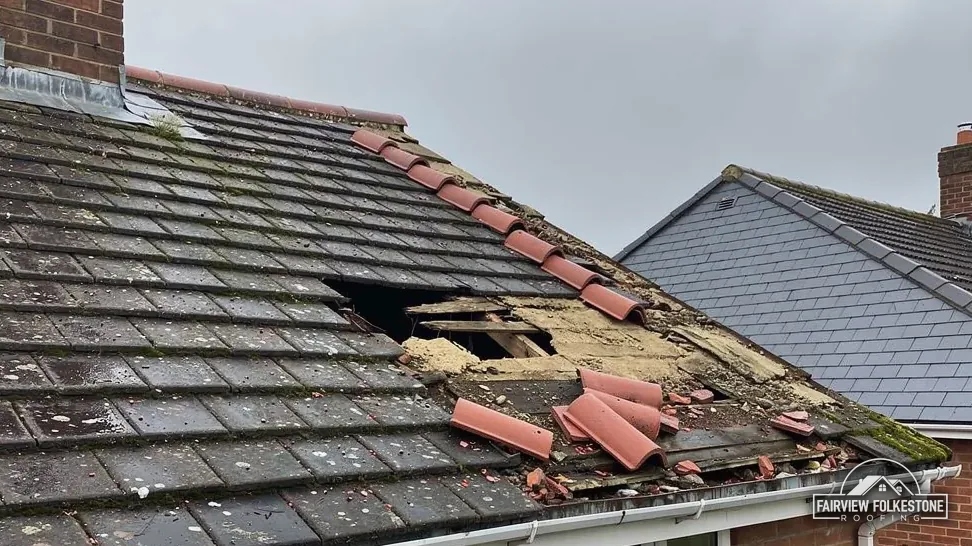
The question sounds simple and the published answers are not. One cost guide puts the average new roof at a little over five thousand pounds. Another prices a full re-roof of an average three-bedroom house at anything from seven thousand to twenty-one thousand. A third puts a plain concrete tile roof on a three-bedroom semi at ten to fifteen thousand. None of them is wrong. Each is describing a different house, a different covering and a different set of items counted in the sum.
This guide lays the three figures side by side with their sources and dates, explains what each is counting, then goes through what moves the price on a real roof: the covering, the access and scaffold, and the rules that can add work. It ends with how to read the quote you are given.
Everything quoted here comes from third parties and is dated. We do not publish a price of our own. Your quote from us arrives as a single written total after a survey, because no sound figure can be given from the pavement.
01Quotes
Three published figures, none of them a quote
The table gives each figure as published, with its source and date. All three are national and describe typical jobs, so none is a price for your roof.
Which? built its range from a survey of 11 of its Trusted Traders. It adds that a South East job is likely to land at the upper end, which takes in Kent and East Sussex. HomeBuilding says labour costs more in London and the South East.
MyJobQuote states no VAT basis for its figure, so do not assume one. The Which? page is open to read at its Trusted Traders roofer cost guide, where the range for other jobs sits beside this one.
Read the table as three snapshots rather than three rival answers. Which? is the only one of the three to say its figure leaves VAT out, so it is the only one you can safely add VAT to for a like-for-like picture. HomeBuilding's figure is the only one that names scaffolding and insulation as included.
None of the three is local to Folkestone, Hythe or Rye, and none allows for the age of the house or the condition of the timber under the covering.
| Source and date | Figure | What it describes |
|---|---|---|
| Which? Trusted Traders, November 2025 | £7,000 to £21,000, excluding VAT | Replacing the entire roof on an average three-bedroom house |
| HomeBuilding, updated 30 September 2025 | £10,000 to £15,000 | A typical three-bed semi with 65 m² of roof in plain concrete tiles, counting labour, scaffolding and insulation |
| MyJobQuote, 3 November 2026 | Around £5,250 | The average new roof in the UK |
02Key points
Why the figures differ
Put the three side by side and the gap looks like a mistake. It is not, because each source is counting something different, and the differences are the useful part.
New roof price questions
Do slate roofs cost so much more than tile?
On HomeBuilding's own example, a Welsh slate roof for a three-bedroom semi might reach £18,000 where plain concrete tiles might run £10,000 to £15,000. The higher outlay buys a longer approximate lifespan of 100+ years. The right choice turns on how long you expect to stay and what the roof structure can carry.
Three things explain most of the spread:
- the house: an average three-bedroom house in one survey, a 65 m² semi in another, and an unspecified average in the third
- what is counted: HomeBuilding includes labour, scaffolding and insulation, Which? includes labour and materials and leaves VAT out, and MyJobQuote does not say
- the covering: plain concrete tiles in one, an unspecified average in the others
A fourth reason is the sample. Which? asked eleven traders. MyJobQuote draws on the quotes passing through its own site. Neither group is a Folkestone or Rye group, and neither is weighted for the age of the house or the soundness of the timber beneath.
For you, the practical lesson is to compare like with like. A quote that leaves out scaffold and VAT and one that includes both will differ by a good deal before a single tile is priced differently. Our roof replacement page sets out what a full re-roof involves from strip to ridge, which is the job any of these figures is pricing.
If a number you are given sits far outside all three ranges, ask what is in it. It may be a different job entirely, or a smaller one wearing the same name. A fair quote shows its working in plain words, so you can see which of the items above it includes, even though it is never broken into separate prices.
03Side by side
The covering you choose
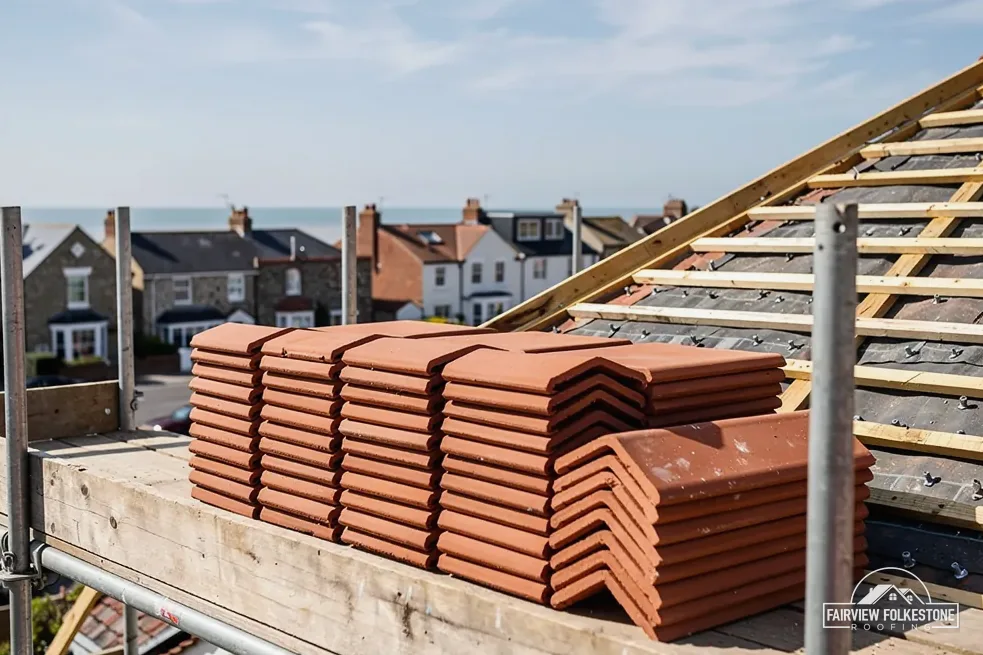
The covering is the largest single choice in the job, and it moves both the price now and the years you get from it. HomeBuilding's own pricing example shows the difference. The three-bedroom semi that might cost between £10,000 and £15,000 in plain concrete tiles might reach £18,000, it says, in Welsh slate.
These are ranges, not promises, and the published numbers vary between sources. Marley, a tile maker, says roof tiles are expected to last around 60 years, typically, and adds that this is no promise about any single roof. It also reports that the BRE set a minimum life expectancy of 60 years for clay tiles, which is a figure for clay only.
| Covering | HomeBuilding's approximate lifespan |
|---|---|
| Welsh slate | 100+ years |
| Clay tiles | 60 to 80 years |
| Plain concrete tiles | 40 to 50 years |
| Fibre cement tiles | 30 to 40 years |
A longer-lived covering can cost more at the start. Whether it suits a particular house depends on how long you expect to stay and on what the roof structure can carry, and that difference is the reason our answer on changing to heavier roof tiles is worth reading before you choose. It also pays to ask for the covering's maker data sheet, which gives the lowest pitch each product is made for, so the choice suits the slope you have. The roof structure matters as much as the budget. If the rafters were sized for a lighter covering, a heavier one may need a structural check first, and that check is a cost of its own that belongs in the conversation before you fall for a sample.
04Scaffold
Access, height and the scaffold licence
A re-roof needs safe access, and the survey settles whether that means a full scaffold. Scaffold hire is priced for the house, and our written price includes the scaffold rather than leaving it as a surprise. What is fixed is the council fee where the scaffold stands over the pavement or the road.
In Kent, a scaffold on the highway costs £52 per week in licence fees for 2026 to 2027, according to Kent County Council, whose page says the scaffolding company should submit the application. We arrange the licence with our scaffolder. In East Sussex the licence comes from East Sussex Highways, whose fee table shows £127 for 28 days; check the current fee, because its site mentions an April 2026 increase. Rye and Camber are the East Sussex addresses we cover.
Does the price change once the old roof is off?
It can. A quote rests on what can be seen from outside and from the loft. If stripping the slope reveals soft battens or damaged rafters, we stop, show you the timber and put a revised price in writing before going on. Nothing proceeds without your agreement to the new figure.
The two fees are quoted in different units, so they cannot be set against each other. What both show is that a re-roof running past the licence period needs a renewal, and that a longer job costs more in licence fees.
Height matters beyond the licence. A tall terrace needs more scaffold and more time moving materials than a bungalow, and a roof with several dormers, valleys and a chimney takes longer to strip and lay than a plain gable. Those are the hours behind a total that looks high for the size of the house, and they are the reason a survey comes before a price.
05Worth knowing
Rules that can add to the job
A few rules turn up on a re-roof, and each can change the work and so the price. In England, the Planning Portal's guide says re-roofing normally needs no building regulations application while it touches under 25 per cent of the building envelope and under 50 per cent of the roof. Go past either limit and an application is expected. A new covering 15 per cent or more heavier needs approval at any size, and the Portal advises taking a structural engineer's or surveyor's view beforehand. Approved Document A words it as an increase of more than 15% in the loading upon the roof, which it calls a significant change.
Dover District Council is stricter for addresses in its district. Its building control page counts replacing roof coverings, even like for like, among the work needing approval, so for a Dover address we confirm the route with the council before pricing a re-roof.
Energy rules can follow. Under AD L 2021, renovating more than half of a roof calls for the whole element to reach the Table 4.3 standard, an improved U-value of 0.16 where feasible, against a threshold of 0.35. Para 4.13 eases this where the work would not pay back within 15 years. AD L 2026 does not apply until 24 March 2027. Our answers on building regulations to re-roof and insulation when re-roofing give the detail. The Planning Portal's own page on building regulations for re-roofing sets out its test.
06In brief
Reading the quote you receive
A quote for a new roof should be a single written total, and it should make clear what that total covers. These are the points to check in any quote you are given, ours included:
Some matters sit outside the roofing price and belong on your list. A chimney breast on a party wall brings a party wall notice, which the building owner serves at least two months ahead. A garage or outbuilding with old cement sheets raises the asbestos question: For a building built or refurbished before 2000, HSE's instruction is to assume that asbestos is there. And under CDM 2015 a homeowner's client duties pass to the contractor, with a construction phase plan on every project.
- whether VAT is in the price
- whether scaffold, and any council licence for it, is in the price
- what happens to the old covering and who removes it
- whether new battens and underlay are included or only if needed
- what the price assumes about the timber, and what follows if it is not sound
If stripping the old covering reveals soft battens or damaged rafters, we stop, show you the timber and put a new price in writing before continuing. A quote that cannot change when the roof is opened is one to question.
Once we have surveyed, you receive a single written total. Whichever quotes you compare, check whether each figure includes VAT and scaffold, and ask for the answer in writing.
Is the Which? range right for a flat or a bungalow?
Not directly. Which? based its range on an average three-bedroom house, so a bungalow, a flat roof or a large detached house sits differently. Treat the range as a scale for that house type only, and ask for a written price after a survey for yours.
More on roof replacement
All guides and posts

Tell us what's wrong with the roof.
You'll get one written total price.