
Asbestos garage roofs
Asbestos garage roofs: what homeowners need to know before replacing one
An old garage roof may be asbestos cement, and the rules for removing it turn on the material and its condition. This post sets out what HSE says and what to ask.
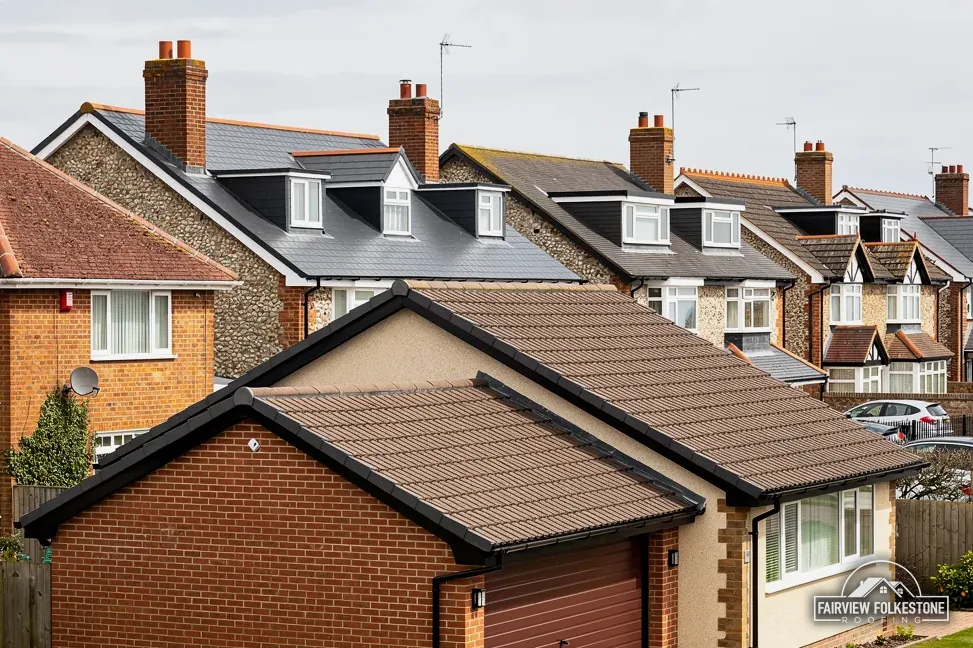
Plenty of garages carry a roof of grey corrugated sheets that nobody has thought about in decades. Then a sheet cracks, a leak shows up over the workbench or a neighbour mentions asbestos, and the question turns from a roof repair into something more serious.
HSE takes a cautious line on older buildings: where one was built or refurbished before 2000, treat asbestos as present until it has been ruled out. That does not mean every garage of that age has an asbestos roof, and it is no reason to panic. It does mean that nobody should drill, cut or break the sheets until the material has been identified, whatever the repair is for.
What follows covers how to find out what you have, how HSE sorts asbestos work into licensed, notifiable and non-licensed categories, why the roof itself is dangerous to walk on, how the waste has to be handled, and what the quote should say.
01Key points
Why the age of the garage matters
Asbestos cement was a common roofing material for decades, and garage and outbuilding roofs were among the places it went. HSE tells anyone managing or altering a building to work on the basis that asbestos is there when the building was built or refurbished before 2000. The wording matters, because a refurbished building can carry newer work over older material, and a garage can have had its roof replaced at a different date from its walls.
Looking at a sheet will not settle it. Modern fibre-cement sheets and old asbestos cement ones can look the same from the ground, and age, weathering and moss cover the surface of both. That is why the first step on an older garage is identification, not removal. If you are buying a house with an older garage, or planning any roof work on one, the same step applies, and it is cheaper to learn the answer before a contractor is booked than after a sheet has been broken. Our garage roof replacement page explains how a garage job runs once the material is known.
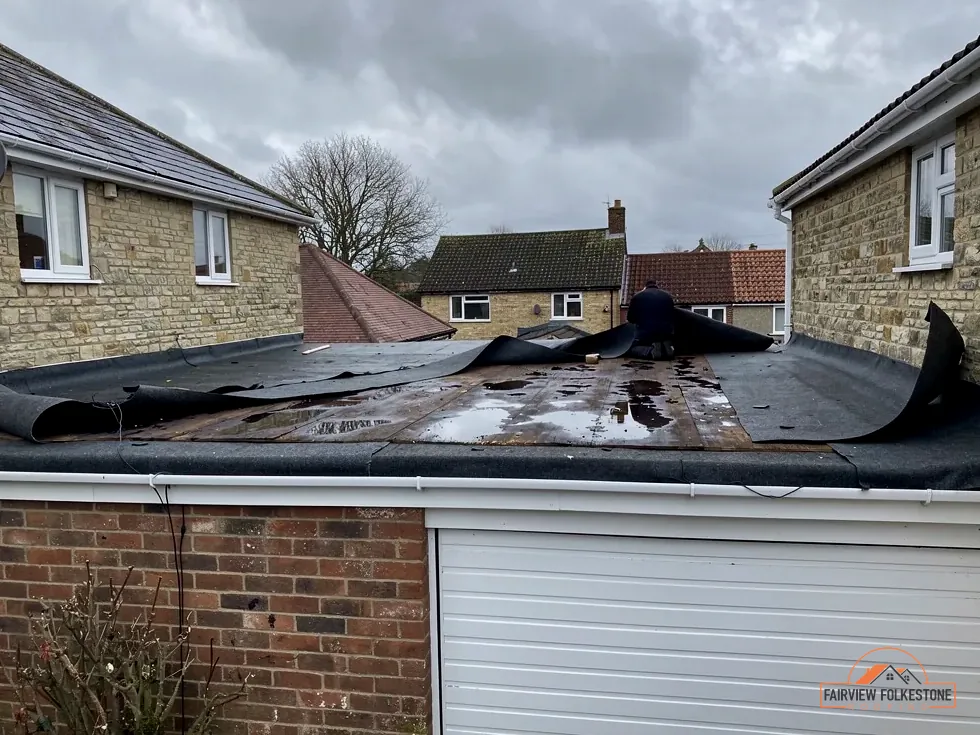
- Note the age of the garage, and whether the roof was ever replaced or repaired.
- Photograph the sheets, the fixings and any labels or markings you can see from a safe position.
- Do not scrape, drill, jet wash or break a sheet to see what is under the surface.
- Ask for the material to be identified by a survey before a quote is agreed.
Our answer on how to tell if a garage roof contains asbestos goes through the clues in more detail.
02Asbestos
How HSE sorts asbestos work
HSE divides asbestos work into three groups: licensed work, notifiable non-licensed work (NNLW) and non-licensed work. Which group a job falls into depends on the product and its condition, not on the size of the garage. The table lists the cases that matter for a garage roof.
The detail is in HSE's own pages on non-licensed work and notifiable non-licensed work. Read them if you want the exact wording, because a sentence such as "cement sheets are fine to remove" leaves out the condition that decides it.
The condition is the point. Careful, whole-sheet removal sits in the lowest group. A roof that has been smashed, or that breaks apart when it is touched, sits in a higher one. A roof that you cannot lift without it breaking is not the roof to treat as routine.
For a homeowner this means the survey comes first. It records what the sheets are, what condition they are in and how they are fixed, and from that the right group and the right method follow. A price given before that point is a guess, and a guess on asbestos is the wrong thing to build a contract on.
| Material and condition | HSE category |
|---|---|
| Asbestos cement sheets, carefully removed without breaking up, including weathered but not substantially damaged | Non-licensed work |
| Asbestos cement sheets substantially damaged or broken up, for example by fire or flood | Notifiable non-licensed work |
| Asbestos insulating board (AIB) where the risk assessment says the work will take a while | Licensed work |
| AIB taken out briefly during a refurbishment | Notifiable non-licensed work |
Asbestos garage roofs: your questions
Does every garage built before 2000 have an asbestos roof?
No. HSE's rule of thumb is to treat a building built or refurbished before 2000 as containing asbestos until you know otherwise, which is a caution, not a diagnosis. A survey tells you what the sheets are, and the answer decides which route the work takes.
03In brief
A fragile roof as well as an asbestos one
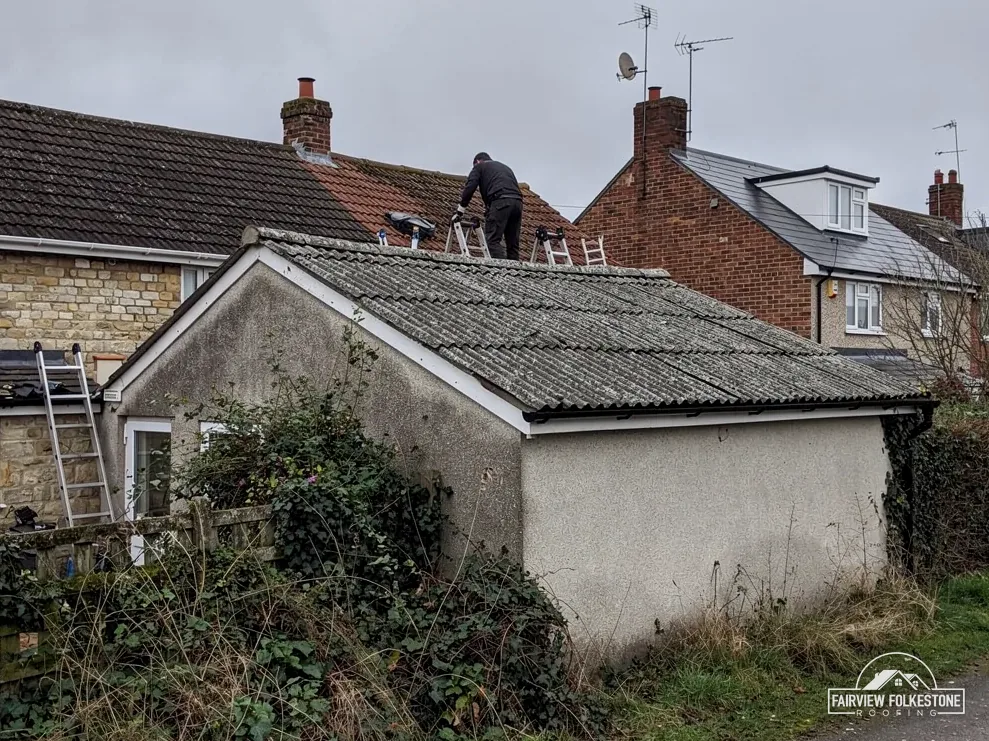
Asbestos is only one of the hazards on this kind of roof. HSE's A14 guidance says that AC roofs are always fragile, so a person standing on one can fall through it. Corrugated sheets can look solid from a ladder yet give way without warning, and moss and age make it worse. Falls through fragile roofs are a recognised risk in their own right.
For you as the homeowner, that comes down to a few plain rules.
- Do not climb onto a corrugated garage roof, to repair it, to clear it or to look at it.
- Do not lean a ladder against the sheets or the edge of the roof.
- Do not allow anyone to "just" patch a crack with sealant while standing on the sheets.
- If a sheet has cracked or slipped, keep the space underneath clear of people and animals until it has been looked at.
A roofer working on a fragile roof uses crawling boards or an edge system rather than the sheets themselves for support, and plans the access before the work begins, not as the work starts. If a quote does not mention how the roof will be reached and protected, that is a gap worth asking about.
We look at the roof from safe positions and tell you what we can and cannot judge from there. Where the survey cannot go further without disturbing the sheets, we tell you that too, because the next step is a proper asbestos survey rather than a closer look.
04Roofline · Asbestos
Soffits and other asbestos hiding in a garage
The roof sheets are not the only place asbestos shows up on a garage or outbuilding. HSE's location list names white AIB panels fixed beneath the eaves, and gives a damaged AIB soffit as its own entry. Most work on AIB is licensed, which makes it a different kind of problem from cement sheets.
That matters on a garage because the roof, the soffit and the fascia are often replaced together, and a quote for new fascias and soffits could take in a board that is an AIB panel rather than a plain timber or fibre-cement one.
| Part | Why to ask |
|---|---|
| Roof sheets | Cement sheets sit in the lowest HSE group only when removed carefully |
| Soffit boards | AIB soffit panels are on HSE's list of places asbestos is found |
| Barge or fascia boards | Ask what material they are before anything is cut or drilled |
| Gutters and rainwater goods | HSE lists rainwater goods among asbestos cement products |
The practical rule is to ask what each part is made of before anyone takes it down. Our page on gutters, soffits and fascias covers the roofline work that comes after.
If anything turns out to be AIB and the work is not brief, the licensed group applies, and that is specialist work with its own requirements. When a garage job crosses that line, we tell you at the survey stage so that you can plan for it, instead of finding out halfway through.
Can I take down an asbestos cement garage roof myself?
HSE classes the careful lifting of cement sheets, kept unbroken, as non-licensed work, but that is a description of the category, not an invitation. The roof is fragile, the dust matters and the waste needs a lockable route. Ask a roofer to survey it first and tell you what the job involves.
05The short list
Where the waste goes
Asbestos waste is hazardous waste, and the routes it can take are narrower than for ordinary rubble. HSE's EM9 guidance is to use a lockable skip for asbestos, and it says that sheeting over an ordinary skip falls short. An open skip is never the answer, and a skip company has to be told what is going into it, so the waste has to be declared at the booking.
The GOV.UK exemption from consignment notes for household hazardous waste is for waste other than asbestos waste, so a householder does not get a blanket exemption for asbestos.
For a garage in East Sussex, such as one at Rye or Camber, check the county's own rules for householders' asbestos before you take any sheets to a tip, since they are not the same pages as Kent's.
For Kent in more detail, our answer on how asbestos from a garage roof is disposed of goes through it.
There are two separate routes, depending on who is moving it.
- A roofer's waste. Asbestos from a roofing job is trade waste. A registered waste carrier then moves the sheets under a consignment note.
- A householder's own small amount. Kent County Council says that its household waste recycling centres accept asbestos apart from Sheerness, double wrapped, kept damp and limited to no more than 5 sacks, or the equivalent, a month for free. You are asked to declare that it comes from your own home.
06Costs · Quotes
What the work costs and what a quote should say
Costs vary with the roof, the access and what has to be removed, so published figures give a sense of the scale rather than a price for your garage. MyJobQuote's guides give these averages for 2026 and the months before:
Where can asbestos sheets from my own garage go in Kent?
Kent County Council says its household waste recycling centres accept householders' asbestos, apart from Sheerness, if it is double wrapped, kept damp and no more than 5 sacks a month, and you declare it comes from your own home. Waste from a roofer's job travels separately, with a registered carrier.
| Work | MyJobQuote average |
|---|---|
| An asbestos survey | Around £325 in 2026 |
| Asbestos removal from a roof | Around £2,750 |
| Garage roof replacement | Between £750 and £3,500 in 2026 |
MyJobQuote gives no VAT basis for these figures, so do not read them as including or excluding it. They are separate guides, and the three figures do not add up to a total for one job.
What sets the price in practice is the size of the roof, how the sheets are fixed, whether the soffits and gutters are involved, how the waste is carried and how the roof is reached. The quote is one written total price, given after the survey, and it should set out in plain words what the survey found, what the work covers, how the waste leaves the site and if the figure includes scaffold and VAT.
If a price is far below the rest, ask where the waste is going. The answer should name a registered carrier and a lockable container, not a promise to take it away. A roof that comes down in a hurry, in pieces, is also a different roof from one taken apart carefully, so ask how the sheets will be lifted and in what order the roof will come off.
Tell us what's wrong with the roof.
You'll get one written total price.