
Roof mortar
Why is mortar falling off my roof, and does it matter?
Crumbs of mortar in the gutter or on the path are a message from the roof. Below: where that mortar came from, why it matters, and what the repair involves.
The short answer
Yes, it matters, because mortar on a roof is holding something in place. Crumbling mortar means the bond around a ridge, hip, verge or chimney has weakened, and the tiles or flaunching it carried may be loose. Loose mortar does not always mean a leak today, but it does mean a roofer should look before the next stormy spell. Work out where the debris is landing, photograph it from the ground, and have the roof checked.
5 min read · Part of Roof repairs

Where the mortar came from
Mortar sits in several places on a roof, and where the crumbs are landing tells you where to look.
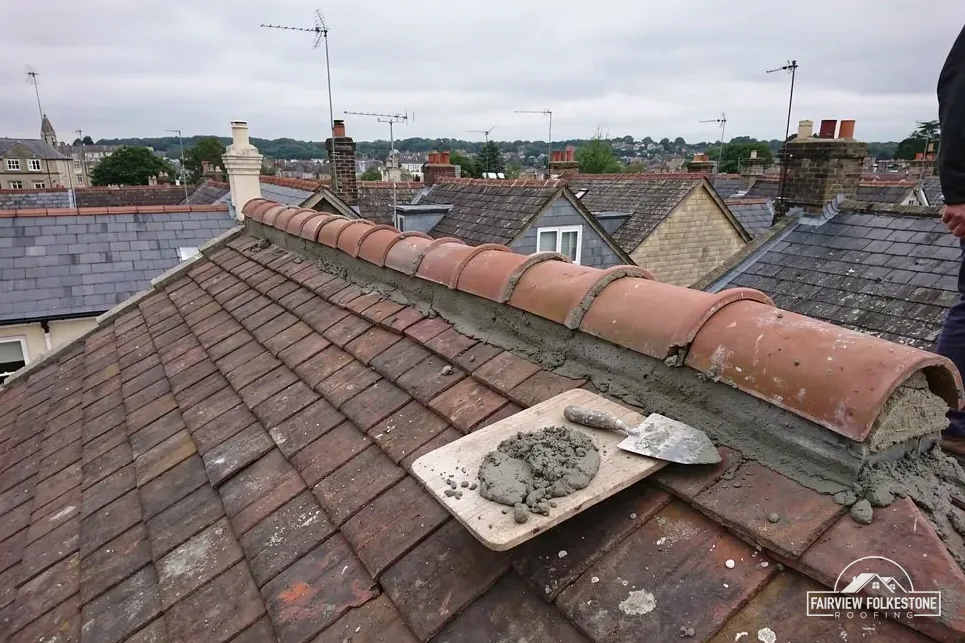
- Ridge: the bedding beneath the capping tiles along the top, and the pointing at their ends.
- Hips: the same bedding on the sloping lines of a hipped roof.
- Verges: the mortar that seals the tiles at a gable end to the wall below.
- Chimney: the flaunching, the sloping mortar collar that holds the pots in place, and the pointing in the brickwork.
If crumbs gather in the gutter below a gable, look at the verge. If they land on the path beside a chimney, look at the stack. If the debris is scattered along the whole length of the eaves, the ridge or hips are the likely source. Take a note of the position before you move anything, because it saves a roofer a long search.
You do not need to climb. Binoculars from the garden show missing pointing as dark gaps or pale lumps, and the photographs help when you ring around.
Why it matters: what mortar is doing
Mortar on a roof is partly a seal and partly a fixing, and each job fails differently when it crumbles. As a seal, it keeps rain out of the gap under a ridge or beside a verge. As a fixing, it holds tiles that would otherwise be free to move.
Marley points out that the 2015 amendments to BS 5534 made clear mortar could no longer be relied upon as the only means of securing the roof covering. It also notes that BS 5534 is a code of practice and is not required by law. In practice it means that older roofs, bedded on mortar alone, depend on a material that has weathered for years.
On a chimney, loose flaunching can let water into the stack, and a loose pot is a falling hazard like a loose ridge tile. Our page on loose ridge tiles explains the capping side of the problem. Whether the debris is only weathered pointing or the first sign of a lifting ridge is what the survey settles.
How the repair works
What the repair involves depends on what the survey finds.
| Where | Typical repair |
|---|---|
| Ridge or hip | Lift the capping, clear the old bedding and refix the tiles, with mechanical fixings added |
| Verge | Rebed the end tiles, or replace the mortar with a dry-verge system |
| Chimney | Rake out and repoint, or renew the flaunching around the pots |
A dry-fixed ridge, hip or verge system is covered by BS 8612, which the BSI lists as current. For a dry verge, MyJobQuote's October 2026 guide says the cost usually falls between £500 and £2,000, and it gives no VAT basis.
A chimney stack is quoted only after the survey, since the amount of brickwork, the height and the access differ from one stack to the next. Where the old tiles are sound they are reused, and the repair stays a repair. Where whole sections have crumbled, you are told plainly, with photographs from your own roof to show it.
Ask for the repair to be described in words you can follow. "Rebed ridge, add fixings" tells you far more than "mortar repairs", and it lets you check later that the work was done as described.
Stopping it happening again
Mortar weathers whatever you do, so the aim is to stop it carrying a load it cannot bear. After a repair, keep an eye on the same places each season. A quick look from the ground after the autumn gales, and again in spring, picks up lifted pointing before a tile follows it.
It helps to keep gutters clear, since debris that sits in a gutter holds water against the fascia and wall below. Clean it out when you see crumbs, and photograph what you find, because a handful of grit tells a roofer which edge of the roof has been losing material, and how recently. Note the date next to each photograph, and keep them together.
If a chimney stack is involved, remember that works to a party wall, such as cutting away a chimney breast, can bring in the Party Wall etc. Act 1996. The party wall rules put the duty to serve notice on the building owner, the person having the work done, and for party-structure work that means at least two months ahead. Repointing is a lighter job than structural work, but ask if you are unsure.
The roof repairs page shows how a repair is weighed against something larger, and the survey ends in a single written total.
More questions
Is a little mortar in the gutter normal?
A few grains from an old roof are not alarming on their own, but lumps, or a steady supply after each gale, are a warning. Note where they land and look at the nearest ridge, verge or chimney. A roofer can tell in a single visit whether it is simple weathering or a loosening bed.
Can crumbling mortar be fixed by painting it?
No. Paint or sealant over cracked mortar covers the crack and leaves the loose bed beneath it. The old material has to be raked out and replaced, or the ridge refixed with a mechanical fixing, so that the repair holds without depending on mortar alone, and so you can see what was done.
Tell us what's wrong with the roof.
You'll get one written total price.