
Hernhill · 23.8 road miles north-west
Roofers in Hernhill
Hernhill has a Grade I parish church, a Grade II* manor house and conservation areas called Fostall, Hernhill and Staplestreet within a short walk of its centre. Explain the trouble overhead and the survey does the sorting from there.
- Church on the national list
- St Michael's, Grade I, entry 1069116
- Houses on the national list
- Manor House at Grade II* and Walnut Tree House at Grade II
- Conservation areas close to the centre
- Fostall, Hernhill and Staplestreet, designated by Swale Borough Council
- Parish population at the 2021 Census
- 724 usual residents
Three Hernhill roofs, and what each one gets
What we found
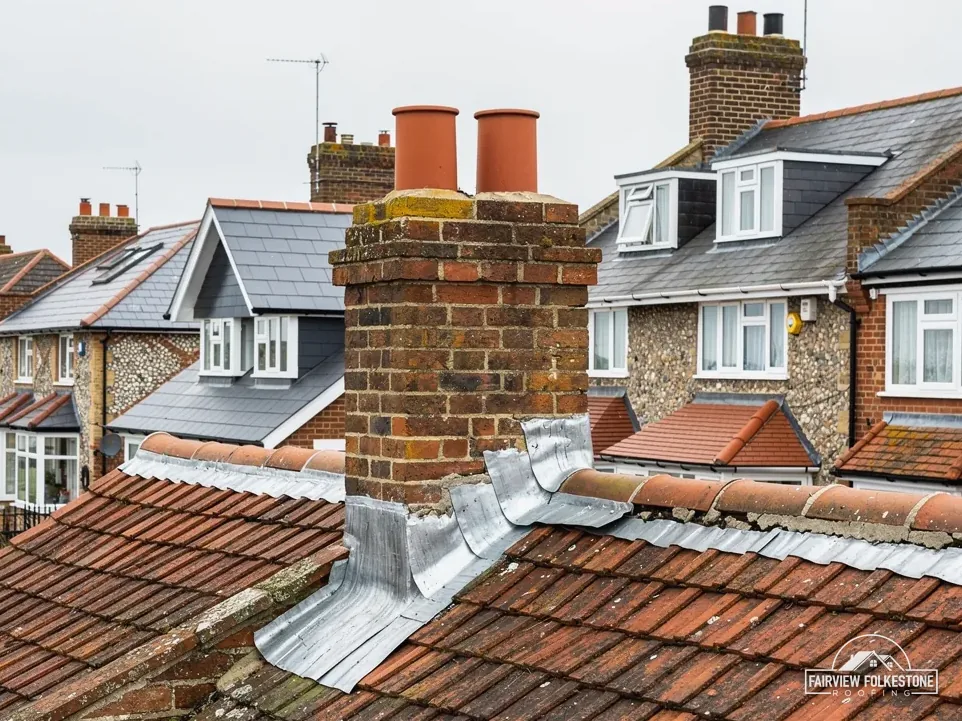
Lead lifting at the chimney's upper edge
What it fairly needs
Refit the flashing in new lead.
What we found
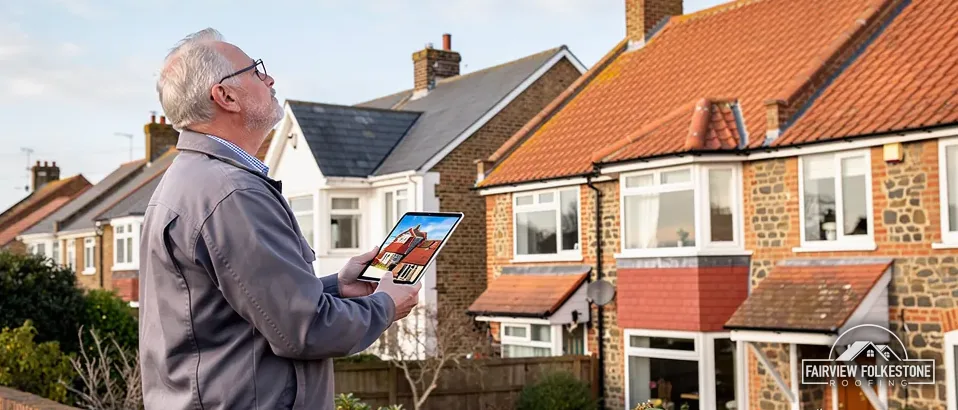
Roof on a house that may be listed
What it fairly needs
The national list, then Swale.
What we found
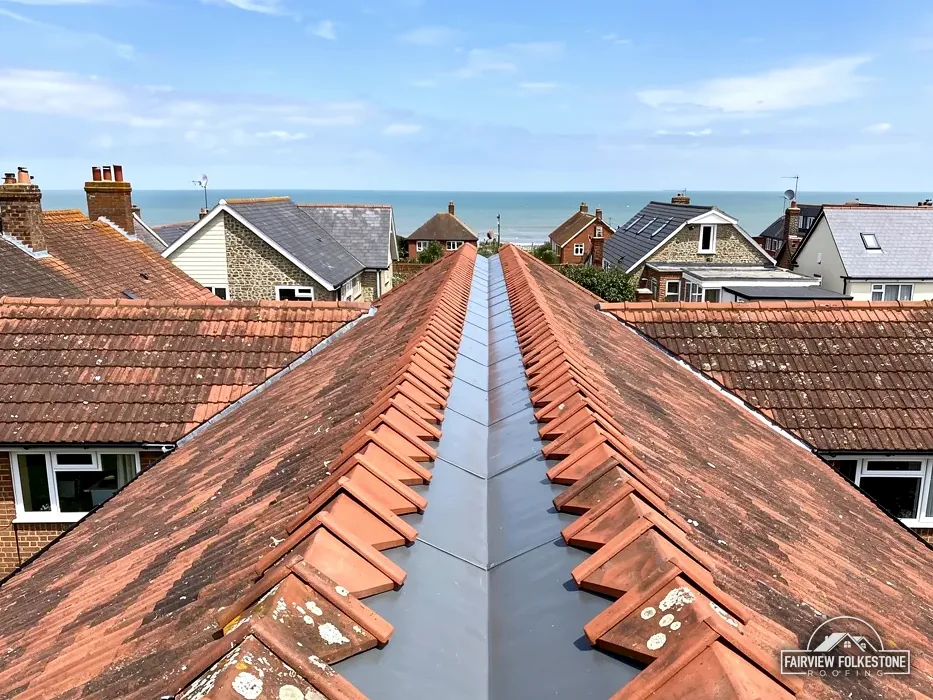
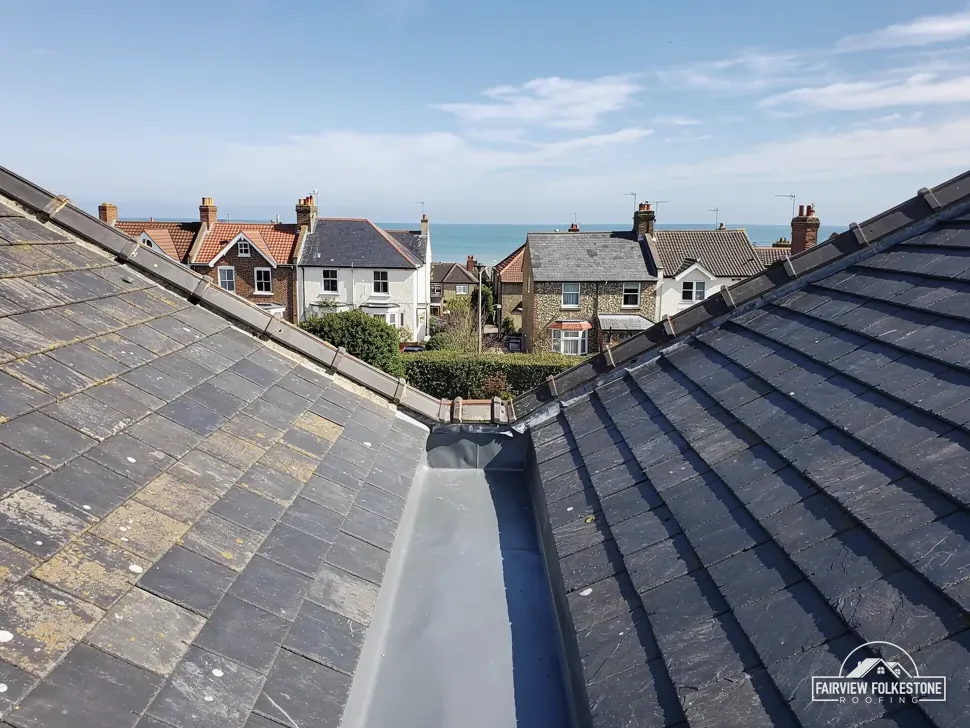
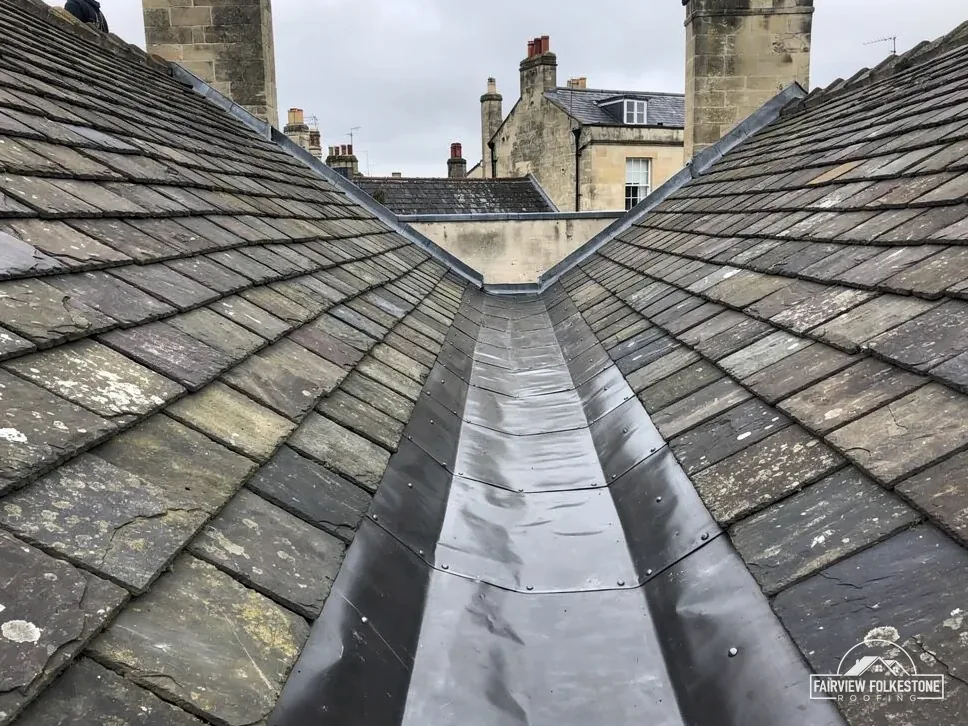
Valley lining split along the join
What it fairly needs
Open the valley and relay it.
The fair ledger
St Michael's, the manor house and a roofline that has to drain
Hernhill's church is listed Grade I, its manor house Grade II*, and its roofs are judged one by one. Three entries cover the church and its faculty route, the listed houses and the lead on their chimneys, and the gutters, each ending in a verdict.
Entry 01Parish church
St Michael's Church: a Grade I building with its own approval route
St Michael's is listed Grade I, and Church of England worship continues in it. Works to the building follow the faculty system, a route that a private house never takes.
Why the church answers to a different body
On the national list St Michael's carries entry 1069116. Listed building consent is the council's job for most listed buildings, yet a Church of England church in use is exempt from it, and the church's own faculty system takes its place. Anyone caring for the building asks that system, and the council is not the body involved. This is the exemption in the Ecclesiastical Exemption (Listed Buildings and Conservation Areas) (England) Order 2010, which keeps it for church buildings within the Church of England's faculty jurisdiction.
For the owner of an ordinary house in the parish, nothing in this changes. The faculty route belongs to church buildings, so a roof on a home that stands nearby is judged on its own facts: whether the house is listed, whether it lies in a conservation area, and what the job would alter. Those three questions are asked at the very first visit, and the answers shape the verdict before a price exists. Our roof replacement service covers what follows when a roof does need replacing.
Who decides on works to St Michael's own roof?
As a Church of England church in use, St Michael's has works decided through the faculty system, not through listed building consent from the council. A listed house takes the other route, with Swale Borough Council as the body to ask, which is why the two are never confused in a survey.
What we ask before any listed roof is priced
- Is the house itself on the national list, and if so, under which entry number?
- Does it stand in Fostall, Hernhill or Staplestreet, the conservation areas Swale Borough Council has designated?
- Would the work change how the roof looks, or only put right what has failed?
- Can the covering be mended in the material already there?
- Which separate roofs, a porch or an outbuilding among them, belong to the house itself?
The answers are written into the survey notes with a photograph of each roof plane, and the verdict is read against them. A house that turns out to be listed gets a different conversation from one that is not, and it is far better to have that conversation before any tile is lifted.
1069116
the number of St Michael's entry on the national list
Grade I
Entry 02Lead and listings
Manor House and Walnut Tree House: read the listing before the roof
Manor House is listed Grade II*, and Walnut Tree House is Grade II. Around a listed chimney, lead is where a careful repair and a heavy-handed one part company.
Entry numbers and what they lead to
Manor House is entry 1323023 on the national list and Walnut Tree House is entry 1344028. If your own house carries a number, give it to Swale Borough Council in your first message. A listed home still enjoys permitted development for roof work, and listed building consent is added whenever a job touches the character of the building. That test comes from section 7 of the Planning (Listed Buildings and Conservation Areas) Act 1990.
Chimneys show the difference between a repair and a change quickly. MyJobQuote says correctly installed lead flashing can last for over 80 years, which is a reason to repair lead in lead and to get the dressing right the first time. Our lead work service describes the flashings, soakers and valley gutters we deal with, and how each is dressed so that it sheds rain without a visible patch.
- Stepped flashing up the stack
- Joint where it meets the brick
- Soakers beneath the tiles
- Flaunching on top of the stack
Flaunching cracked, lead sound
Reform the flaunching
Listed house, ridge to be changed
Council consent first
Lead split along every fold
Renew the lead
What a chimney survey checks
- The stepped flashing against the stack, for gaps at the joints.
- The mortar flaunching on top of the stack, where cracks let in rain from above.
- The back gutter behind the chimney, for a fall that sends water away.
- Any lead that has split along a fold, rather than simply lifted at an edge.
- Whether the pots and the pointing are in step with the repair, so nothing is half done.
- The lead itself, where it can be seen, for splits along a fold that mean the piece wants renewing.
- The loft beneath the stack, for staining that traces back to the chimney and not to the slope.
The fall a gutter needs
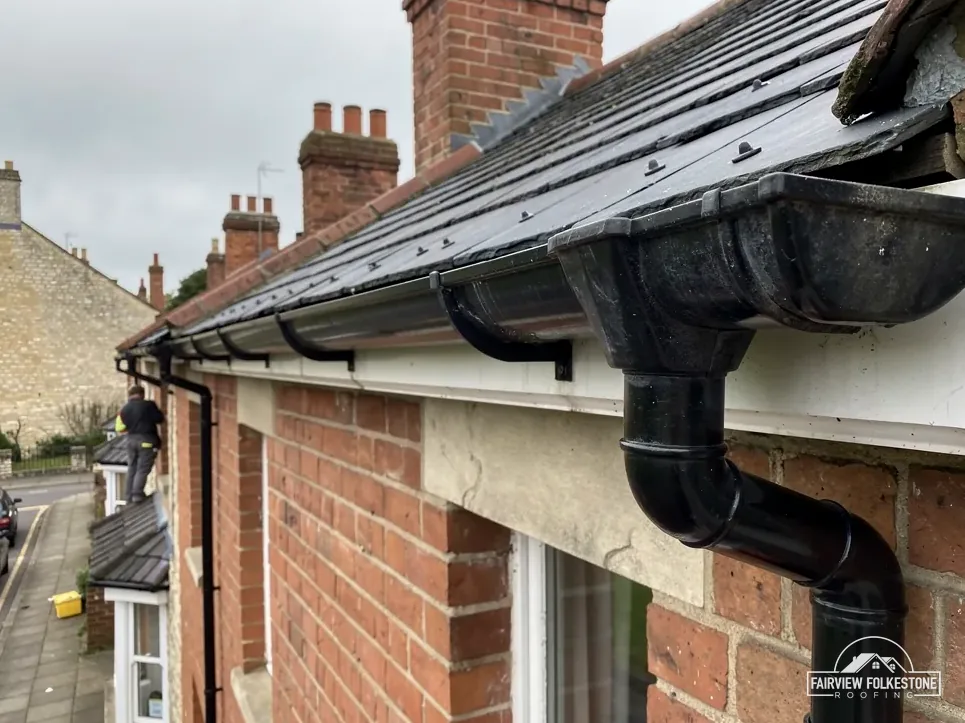
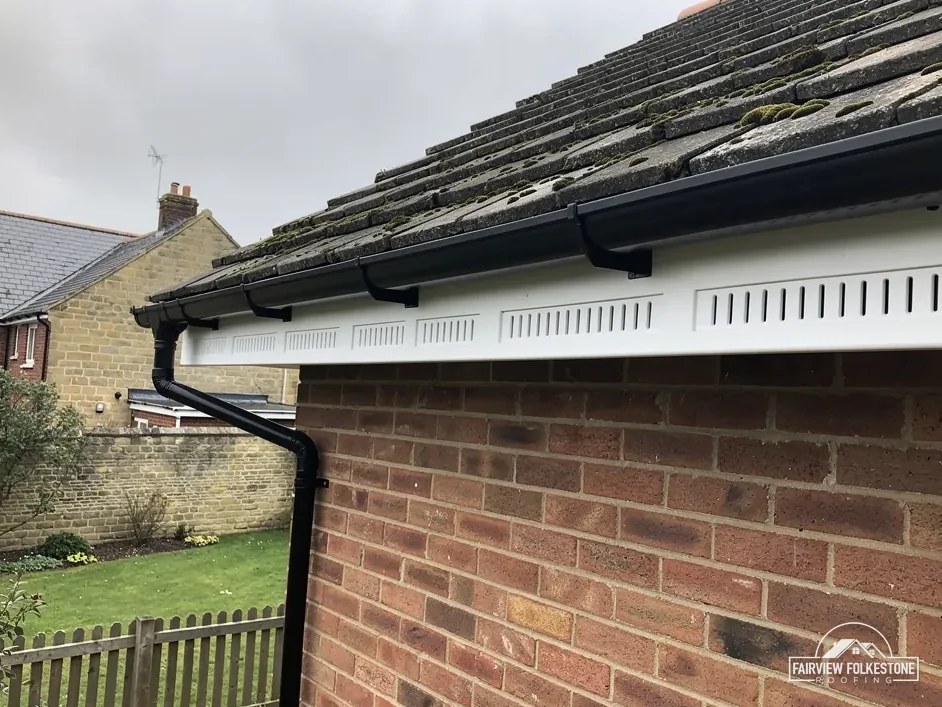
Brett Martin, a gutter maker, recommends laying a run so that it drops 1 mm in every 600 mm on its way to the outlet. A sagging run has lost that fall, so rain stands in the dip instead of moving on. Before replacing anything we look for a bracket that has come away, a joint that has dropped, or an outlet that is blocked, and we look at the fascia behind, since a soft board cannot hold new brackets for long. The downpipe and the drain at its foot are part of the same check, because a run that falls correctly still floods if its outlet has nowhere to go.
The gutter is also the best place to look at how the roof ends. Our gutters, soffits and fascias service covers the roofline end to end, so the eaves are not left for a second visit.
The eaves are also where ventilation is settled. With a high-resistance underlay, which is not vapour-permeable, Marley's cold-roof guidance asks for 25 mm at the eaves when the pitch is 15° or less, falling to 10 mm above 15°. A new fascia or soffit is the moment to get that right, since a vent that a board has closed off cannot be seen from the ground, so we look for it from the loft side.
Entry 03Roofline
Gutters fall towards the outlet, and one scaffold serves the roofline
A run of gutter that holds water has lost its fall, or its brackets, or a joint. Brett Martin gives the fall that a new run should have.
What sets the price
- Length of the gutter run
- Height of the eaves
- Condition of the fascia behind
One written total price
- Bracket holding the run
- Joint that has dropped
- Outlet carrying rain away
Scaffold on the village road
Scaffold that stands on the road outside needs permission under section 169 of the Highways Act 1980, and for Hernhill the authority that grants it is Kent County Council. A permit covers 7 calendar days, and applications, renewals included, are due 5 working days ahead of the start. A long job is therefore booked with its renewal date already in mind.
Staging that never leaves your own plot does not touch the highway, so no licence comes into it. Our survey settles which applies by checking how the eaves, the footway and your gate line up with one another, and by measuring from the wall to the kerb where a scaffold would have to stand.
Getting from Folkestone to Hernhill
Folkestone to Hernhill is 23.8 road miles heading north-west, about 32 minutes in the car, and the parish had 724 usual residents at the 2021 Census. A photograph of the problem is the easiest way to begin. After our visit to the roof, one total price is written, and the decision is yours once you have read it. Phone and WhatsApp numbers are on every page for anyone who would rather talk.
Questions about roofs in Hernhill
What does a survey look for around a chimney on a Hernhill house?
We look at the stepped flashing, the joints where lead meets brick, the flaunching on the stack and the gutter behind it. MyJobQuote says correctly installed lead flashing can last for over 80 years, so lead that has only lifted is refitted rather than replaced. Where it has split along its folds, the fair answer is new lead, and we show you the split in a photograph before suggesting it. The same visit looks at the back gutter and the flaunching, so one scaffold serves every part of the repair.
Which conservation areas lie close to Hernhill?
Swale Borough Council has designated Fostall, Hernhill and Staplestreet near the centre. Plain re-roofing is normally permitted development even in a conservation area, whereas a dormer is a planning question that our guide to roof work covers. An Article 4 direction can curtail further rights, which is a reason to ask Swale Borough Council about your own address. Ours goes to the council during the survey, and its reply comes to you in writing.
Do I have to arrange a scaffold licence for a Hernhill roof myself?
No. Kent County Council is the licensing body, charging £52 per week for 2026 to 2027 for scaffolding on the highway, and its householder guidance gives the application to the firm putting up the scaffold. We arrange it with our scaffolder. Staging that stays on your own plot needs no licence, and our survey says which case yours is before any date is agreed.
Does a small re-roof in Hernhill need Building Regulations approval?
The Planning Portal gives two tests. Work that touches less than 25 per cent of the building envelope and less than 50 per cent of the roof normally goes without an application. A replacement covering that adds 15 per cent or more in weight brings approval in regardless, so we ask about the new covering's weight at the first visit. Swale's building control comes from the STG Building Control Partnership, on 01634 331133, if you want a ruling on your own house.
Where do I start if I think my Hernhill house is listed?
Look the address up on Historic England's national list, where Manor House and Walnut Tree House both appear with their entry numbers, searching by street name if you do not have one. Swale Borough Council can confirm a listing too. Tell us at the first call and we ask the council before any price is written, because a listed roof needs the consent question settled first and the written figure follows that answer, never the other way round.
Say what your Hernhill roof is doing
You'll get one written total price.