
Lympne · 8.2 road miles west, in the Kent Downs
Roofers in Lympne
A village with its own conservation area, a Grade I church and a Grade I castle, inside the Kent Downs National Landscape. So we check the address and the rules that go with it before we price a mend, a re-cover or a rebuild. The price that follows the survey is a single written total, and the work starts only once you have said yes.
- Village designation
- Lympne conservation area, with Folkestone & Hythe District Council
- Grade I listings
- The Church of St Stephen and Lympne Castle
- National Landscape
- Lympne lies within the Kent Downs
- Scaffold licence from
- Kent County Council; we arrange it with our scaffolder
What a Lympne survey finds, and the verdict on each
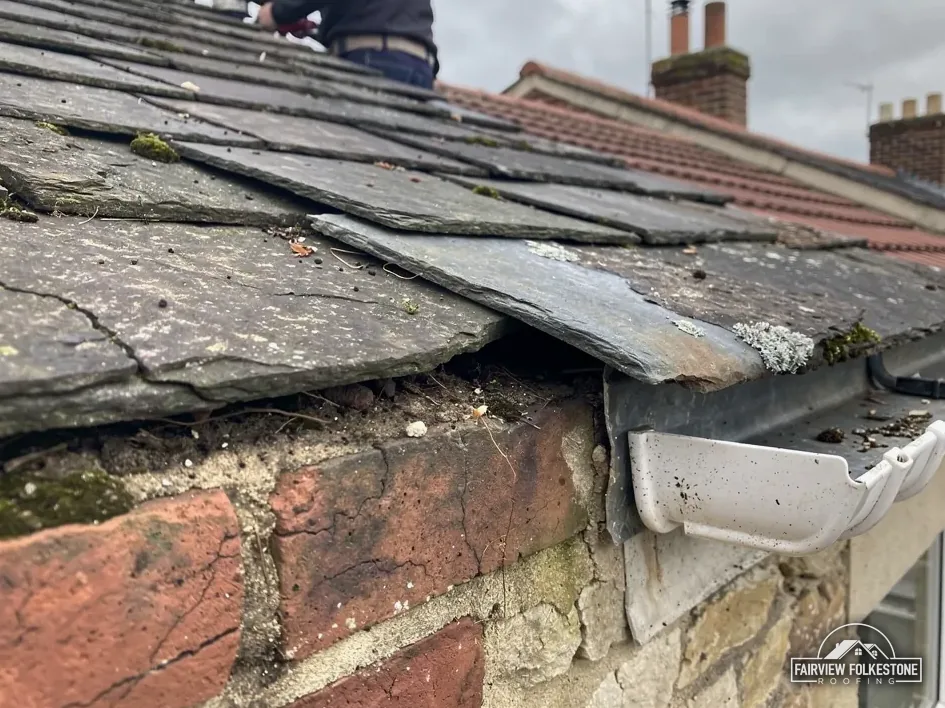
What we found
Eaves vents packed shut by old insulation
What it fairly needs
Reopen the gap before any re-cover.
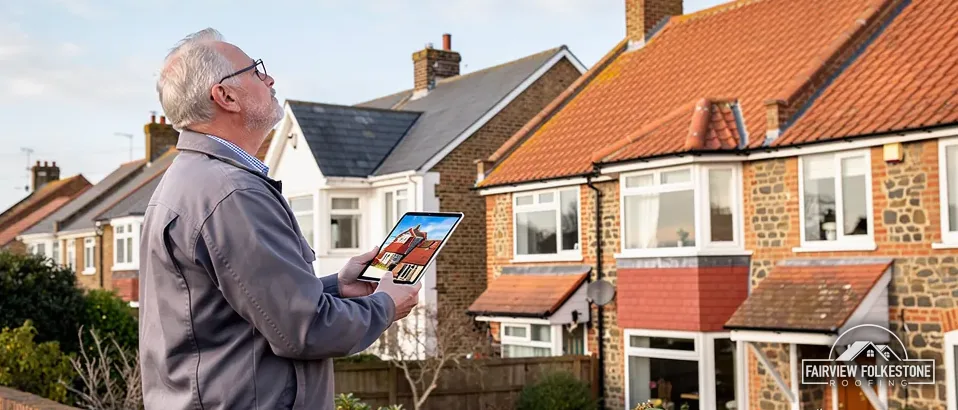
What we found
A house with its own listing
What it fairly needs
Consent route first, then a matched repair.
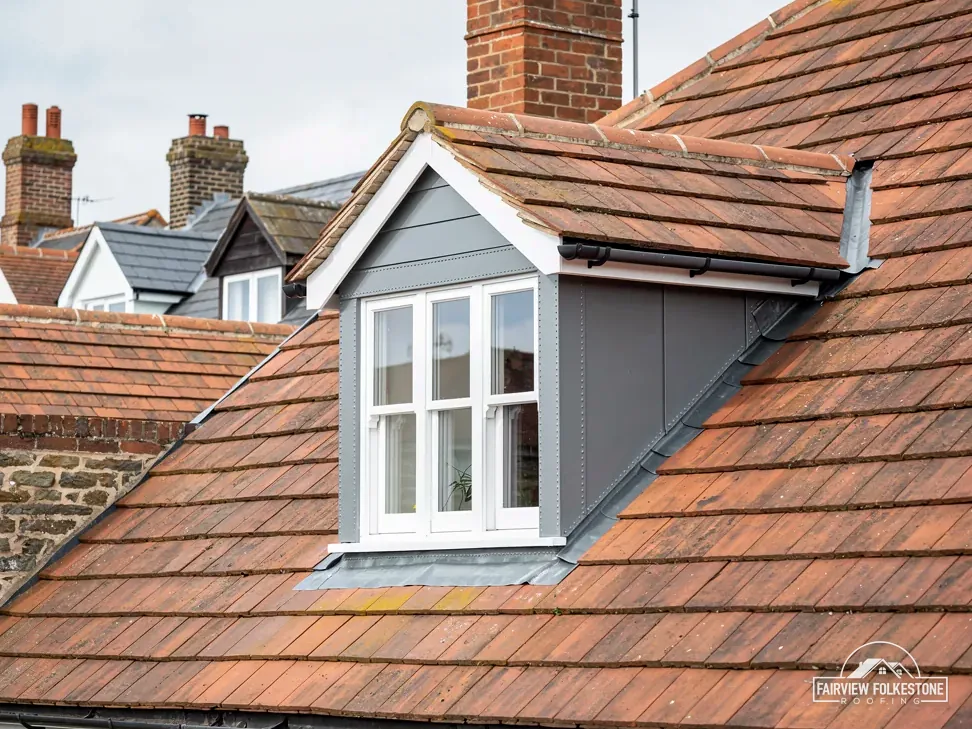
What we found
Valley lining split and letting rain through
What it fairly needs
Strip the valley and lay a new lining.
The fair ledger
Designations, Grade I neighbours and eaves air: three Lympne entries
Three questions decide a Lympne roof job: what the village's designations allow, which consent route a listed neighbour sets, and whether the eaves can still breathe once the roof is re-covered. Each entry ends in a verdict.
Entry 01Two layers
Lympne's conservation area and the Kent Downs: two layers, one council
Lympne has a designated conservation area, and the village also lies within the Kent Downs National Landscape. Both are read by the same council.
What each layer changes for a roof
Folkestone & Hythe District Council describes a conservation area as a place where new development has to be appropriately designed, including with traditional natural materials, and it publishes an interactive map so that you can see whether an address falls inside. We open that map before we price, because a postcode cannot answer the question.
A conservation area does not by itself change how a like-for-like re-cover is treated; our planning guide sets out that position. The rights that can be taken away are the business of an Article 4 direction, which the government's guidance describes as a way for a local planning authority to withdraw specified permitted development rights across a defined area. The council alone knows if your road is covered, and we ask it at the survey.
The Kent Downs layer is different in kind. It is a landscape designation and its team advises; Folkestone & Hythe District Council still decides applications. A like-for-like re-cover follows the usual rules, and our planning guide deals with anything bigger.
For the work itself we use our roof replacement team where a full re-cover is the sound answer. It is the sound answer only when the survey shows the old covering has failed across the slope. Where a few pieces have gone, a repair comes first, and the survey photographs the ridge, the verges and the eaves so that any application carries the details with it.
Does Lympne's conservation area mean I cannot re-roof?
No. Being in a conservation area does not, on its own, stop a house being re-covered. What the designation adds is a closer look at design and the possibility of an Article 4 direction, so the council's map and its answer come first. We run both checks at the survey and write the results down for you, with the photographs that go with them.
What sets the price
- Whether the address needs a council answer
- How much of the roof is involved
- What the covering has to match
- How we reach the slope
One written total price
Entry 02Grade I neighbours
Beside a Grade I church and castle: which consent route applies
The Church of St Stephen and Lympne Castle are both listed Grade I, and Shepway Cross is listed Grade II. Each sits under its own consent rules.
One village, more than one consent route
Historic England records the Church of St Stephen as entry 1101780 and Lympne Castle as entry 1101773, both first listed on 29 December 1966, and Shepway Cross as entry 1251489, first listed on 11 October 1990. Being near a listed building does not put restrictions on your own roof. A house that has an entry of its own does carry them.
The route depends on the building. A church still in Anglican use is dealt with by the faculty system of the Church of England, not by listed building consent, and St Stephen's is in Church of England use. A listed house, by contrast, needs listed building consent from the council where the work would change its character, even though roof work on it stays within permitted development.
We therefore ask two questions at the door. Is your address on the list? If so, what is the smallest repair that works? When both answers are in hand, Folkestone & Hythe District Council then gets a precise question, which is easier to answer in a line than in a letter. A precise question also means nothing is priced for work that may not be allowed. On an unlisted house the job is ordinary pitched roof work and no consent step arises. Photographs of the roof from the garden are enough to start with, and the search of the list settles the rest.
Who agrees to what
Church of England church in use
Church faculty system
Listed house, repair affects character
Listed building consent
Unlisted house next door
Ordinary rules apply
Myth: A listed castle nearby limits what I can do to my roof.
Fact: Only a building's own listing brings consent rules; a listed neighbour leaves your roof under the ordinary ones.
Who decides if my Lympne house counts as listed?
Historic England keeps the list, and the entry for your address either exists or does not. Search it, or ask Folkestone & Hythe District Council. We repeat the search at the survey so that nothing is priced on an assumption either way, and the result is written on the first page of the survey notes.
The gap under the lowest course
In a cold roof, where the insulation lies along the loft floor and the space above it stays cold, moist air has to leave through the eaves. Marley, the tile maker, asks for a continuous gap at the eaves wherever a high-resistance underlay is used: 25 mm up to a pitch of 15 degrees, and 10 mm on anything steeper. That sort of underlay stops water vapour passing through it, which is why the air has to get out at the eaves. BS 5250 deals with controlling moisture in buildings.
If a breather-type underlay is used, the ceiling below is sealed well and the covering itself is air permeable, Marley says the 3 mm that normal eaves construction gives is all that is required, so long as UKAS third-party certification is met. So the right answer depends on the underlay chosen, and a re-cover is the moment to settle it. A roof that was ventilated one way and is re-covered another can end up with the wrong gap for its new underlay, which is why we write the figure into the specification and do not leave it to the day.
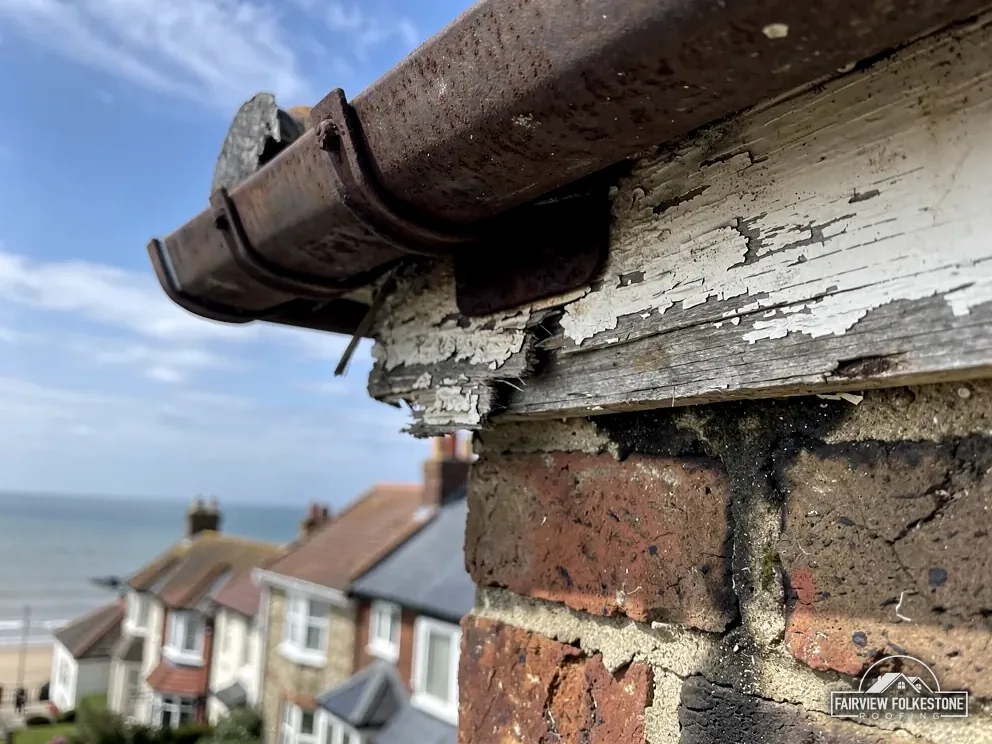
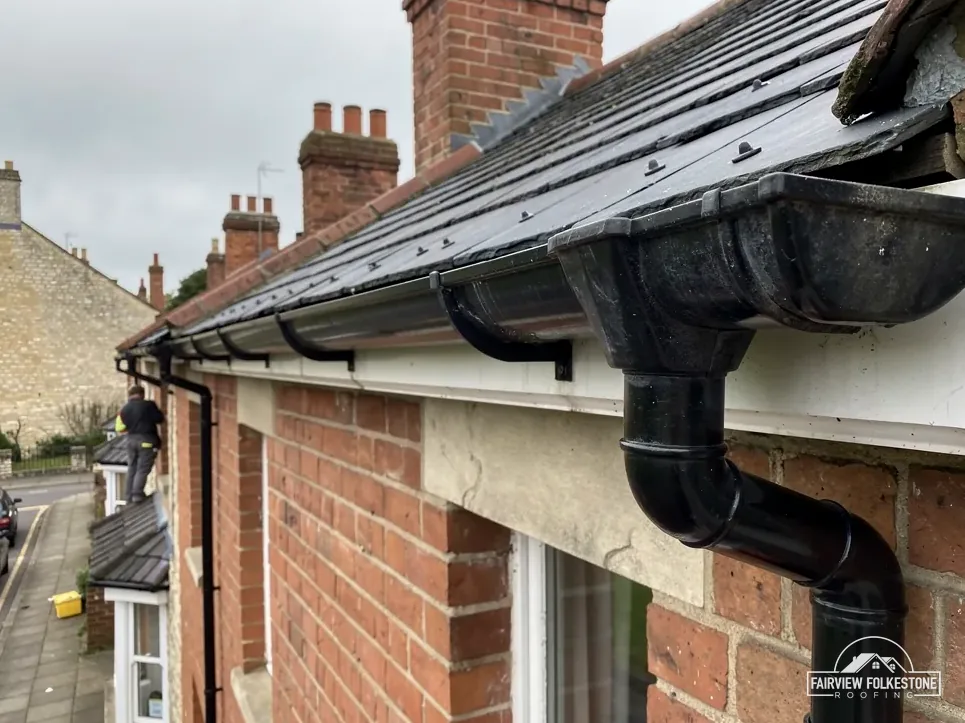
We look at the eaves on every survey: whether the vents are open, whether old insulation has been pushed into the gap, and whether the gutter and fascia are fixed so that the gap stays clear. The finding goes into your fascia, soffit and gutter notes as well as the roof notes. Where old insulation has been pushed into the gap, we pull it back and say so. That is a repair in its own right, and it is no reason to replace a covering that is otherwise sound.
Entry 03Eaves air
Eaves ventilation under a re-cover: the gap that has to stay open
A re-cover can quietly close the airflow at the eaves. The gap is small, it is easy to lose, and the roof timbers need it to dry out.
10 mm
Marley's eaves gap for pitches above 15 degrees under a high-resistance underlay
What sets the price
- Which underlay the roof needs
- Whether the eaves can be opened
- How we reach the gutter line
One written total price
- Fascia board
- Gutter
- Underlay lapped into the gutter
- Soffit vent
Which of the three entries sounds like your Lympne roof?
Send photographs or book a survey visit. The verdict comes first, in writing, and then one written total price, so you can weigh the two against each other before anything starts.
Lympne from Folkestone
8.2 road miles west of Folkestone, about 12 minutes by road. Lympne parish had 1,483 usual residents at the 2021 Census, and the roofs in it are surveyed one address at a time, with a written verdict and one total price to follow. We bring the ladders and the scaffolder, and the scaffold's position is agreed with you beforehand.
What Lympne householders need to know first
Plain answers, with the reasons given.
Do I need to keep the eaves vents when I re-roof a Lympne house?
Yes, where a high-resistance underlay is fitted over cold loft space. Marley asks for 25 mm at the eaves up to 15 degrees of pitch and 10 mm above it. On a Lympne roof, a breathable underlay over a sealed ceiling, beneath an air-permeable covering, changes the figure, so the underlay and covering decide it. We check what is already fitted at the survey, say which case your roof falls into, and put the gap we propose in the written notes.
Is my Lympne house inside the village conservation area?
The Lympne conservation area is designated, and Folkestone & Hythe District Council's interactive map shows its edge. A map answers it where a postcode cannot, so open it with your address to hand. Inside the area a like-for-like re-cover is not ruled out, and any Article 4 direction is a matter for the council, which we ask at the survey and report back to you in writing.
Who licenses scaffold on a road in Lympne?
Kent County Council runs the licensing of scaffolds on the highway and charges £52 per week for 2026 to 2027. Kent County Council's licence page says "the skip or scaffolding company should submit the application for you", which is how a Lympne job runs. We arrange it with our scaffolder, and we fix the scaffold's position and the time it will stand at the survey, so that the length of the licence is known before you agree the price.
Will a Lympne re-roof need Building Regulations approval?
The Planning Portal's test sets two limits: less than 25 per cent of the building envelope and less than 50 per cent of the roof. Keep under both and a Lympne re-roof needs no application as a rule. A new covering 15 per cent or more heavier is the exception and needs approval. For your own case, Folkestone & Hythe District Council's Building Control team is on 01303 853538, and we agree the route with it before work begins.
Does Grade I status on St Stephen's Church affect nearby roofs?
Not by itself. The listing belongs to the church, and a church in Anglican use is handled through the faculty system. A house near it is only affected if it has its own entry on Historic England's list. If it does, listed building consent applies to work that affects its character, and we ask the council before pricing, so you hear about it at the survey and not halfway through.
How would I know if an Article 4 direction covers my Lympne road?
Ask Folkestone & Hythe District Council, which makes and keeps any direction. Government guidance explains that such a direction lets the planning authority switch off chosen permitted development rights inside a boundary it draws. So the real question is whether a direction has removed a right your house would otherwise have. We ask at the survey, in writing, and pass the reply on.
A Lympne roof you would like looked at?
You'll get one written total price.