
Inspection methods
Drone, ladder or loft: what each kind of roof inspection can and cannot see
A roof can be inspected from the air, from a ladder or from the loft. Each method shows something the others cannot, so the useful question is which one answers yours.
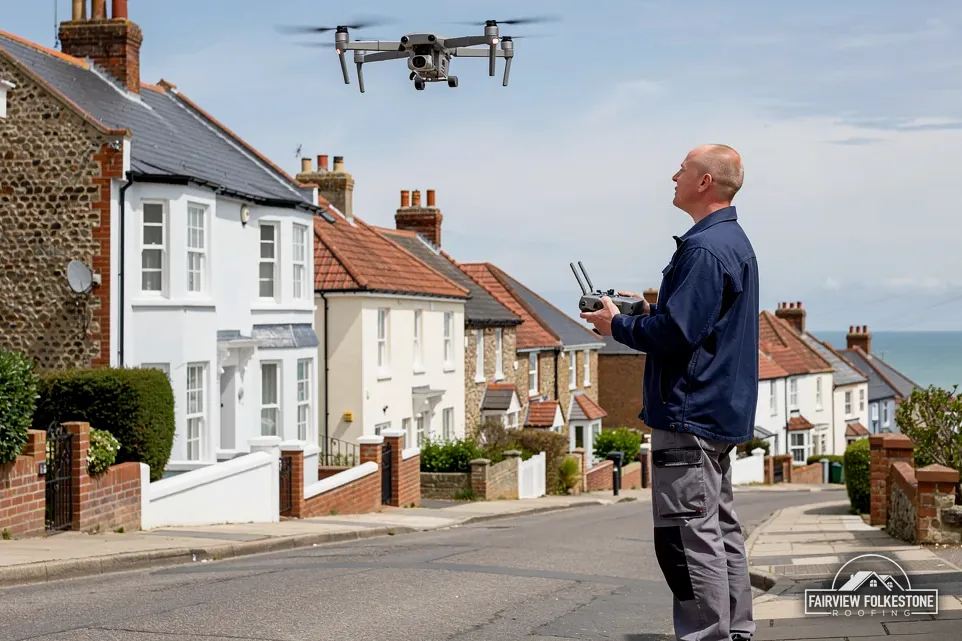
Three people can look at the same roof and report three different things, depending on where they stood. A drone sees the whole outer surface from above. A ladder at the eaves puts someone within reach of the tiles, the gutter and the fascia. The loft shows the roof from underneath, where timber, underlay and daylight tell their own story.
None of these is the complete inspection on its own, and none is a trick. What matters is knowing what you are being offered: a set of images, a verdict given from the eaves, or a look at the structure from inside. Anyone searching for a drone roof inspection will find that the pictures are sharp, while the questions those pictures cannot answer are easy to overlook.
This post sets out what each approach can see, where each one stops, what to ask before anyone books a visit, and how a survey can combine them. It also covers access, because getting close to a roof is where the risk to people lies, and a sound inspection never puts anyone in danger for the sake of a better picture.
01Key points
What a drone can see from above
A drone flies over the roof and records it, so the whole outer surface can be checked without anyone setting foot on it. That is its real strength. Chimney stacks, ridge lines, the back slope you cannot see from the road and valleys tucked between two roofs all land in one set of images, which you can keep and compare against later ones.
- Tiles or slates that have slipped, cracked or gone altogether, on slopes you cannot see from the ground.
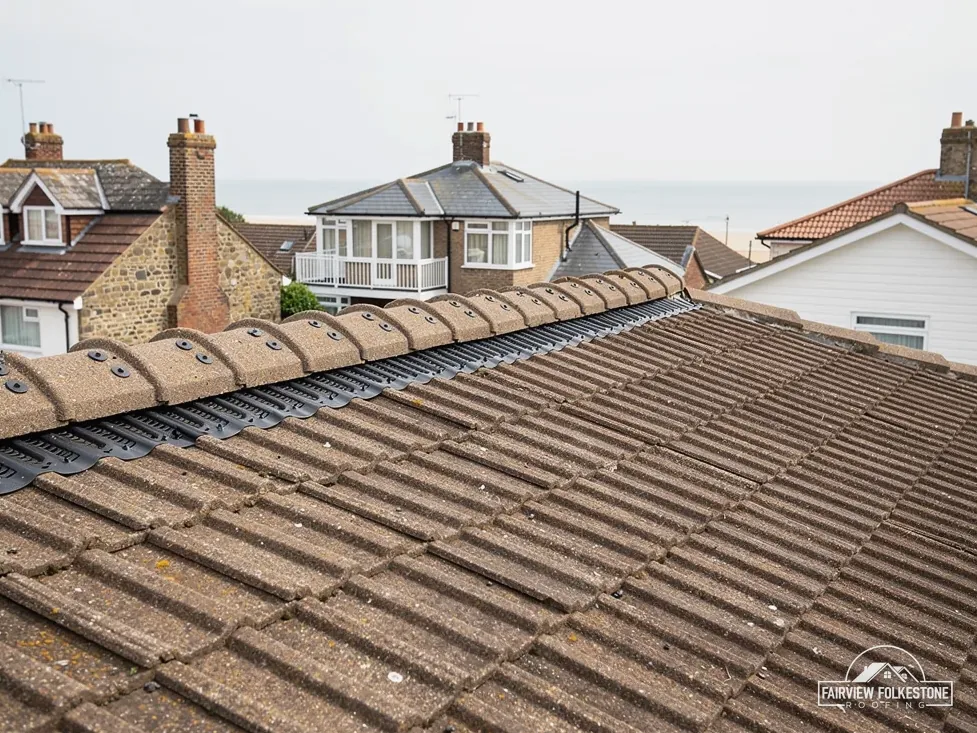
- The state of the ridge and hip lines, and any gaps along them.
- Moss, leaves or debris sitting in valleys and gutters.
- Chimney pots, the flaunching (the mortar bed around the base of a pot) and the top of the stack.
- The layout of the roof, which helps where a flat extension roof meets a pitched slope.
What a drone cannot do is touch anything. It cannot lift a tile to see the batten beneath, tap a ridge to hear whether the mortar has gone loose, or tell a hairline crack from a shadow. A join between lead and brickwork can look sound from above and still have a lifted edge that only a hand would find. Images also depend on the day: low sun, wet glare and cloud all change what the lens picks up.
The quality of the record depends on the person flying. A set route around the roof, with close passes over each chimney, valley and abutment, gives you images you can use. A single high pass over the ridge gives you a postcard. Ask to see a sample before you pay for the visit.
02The detail
What a ladder at the eaves adds
A ladder gives something a drone cannot: hands on the roof edge. From the eaves a roofer can look closely at the gutter, the fascia and soffit (the board and the underside of the overhang), the first few courses of tiles and the way the underlay laps down into the gutter. A tile can be tapped, a slipped one can be lifted for a look, and a gutter joint can be checked by hand.
Drone and ladder inspections: your questions
Can a drone survey replace a visit to the loft?
No. A drone shows the outer surface from above and cannot see the rafters, the underlay or any damp inside. A loft check cannot see the outside of the covering either. Where both are possible, each one fills a gap the other leaves, and a report should say which parts it could not see.
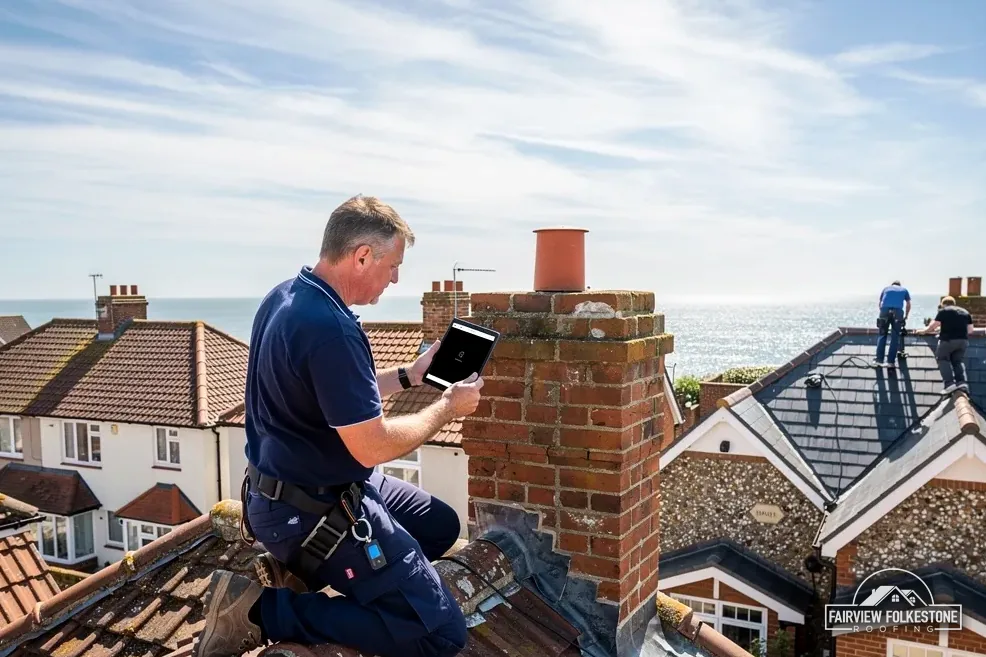
The limit is reach. From the ladder the lower part of the slope is clear and the rest sits at a shallow angle, so the ridge, the far slope and the top of a chimney are out of view. Getting to them means going onto the roof, and that is a decision about safety before it is a decision about thoroughness. Wet tiles and slates are slippery and a roof edge is a fall risk, so a careful inspector does not climb onto a roof that cannot be reached safely.
The eaves are also where a close photograph tells most. A fascia board gone soft, a gutter that has dropped away from its fall, and an underlay edge that has curled all show at arm's length, and none of them shows clearly in a picture taken from high above the roof.
A ladder also needs somewhere to stand. A firm, level base clear of a conservatory roof, a porch or a bay window matters more than the height of the ladder. Where there is no safe footing, the answer is another method, or access equipment set up for the job, never a longer stretch.
03In brief
What only the loft can show
The loft shows the roof from the side the weather has to get through. With a torch, someone standing on the joists can see whether daylight comes through the covering, whether the underlay is torn, sagging or has slid, whether timber is stained, and whether there is damp near the chimney, a valley or a roof window. A leak shows in the loft long before it reaches a ceiling.
- Daylight at the ridge, the eaves or around a chimney stack.
- Dark staining on rafters and battens, particularly below a valley or a flashing.
- Underlay that is torn, bunched or hanging away from the rafters.
- Condensation on the underside of the covering, or on pipes and tanks.
- Droppings, nests or a smell that point to something living in the roof space.
The loft has limits as well. It says nothing about the outer face of the covering, and insulation or boarding laid over the joists can hide the timber you want to see. RICS's spray foam guide warns that foam over the rafters means the timber "cannot be fully seen or inspected", so a loft with foam on the rafters gives this method much less to work with. If you meet a bird's nest while you look, leave it alone: the Wildlife and Countryside Act 1981 treats intentional damage to a wild bird's nest as an offence once the nest is in use or being built. Wait until the nest is empty and ask a roofer how to work around it.
04Side by side
Side by side: what each method shows and misses
Laid out together, the three methods are less rivals than partners. Each row below lists what the method does well and what it leaves unseen.
Each method also carries its own risk to the roof and the people on it. Walking a slope can crack tiles that were sound, and a loft visit can disturb insulation and stir up dust, while a drone touches nothing at all. Weigh that against what each can find. A sound roof with one doubtful corner may only need a drone and a ladder at the eaves; a roof with a stain on the ceiling below it needs the loft before anything else.
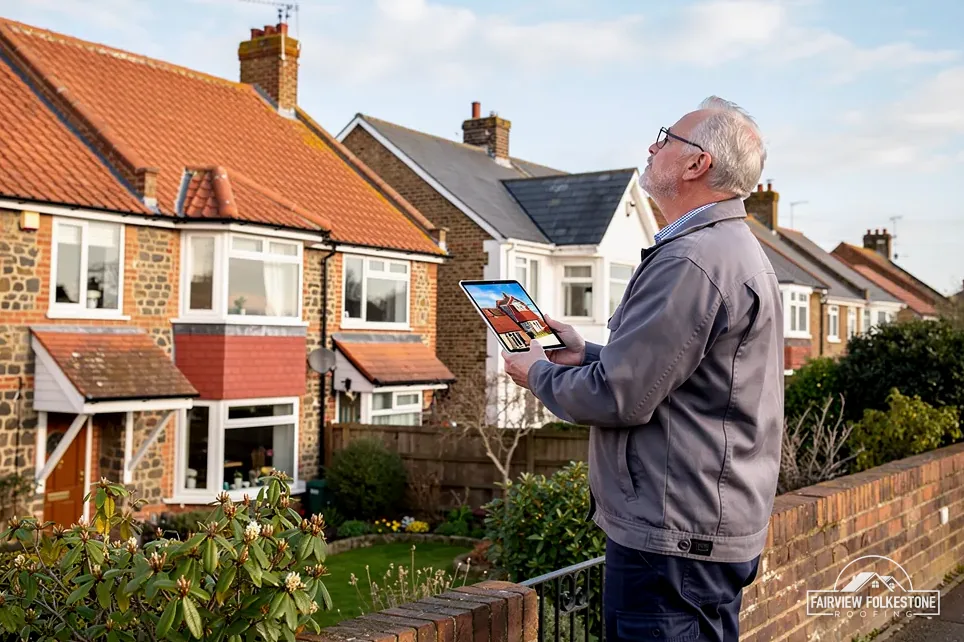
A fourth method costs nothing: binoculars from the street or the garden. It will not replace the other three, but it shows where to point them, and it lets you compare a roof from one season to the next.
Thermal imaging is a different tool again, aimed at heat and moisture patterns instead of damaged tiles. Our page on thermal imaging roof surveys explains where it fits and where it does not.
| Method | Shows well | Cannot show |
|---|---|---|
| Drone | Whole outer surface, ridge, chimney tops, back slopes | The underside, loose mortar by touch, damp inside |
| Ladder at the eaves | Gutters, fascia, soffit, lower courses up close | The ridge, far slopes, tops of stacks |
| Loft | Daylight, stains, underlay, timber, damp | The outer face of the covering, anything under foam or boarding |
Does a drone inspection avoid the need for scaffolding?
It can avoid scaffold for the looking stage, because nobody has to climb to see the surface. It cannot avoid it for repairs that need safe access to the roof. Check that any quote says whether scaffold is included, and ask what a highway licence for scaffold on the pavement would add.
05In order
Questions to ask before you book
Two quotes for a roof inspection can describe entirely different jobs. These questions bring the difference into the open before any money changes hands.
The cost question follows. MyJobQuote gives around £300 as the average for a roof survey (its page was updated in October 2026), but the figure moves with the roof and the access, and a quote that does not say what the visit covers is not much use. Ask whether scaffold or other access equipment is included, because a job that needs it is a different job.
Ask, too, how long the images will be kept and in what form. A record you can open next year lets you set it beside a later visit and see whether a stain has spread or a gap has widened, which is worth more than a verdict you cannot check.
A report that marks a part of the roof as not inspected is doing its job. The report to be wary of is the one that describes every part of the roof in confident terms when the method used could never have reached it.
- Which methods are in the price, and which are left out?
- Will someone go into the loft and look at the rafters and the underside of the covering?
- If a drone is flown, who is flying it, and what permissions does the operator need for your address?
- Will you receive the images and notes in writing, with a line on what was not seen?
- Is each fault shown in a close-up, not only in a distant frame?
06Background
Putting the three together on one roof
On a pitched roof with a loft, a sensible order runs from the ground to the loft, then the eaves, then the roof surface where it can be reached safely. Each step tells the next where to look. A stain on a landing ceiling points to the loft; a damp rafter in the loft points to the slope above it; and a picture from above of a slipped tile shows exactly where a ladder should go.
What should an inspection report show me?
It should name the methods used, show each fault in a close photograph, mark the parts that were not seen, and give a verdict on each finding. A list of problems with no view of the roof or the loft behind it is hard to act on, and harder to compare with a second quote.
A drone earns its place where the slopes are out of sight and a climb would add risk for little gain: a tall house, a steep back roof, a stack that cannot be seen from the street. The ladder and the loft earn theirs wherever something needs feeling, lifting or measuring. If the images show a worry, someone then has to put hands on it, and that is where a survey turns into a repair or replace decision.
At that point the useful result is a clear verdict on each fault: repair, replace or leave alone. We say which and why, and a sound repair comes before any talk of a new roof. Whichever mix of methods you choose, ask for the findings in writing so that a second opinion has something to work from. If you want to see how access shapes the visit, read our answer on inspecting a roof without scaffolding, and for what the loft check covers, what a roofer checks in the loft. The wider picture sits on our roof inspections page, and the written quote for any work that follows is one total price after a survey.

Tell us what's wrong with the roof.
You'll get one written total price.