
Checking a roofer
Do roofers need qualifications in the UK, and what can you check?
The rules on roofing attach duties to the job, not a single badge to the person. Below: what those duties are and what you can check before you say yes.
The short answer
No single roofing qualification is a condition of quoting for your roof under the Building Regulations, CDM 2015 or consumer law. Those rules set duties for the work: care and skill, a construction phase plan, and a route for checking the job. So the useful question is what you can verify. Ask for proof of any qualification or membership a roofer mentions, and check it with whoever issued it.
4 min read · Part of Roofing in Folkestone
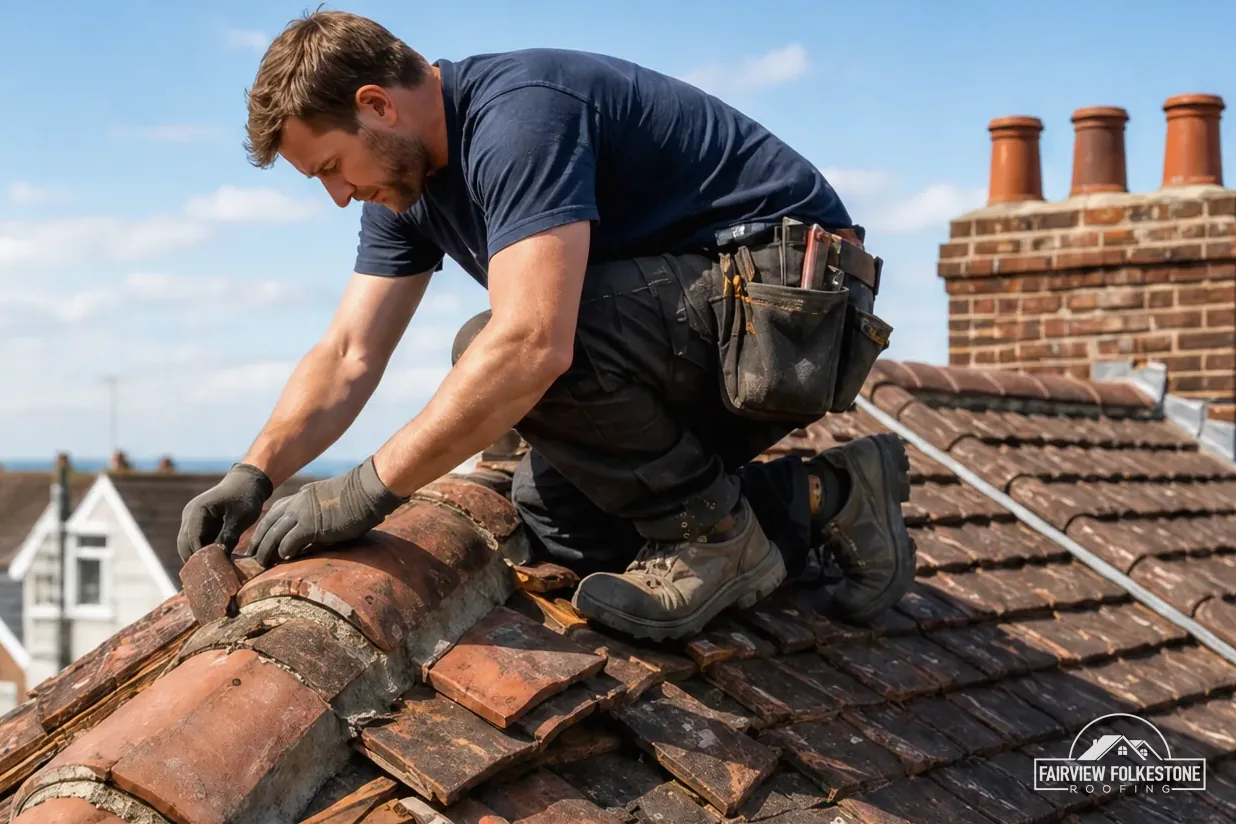
What the rules attach to the work
Where the rules reach a roofing job, they put duties on whoever carries it out. Three of them matter to a homeowner.
- Consumer law. Section 49 of the Consumer Rights Act 2015 is headed with the words reasonable care and skill: a service has to meet that standard.
- CDM 2015. As a domestic client you hand your own client duties to the roofing contractor, or to the principal contractor if several firms share the site, and every project carries a construction phase plan, however small.
- Building Regulations. When a re-roof needs approval, someone independent checks it: the council's building control officers, or a registered building control approver.
None of these asks you to see a certificate. Each asks whether the work was done to a proper standard and whether the paperwork exists. A roofer's competence shows in how they survey, the notes they write down and the method they describe, so read those closely before you sign, and keep copies afterwards for the next owner of the house.
Ask for the construction phase plan by name. A roofer who has never heard of it has told you something.
Five things you can check yourself
Claims are easy to make and slower to check, so ask for the evidence and then follow it up. Do this before any deposit changes hands.
- Ask for a written quote with one total price, not a figure given on the doorstep, and read what it covers.
- Ask which qualification or membership is meant, then contact the body that issued it. A logo on a van proves nothing by itself.
- Ask who arranges the scaffold licence if scaffold goes up over the pavement or the road. We arrange the licence with our scaffolder.
- Ask how asbestos will be handled if the building was built or refurbished before 2000, because HSE advises assuming it is present.
- Ask which route will check the work if the job needs Building Regulations approval: the council, or a registered approver.
A roofer who answers these plainly and in writing has told you more than a certificate would. One who bristles has told you something as well. The next section turns the claims you are likely to hear into questions.
Claims you may hear, and a better question
A claim is a prompt for a question, never an answer in itself. The table pairs each of the usual ones with something specific to ask.
| What you are told | What to ask |
|---|---|
| I am fully qualified | Which qualification, awarded by whom, and can I check it? |
| We belong to a trade body | What is the membership number, and what does the body say? |
| I know roofs like yours | May I see a recent job like mine, and the written scope for it? |
| No survey needed | How can the price be fixed without looking at the roof? |
Notice that the table ranks nobody. A badge is a starting point for a question, and the reply should arrive in writing. If a trader will not give a straight reply, the Citizens Advice consumer helpline on 0808 223 1133 can say what your options are, and a contract made in your own home can be cancelled up to 14 days after the day you sign, which is worth knowing before any money changes hands.
Asbestos is where who does the work really matters
One part of roof work does turn on who may carry it out. HSE sorts asbestos work into non-licensed, notifiable non-licensed and licensed. Cement sheeting from an old roof sits in the first group when it is handled with care and lifted off whole. If it has been substantially damaged or broken up, the job becomes notifiable non-licensed work. Insulating board is different. HSE lists it among soffit materials, and the work is licensed wherever the risk assessment says it will not be of short duration. A roofer should not assume that licence is held, and neither should you.
So a roofer who finds board in a soffit has to stop and tell you, not carry on. We flag the finding, and the work waits until the right route is agreed. For the waste, HSE guidance wants a lockable skip, not an open one, so ask where the sheeting will go.
For what a quote should say about all this, see the page on what a written roofing quote should include. The homepage lists the full range of roof work.
More questions
Does a roofer need a licence to remove asbestos?
It depends on the material. HSE treats careful, intact removal of asbestos cement sheets as non-licensed, and broken-up cement as notifiable non-licensed work. Insulating board is licensed wherever the job is not of short duration. If a roofer finds board in a soffit, the sensible step is to stop and get the right route confirmed before anything is disturbed.
Who checks that roofing work meets Building Regulations?
Building control does, through the council's team, or an approver on the registered list. The Planning Portal's guide puts the line at 25 per cent of the envelope and 50 per cent of the roof: a job below both lines normally goes ahead without an application. Ask your roofer which route fits your house before the quote is signed.
More from the blog
All guides and posts
Tell us what's wrong with the roof.
You'll get one written total price.