
Insurance and roofs
Does home insurance cover roof damage, and what does it leave out?
Whether a policy pays for roof damage turns on its wording and on how the damage happened. Below: how storms are judged, what to do, and where disputes go.
The short answer
It depends on your policy wording and on what caused the damage, so no one can say in advance whether a claim will be paid. Storm damage is the usual head of cover, and the Financial Ombudsman Service describes a storm as usually involving violent winds, usually with rain, hail or snow. A tired roof is a different story: if an insurer leans on an exclusion, the insurer must show that it applies. Read your schedule, tell your insurer first, and keep the evidence.
5 min read · Part of Roofing in Folkestone
How a storm is defined
Policies tend to pay for damage caused by a storm and to leave out damage caused by wear. The border between the two is where disagreements start, so it helps to see how the Financial Ombudsman Service reads the word. Its storm-damage guidance takes the Beaufort Scale into account, and it notes that certain insurers treat only winds past a particular point on that scale as storm-force.
The same guidance adds that snowfall, hail or rain by itself can constitute a storm. So the weather does not have to be a gale. What counts is whether the weather, rather than the slow ageing of the covering, caused the damage you are claiming for.
Your policy booklet and schedule hold the exact test your insurer applies. Find the storm definition, and any list of things the policy does not pay for, before you phone. Note the excess too, because a small repair may sit below it. A roofer can describe what is visible on the roof, but only your insurer decides what the policy covers. The Ombudsman's own storm damage guidance sets the point out in full.
What to do in the first hours
Order matters more than speed. These steps protect the roof and the claim together.
- Ring your insurer before arranging any permanent repair, and ask what they want from you.
- Stop the damage spreading with a temporary repair, such as sheeting over the opening.
- Take photographs before anything is shifted, from outside at ground level and from the loft or room below.
- Keep every receipt, temporary work included.
- Ask the roofer to write down what was found and what seems to have caused it, in plain terms.
The Ombudsman says it will usually look at expert reports and photos, and that the insurer will normally send a surveyor to write a report. Pictures you took early give that surveyor something to compare against, and they cost nothing. A short video walk-through of the room below, showing any stain or drip, is useful too.
We cannot handle a claim on your behalf or tell you that one will succeed. What we can do is write up what the roof needs, so that the facts are on paper in the order they were found.
What a policy tends to leave out
The table sets out common causes of damage beside the question an insurer is likely to ask about each one.
| What happened | Question the insurer asks |
|---|---|
| Tiles lifted in a storm | Did the weather meet the policy's storm definition? |
| Slow leak from a worn covering | Does a wear or maintenance exclusion apply? |
| Damage after a poor earlier repair | Does a workmanship exclusion apply? |
| Water in after a missing tile | Was the roof maintained, and what caused the loss? |
Exclusion wording varies from policy to policy, so the table shows questions, not answers. The Ombudsman's point is the one that matters: the burden sits with the insurer, which has to prove an exclusion applies, for example with an inspection report. A refusal is therefore something you can ask them to back up in writing.
Roofs also wear out with age and no single event to blame. A survey every so often, filed with your papers, records the state of the roof on a given date.
If the claim is refused
Begin with the insurer's own complaints process; the Ombudsman expects you to go there first. Firms generally get up to 8 weeks to consider a complaint. If you still disagree with the final response, you can take it to the Financial Ombudsman Service within 6 months of the date on that response, and its helpline is 0800 023 4567.
Gather your papers before you write: the policy schedule, your photographs, the roofer's notes, receipts and each letter from the insurer. A clear timeline helps whoever reads the file, and a short covering note beats a long one. Write down when the damage happened, when you noticed it, when you told the insurer and what each person said, with a date against every entry.
Keep any temporary cover in place while the dispute runs, and keep the receipts safe. If the insurer sends its own surveyor, ask for a copy of the report, since it may be the evidence the decision rests on. For the wider cost picture, read the page on what roofers charge, and the homepage lists the roof work we carry out in Kent and East Sussex.
More questions
Do I call my insurer or a roofer first?
Call your insurer first, then arrange a temporary repair so the damage stops spreading. Take photographs before anything is moved and keep every receipt. A roofer can make the roof safe and write down what was found, while the insurer alone decides what your policy pays for, so ask before booking anything permanent.
Will my insurer pay for a whole new roof?
Nobody can promise that. Cover turns on your policy wording and on what caused the damage. Storm damage may be covered, while wear and age are the sort of thing exclusions deal with. If an insurer refuses, it has to prove the exclusion applies, and the Financial Ombudsman Service can look at the dispute once you have complained to the firm.
More from the blog
All guides and posts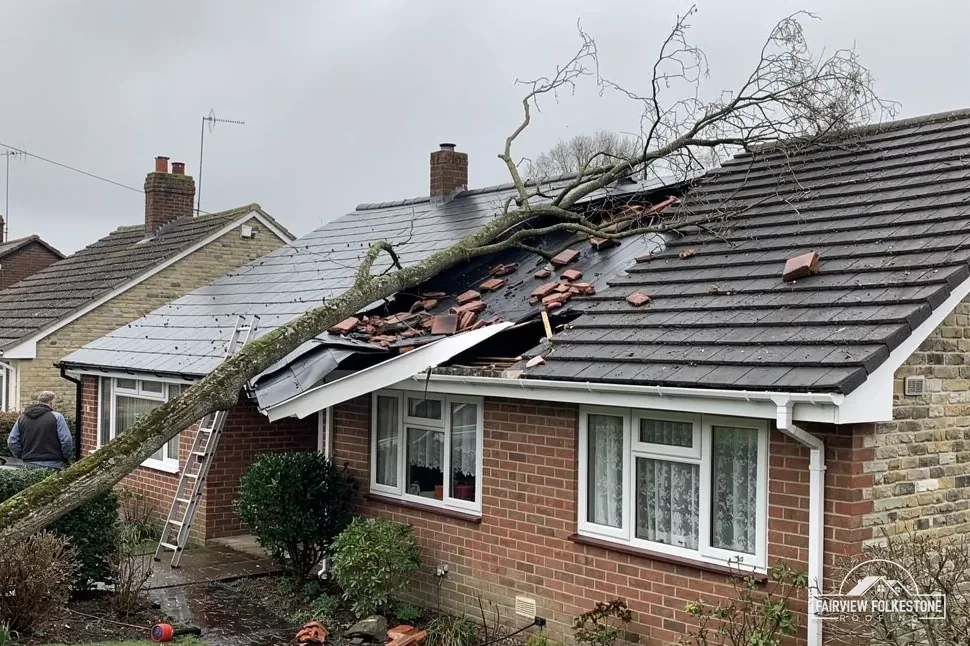
Tell us what's wrong with the roof.
You'll get one written total price.