
Roof lifespan
How long does a roof last in the UK, by material?
Roof lifespans depend on the material, the fixing and the weather it takes. Below: published figures by covering, with their sources, and what wears a roof out sooner.
The short answer
A pitched roof of slate or clay can run for 60 years or more, while a flat roof membrane is measured in decades, not generations. HomeBuilding's approximate figures are 100+ years for Welsh slate, 60-80 years for clay tiles and 40-50 years for plain concrete tiles. They are published ranges, never promises, and fixings, upkeep and exposure move the real number up or down.
4 min read · Part of Roofing in Folkestone
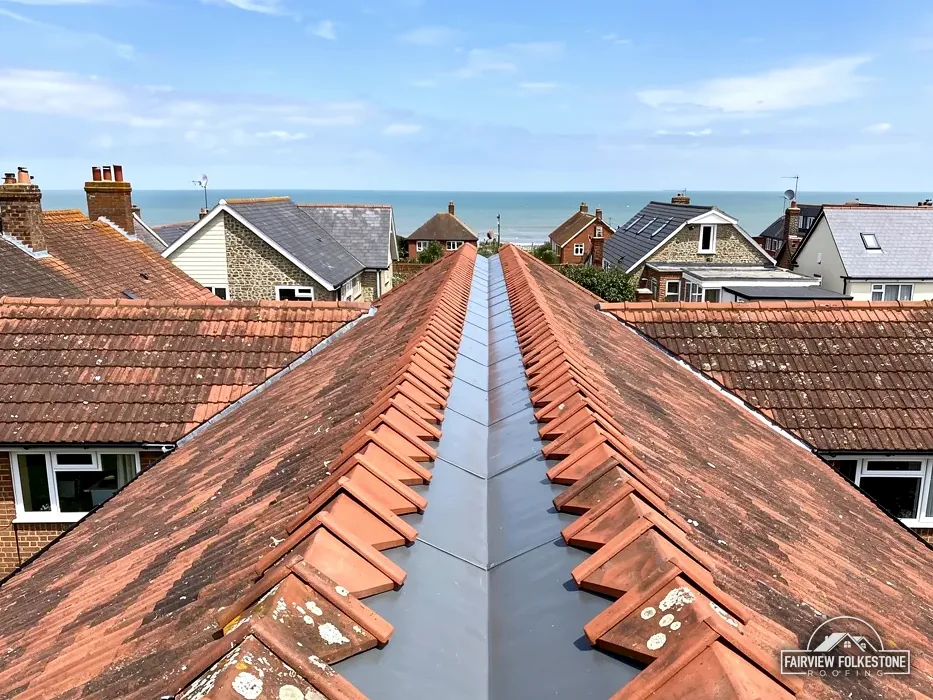
Pitched roofs: slate, clay and concrete
For slate, HomeBuilding's approximate figures run from 100+ years for Welsh slate, down to 75-100 years for Spanish natural slate and 50-80 years for reclaimed Welsh slate.
Clay sits lower. Marley, a tile maker, says the BRE determined a minimum life expectancy of 60 years for clay roof tiles, a figure that belongs to clay alone and says nothing about concrete. Elsewhere, HomeBuilding lists clay tiles at 60-80 years.
Concrete is where the sources part company. Marley expects roof tiles to last around 60 years, typically, yet stresses it offers neither a guarantee nor a warranty of longevity. HomeBuilding's range for plain concrete and double Roman tiles is 40-50 years. Two sources, two answers: quote both and read each as a rough guide. Fibre cement tiles come in shorter again, at 30-40 years on HomeBuilding's list.
Whatever the covering, the battens, underlay and fixings beneath it age at their own pace, and a covering in good order can outlast what holds it down. A survey looks at both layers, not only the surface you can see from the road. Ask what the underlay and battens look like where they can be seen from the loft, and whether any are damp or split.
Flat roofs and metal: a wider spread
Flat roof coverings disagree with each other more than pitched ones do, because the sources measure different products in different conditions. The table sets out what each publishes, with the source named. Where two sources give two ranges, both appear, and the gap between them is itself information: nobody can state one exact figure for a membrane.
| Covering | Published lifespan | Source |
|---|---|---|
| EPDM | 25-30 years; 30 to 50 years | HomeBuilding; Less |
| GRP | 25-30 years; 25 to 40 years | HomeBuilding; Less |
| Felt (torch-on) | 10-15 years; 10 to 20 years | HomeBuilding; Less |
| Lead flat roof | 60-100 years; 50 to 100 years | HomeBuilding; Less |
Zinc is the other metal worth naming. VMZinc, the maker, writes that when a zinc roof is designed and fitted correctly it can last for more than a century. That is a manufacturer describing its own product, so treat it as an upper marker rather than a forecast for your house. The roof's fall matters too: BS 6229:2025 sets a minimum finished fall of 1:80 on membrane flat roofs.
Lead flashing, fascias and conservatory roofs
Smaller parts of a roof follow their own clocks. MyJobQuote says correctly installed lead flashing can last for over 80 years, and the words can last matter: they describe what good installation makes possible, not what every flashing will reach. The lead and the way it is dressed into the wall both affect the result.
A plastic roofline has its own figure. A retailer of uPVC boards writes that, once installed correctly, they can typically maintain reliable performance for between 20 and 40 years. That is a seller's estimate, so it sits beside the others with its source attached.
Conservatory roofs differ again. HomeBuilding itself gives polycarbonate a typical lifespan of 10 years. The other two figures are credited to Roofing Megastore's managing director: his two figures are "A glass conservatory roof will likely last in excess of 30 years." and "A tiled conservatory roof will typically last in excess of 50 years with little maintenance being required." Each figure is the speaker's own, and none is a promise from us. Ask any roofer who quotes a lifespan which source it comes from.
What shortens a roof's life
Each published lifespan presumes a roof that was fitted properly and looked after. A few things pull the real figure down.
- Exposure. Cupa, a slate maker, states: "Buildings positioned on slopes, hills or coastal areas as well as tall buildings will be graded with higher exposure." That raises the demands on the fixings.
- Thin fixing. Marley notes that BS 5534 is guidance rather than law, yet after the 2015 amendments mortar could no longer serve as the sole fixing.
- Rough cleaning. Marley does not recommend a high-powered jet wash, since it can harm slate or tile surfaces and reduce the expected life considerably.
- Neglect. A slipped tile or a cracked flashing left alone lets water into the timbers below, and wet timber is slower and dearer to put right than the tile ever was.
Age alone does not decide repair against replacement. We look at what the survey finds, say plainly whether a repair is sound, and replace the roof only where that is the fair answer. The page on what a quote should include explains what to ask for, and the homepage lists the full range of roofing work.
More questions
Is a roof's age a reason to replace it?
Not by itself. The figures above are published ranges, and a roof of any age is judged by what a survey finds in the covering, battens and fixings. A sound older roof can often be repaired, and a poorly fixed newer one may not be. We say which applies and why, and a written price follows the survey.
Which roof covering lasts longest?
On the published figures, natural slate and lead sit at the top: HomeBuilding gives Welsh slate 100+ years and lead flat roofing 60-100 years, and VMZinc writes that a zinc roof can last for more than a century. Felt and uPVC sit lower. These are sources' figures, not promises, and installation matters as much as material.
More from the blog
All guides and posts
Tell us what's wrong with the roof.
You'll get one written total price.