
Roof replacement timing
How long does a full roof replacement take?
No fixed number of days fits every house, so the timetable is set in writing after the survey. Below: what moves it and the notice periods that come first.
The short answer
The answer turns on the size and shape of your roof, the covering chosen, the weather and anything the strip uncovers, so we put a start window and an expected number of working days in writing after the survey, not a stock figure. Notice periods can run first, among them scaffold licence applications and, for some jobs, party wall notices, and these lengthen the calendar even when the roof work itself is quick.
4 min read · Part of Roof replacement

What lengthens or shortens the job
Two roofs with the same footprint can take very different times. The survey looks at the points below, and each one moves the estimate.
- the roof area, and how many slopes, hips and valleys it has
- the covering going on, since some are laid faster than others
- how many battens and rafters need replacing once the old covering is off
- chimneys, leadwork, roof windows and gutters that belong to the same job
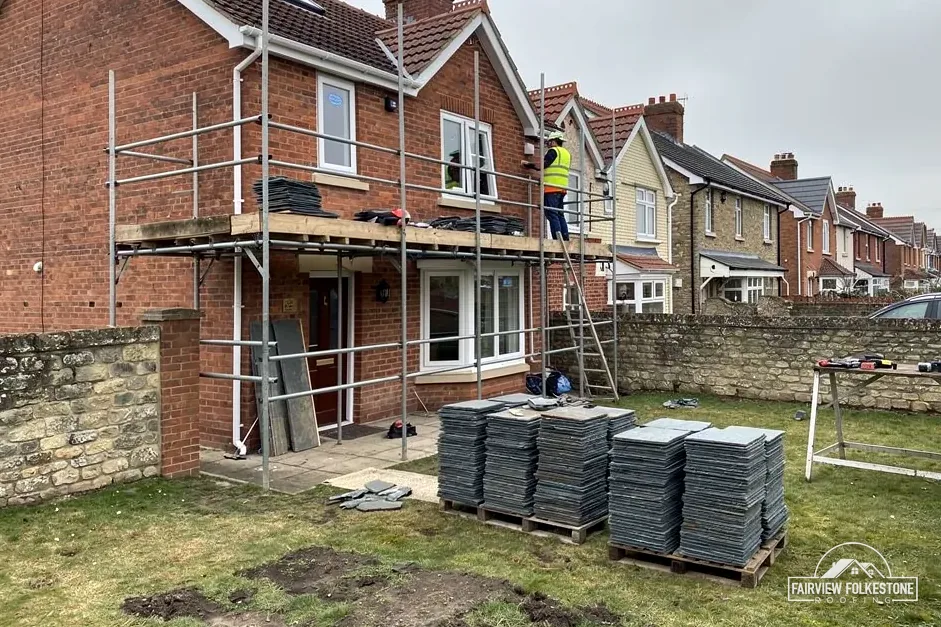
- room for the scaffold, the materials and the skip
- rain and wind on the days planned
If stripping exposes a defect hidden from the survey, soft battens for example, you hear about it before it is added to the job. A small, simple roof with easy access sits at one end of the range, while a large roof with several hips, valleys and chimneys sits at the other. To read any timescale sensibly, ask what it assumes: the number of people on the roof, the days the scaffold is up, and whether the skip is collected on schedule. A figure that states none of those is a guess. Weather is the one input nobody can fix ahead, which is why a window of dates suits a roof better than a single day.
Notice periods that come before the first tile
Some of the waiting is set by rules, not by the roofers. Not every row applies to every house.
| Step | Notice | Set by |
|---|---|---|
| Scaffold licence in Kent | Applications, renewals included, 5 working days before the start | Kent County Council |
| Scaffold extension in East Sussex | Applied for no later than five working days before expiry | East Sussex Highways |
| Party wall notice for work to a party wall, such as cutting away a chimney breast | At least two months | Party Wall etc. Act 1996 |
| Party wall notice for a new boundary wall or nearby excavation | At least one month | Party Wall etc. Act 1996 |
| Cancelling a contract signed at home | 14 days | Consumer Contracts Regulations 2013 |
A neighbour can agree to an earlier start by giving written consent. A surveyor comes into it only where the neighbour dissents or stays silent for 14 days. Together, these rows mean a start date can sit weeks after you say yes, so ask at the survey which of them apply to your house.
Scaffold permits and a job that runs on
Scaffolding that obstructs a public road or pavement cannot go up without a licence, and each licence covers a set period. Kent County Council licenses scaffolding on the highway at £52 per week for 2026 to 2027, for 7 calendar days per permit, and its page says the scaffolding company should submit the application. We arrange it with our scaffolder.
For Rye and Camber, the licence is issued by East Sussex Highways, whose fee table gives £127 for 28 days. It is wise to confirm the amount in force, because the site quotes two different April 2026 uplifts. Each authority states its fee in its own unit, so the two are not like for like.
A job that runs past the permit needs a renewal in good time. If bad weather stops work for several days, ask whether the permit will have run out, and have the quote say that any renewal sits inside its one total price. Our page on working in the rain explains how wet days are handled.
Putting the timetable in writing
A quote for a full re-roof should state more than a price. Before you accept one, ask for these in writing:
- a start window and the number of working days expected
- how each slope is kept covered overnight
- what happens to the timetable if rafters or battens need work
- who arranges the scaffold licence, and for how long it runs
- how an asbestos finding would be handled
On that last point, HSE's advice for a building built or refurbished before 2000 is to treat asbestos as present. Whole cement sheets that are carefully lifted out count as non-licensed work, while most jobs involving asbestos insulating board fall under HSE's licensing rules, so a finding can change who does the job and when. Keep the answers in an email, since a start window agreed by phone is easy to forget by the first morning on site. The roof replacement page follows the job from survey to clear-up, and the page on living at home during the work covers the days themselves.
More questions
Can work begin the day after I sign the contract?
Only if you request it in writing. A contract signed at home after a survey can be cancelled within 14 days, and beginning sooner needs your written request. Ask for the start date to be stated in the quote. An urgent repair visit that you specifically asked for sits outside this arrangement, with no cancellation right attached to it.
Can finding asbestos delay a roof replacement?
It can. Soffits and cement sheets get checked ahead of stripping, in line with HSE's pre-2000 rule. Careful removal of intact cement sheets needs no licence, but HSE treats most work on asbestos insulating board, which it lists among soffit panels, as licensed, so the person doing the work and the date can both change.
More on roof replacement
All guides and posts
Tell us what's wrong with the roof.
You'll get one written total price.