
Living through a re-roof
Can you live in the house while the roof is replaced?
You can stay put when the plan keeps the roof covered and the house safe. Below: what to expect, what can change the plan and what to settle first.
The short answer
Yes, where the plan keeps the roof covered overnight and the rooms below stay safe to use. The work is noisy overhead, it shakes loose items on walls and in the loft, and a scaffold takes daylight from some windows. Findings such as asbestos or a bat roost can change the plan, and we raise any of them with you straight away.
5 min read · Part of Roof replacement

What the work is like from inside
Stripping and refixing a roof happens right above your head, and a few effects are worth planning for.
- Noise from stripping, hammering and tile cutting, loudest in the rooms under the working slope.
- Vibration that can move pictures, shelves and anything stacked in the loft.
- Dust that drops through the loft hatch and settles on boxes and furniture.
- Scaffold boards across windows, which cut daylight and affect privacy.
- Workers moving around the outside of the house, including near doors and gates.
Empty the loft of anything you would mind seeing dusty, take pictures off the walls under the working slope, and hold the garden side clear of children and pets while materials are moving. Tell us about anyone who works nights, is unwell or needs quiet, so the order of slopes can be planned around them. Working from home during a re-roof is possible but loud, so a call-heavy day might be better spent elsewhere. Pets can be unsettled by the noise and the unfamiliar people outside, so plan a quiet room away from the working slope for them. Close internal doors on the working side to keep dust and noise down.
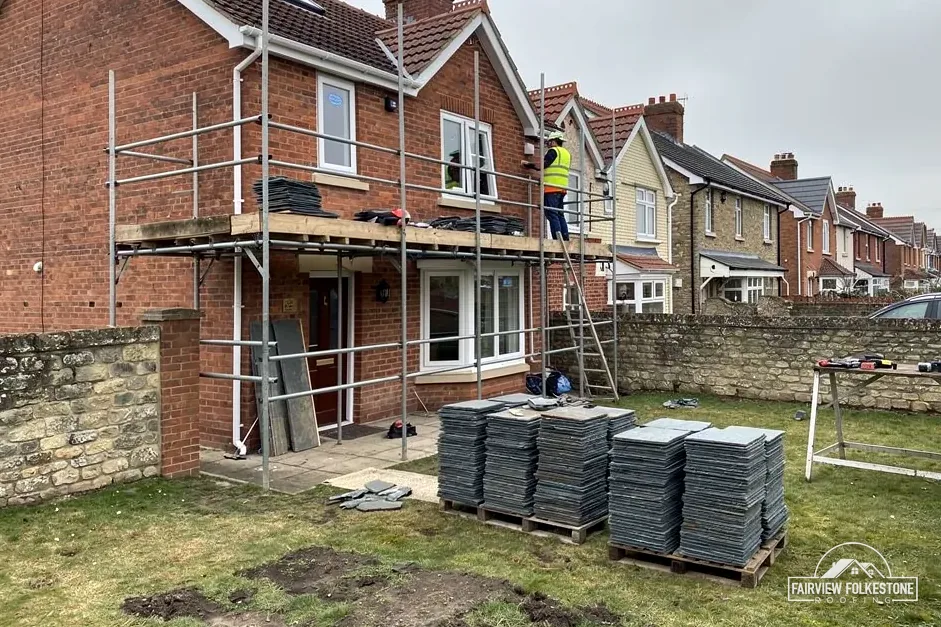
Scaffold, access and the street
Where scaffold stands on the highway, a licence is needed from the county council, and we arrange the licence with our scaffolder. The two counties we cover set their terms differently.
In Kent, the council licenses scaffolding at £52 per week for 2026 to 2027, with 7 calendar days per permit. Its terms say that if the scaffold is walk around, there must be a minimum distance of 1.2 metre between the scaffold and carriageway for pedestrian access.
In East Sussex, which includes Rye and Camber, East Sussex Highways lists a fee of £127 covering 28 days; confirm the amount in force before relying on it. Its terms ask for a clear passageway for pedestrians of at least 1.5m, with a clearance of at least 450mm between the scaffolding and the carriageway edge.
A scaffold also fixes where the skip and materials stand, and how visitors, post and deliveries reach your door. Settle those points at the survey, when the layout can still change, and tell neighbours who share the pavement. Ask where the ladder access will sit, since it can limit where you park or walk.
Findings that can change the plan
Some discoveries are decided by law, not by the roofers. You should know how each would work.
- Asbestos: for a building built or refurbished before 2000, HSE advises assuming it is present. Asbestos goes in a lockable skip, never an open one, and household asbestos is not covered by the consignment-note exemption.
- Bats: GOV.UK guidance treats bats, their breeding sites and their resting places as fully protected, with repair or replacement of a roof named among the activities concerned. Under the Habitats Regulations the protection for a breeding site or resting place carries no intent requirement.
- Nesting birds: under section 1 of the Wildlife and Countryside Act 1981 a person commits an offence by intentionally taking, damaging or destroying a nest that is in use or being built, whichever wild bird it belongs to.
In any of these cases we stop the affected area and talk to you before going further. The finding may add time, so it is raised before the work resumes, and nothing restarts until you have been told what was found.
Questions to settle before the start date
Agree these with whoever is doing the work, and have the answers in your written quote or covering email.
- How is each slope kept weathertight when the crew leaves?
- Which rooms and which parts of the garden should be cleared?
- Where do the skip and the materials stand?
- When does the scaffold licence start, and how long does it run?
- Who do you call on the day if something moves in the house?
- How can you be reached during the day if a decision is needed while the roof is open?
If anyone in the household has a health condition that noise or dust affects, say so at the survey, so the plan can allow for it. Take a photo of each ceiling before work starts, so any later mark can be compared. Sign at home after our survey and you may cancel for 14 days, with work starting sooner only on your written request. Neighbours matter too: the party wall page explains when a notice is needed. The page on how long a replacement takes explains the timetable, and the roof replacement page covers the job as a whole.
More questions
Do I need to warn the neighbours about a re-roof?
A friendly word is wise because of the scaffold and the noise. A legal notice is a separate matter: the building owner serves a party wall notice at least two months ahead for work to a party wall, such as cutting away a chimney breast. Questions on that go to a party wall surveyor, not to building control.
Can I cancel if living at home turns out to be hard?
If you signed at home after our survey, you have 14 days to cancel, and work starts sooner only if you ask in writing. After that period, talk to us about the plan first, since the order of slopes may be changed. The Citizens Advice consumer helpline on 0808 223 1133 explains your rights.
More on roof replacement
All guides and posts
Tell us what's wrong with the roof.
You'll get one written total price.