
Roof window lifespan
How long do Velux windows last?
No single number fits every roof window, because its life depends on the parts and the roof around it. Below: what wears, what the covering lasts and when to replace.
The short answer
No one figure covers every Velux window, because a roof window is several parts with different lives: the frame, the glazing seal, the hinges and the flashing kit. A window that has been kept dry and looked at can stay in service well beyond one that has been left to weep. We read the window on the roof, then say whether it can be mended or should be replaced.
5 min read · Part of Roof windows & skylights

Why no single figure fits
Lifespans are published for slate, tile and lead, but not for the roof window itself, so this page gives no number for it. A figure pulled from a sales page would sound firm and mean little, because the same model ages differently on two roofs.
Three things pull a window's life one way or the other:
- how often the room behind it fills with damp air, since moisture on the timber frame wears it
- how well the flashing kit was fitted to the covering, because a poor fit lets rain in at the frame
- how exposed the slope is, and Cupa, a slate maker, writes: "Buildings positioned on slopes, hills or coastal areas as well as tall buildings will be graded with higher exposure."
A window on a sheltered back slope and one on a slope facing the open Channel are not the same test, even when they are the same make and size. The way the window is used counts too: a bedroom window opened every morning wears its hinges and seals differently from a landing window opened twice a year, and a window that is never opened can seize.
The parts that wear, and what to do
A roof window ages part by part, and each part gives a sign before it fails. The table pairs the sign with the usual way forward, so you can tell a repair from a replacement before anyone climbs on the roof. Take a photo of each sign, and note whether it gets worse after rain or only on cold mornings, as that detail helps the survey.
| Part | Sign of age | Way forward |
|---|---|---|
| Glazing unit | Mist between panes | New glazing unit |
| Hinges and handle | Sticking or a dropped sash | Adjust, then replace the part |
| Timber frame | Soft or dark lower rail | Replace the window |
| Flashing kit | Lifted or split edges | Replace the kit |
Two of these are quick to put right when caught early, and we can tell from inside the room which part has gone. A sash that drops, for instance, may only need its hinges set again. A soft frame is a bigger job, because the rot can reach the lining by the time it shows.
How the roof round it compares
The covering around a window has published lifespans of its own, and they are worth knowing, because a window and its roof can be planned together. HomeBuilding gives approximate lifespans of 100+ years for Welsh slate, 60 to 80 years for clay tiles and 40 to 50 years for plain concrete tiles. Marley expects its own tiles to reach around 60 years, and it adds that this is not a guarantee. Where two sources give different figures, as they do for concrete tiles, it is fair to read both.
For flashing in lead, MyJobQuote says correctly installed lead flashing can last for over 80 years. Lead is only one material that can be used round a frame, and the window parts inside the flashing are not covered by that figure.
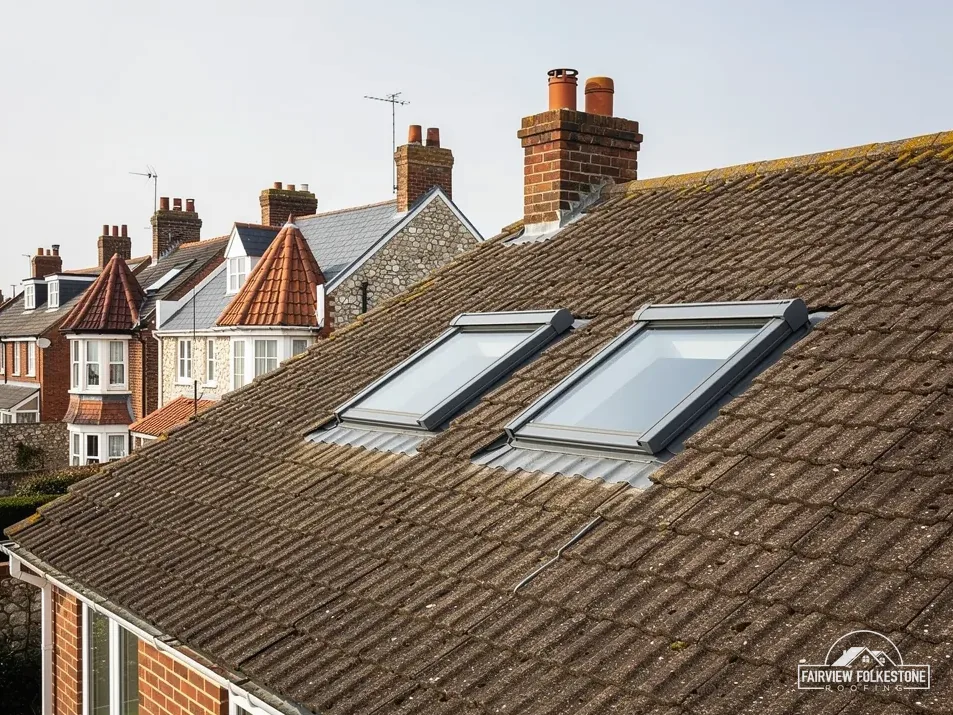
The practical gain is timing. If the covering is close to the end of its life, replacing it with the windows in one go means one scaffold and one set of tiles or slates lifted around each frame, instead of two visits to the same slope. The tiles beside each frame come off anyway when the covering is renewed, so the flashing kits can be fitted new as the roof goes back, and the window and roof start their next stretch together.
Mend, reglaze or replace
The decision follows the survey, and it follows the part that has gone. A misted glazing unit with a sound frame is a candidate for reglazing, which our page on Velux reglazing covers. A rotted frame, or a sash that will not seal, points to replacement, and the page on replacing a Velux window like for like sets out how a swap is done.
The price matters here. MyJobQuote states: "Average cost for a standard mid-range Velux window is £1,100." A straightforward swap comes in around £100 lower, since the opening already exists. Under Approved Document L 2021, a new roof window has to meet 1.4 W/m²K or Window Energy Rating Band B, so a swap can lift the performance of the opening as well as its looks. A rotted frame can bring the lining and the insulation behind it into the job, and the survey looks at those before the price is set.
Our roof window installation page explains the survey, and the written price that follows it is one total.
More questions
Does condensation shorten the life of a roof window?
It can, when the moisture sits on a timber frame day after day and the paint or finish gives way. Damp that is cleared by ventilation does far less harm than damp left to dry on its own. Our page on condensation on Velux windows explains how to cut the moisture and where the fault lies in the roof.
Should I replace an old roof window before it fails?
Not on age alone. A window with a sound frame, a working sash and clear glazing has life left, whatever the date on it. Replacement makes sense when the signs add up, or when the roof is about to be re-covered and the work can share one scaffold. A survey will tell you which side of that line yours is on.
Tell us what's wrong with the roof.
You'll get one written total price.