
Slate on period houses
Slate roofs on Folkestone's Victorian and Edwardian homes
If your Folkestone house dates from the Victorian or Edwardian years and still has slate on it, this covers reading the roof, the rules, and when a repair beats a re-slate.
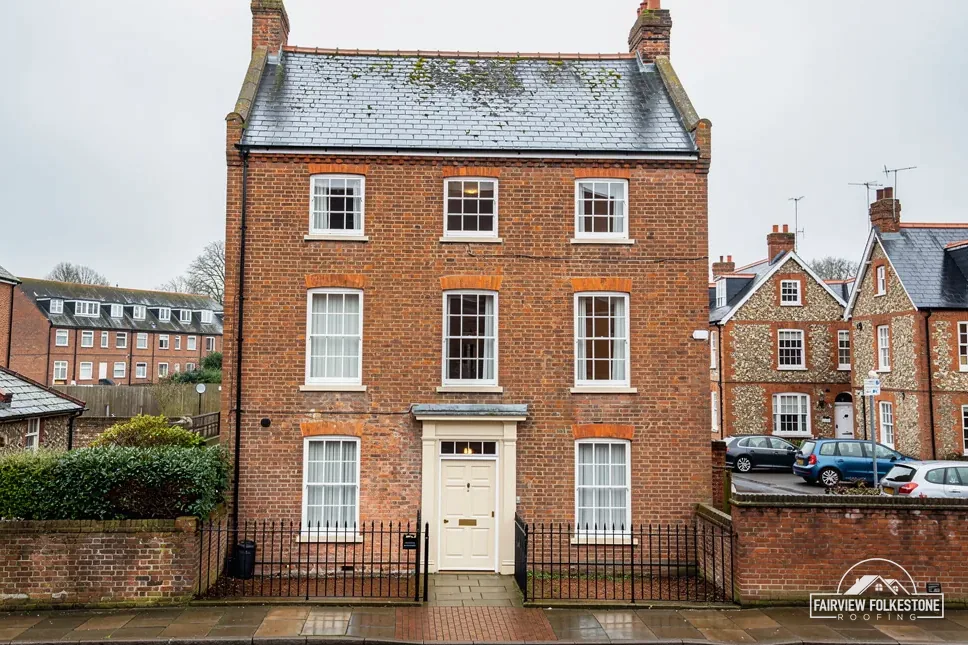
A slate roof on an older house is easy to admire from the pavement and hard to judge from it. The covering can look even and grey from the street while the nails underneath are tired, and a roof that looks patchy may have nothing wrong with the slates themselves. Telling the two apart is the first job on any older slate roof, and it comes before any talk of repair or replacement.
We are not going to tell you what your street's roofs are made of, because nothing reliable counts them. This post is for the owner who already knows their own house has slate, and wants to understand it. It covers how to read the roof from the ground, how long slate can last according to published figures, what the fixing and pitch rules say, and how conservation areas, Article 4 directions and listed status affect work on an older house in Folkestone and the places around it.
At the end there are published costs and a short test for repair against re-slate. A survey from the loft and the roof is what settles it for a particular house, and that is where we begin.
01Slate
Reading a slate roof from the pavement
Plenty shows from the pavement. Choose a dry, bright day, cross the road or use binoculars, and take in the whole roof before you study any single slate. Then work through what you see.
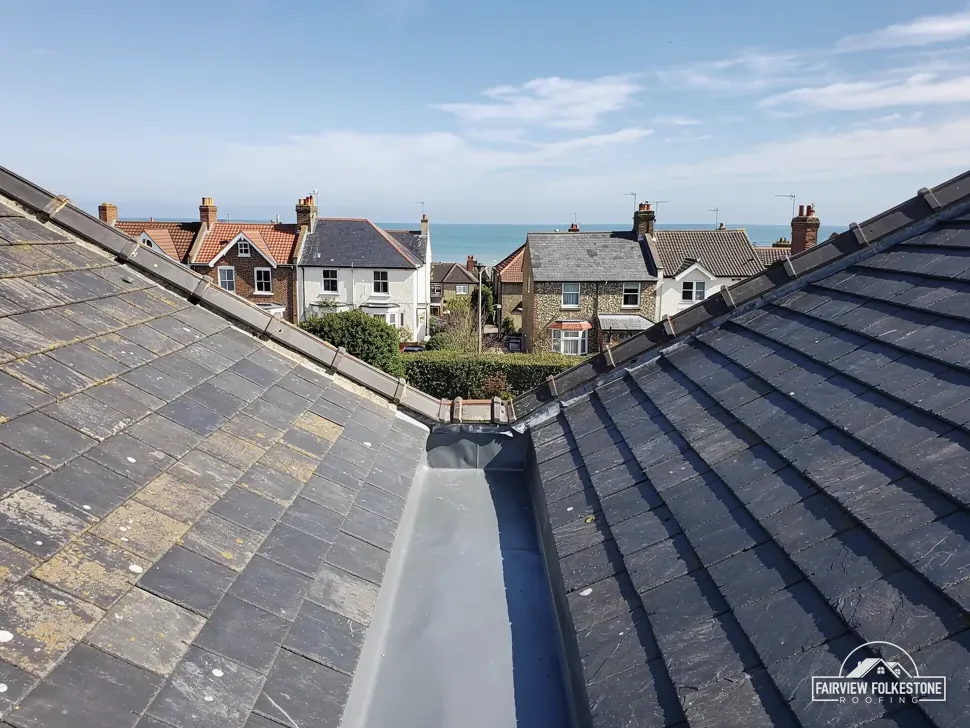
- A slipped slate shows as a dark gap, or a slate hanging lower than the rest of its row.
- A line of slates sitting proud of its neighbours may mean the fixings behind it are working loose.
- Flashings in the angle beside a chimney stack or a party wall should lie flat and tight, with no lifted edges.
- Ridge tiles should run in a straight, unbroken line.
- Gutters and downpipes should be clear and true, since a blocked gutter sends rainwater down the wall and under the eaves.
Then look at colour and surface. A roof with patches of different shades may have been repaired with other slates at some point, and that is not a fault on its own.
Inside the loft, a torch shows the underside. Daylight through the covering means a gap, and stained timber means water has been getting in. Photograph what you find, with a note of where it is, because it helps whoever surveys the roof. Each of those signs points to a different fault, and the survey sorts one from another.
Please do not walk on the slates yourself. They snap underfoot, and a wet slate roof is slippery.
02Slate · Lifespans
How long slate lasts, and what age tells you
Slate has a long reputation, and the published figures back some of it up. The figures come from one source, though, so they are a guide, not a promise. HomeBuilding gives approximate lifespans by type, and they differ:
Those are approximate ranges for the slate, not for the roof. A slate roof is a system: the slates, the nails or hooks that hold them, the battens, the underlay if there is any, and the lead and ridge details. Any of those can wear out before the slate does, which is why an older roof that looks complete may still need work, and why a lifespan on paper never replaces a look at the actual roof.
| Slate type | Lifespan (approx) |
|---|---|
| Welsh slate | 100+ years |
| Spanish natural slate | 75 to 100 years |
| Reclaimed Welsh slate | 50 to 80 years |
For a Victorian or Edwardian house still on its original covering, the slates may well sit inside those ranges. Age alone is therefore not a verdict on the roof; it is a prompt to look hard at the fixings and the details, including the nails, the battens and every piece of lead. If the slates are sound and a few have slipped, a repair is the sound answer, and you hear that from us before anything bigger is suggested.
Our guide to re-slating or repairing sets out how to tell which it is.
Slate on older houses: your questions
Can an old slate roof be repaired rather than replaced?
Yes, where the slates are sound and the fault is a few slipped, cracked or missing slates, or worn lead or ridge details. The survey checks the fixings and battens as well as the slates, because those decide whether a patch will hold. We tell you which it is and why before any bigger job is suggested.
03Pitch · Fixings
Pitch, fixings and exposure
A slate roof relies on how the slates overlap and how each one is held. Cupa, a slate maker, reports that BS 5534:2014+A2:2018 indicates a minimum pitch of 20 degrees for natural slate where a site has moderate exposure and the slate is 500 mm long with a 115 mm overlap. Hook fixings, Cupa adds, are not for pitches below 25º. A roof that falls short of those figures needs its fixing method checked.
BS 5534 covers slating and tiling. Marley says the standard is not a legal requirement, but its 2015 amendments made clear that a covering cannot depend on mortar as its only security. On an old slate roof the ridge is the place to look, since a bedded ridge with no other fixing is the case that rule is aimed at.
Exposure matters because wind and rain load the roof. Cupa lists those two as the main environmental factors, and it says "buildings positioned on slopes, hills or coastal areas as well as tall buildings will be graded with higher exposure". Coastal homes are graded for higher exposure, so the fixing specification is calculated for the individual site. We quote no wind speed or zone for a Folkestone roof; instead the survey assesses the house in front of us.
- Pitch: measured on site, then checked against the slate size and overlap.
- Fixings: nails or hooks chosen for that pitch and the site.
- Ridge and hip: mortar not relied on alone.
- Lead: the code suited to each detail.
Whether the fixings are sound decides whether an older slate roof needs more than a patch, so ask about them at survey.
04Conservation areas · Listed homes
Conservation areas, Article 4 and listed homes
A conservation area or a listing changes what you can do to a roof, and it is worth knowing which, if either, applies to your house. The rules are national, but the detail depends on the council.
Folkestone & Hythe District Council does not publish a count of its conservation areas. It points owners to an interactive map to check an address, and it ties designation to appropriate design and traditional natural materials in new development. Nearby towns show how it looks on the ground: Sandgate and Hythe each have conservation areas close to their centres. For your own address, use the council's map.
Does re-slating a period house in a conservation area need permission?
Class C normally permits re-roofing a house, conservation area or not, though an Article 4 direction can remove further rights. For a listed home, listed building consent is required for work touching its character. Check with Folkestone & Hythe District Council for your address before ordering slates.
Three points follow from the permitted development rules:
- Class C, which covers re-roofing a house, has no conservation area exclusion, so ordinary re-roofing is normally permitted development there too.
- An Article 4 direction can remove further rights, and the council's list is not one we can give for Folkestone & Hythe, so check with Folkestone & Hythe District Council before work.
- A flat has no permitted development rights, so any change to its outside needs planning permission.
A listed home keeps those same permitted development rights for its roof; what it adds is a second layer, since listed building consent covers work that alters the building's special character. Swapping slate for a different material is a change the council will want to see first. Our answer on slate roofs in a conservation area goes further into the planning side.
None of this stops a sound repair. It means asking the right office before you order materials, and keeping the reply.
05Key points
Reclaimed, natural and man-made slate
When slates are beyond use, the question is what goes back. A like-for-like re-slate keeps the character of the house. The choices fall into three groups, and the published lifespans above cover the first two.
Reclaimed Welsh slate has the shortest of HomeBuilding's slate lifespan ranges, 50 to 80 years, but it can still suit a repair where the new slates must match the old in size and colour, and reclaimed slates can be used to make a patch blend in. Our guide on natural against man-made slate compares the groups.
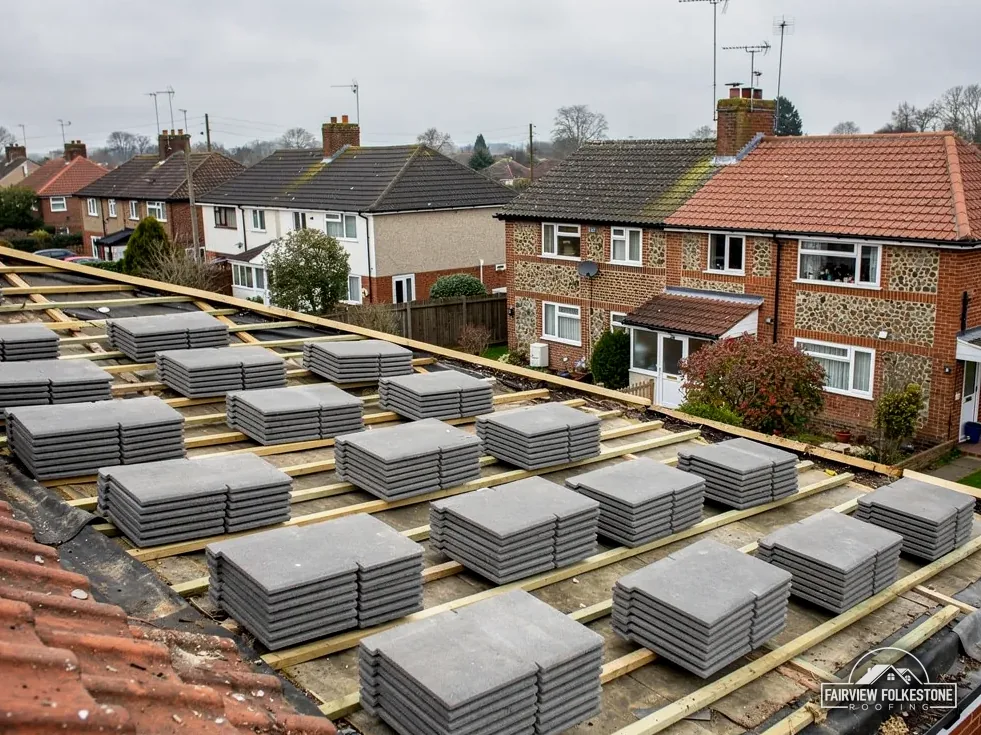
Weight is a Building Regulations matter. Under the Planning Portal's guide, a covering 15 per cent or more heavier than the old one calls for approval. When a roof is re-covered in another material, the two weights are set against each other first and a structural check may follow. The same guide gives the re-roofing test: no building regulations application is normally needed if the job touches under 25 per cent of the building envelope and under 50 per cent of the roof.
In a conservation area or on a listed house, the council may have its own view on the material, which is one more reason to ask before slates are ordered. A matching mistake is slow and costly to undo, because the slates are already on the roof.
- New natural slate, such as Welsh or Spanish.
- Reclaimed natural slate, taken from another roof and sorted for reuse.
- Man-made (fibre cement or similar) slate, which looks like slate but is a different material.
06Costs · Repairs
What it costs, and repair against re-slate
Costs for slate are published by several third parties, and they should be read as a guide, because the price turns on the roof's size, access, the slate chosen and the state of the timbers.
Why does the pitch of my slate roof matter?
Slates shed water by overlapping, so a shallow slope needs a larger overlap or a different fixing. Cupa gives 20 degrees as a minimum for natural slate at moderate exposure with a 500 mm slate and a 115 mm overlap. The survey measures your pitch and checks it against the slates and fixings in use.
| Source | Figure | What it covers |
|---|---|---|
| MyJobQuote | Around £7,800 | The average cost of fitting a slate roof |
| HomeBuilding | Might reach £18,000 | Welsh slate on a standard three-bedroom semi |
The two differ because they measure different things, and neither stands in for a quote on your own roof. Here the price is one written figure, given after a survey, and scaffold is part of it where the work needs it. Set any quotes side by side and see which of them says what is in the price and what the VAT position is.
The decision itself comes down to what the survey finds. A short test helps:
- If the slates are sound but a few have slipped, a repair is the right answer.
- If many slates are failing at the same fixing points, the roof may need re-fixing or re-slating.
- If the battens or the underlay have gone, a re-slate, with any good slates kept for reuse, is the likelier route.
We say which and why, and a repair comes first wherever one is sound. A re-slate is the honest answer only when the roof's condition makes it one. For the wider service, see our slate roofing page.
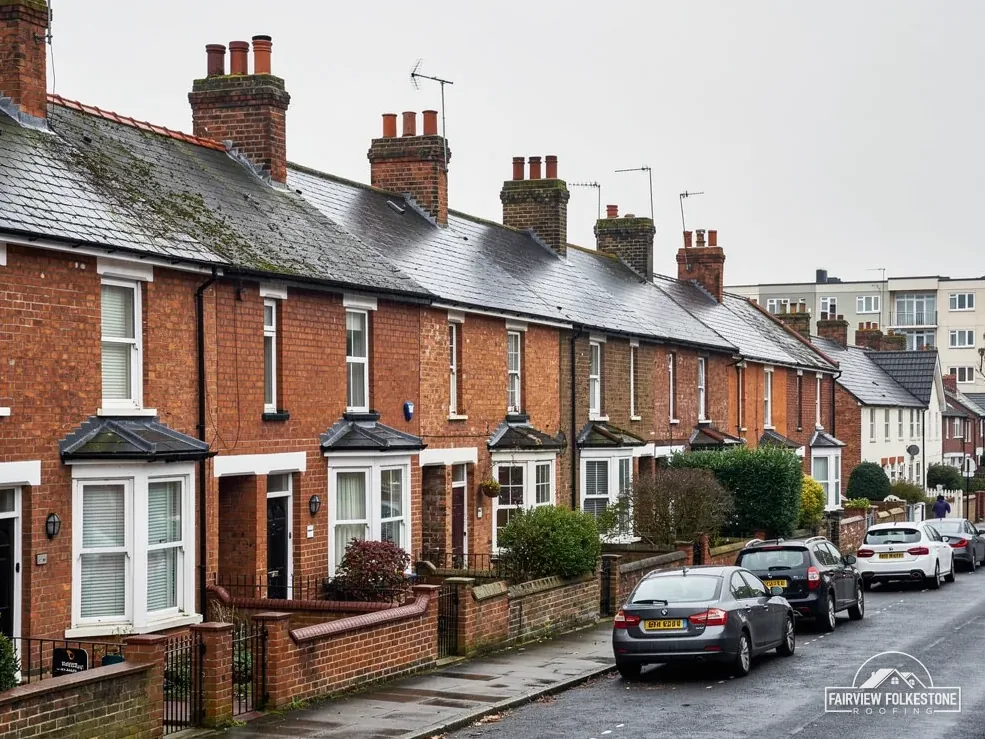

Tell us what's wrong with the roof.
You'll get one written total price.