
Repair or replace
Should a commercial roof be refurbished or replaced?
Refurbishing suits a roof with a sound build-up and local faults; replacing suits one without. Below: the findings that settle it and what each choice sets off.
The short answer
Refurbish a roof whose deck and insulation have stayed dry and whose faults are local; replace one where they have not. The survey settles it by testing four things: whether the insulation is wet, whether the falls clear water, whether the deck is sound and whether the sheets are asbestos. We tell you which verdict your roof earns, then give you one written total price for it.
4 min read · Part of Commercial roofing
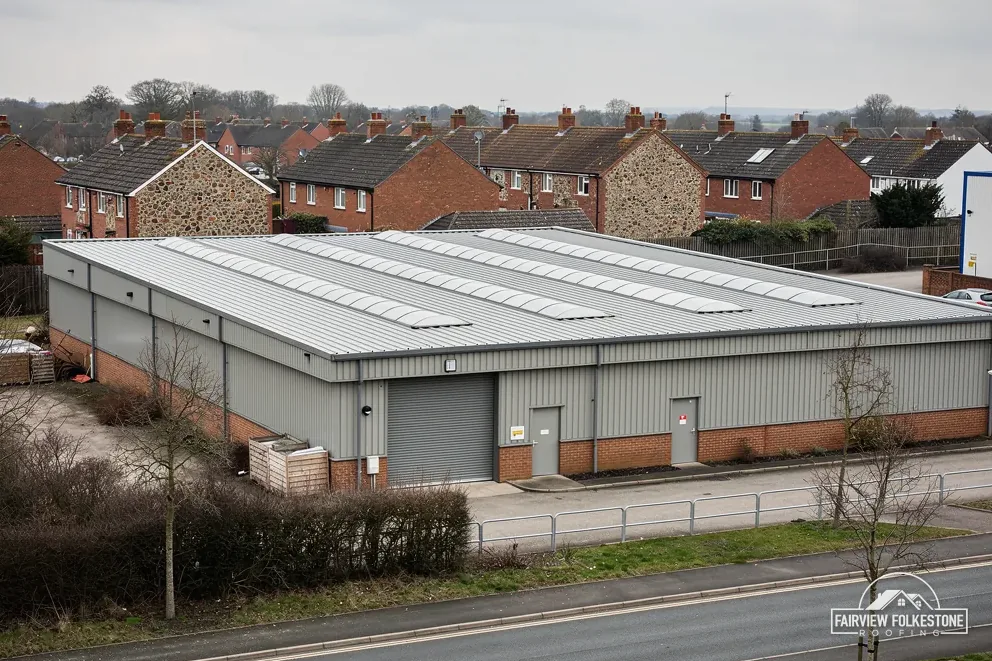
The four findings that decide it
Refurbishment means repairing the roof you have, or recovering it with a new layer. Replacement means stripping back and building again. Four findings separate the two, and the table shows where each one points. None needs special equipment: they come from walking the roof, testing the insulation and looking at the building from inside.
| Finding | Points to |
|---|---|
| Insulation dry, faults at a few details | Repair |
| Dry deck and insulation, covering worn across the field | Recover over the old layer |
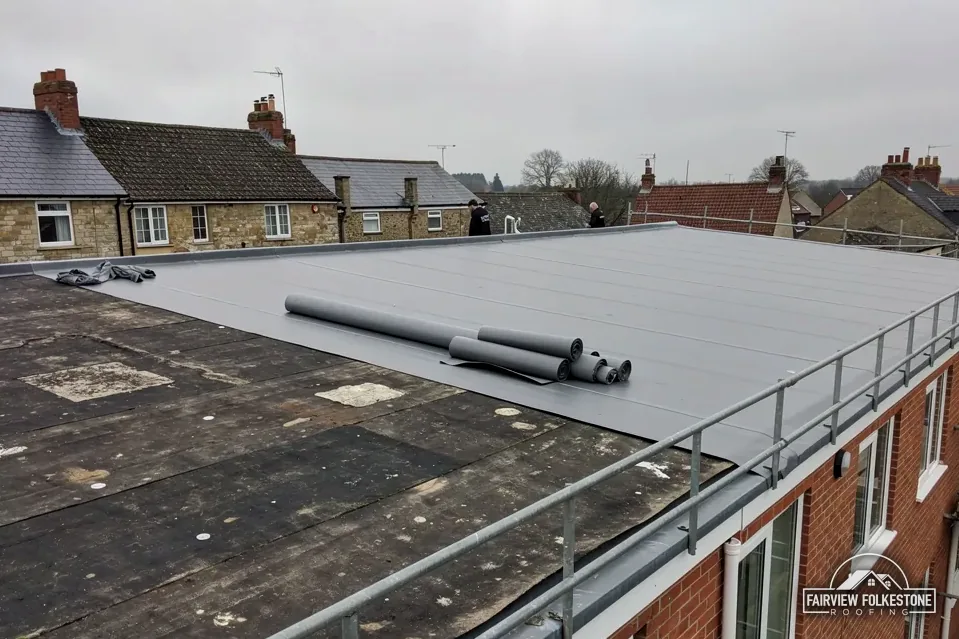
| Wet insulation or a soft deck | Strip to the deck |
| Asbestos cement sheets | Survey and careful removal |
Wet insulation rules out most shortcuts. A fresh covering laid across a damp build-up locks the moisture in, and the leak reappears somewhere new. We test for wet areas on the survey and mark them on a roof plan, so you can see where the decision comes from.
A deck that has gone soft, or fixings that no longer grip it, means the roof has to be opened whatever the covering looks like on top.
Falls and ponding
Water left standing after rain is a design fault as much as a maintenance one. The NFRC reports that BS 6229:2025 sets a minimum finished fall of 1:80 for membrane flat roofs. Ponding means the roof falls short of that, or that the deck has sagged since it was laid.
That matters here because a recover keeps the falls it finds. A new membrane over a ponding roof ponds in the same places. A full replacement is the chance to correct the slope, using tapered insulation or firrings, which are the timber or insulation wedges that add fall.
On a large roof the falls are checked outlet by outlet. A roof with several outlets can drain well at one end and badly at the other, which can lead to a repair at one end and a rebuild at the other.
Where a roof ponds but its insulation is dry and its deck sound, tapered insulation under a new membrane can sometimes avoid a full strip. The survey says whether yours qualifies, and what it would add to the work.
What each route sets off
The choice also decides which rules you meet along the way.
- Building Regulations. Building control can come in when a re-roof affects more than 25 per cent of the building envelope or more than 50 per cent of the roof, which are the Planning Portal's limits, or when the new covering is 15 per cent or more heavier, so it is worth asking early. A full replacement of a large roof can pass those limits, where a repair would not. Our answer on commercial roof building regulations covers the route.
- Asbestos. For a building built or refurbished before 2000, HSE says to assume it contains asbestos, so a survey comes before any quote.
- A construction phase plan, which CDM 2015 requires on every project.
- Fragile surfaces. Rooflights and some older sheets cannot carry a person, so access is arranged before the work starts.
None of these points towards either route. They are what you need to know before you compare quotes, because a quote that ignores them is pricing a different job. Replacement tends to set off more of them than repair, which is part of why its price is harder to give without a survey.
How the verdict reaches you
After the survey you receive a written view: what we found, where it is, and the route we would take. If a repair is sound, we recommend it and leave the bigger job alone, because a roof that needs a patch should be given one. If the roof needs replacing, the reasons come with the wet areas and photographs to back them.
The price follows the survey and arrives in writing as one total, with scaffold or access included. It covers the route we recommend, not a menu of options to choose between, and commercial roofing is priced only once someone has been on the roof.
If you want a cross-check, ask for the survey findings to be set against both routes. A repair repeated every winter at the same detail can end up costing more than the replacement it postpones, and the survey notes should let you see whether that is happening. Keep a dated record of each call-out, since a run of repairs at one detail is the clearest sign a roof is nearing the end of its useful life.
For the roof types we cover, see our commercial roofing page, and for the figures behind the decision, our answer on commercial flat roof lifespan.
More questions
Can a new membrane go over the old one?
Yes, where the old layer, the insulation and the deck are dry and the falls clear water. The survey tests for that before anything else. Wet insulation means the old roof comes off, because a new layer over damp material traps the moisture and the leak moves somewhere else.
Does refurbishing delay the need for a new roof?
It can, where the trouble is confined to a few spots and the build-up beneath is sound. Repairs only delay a replacement when their cause has been removed. Each repeat repair at the same detail suggests the roof is nearing the point where replacing it is the sounder course.
More on commercial roofing
All guides and posts
Tell us what's wrong with the roof.
You'll get one written total price.